
侵权责任

Search documents
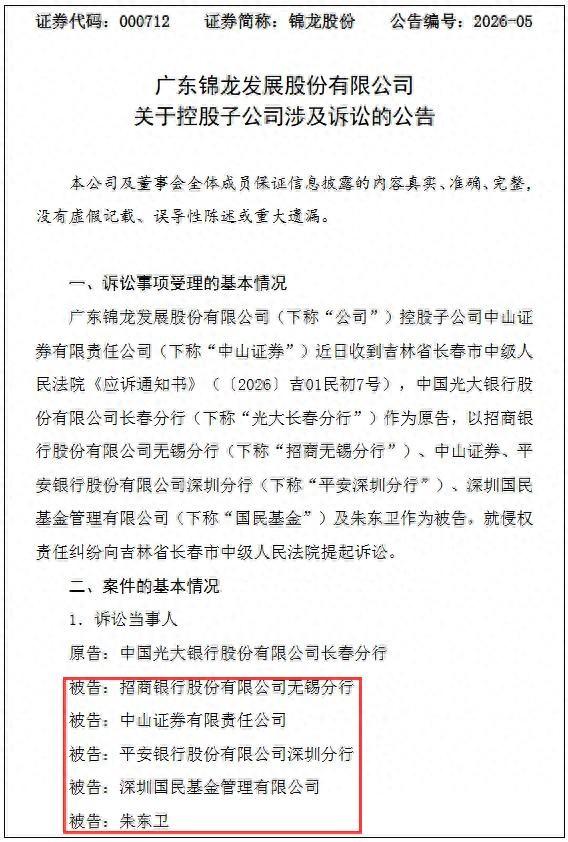
被萝卜章骗走3.5亿,光大银行起诉招商银行、平安银行、中山证券等机构
Guan Cha Zhe Wang· 2026-01-30 07:32
Core Viewpoint - Zhongshan Securities, a subsidiary of Jindong Co., is embroiled in a legal dispute involving approximately 490 million yuan, stemming from a financial fraud case that began 12 years ago [1][8]. Group 1: Lawsuit Details - The lawsuit was initiated by China Everbright Bank's Changchun branch against five defendants, including Zhongshan Securities, for tort liability [2][8]. - The case traces back to 2013 when Liu Xiaoyi, the legal representative of Liuhe Juxinyuan Rice Industry Co., misrepresented the company's financial status to secure a loan of 350 million yuan [3][4]. Group 2: Fraud Mechanism - Liu Xiaoyi collaborated with Zhang Lei, an assistant manager at Everbright Bank, to fabricate financial documents and mislead the bank into approving the loan [3][4]. - The fraudulent scheme involved a complex flow of funds, where Everbright Bank deposited 350 million yuan into China Merchants Bank, which was then transferred through Zhongshan Securities to Ping An Bank, ultimately reaching Liu's company [4][6]. Group 3: Legal Proceedings - After the fraud was uncovered in 2014, criminal charges were filed against Liu and Zhang, resulting in severe penalties, but only a small portion of the embezzled funds was recovered [6][7]. - In 2015, Everbright Bank filed a civil lawsuit against China Merchants Bank to recover the funds, but the Supreme Court ruled that the original agreement was invalid due to its fraudulent nature [7][8]. Group 4: Current Developments - In 2026, Everbright Bank reinitiated legal action, this time claiming tort liability and seeking a total of 489 million yuan, including principal and interest [8]. - The outcome of this case remains uncertain, with questions surrounding the liability of the involved banks and the potential for Everbright Bank to recover its losses from a decade-old fraud [9].




婚房漏水起争议 高效解纷护权益
Xin Lang Cai Jing· 2026-01-29 22:56
Core Viewpoint - The article highlights a successful mediation case in Zhangjiakou City, where a water leakage issue from a new home led to a dispute involving multiple parties, ultimately resolved through court mediation, emphasizing the importance of legal responsibility and efficient conflict resolution [1] Group 1: Case Background - The plaintiff purchased a new home intended for their child's marriage, which experienced a sudden water leak from the water distribution device during winter, causing damage to their home and several neighbors' properties [1] - After compensating the neighbors for their losses, the plaintiff sought compensation from the property management company, real estate development company, and construction group, believing all three bore responsibility for the maintenance and quality of the housing facilities [1] Group 2: Legal Proceedings - The plaintiff filed a lawsuit after failing to reach an agreement with the three parties regarding compensation for economic losses [1] - The presiding judge meticulously reviewed the case details, organized multiple discussions among the parties, and analyzed legal provisions, responsibility allocation, and evidence materials [1] Group 3: Mediation Outcome - Through patient explanations and several rounds of mediation, all parties reached a consensus, signed a mediation agreement, and fulfilled their compensation obligations on the spot [1] - The mediation not only effectively protected the legal rights of the parties involved but also helped the property management, real estate development, and construction companies understand their legal responsibilities and obligations, achieving a resolution that benefited all [1]
装修工人不幸坠亡,租户赔偿30万后,家属又起诉房东索赔50万……
Xin Lang Cai Jing· 2026-01-26 09:44
Core Viewpoint - The court ruled that the landlord, Zhang, is not liable for the compensation claims made by the family of the deceased, Zheng, as the incident occurred during the rental period and the tenant, Gao, had already compensated the family [2][3]. Group 1: Incident Overview - In June 2025, a rental agreement was signed between Zhang and Gao for a three-year lease for hotel operations [1]. - Zheng, an employee of Gao, fell to his death while cleaning renovation debris from the balcony [1]. - Gao compensated Zheng's family with 300,000 yuan for the death and related expenses [1]. Group 2: Legal Proceedings - Zheng's family sued Zhang for a total of 500,000 yuan, including death compensation, funeral expenses, and emotional distress [1]. - The court found no legal basis for the family's claims against Zhang, citing the Civil Code which states that landlords are not liable for damages occurring during the tenant's occupancy [2]. Group 3: Court's Rationale - The court emphasized that the incident did not involve any structural failure of the property, and the cause of death was due to Zheng's actions while using the property [2]. - The court's decision was based on the fact that Gao had already settled the matter with Zheng's family, fulfilling his obligations [3]. Group 4: Recommendations for Landlords and Tenants - Landlords should conduct thorough safety inspections of properties before renting and inform tenants of any potential hazards [4][5]. - Tenants are advised to maintain safety awareness and conduct their own inspections of the property and its facilities [4][5].
公交车关门两秒即启动致乘客摔伤 法院判公交公司担80%责任
Xin Lang Cai Jing· 2025-12-29 14:07
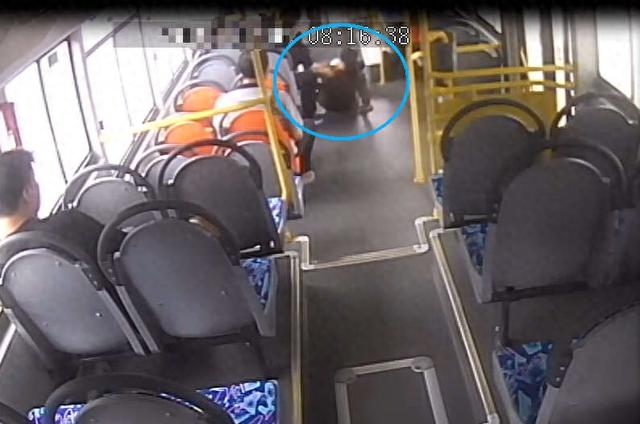
Core Viewpoint - A public transportation liability case in Beijing highlights the responsibilities of both the bus company and passengers regarding safety during transit [1][4]. Group 1: Incident Details - The incident occurred when a passenger, Zhao, boarded a bus and the driver closed the doors and started the vehicle within two seconds without checking if passengers were stable [2][3]. - Zhao attempted to grab the handrail but lost balance and fell, resulting in a fractured bone and medical expenses exceeding 40,000 yuan [3]. Group 2: Court Ruling - The court ruled that the bus company was 80% liable for the incident, ordering them to compensate Zhao over 70,000 yuan for medical and other related expenses [1][2]. - The court noted that the bus driver failed to ensure passenger safety before starting the vehicle, which was a significant factor in the accident [3]. Group 3: Legal Implications - According to the Civil Code, carriers are strictly liable for passenger injuries unless the injury is due to the passenger's intentional actions or gross negligence [4]. - The case emphasizes the need for bus drivers to ensure passengers are secure before moving and for passengers to take reasonable precautions for their safety [4].
裁判明责指引安全 社会共筑平安道路
Xin Lang Cai Jing· 2025-12-20 20:03
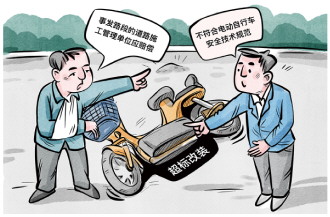
Core Viewpoint - The article highlights the increasing number of traffic accident liability disputes in Beijing's Xicheng District, emphasizing the need for all traffic participants to adhere to traffic regulations and enhance self-protection awareness to prevent accidents [3]. Group 1: Traffic Accident Liability Disputes - From January to November this year, the number of traffic accident liability disputes received by Xicheng Court increased by 32.03% compared to the same period last year [3]. - Among these, motor vehicle traffic accident disputes rose by 27.1%, while non-motor vehicle disputes surged by 60.98% [3]. Group 2: Electric Bicycle Modifications - Modifications to electric bicycles for speed and functionality can lead to significant liability issues, as demonstrated in a case where a modified electric bicycle resulted in the rider being deemed 80% responsible for an accident [4]. - The court found that the modified bicycle exceeded safety standards, lacking necessary components and exceeding weight limits, which contributed to the accident [4]. Group 3: Safety Belt Usage - A case involving a passenger not wearing a seatbelt in a taxi during an accident resulted in the court ruling that the passenger must bear 20% of the damages due to their failure to take reasonable safety measures [6]. - The court emphasized that wearing a seatbelt is a simple yet effective way to prevent injury during accidents [6]. Group 4: Workers' Compensation and Liability - A worker injured in a traffic accident while commuting was recognized as having a work-related injury, and the court ruled that the responsible parties must compensate for damages despite the worker receiving salary during the recovery period [7]. - The ruling clarified that receiving workers' compensation does not exempt the liable parties from their responsibility to compensate for damages [7]. Group 5: Non-Motor Vehicle Insurance - The article discusses the lack of mandatory insurance for non-motor vehicles, highlighting the risks associated with low insurance coverage among individual riders [8]. - It suggests that insurance companies should develop a multi-tiered insurance system for non-motor vehicles to mitigate risks and encourage riders to purchase third-party liability insurance [8].
不当使用“万能遥控器”或涉嫌违法(百姓关注)
Ren Min Ri Bao· 2025-10-26 22:19
Core Viewpoint - The article discusses the emergence and implications of "universal remote controls" that can bypass security systems in residential areas, raising concerns about security and legality [1][2][4]. Group 1: Product Description and Functionality - The "universal remote control" can replicate signals to control various access points like gates and doors, allowing unauthorized access to restricted areas [1][2]. - These remotes are sold online at prices ranging from a few yuan to hundreds, with some listings indicating high sales volumes and user comments suggesting their use for bypassing security [1][2]. Group 2: Legal and Ethical Concerns - The legality of producing and selling these remotes is questioned, particularly if their design is intended to circumvent security measures, which could violate intellectual property laws [2][3]. - Sellers and e-commerce platforms may face legal responsibilities if they knowingly sell products that compromise safety or violate consumer rights [3][4]. Group 3: Recommendations and Responsibilities - Producers should enhance legal awareness and refrain from selling products with illegal functionalities, while sellers must verify the legitimacy of their products and cannot rely solely on disclaimers for protection [4]. - E-commerce platforms are urged to fulfill their regulatory obligations by monitoring and removing illegal products from their listings [4].
无人机喷洒农药“误伤”相邻农田 怎么赔偿?
Ren Min Wang· 2025-08-20 01:00
Core Viewpoint - The court ruled that the parties involved in the drone pesticide spraying incident are liable for damages due to negligence, with a compensation amount of 31,000 yuan to the affected farmers [1][2]. Group 1: Incident Overview - A case was adjudicated in Urumqi, Xinjiang, where improper pesticide spraying by a drone led to significant damage to neighboring farmland, specifically 20 acres of winter melons [1]. - The affected farmers, Xiao Long and Xiao Niu, sought compensation after their crops exhibited severe damage, which was confirmed to be linked to the pesticide application [1][2]. Group 2: Legal Proceedings - The court identified two main issues: the causal relationship between the pesticide spraying and the crop damage, and the liability of the parties involved [2]. - The court accepted the findings of a qualified assessment agency that established a causal link between the drone's pesticide application and the damage to the winter melons [2]. Group 3: Liability and Compensation - Both Xiao Hu (the contractor) and Xiao Yang (the drone operator) were found to have acted negligently, leading to the court's decision to hold them each responsible for 50% of the compensation [2]. - The ruling emphasized that Xiao Yang failed to exercise due caution during the pesticide application, while Xiao Hu did not adequately inform neighboring farmers about the spraying [2].
老人逆行被绊倒去世,家属索赔顺行者60余万元!法院判了
Zhong Guo Ji Jin Bao· 2025-08-13 02:52
Case Summary - The case involves an incident at a train station where an elderly woman, referred to as Wang Yi, fell and later died due to complications from her injuries. Her son, Xiao Wang, claims that another passenger, Xiao Zhang, is at fault for the incident and is seeking compensation [4][5]. Incident Details - On March 8, 2019, Wang Yi was at the train station with her son when she unexpectedly turned around and collided with Xiao Zhang's luggage, leading to her fall [2][3]. - After the fall, Wang Yi experienced severe symptoms and was later diagnosed with subdural hematoma and respiratory failure, resulting in her death on March 24, 2019 [4]. Legal Proceedings - Xiao Wang argues that Xiao Zhang should bear at least 60% of the responsibility for the incident, seeking over 600,000 yuan in damages for medical expenses, funeral costs, and emotional distress [4][5]. - Xiao Zhang contends that he did not act negligently and should not be held liable for Wang Yi's fall, as he was moving normally through the station [5][6]. Court Ruling - The court determined that Wang Yi had a duty to exercise caution while moving in a crowded area and that her sudden reversal was a significant factor in the incident [5][7]. - The ruling stated that Xiao Zhang did not exhibit any negligence or foreseeability regarding Wang Yi's actions, thus he was not held liable for her injuries [7]. Court's Advice - The court emphasized the importance of individuals in public spaces, especially the elderly, to maintain heightened awareness and caution to avoid accidents [9][10]. - It also highlighted the responsibility of accompanying family members to provide adequate supervision and support to elderly individuals in public settings [9].
老人逆行被绊倒去世,家属索赔顺行者60余万元!法院判了
中国基金报· 2025-08-13 02:31
Case Overview - The case involves an incident at a train station where an elderly woman, Wang Yi, fell after colliding with a passenger's luggage while attempting to leave the ticketing area [4][5] - Wang Yi suffered severe injuries leading to her death, prompting her son, Xiao Wang, to sue the other passenger, Xiao Zhang, for compensation [5] Court Judgment - The court determined that Wang Yi had a responsibility to exercise a higher degree of caution while moving against the flow of pedestrian traffic [8] - It was concluded that Xiao Zhang, as a normal passenger moving forward, could not have anticipated Wang Yi's sudden reversal and therefore should not bear liability for the incident [9] - The court ruled in favor of Xiao Zhang, dismissing Xiao Wang's claims for compensation [9] Legal Implications - The ruling emphasizes the importance of personal responsibility in public spaces, particularly for individuals who may be more vulnerable, such as the elderly [11] - It highlights the need for accompanying family members to provide adequate supervision and support to prevent accidents [11][12]
轻信销售人员推荐用错农药致百亩瓜田几乎绝收
Ren Min Wang· 2025-07-09 01:02
Core Points - A farmer in Xinjiang suffered significant economic losses due to misleading recommendations from a pesticide sales company, resulting in a court ruling that the company must compensate the farmer for over 300,000 yuan while the farmer bears 290,000 yuan of the loss [1][2] Group 1 - The farmer purchased a pesticide intended for apple trees, which was incorrectly recommended by the sales personnel, leading to the death of nearly all crops on 100 acres of land [1][2] - The court confirmed a direct causal relationship between the use of the inappropriate pesticide and the crop failure, holding the sales company accountable for its major fault in the recommendation process [2] - The farmer, despite having some planting experience, failed to verify the product's suitability, which contributed to the losses, leading to a shared responsibility ruling by the court [2]