全球产业链转移

Search documents
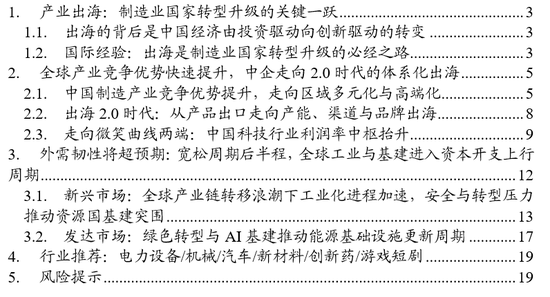
中国企业全球化与出海系列一:越世界,越中国
Sou Hu Cai Jing· 2026-02-08 02:58
Group 1 - The core viewpoint of the article is that Chinese enterprises are entering an accelerated phase of going global, which is essential for the transformation and upgrading of a manufacturing country and reflects the shift in China's economic development model [1][6]. - The transition from a GDP-driven, investment-focused model to a GNI-driven, innovation-focused model is highlighted, emphasizing the need for companies to integrate global resources to enhance production efficiency and global competitiveness [1][6]. - Chinese companies are moving into the 2.0 era of going global, transitioning from product exports to a systematic approach that includes "capacity + brand + channel," aiming for high-value segments of the industrial chain [1][6]. Group 2 - The article notes that the global easing cycle and the upturn in overseas industrial and infrastructure capital expenditure provide unexpected resilience in external demand for Chinese companies [2][6]. - Emerging markets are experiencing rapid industrialization and urbanization, leading to explosive demand for infrastructure and production equipment, while developed markets are driven by green transformation and AI infrastructure needs [2][6]. - Chinese companies are encouraged to focus on three main lines for overseas expansion: capital goods (electric power equipment, engineering machinery), high-value components (communication equipment, innovative pharmaceuticals), and consumer goods (two-wheeled vehicles, gaming) [2][6]. Group 3 - The article emphasizes that the essence of going global for Chinese enterprises is to occupy high-value segments of the industrial chain, which is a key stage in the economic transformation of a manufacturing country [6][7]. - The competitive advantages of Chinese companies in capital and technology-intensive industries, such as electric power equipment and engineering machinery, are highlighted, along with the resilience of exports under tariff pressures [6][7]. - The overseas gross profit margins of non-financial listed Chinese companies have consistently exceeded domestic margins, particularly in sectors like engineering machinery and automotive components [1][6].


国泰海通|策略:越世界,越中国——中国企业全球化与出海系列一
国泰海通证券研究· 2025-12-24 13:38
Core Viewpoint - Chinese enterprises are entering a new era of globalization, focusing on high-end segments of the global value chain, driven by the need for economic transformation and high-quality development [1][2]. Group 1: Industry Trends - The trend of Chinese companies going global is characterized by a systematic approach, moving from product exports to a model that includes "capacity + brand + channel" [2]. - China's trade competitiveness has significantly improved, especially in capital and technology-intensive sectors such as power equipment, engineering machinery, and motorcycles, with notable gains in passenger vehicles, machine tools, new materials, optical communications, and medical devices [2]. - The overseas gross profit margins of non-financial listed Chinese companies have surpassed domestic margins in the first half of 2023, indicating a shift towards higher value-added segments [2]. Group 2: Global Economic Context - The global industrial and infrastructure capital expenditure is entering an upward cycle, with emerging markets accelerating their capital spending due to previous high-interest rate constraints [3]. - Southeast Asian countries, with GDP per capita between $3,000 and $10,000, are experiencing explosive demand for electricity, infrastructure, production equipment, and durable consumer goods [3]. - Developed markets are also seeing a surge in demand for energy infrastructure updates driven by green transitions and AI-related needs, which is expected to boost demand for Chinese power equipment [3]. Group 3: Investment Recommendations - Recommended sectors include power equipment, machinery, automotive, new materials, innovative pharmaceuticals, and gaming, driven by industrialization in emerging markets and infrastructure updates in developed countries [4]. - High-value components are highlighted due to China's significant technological and cost advantages, with recommendations for communication equipment, automotive parts, innovative pharmaceuticals, and new materials [4]. - Consumer exports are expected to grow due to urbanization in emerging markets and the enhancement of China's cultural soft power, with recommendations for motorcycles, passenger vehicles, and gaming content [4].

国泰海通:中国企业正进入大出海时代,并向着全球价值链高端环节进军
Xin Lang Cai Jing· 2025-12-24 09:12
Group 1 - The core viewpoint is that Chinese enterprises are entering a new era of overseas expansion, advancing towards high-end segments of the global value chain, with expectations of resilient growth in external demand for Chinese technology manufacturing amid a global easing cycle [1][64][66] - The essence of overseas expansion for Chinese companies is to occupy high value-added segments of the global supply chain and achieve deep globalization, driven by rising domestic factor costs and stricter external market access [2][65] - Historical experiences indicate that overseas expansion is both a proactive strategic choice and a rational response to growth constraints, with emerging market countries typically entering an accelerated phase of overseas expansion after reaching a GDP per capita of approximately $15,000 [2][11][14] Group 2 - China's manufacturing industry is rapidly enhancing its global competitive advantage, transitioning from a "world factory" to a "global manufacturing center," with significant improvements in sectors such as power equipment, engineering machinery, and electric vehicles [3][21] - The export resilience of Chinese companies is evident through regional diversification and high-end product offerings, with non-financial listed companies showing higher overseas gross margins compared to domestic margins in sectors like engineering machinery and communication equipment [3][25][37] - The global industrial and infrastructure capital expenditure is entering an upward cycle, driven by easing monetary policies, with emerging markets experiencing accelerated industrialization and urbanization, leading to explosive demand for power and infrastructure [4][46][56] Group 3 - Industry recommendations include sectors such as power equipment, machinery, automotive, new materials, innovative pharmaceuticals, and gaming, driven by the acceleration of industrialization in emerging markets and the need for infrastructure updates in developed countries [5][68] - The transition to a "2.0 era" of overseas expansion involves moving from product exports to a systematic approach that includes capacity, brand, and channel development, with significant growth in foreign investment by Chinese non-financial enterprises [29][33] - The shift towards the ends of the "smile curve" indicates that Chinese technology companies are experiencing rising profit margins overseas, surpassing domestic margins, as they enhance their competitive positioning through innovation and systematic overseas expansion [37][38]

压力下的突围:中国出口韧性从何而来,能否持续?
Hua Xia Shi Bao· 2025-11-14 07:56
Core Viewpoint - Despite significant pressure from increased tariffs and geopolitical uncertainties, China's overall export growth has exceeded market expectations, showcasing remarkable resilience in the face of challenges [2][3]. Group 1: China's Export Resilience - In the first three quarters of 2025, China's total export reached $2.8 trillion, a year-on-year increase of 6.1%, marking the highest level for the same period in nearly three years [2][3]. - The net export of goods and services contributed 1.5 percentage points to GDP growth, the second-highest in nearly a decade, only behind the recovery period of 2021 [2]. Group 2: Market Diversification and Structural Upgrading - Exports to non-U.S. markets have shown significant growth, compensating for the decline in exports to the U.S. [5][6]. - In the first three quarters of 2025, exports to Africa, ASEAN, India, the UK, the EU, Latin America, and Canada grew by 28.3%, 14.7%, 12.9%, 8.7%, 8.2%, 6.9%, and 5.1% respectively, collectively contributing approximately 6.3 percentage points to overall export growth [5][6]. Group 3: Changes in Export Structure - The share of intermediate goods in total exports increased from 41.7% in 2017 to 47.4% in the first three quarters of 2025, while the share of consumer goods decreased from 37.2% to 32.5% [9][10]. - Intermediate goods and capital goods have become the main drivers of overall export growth, with intermediate goods exports growing by 10.2% year-on-year in the first three quarters of 2025 [9][11]. Group 4: Trade Relations with Major Economies - The trade relationship with developed economies like the U.S. and EU is shifting from complementarity to a mix of competition and cooperation, with China's exports to these regions facing pressure [12][13]. - Despite challenges, there remains potential for growth in high-value intermediate and capital goods exports to developed economies, as China's competitiveness in high-tech sectors continues to improve [14][15]. Group 5: Emerging Markets as Growth Drivers - Emerging markets, particularly in Africa, are becoming significant growth markets for Chinese exports, with a shift in the export structure from consumer goods to capital and intermediate goods [19][20]. - China's exports to Africa have increased from 4.2% to 5% of total exports from 2017 to 2024, with capital goods' share rising from 17.4% to 24% during the same period [19][20].
中美若达成贸易协议,印度不高兴
Sou Hu Cai Jing· 2025-05-19 13:01
Group 1 - The recent trade policy adjustments between the US and China have cast a shadow over India's ambition to become the "world's factory," as the US has significantly reduced tariffs on Chinese goods from 145% to 10%, while maintaining a 27% tariff on Indian goods [1] - Experts indicate that the shift in tariff policy may lead to a stagnation or reversal of manufacturing investments that were previously directed towards India, threatening the growth of high-value industries despite the low-cost assembly segment remaining viable [1][3] - Apple's recent decision to shift a significant portion of its iPhone production from China to India contrasts sharply with the current challenges faced by India's manufacturing sector, highlighting the complexities of global supply chains [1] Group 2 - A joint venture between Foxconn and India's HCL Group has received approval for a $435 million semiconductor factory, expected to begin production in 2027, focusing initially on chip packaging and testing [2] - Apple CEO Tim Cook has emphasized that deepening operations in India is a key strategy to navigate uncertainties in US-China trade relations, with data showing that 40% of India's exports to the US overlap with Chinese products, indicating potential for short-term substitution [2] - Despite the positive outlook, India's manufacturing sector faces structural weaknesses, with manufacturing contributing only 15% to GDP and a heavy reliance on imports for core components, particularly in high-end production like iPhones [3][4] Group 3 - The Indian government's Production-Linked Incentive (PLI) scheme has shown limited success, achieving only 37% of its target output by October 2024, with subsidies disbursed falling short of initial plans [4] - Recent trends indicate a reversal of some Apple supply chain activities back to China due to quality control issues and operational challenges in Indian factories, underscoring India's shortcomings in high-end manufacturing capabilities [4] - Experts suggest that while India aims to attract Chinese investments to bolster its manufacturing sector, this could potentially undermine local technological development, emphasizing the need for integration into global supply chains [4]