
蓄电池

Search documents
超级电容:通过DC/DC变换器等功率变换装置转换成符合要求的直流或交流电供给负载使用
驱动视界· 2026-03-18 01:38
Investment Rating - The report does not explicitly state an investment rating for the industry Core Insights - The application of supercapacitors in electric vehicles (EVs) is gaining traction due to their high power density and rapid charge/discharge capabilities, which are significantly superior to traditional batteries [2][25] - Supercapacitors can recover energy during braking, which is crucial for energy management in urban driving conditions where frequent stops occur [2][25] - The technology is positioned as a bridge between batteries and capacitors, offering unique advantages such as long cycle life, high reliability, and safety [15][28] Summary by Sections 1. Mechanism and Characteristics of Supercapacitors - Supercapacitors store energy through the electrochemical double-layer theory, allowing for rapid charge and discharge [4][14] - They exhibit high power density, long cycle life (up to 500,000 cycles), and can deliver high discharge currents, making them suitable for applications requiring quick energy bursts [15][28] 2. Key Parameters and Charging/Discharging Time Constants - Important parameters include working voltage, current, time constant, and discharge capacity, which influence the efficiency and performance of supercapacitors [18][19] - The time constant is critical for determining the charging efficiency, with smaller time constants leading to higher efficiency [21][24] 3. Comparison with Batteries - Supercapacitors outperform traditional batteries in terms of charge/discharge cycles and can handle high discharge currents without significant degradation [25][28] - While supercapacitors have lower energy density compared to batteries, their rapid charging capabilities and long lifespan present a compelling case for their use in electric vehicles [26][28] 4. Automotive Application Cases - Notable applications include Lamborghini's hybrid supercars, which utilize supercapacitors for energy recovery and performance enhancement [32] - Various manufacturers, including Volvo and Cadillac, are integrating supercapacitors into their vehicles to improve battery life and performance [32][33] 5. Simulation Analysis - The report discusses simulation models used to optimize electric vehicle designs, focusing on energy recovery and system performance under various driving conditions [34][39] 6. Conclusion - The report emphasizes the importance of supercapacitors in the context of energy crises and the need for efficient energy management in electric vehicles, highlighting their potential for future development [52]
超级电容在电动汽车上的应用
驱动视界· 2026-03-16 03:35
Investment Rating - The report does not explicitly state an investment rating for the industry Core Insights - The report highlights the significant advantages of supercapacitors over traditional batteries in electric vehicles, including higher power density, longer cycle life, and faster charging times [2][25][28] - Supercapacitors can recover energy during braking, which is crucial for energy management in electric vehicles, especially in urban driving conditions [2][25] - The report emphasizes the growing adoption of supercapacitors in various automotive applications, showcasing their integration in hybrid and electric vehicles [32] Summary by Sections 1. Mechanism and Characteristics of Supercapacitors - Supercapacitors are described as having a unique structure that allows for high energy storage and rapid charge/discharge capabilities, making them suitable for applications requiring quick energy bursts [14][15] - They can achieve power densities of several kW/kg, significantly higher than traditional batteries [15] - The report outlines the long cycle life of supercapacitors, which can reach up to 500,000 cycles compared to the typical 1,000 cycles for conventional batteries [28] 2. Key Parameters and Charging/Discharging Time Constants - Important parameters for supercapacitors include working voltage, current, time constant, and discharge capacity, which are critical for determining their efficiency and performance [18][19] - The report discusses how the time constant affects the charging and discharging efficiency of supercapacitors, emphasizing the need for optimal design to maximize performance [21][24] 3. Comparison with Batteries - The report identifies the limitations of traditional batteries, such as reduced lifespan under high current discharge and poor performance in high-temperature environments [25] - In contrast, supercapacitors offer advantages like high discharge currents and a wide operational temperature range, making them more reliable for electric vehicle applications [26][28] 4. Automotive Application Cases - Several automotive models are highlighted for their use of supercapacitors, including Lamborghini's hybrid supercars and various models from Volvo and Cadillac, showcasing the technology's versatility and effectiveness in enhancing vehicle performance [32] - The report notes the implementation of supercapacitors in public transportation, such as buses, which benefit from rapid charging and energy recovery capabilities [32] 5. Simulation Analysis - The report describes the use of simulation models to optimize electric vehicle designs, focusing on the integration of supercapacitors to improve overall system performance [34][39] 6. Conclusion - The report concludes that supercapacitors represent a promising technology for the future of electric vehicles, emphasizing their efficiency, environmental benefits, and potential for widespread adoption [52]
爸爸妈妈别塞了,这些真不让带!
Xin Lang Cai Jing· 2026-02-23 12:30
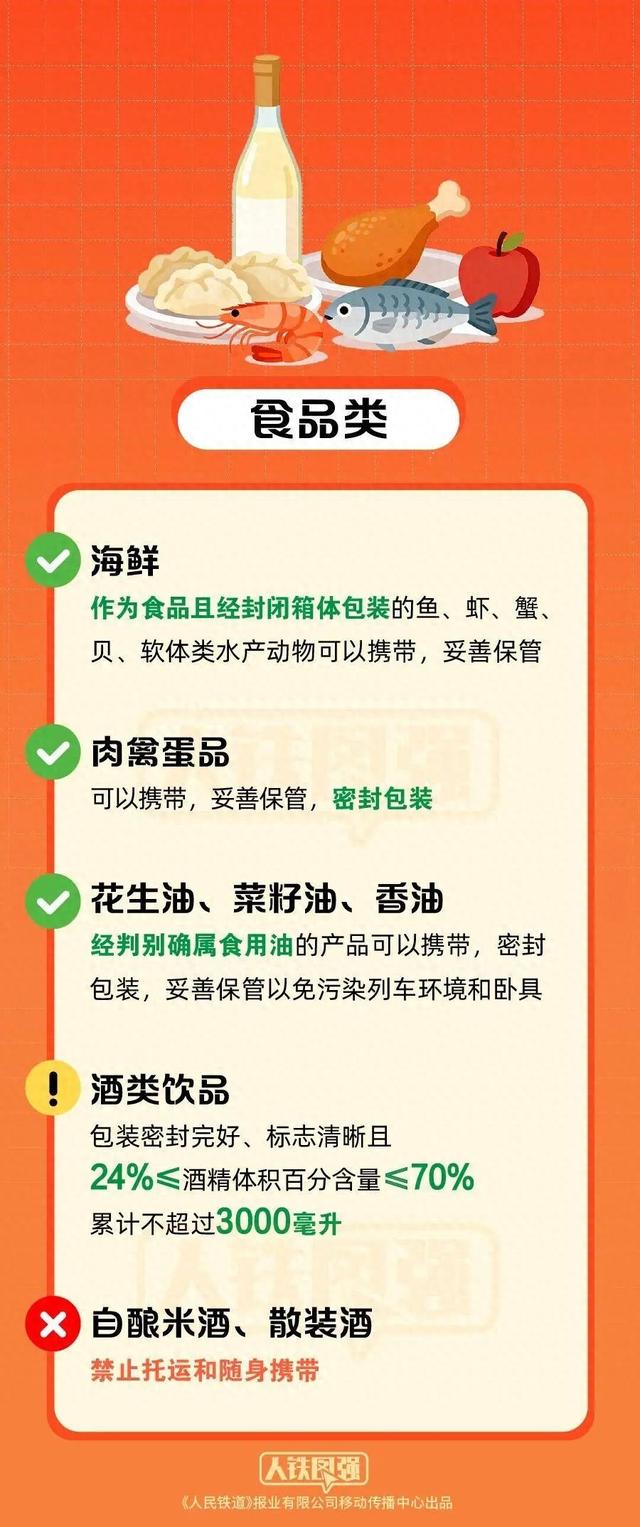
Group 1 - The article provides guidelines on items that can and cannot be carried on trains, emphasizing the importance of proper packaging and handling to avoid contamination and safety issues [1][3][4] - Specific food items such as meat, poultry, and eggs are allowed if properly sealed and stored, while certain alcoholic beverages are permitted under specific conditions, including a maximum alcohol content of 70% and a total volume not exceeding 3000 milliliters [3][4] - Personal care items like perfumes and sprays are allowed in limited quantities, with restrictions on container sizes for flammable products [6][7] Group 2 - Items such as knives with blades longer than 60mm are prohibited for carry-on but can be checked in, while smaller knives are allowed [7][11] - Certain recreational items like folding strollers and wheelchairs are permitted, with specific guidelines for electric wheelchairs [8][9] - Prohibited items include flammable liquids, certain tools, and weapons, which cannot be carried on or checked in [14][15] Group 3 - Smoking is strictly prohibited on high-speed trains and in designated areas of regular trains, with fines imposed for violations [18] - Passengers are allowed to carry a limited number of electronic cigarettes and lighters, but usage is restricted [18] - Guidelines for transporting small animals, such as guide dogs and pets, are provided, including weight limits and health requirements [19] Group 4 - The article outlines procedures for reporting lost items, including using the railway's official app and contacting customer service for assistance [20][21][22][23]

雄韬股份股价波动,前三季度营收净利双降
Jing Ji Guan Cha Wang· 2026-02-13 05:17
Core Viewpoint - The stock price of Xiongtao Co., Ltd. has shown volatility recently, with a slight increase on February 4, 2023, while the company's financial performance has declined year-on-year in terms of revenue and net profit [1][3]. Group 1: Stock Performance - The company's stock price increased by 2.14% on February 4, 2023, reaching 20.51 CNY per share, with a trading volume of 68.32 million CNY and a net inflow of 1.69 million CNY from main funds [1][2]. Group 2: Financial Performance - For the first three quarters of 2025, the company's operating revenue was 2.38 billion CNY, a year-on-year decrease of 9.39%, while the net profit attributable to shareholders was 106 million CNY, down 10.40% year-on-year [1][3]. Group 3: Shareholder Information - As of January 20, 2026, the number of shareholders increased to 54,800, representing a 4.90% rise compared to the previous period [1][4].

超越美国,中国再成德国第一大贸易伙伴,默茨着急访华有门道
Sou Hu Cai Jing· 2026-02-12 11:51
Group 1 - China has regained its position as Germany's largest trading partner, surpassing the United States, largely due to U.S. tariff policies [1][3] - In 2025, Germany's imports from China increased by 9%, reaching €171 billion, significantly higher than imports from the U.S. [1] - From 2016 to 2023, China was Germany's top trading partner for eight consecutive years until the U.S. briefly overtook this position in 2024 [3] Group 2 - U.S. tariffs have severely impacted German manufacturing, particularly in the automotive and machinery sectors, leading to a significant drop in demand for German products in the U.S. market [3][5] - The German automotive industry has faced substantial profit declines, with Volkswagen's operating profit dropping by one-third and Mercedes-Benz's net profit plummeting by 56% [3] - The German mechanical engineering sector is projected to see a 5% decline in production this year due to U.S. tariffs [5] Group 3 - China has maintained a stable trade environment without imposing tariffs, providing German companies with a predictable market, particularly for key components supporting Germany's green transition [5] - A survey indicated that 93% of German companies in China plan to continue investing in the Chinese market, with over half intending to increase their investments in the next two years [5] Group 4 - German Chancellor Merz is set to visit China with a delegation of major industrial leaders to strengthen trade relations and seek new orders in sectors like renewable energy and digitalization [6][8] - Despite the need for closer ties with China, German Foreign Minister Baerbock emphasized Germany's closer relationship with the U.S., indicating a complex diplomatic balancing act [8] - The German wholesale and foreign trade association has stated that U.S. protectionist tariffs pose a significant challenge to German exports, highlighting the necessity for enhanced cooperation with China [8]
中国企业全球化与出海系列一:越世界,越中国
Sou Hu Cai Jing· 2026-02-08 02:58
Group 1 - The core viewpoint of the article is that Chinese enterprises are entering an accelerated phase of going global, which is essential for the transformation and upgrading of a manufacturing country and reflects the shift in China's economic development model [1][6]. - The transition from a GDP-driven, investment-focused model to a GNI-driven, innovation-focused model is highlighted, emphasizing the need for companies to integrate global resources to enhance production efficiency and global competitiveness [1][6]. - Chinese companies are moving into the 2.0 era of going global, transitioning from product exports to a systematic approach that includes "capacity + brand + channel," aiming for high-value segments of the industrial chain [1][6]. Group 2 - The article notes that the global easing cycle and the upturn in overseas industrial and infrastructure capital expenditure provide unexpected resilience in external demand for Chinese companies [2][6]. - Emerging markets are experiencing rapid industrialization and urbanization, leading to explosive demand for infrastructure and production equipment, while developed markets are driven by green transformation and AI infrastructure needs [2][6]. - Chinese companies are encouraged to focus on three main lines for overseas expansion: capital goods (electric power equipment, engineering machinery), high-value components (communication equipment, innovative pharmaceuticals), and consumer goods (two-wheeled vehicles, gaming) [2][6]. Group 3 - The article emphasizes that the essence of going global for Chinese enterprises is to occupy high-value segments of the industrial chain, which is a key stage in the economic transformation of a manufacturing country [6][7]. - The competitive advantages of Chinese companies in capital and technology-intensive industries, such as electric power equipment and engineering machinery, are highlighted, along with the resilience of exports under tariff pressures [6][7]. - The overseas gross profit margins of non-financial listed Chinese companies have consistently exceeded domestic margins, particularly in sectors like engineering machinery and automotive components [1][6].

这些东西不能带上火车 出发前要注意
Yang Shi Xin Wen Ke Hu Duan· 2026-02-02 06:44
Group 1 - The article discusses the regulations regarding items that can and cannot be brought on trains during the Spring Festival travel period, emphasizing the importance of compliance for travelers [1][3] - Food items such as seafood in sealed packaging and alcoholic beverages with an alcohol content between 24% and 70% (up to 3000 milliliters per person) are allowed, while odorous foods like durian and stinky tofu can be brought but not consumed on the train [1][3] - Daily necessities like small household appliances (e.g., rice cookers, curling irons) can be carried, but their use is prohibited on trains and at stations [3] Group 2 - Specific items like power banks must have clear labeling and an energy rating not exceeding 100Wh, while ordinary lighters are limited to two per person [5] - Items that cannot be carried on board but can be checked include knives longer than 60mm, blunt instruments, and certain tools, with exceptions for guide dogs for visually impaired passengers [5] - Certain items are completely prohibited from both carry-on and checked luggage, including controlled knives, fireworks, and self-heating food products containing magnesium-aluminum powder [7]

视频丨这些东西不能带上火车 出发前要注意
Yang Shi Xin Wen Ke Hu Duan· 2026-02-02 06:05
Group 1 - The article discusses the regulations regarding items that can and cannot be brought onto trains during the Spring Festival travel period in 2026 [2][4] - Food items such as seafood in sealed packaging and alcoholic beverages with an alcohol content between 24% and 70% (up to 3000 milliliters per person) are allowed [2] - Items like small household appliances (e.g., rice cookers, curling irons) can be carried but should not be used on trains [4] Group 2 - Certain items, including knives longer than 60mm, blunt instruments, and live animals (except guide dogs), are prohibited from being carried but can be checked in [6] - Some items are completely banned from both carry-on and checked luggage, such as controlled knives, fireworks, and self-heating hot pots made with magnesium-aluminum powder [8] - Passengers can temporarily store prohibited items at the station if they meet storage conditions, allowing for retrieval or mailing later [8]

宁德时代在临汾成立动力科技公司,注册资本2000万
Zhong Guo Neng Yuan Wang· 2026-01-21 03:14
Group 1 - The establishment of Times Qiji Power Technology (Linfen) Co., Ltd. has been officially registered, with a legal representative named Zhang Yan and a registered capital of 20 million RMB [1] - The company's business scope includes operations related to electric vehicle charging infrastructure, battery leasing, recycling and repurposing of used power batteries from new energy vehicles, rental of charging control equipment, energy storage technology services, battery sales, and sales of battery accessories [1] - Times Qiji Power Technology is wholly owned by Times Qiji New Energy Technology (Shenzhen) Co., Ltd., which is a subsidiary of CATL (Contemporary Amperex Technology Co., Ltd.) [1]

中经评论:中国不是“冲击”是机遇
Jing Ji Ri Bao· 2026-01-06 00:12
Core Viewpoint - The narrative of "China Shock 2.0" is a politically constructed discourse that misrepresents China's rapid development as a threat, while ignoring the benefits and opportunities it brings to the global economy [1][5]. Group 1: Economic Performance and Innovation - China's high-tech manufacturing profits increased by 10% year-on-year from January to November 2025, outpacing the average growth of all industrial sectors by 9.9 percentage points [2]. - The growth in China's high-tech sector is attributed to a mature innovation ecosystem, a complete industrial chain, and a large pool of R&D personnel, rather than "unfair competition" [2]. Group 2: Contribution to Global Sustainability - China has become a core player in global clean energy deployment, with renewable energy capacity leading the world and contributing significantly to climate crisis mitigation [3]. - By providing affordable solar panels and batteries, China is helping developing countries reduce reliance on fossil fuels, establishing itself as a reliable source of clean technology products [3]. Group 3: Open Market and Foreign Investment - China is committed to high-level openness, expanding access in sectors like telecommunications and healthcare, and has seen significant foreign investment in high-tech industries, amounting to 221.26 billion RMB in the first 11 months of 2025 [4]. - The Belt and Road Initiative and international capacity cooperation are enhancing infrastructure in developing countries, reducing global logistics and transaction costs [4]. Group 4: Global Economic Relations - In response to the U.S. imposing tariffs on Chinese products, China has taken decisive countermeasures while also engaging in dialogue to maintain communication channels between the two largest economies [4]. - The narrative of "China Shock 2.0" reflects anxieties in some Western circles about their declining competitiveness, which leads to a misallocation of blame towards China instead of addressing internal economic issues [5].