
全球公共债务

Search documents
全球财富管理论坛·2025上海苏河湾大会举行 专家建言“世界变革下的未来之路”
Jing Ji Guan Cha Wang· 2025-10-19 02:59
Group 1: Monetary Policy and Financial Regulation - The People's Bank of China emphasizes the dual function of monetary policy, focusing on both total and structural adjustments to address the structural challenges in the economy [1] - The design of structural monetary policy tools aims to create an incentive-compatible mechanism, linking the central bank's base currency issuance to commercial banks' lending to specific sectors [1] - The application of artificial intelligence in finance is expected to have significant and fundamental impacts, enhancing financial services and operational efficiency while ensuring risk management [2] Group 2: Financial Supply and Demand - AI technology is projected to drastically reduce the costs of financial product development and production, making it economically feasible to cater to previously neglected niche demands, thus generating a "long tail effect" [2] - Financial regulation encourages institutions to leverage the latest technologies to optimize services, reduce operational costs, and improve management efficiency while maintaining a balance between safety and efficiency [2] Group 3: Macro Policy and Economic Challenges - The rising global public debt and increasing leverage levels pose challenges, necessitating the use of macro policy space to enhance effective borrowing and investment in data-driven infrastructure [2][3] - China is advised to optimize its debt structure and implement comprehensive debt solutions while maintaining a sustainable government debt ratio aligned with economic resilience [3] - In the face of global protectionism and fragmented supply chains, China is adopting a more open approach to globalization and is actively constructing a new development pattern that balances safety and efficiency [3]
央行开展2360亿元7天期逆回购操作;A股保险板块持续领涨| 金融早参
Mei Ri Jing Ji Xin Wen· 2025-10-16 23:24
Group 1: Central Bank Operations - The central bank conducted a 236 billion yuan 7-day reverse repurchase operation at an interest rate of 1.40%, indicating flexibility and proactivity in monetary policy to maintain market liquidity stability [1] Group 2: Bilateral Currency Swap Agreement - The People's Bank of China and the Central Bank of Iceland renewed a bilateral currency swap agreement with a scale of 3.5 billion yuan/70 billion Icelandic króna, effective for five years, aimed at enhancing financial cooperation and trade facilitation [2] Group 3: A-Share Insurance Sector Performance - The A-share insurance sector saw significant gains, with China Life rising over 5% and China Pacific Insurance over 2%, reflecting investor confidence driven by policy support, increased consumer demand, and industry innovation [3] Group 4: US Economic Conditions - The Federal Reserve's "Beige Book" reported that tariffs have contributed to rising prices across all Federal Reserve districts, with increased input costs being passed on to consumers by some manufacturing and retail companies [4] Group 5: Global Public Debt Warning - The International Monetary Fund warned that global public debt is expected to exceed 100% of global GDP by 2029, potentially reaching 123% in extreme scenarios, highlighting the need for countries to optimize spending and enhance fiscal resilience [5]
国际货币基金组织对全球公共债务发出警告
Yang Shi Xin Wen· 2025-10-16 19:07
Core Insights - The International Monetary Fund (IMF) projects that global public debt will exceed 100% of global GDP by 2029, potentially reaching 123% in extreme scenarios, marking the highest level since 1948 [1] Group 1: Global Debt Projections - By 2029, global public debt is expected to surpass 100% of global GDP [1] - In extreme scenarios, global public debt could reach 123% of GDP [1] - This level of debt would represent a record high since 1948 [1] Group 2: Recommendations for Action - Countries are urged to "act now" to enhance fiscal resilience [1] - Suggested measures include optimizing expenditure structures and improving efficiency [1]
总台专访丨国际货币基金组织对全球公共债务发出警告
Sou Hu Cai Jing· 2025-10-16 11:29
Core Insights - The International Monetary Fund (IMF) projects that by 2029, global public debt is expected to exceed 100% of global GDP, potentially reaching 123% in extreme scenarios, marking the highest level since 1948 [1][3] Group 1: Debt Sustainability - The IMF emphasizes the urgent need for countries to prioritize fiscal policies to ensure debt sustainability and build fiscal buffers against severe shocks, including potential financial crises [3][6] - There is a notable divergence in debt situations between developed economies and low-income countries, necessitating improved spending efficiency and structural optimization for sustainable growth [3] Group 2: Fiscal Resilience - Countries are encouraged to enhance fiscal resilience by optimizing expenditure structures and improving efficiency to better prepare for economic uncertainties and potential shocks [1][6] - The IMF calls for increased trade cooperation among nations to alleviate the compounded effects of debt and fiscal pressures [3]


IMF:全球公共债务占全球GDP比重将于2029年创新高
Sou Hu Cai Jing· 2025-10-16 09:44
Core Insights - The International Monetary Fund (IMF) projects that global public debt will exceed 100% of global GDP by 2029, potentially reaching 123% in extreme scenarios, marking the highest level since 1948 [1][5]. Group 1: Debt Projections - By 2029, global public debt is expected to surpass 100% of global GDP, with a possible extreme scenario reaching 123% [1][5]. - This increase in debt levels is a significant concern, as it indicates a trend of rising fiscal vulnerability across nations [11]. Group 2: Policy Recommendations - The IMF emphasizes the need for countries to prioritize fiscal policies to ensure debt sustainability and build financial buffers against severe shocks, including potential financial crises [5][11]. - Countries are encouraged to optimize spending structures and enhance efficiency to strengthen fiscal resilience [3][7]. Group 3: Global Economic Disparities - There is a notable divergence in debt situations between developed economies and low-income countries, necessitating tailored approaches to achieve sustainable growth [7]. - The IMF calls for enhanced trade cooperation among nations to alleviate the compounded effects of debt and fiscal pressures [7][9].

国际金融市场早知道:10月16日
Xin Hua Cai Jing· 2025-10-16 00:34
Core Insights - The Federal Reserve's "Beige Book" indicates that tariffs have contributed to rising prices in the U.S. economy [1] - U.S. ETFs are experiencing unprecedented inflows, with over $1 trillion in assets added this year, marking the fastest pace in history [2] - The IMF warns that global public debt is projected to exceed 100% of GDP by 2029, posing risks to financial stability [2] Economic Indicators - The New York Fed's manufacturing index rose significantly by 19.4 points to 10.7 in October, surpassing market expectations of -1.4 [2] - The Federal Reserve officials suggest that recent trade tensions have increased economic uncertainty, leading to a stronger case for interest rate cuts [1][2] Market Performance - The Dow Jones Industrial Average fell by 17.15 points to 46,253.31, a decrease of 0.04%, while the S&P 500 rose by 26.75 points to 6,671.06, an increase of 0.40% [5] - COMEX gold futures increased by 1.48% to $4,224.90 per ounce, and silver futures rose by 3.76% to $52.53 per ounce [5] Currency Movements - The U.S. dollar index decreased by 0.25%, closing at 98.794, with fluctuations in various currency pairs noted [6] - The onshore Chinese yuan appreciated against the U.S. dollar, closing at 7.1239, up 172 basis points from the previous day [6]
2024年全球公共债务达102万亿美元 发展中国家受影响严重
news flash· 2025-06-27 23:11
Core Insights - Global public debt is projected to reach $102 trillion in 2024, up from $97 trillion in 2023, marking a historical high [1] - Developing countries are significantly impacted, with their public debt expected to grow at twice the rate of developed economies since 2010, reaching $31 trillion in 2024 [1] - Debt interest costs for developing countries are projected to hit $921 billion in 2024, reflecting a 10% increase from 2023 [1] Summary by Categories Global Public Debt - The total global public debt is set to increase to $102 trillion in 2024, representing a significant rise from the previous year [1] Impact on Developing Countries - Developing countries are facing severe challenges, with their public debt growth rate being double that of developed economies since 2010 [1] - In 2024, 61 developing countries are expected to allocate over 10% of their fiscal revenue to debt interest payments [1] Debt Management and Economic Development - While debt can be a tool for promoting development, excessive debt levels and high costs can hinder economic growth [1] - The report calls for urgent reforms in the international financial architecture to enable countries, especially developing ones, to secure funding for future development in a more sustainable and affordable manner [1]
国际金融市场早知道:4月24日
Xin Hua Cai Jing· 2025-04-24 02:47
Group 1: Shanghai International Financial Center - The People's Bank of China introduced the "Action Plan to Further Enhance the Facilitation of Cross-Border Financial Services" focusing on the construction of the Shanghai International Financial Center and improving cross-border financial service facilitation [1] - The Action Plan features four highlights: pilot policies, optimized business processes, innovative products and services, and digital empowerment [1] Group 2: Global Economic Outlook - The IMF's latest Fiscal Monitor report warns that rising tariffs and weak growth prospects could worsen global public debt, with recent U.S. tariff measures and retaliatory actions from other countries leading to increased market volatility and heightened risks [1] - The Federal Reserve's Beige Book indicates minimal change in economic activity, with uncertainty in international trade policies affecting various regions, suggesting a prolonged period before potential interest rate cuts [2] Group 3: Trade and Export Data - In February, EU exports to the U.S. surged by 22.4% year-on-year, reaching €51.8 billion, marking the highest growth rate in 13 months, while imports from the U.S. increased by 2.4% to €28.2 billion [2] - The Eurozone's adjusted trade surplus for February was €21 billion, exceeding expectations of €15 billion, with an unadjusted surplus of €24 billion [2] Group 4: Manufacturing and Services PMI - The U.S. April manufacturing PMI preliminary value was 50.7, above expectations of 49.1, while the services PMI preliminary value was 51.4, below expectations of 52.8 [2] - The Eurozone's April manufacturing PMI preliminary value was 48.7, above expectations of 47.5, while the services PMI preliminary value was 49.7, below expectations of 50.5 [3] - The UK's April manufacturing PMI preliminary value was 44.0, matching expectations, while the services PMI preliminary value was 48.9, below expectations of 51.3 [3] - Japan's April manufacturing PMI preliminary value was 48.5, while the services PMI preliminary value was 52.2, indicating mixed performance [3]
全线爆发!道指涨超1000点,纳斯达克中国金龙指数涨超5%!特朗普:美对华关税将大幅下降
Zheng Quan Shi Bao Wang· 2025-04-23 14:24
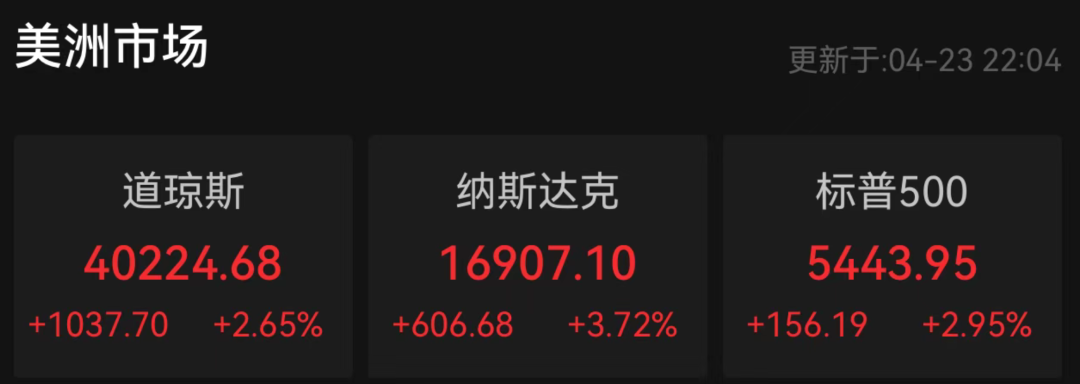
Market Reaction - The White House may ease tariff policies, leading to a significant rise in U.S. stock markets, with the Dow Jones up 2.65%, gaining over 1000 points, the Nasdaq up 3.72%, and the S&P 500 up 2.95% [1][2] Technology Sector Performance - Major U.S. tech stocks saw substantial gains, with all seven tech giants rising over 3%, and Amazon increasing nearly 7% [2][3] Chinese Stocks Surge - Chinese stocks also experienced a strong rally, with the Nasdaq Golden Dragon China Index rising over 5%, and companies like Xiaomi, Pinduoduo, and Alibaba all gaining more than 5% [3][4] European Market Trends - European stock markets also posted significant gains, with France's CAC40 index up over 2%, Germany's DAX index up over 3%, and the European Stoxx 50 index up over 3% [5][6] Gold Market Adjustment - Gold prices continued to decline, with the main futures contract reported at $3287.7 per ounce, reflecting a daily drop of 3.85% [6] U.S.-China Trade Relations - President Trump indicated that U.S. tariffs on China could significantly decrease, stating that the current 145% tariffs are too high, and a deal could lead to reduced tariffs, though not to zero [8] - The U.S. Treasury Secretary mentioned that the current situation resembles a trade embargo, and a comprehensive agreement with China could be reached within two to three years [8] Global Debt Concerns - The IMF reported that global public debt levels are rising amid increasing economic uncertainty, with projections indicating that by 2025, global public debt could exceed 95% of GDP [9][10] - The report warns that in extreme scenarios, global public debt could reach 117% of GDP by 2027, marking the highest level since World War II [10]
国际货币基金组织:关税压力将使全球公共债务超过疫情时期水平
news flash· 2025-04-23 13:34
Core Viewpoint - The International Monetary Fund (IMF) indicates that tariff pressures will push global public debt beyond pandemic levels, potentially reaching nearly 100% of global GDP by the end of this decade [1] Summary by Relevant Sections - **Global Public Debt Projections** - The IMF's latest Fiscal Monitor report forecasts that global public debt will increase by 2.8 percentage points, reaching 95.1% of global GDP by 2025 [1] - This upward trend is expected to continue, with projections indicating that by 2030, global public debt could reach 99.6% of global GDP [1] - **Factors Contributing to Debt Increase** - The report highlights that rising defense spending, increased demand for social support, and higher costs of debt servicing are straining government budgets [1] - Governments will face tougher trade-offs due to these financial pressures [1]