供给侧优化

Search documents
上游表现强于下游,格局优化进行中
Orient Securities· 2026-03-31 14:42
Investment Rating - The industry investment rating is maintained as "Positive" [5] Core Viewpoints - The upstream pulp prices are expected to outperform downstream paper prices, indicating a potential cost advantage for leading paper companies with self-sufficient pulp production [3][8] - The current market conditions show that paper prices are at historical lows, while pulp prices have maintained a stronger position, leading to a divergence in profitability between companies with self-produced pulp and those relying on external sources [8] - The ongoing geopolitical conflicts may further strengthen the trend of upstream pulp prices outperforming downstream paper prices due to supply chain vulnerabilities [8] Summary by Relevant Sections Upstream vs. Downstream Performance - Upstream pulp prices are anticipated to perform better than downstream paper prices, with a focus on companies that have invested in self-sufficient pulp production [3][8] - The current pricing dynamics show that paper prices are below the 5th percentile of historical data, while pulp prices are around the 30-40th percentile, indicating a significant cost pressure on paper companies relying on external pulp [8] Investment Recommendations - Companies such as Sun Paper (002078), Xianhe Co. (603733), Wuzhou Special Paper (605007), and Nine Dragons Paper (02689) are highlighted as potential investment opportunities due to their upstream pulp production capabilities [3] Market Trends - The paper market is experiencing a seasonal low, with cultural paper prices not showing the expected seasonal increase, while pulp prices continue to rise [8] - The waste paper segment has seen a slight price increase post-holiday due to low inventory levels, but the sustainability of this trend remains uncertain [8]


华锦股份股东数减少,股价震荡,机构评级中性
Jing Ji Guan Cha Wang· 2026-02-14 07:06
Group 1 - The core viewpoint of the news highlights the potential impact of Middle Eastern geopolitical risks on oil prices and changes in the shareholder structure of Huajin Co., Ltd. [1] - The escalation of conflicts in the Middle East could lead to a significant surge in oil prices, particularly if Iran closes the Strait of Hormuz or attacks Iraqi oil facilities, which would disrupt global oil supply [1] - As of February 10, the total number of shareholders in Huajin Co., Ltd. was reported at 40,814, a decrease of 1,391 (3.3%) from January 30, indicating a slight increase in shareholding concentration [1] Group 2 - Huajin Co., Ltd.'s stock price exhibited volatility over the past week, closing at 5.83 yuan on February 13, down 2.18% for the day, with a high of 6.10 yuan on February 11 and a low of 5.88 yuan on February 10 [2] - On February 13, there was a net inflow of 1.8034 million yuan from major investors, while retail investors accounted for a 36% outflow [2] - Technical analysis indicates that the stock price is under pressure, with the upper Bollinger Band resistance at 6.22 yuan and support at 5.54 yuan, while the MACD indicator shows weakness [2] Group 3 - According to a report by Guosen Securities on February 2, the combination of geopolitical risks and OPEC+ production cuts is expected to keep Brent crude oil prices in the range of 55-65 USD per barrel, suggesting opportunities for supply-side optimization in the refining and chemical sector [3] - As of February 14, institutional views on Huajin Co., Ltd. are neutral, with an average forecast from eight institutions predicting a net loss of 1.803 billion yuan for 2025, but a potential return to profitability by 2027 [3]

当电商平台开始集体「卷」扶商
Sou Hu Cai Jing· 2026-02-05 09:27
Group 1 - The core issue in the cloud computing industry is the price war among Chinese cloud vendors, leading to unsustainable profit margins and a challenging profitability environment [2] - The concept of "anti-involution" has gained traction in policy discussions, emphasizing the importance of sustainable business practices over short-term profit maximization [2] Group 2 - Douyin E-commerce has implemented a comprehensive support policy for merchants, which includes nine major initiatives aimed at reducing costs and improving the business environment [3][5] - The cost savings for merchants due to these policies have reached 32 billion RMB, significantly alleviating financial pressures [5] - The support policies are designed to favor high-quality merchants, ensuring that resources are allocated effectively and promoting a healthier competitive landscape [6][9] Group 3 - The upgraded policies in 2026 include expanded commission waivers across all categories and the introduction of a "net transaction pricing" product, which helps merchants save on promotional costs related to refunds [10] - These changes are expected to encourage merchants to invest in profitable products without the fear of high return rates affecting their financials [10] - The focus on creating a balanced ecosystem through these policies reflects a long-term strategic vision for the platform [12]


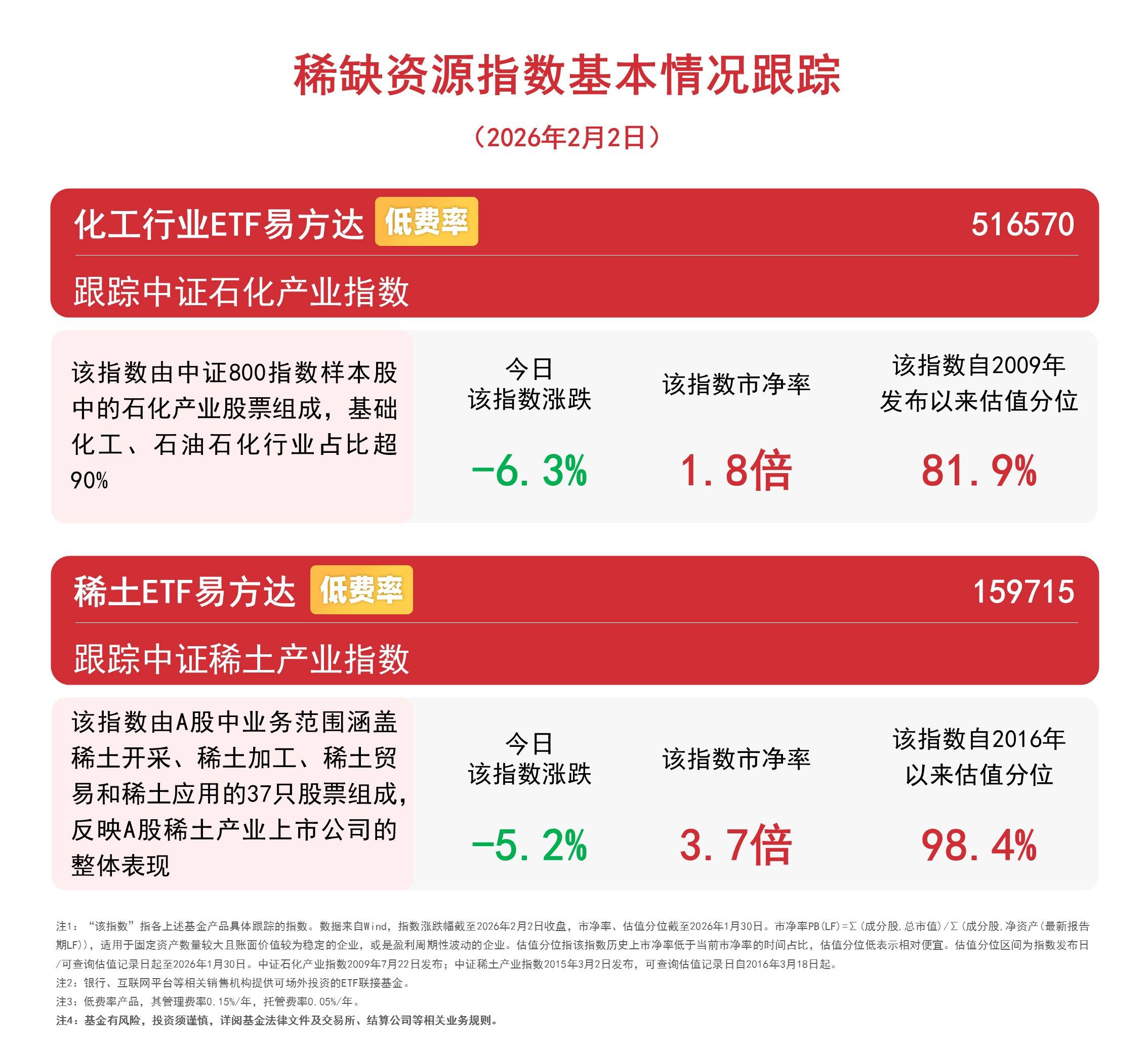
石化产业指数延续调整,化工行业ETF易方达(516570)等产品持续受资金关注
Sou Hu Cai Jing· 2026-02-02 11:10
Group 1 - The core viewpoint of the article highlights a significant decline in the performance of the rare earth and petrochemical sectors, with the China Rare Earth Industry Index dropping by 5.2% and the China Petrochemical Industry Index falling by 6.3% [1] - Recent data indicates that capital has been continuously flowing into related ETFs, with the E Fund Chemical Industry ETF (516570) attracting over 1.1 billion yuan in funds over the past 11 trading days [1] - Looking ahead, Everbright Securities suggests focusing on three main lines: upstream oil services, leading chemical companies, and domestic production, driven by the recovery trend in chemical industry prosperity and favorable policy directions [1] Group 2 - The chemical industry is experiencing a shift characterized by "east rising and west falling," indicating that Chinese chemical companies are enhancing their global competitiveness [1] - A slowdown in capital expenditure is expected, which may lead to increased profit elasticity as production capacity is released [1]
政策导向推动供给侧优化,龙头企业竞争优势凸显,石化ETF(159731)连续18天净流入
Xin Lang Cai Jing· 2026-02-02 02:28
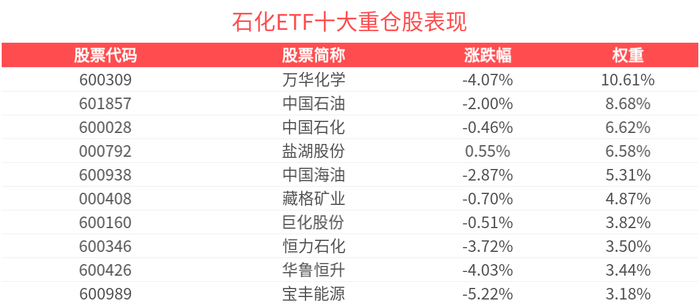
Core Viewpoint - The petrochemical industry is experiencing fluctuations in stock performance, with significant policy changes expected to optimize supply-side dynamics and enhance the competitive advantages of leading enterprises [2]. Group 1: Market Performance - As of February 2, 2026, the China Securities Petrochemical Industry Index has decreased by 2.78%, with mixed performance among constituent stocks [1]. - The top-performing stock is Sanmei Co., which increased by 1.75%, while Luxi Chemical led the decline with an 8.18% drop [1]. - The Petrochemical ETF (159731) has fallen by 2.79%, with a latest price of 1.01 yuan and a turnover rate of 6.58% [1]. Group 2: Fund Flows and ETF Performance - The Petrochemical ETF has seen continuous net inflows over the past 18 days, with a peak single-day net inflow of 348 million yuan, totaling 1.351 billion yuan [1]. - As of January 30, 2026, the Petrochemical ETF's net value has increased by 69.05% over the past two years [2]. - The ETF has achieved a maximum monthly return of 15.86% since its inception, with the longest streak of monthly gains lasting 9 months and an average monthly return of 5.59% [2]. Group 3: Policy Impact - Recent government policies aimed at "decarbonization," "environmental protection," and "cancellation of export tax rebates" are expected to suppress low-level redundant construction and disorderly expansion in the chemical industry [2]. - The policies are part of a broader strategy to optimize supply-side dynamics and enhance the competitive advantages of leading enterprises in the petrochemical sector [2]. Group 4: Index Composition - As of January 30, 2026, the top ten weighted stocks in the China Securities Petrochemical Industry Index account for 55.71% of the index, with Wanhua Chemical and China Petroleum being the top two [2].



【基础化工】26年1月化工涨幅居前,坚守上游油服、化工龙头、国产替代三主线——行业周报(0126-0130)(赵乃迪/周家诺/蔡嘉豪/王礼沫)
光大证券研究· 2026-02-01 23:03
Core Viewpoint - The chemical industry is experiencing a recovery trend, supported by macroeconomic data and government policies aimed at optimizing supply-side dynamics, which enhances the competitive advantage of leading enterprises [4][5][6]. Group 1: Industry Performance and Macroeconomic Data - In January 2026, the oil and petrochemical index and the basic chemical index increased by 14.9% and 10.1% respectively, ranking third and sixth among all primary industries, indicating market expectations for recovery in the chemical sector [4]. - The Producer Price Index (PPI) has shown positive signals, with a continuous narrowing of year-on-year declines since July 2025 and a month-on-month improvement since October 2025, suggesting a release of pressure on industrial product prices [4]. - The China Chemical Price Index (CCPI) has risen by 4.2% compared to the end of 2025, indicating a recovery in chemical prices and potential improvement in the profitability of chemical enterprises [4]. Group 2: Policy Guidance and Supply-Side Optimization - Since 2025, the government has issued various guiding documents related to "anti-involution" and "stabilizing growth," including the "Stabilizing Growth Work Plan for the Petrochemical Industry (2025-2026)" [5]. - Recent policies aimed at "carbon reduction," "environmental protection," and "cancellation of export tax rebates" are expected to suppress low-level repeated construction and disorderly expansion in the industry, promoting the clearing of existing supply [5]. - Leading enterprises with scale effects, low energy consumption technologies, and compliance with environmental regulations are likely to gain higher market shares and face increased entry barriers in their industries [5]. Group 3: Global Competitive Landscape - European chemical enterprises are facing significant operational pressures due to energy costs and environmental regulations, leading to a sixfold increase in capacity closures from 2022 to 2025, with a total loss of 37 million tons, accounting for 9% of Europe's total chemical capacity [6]. - In contrast, Chinese chemical enterprises have seen a significant increase in export volumes, with the monthly average export quantity index for chemical raw materials and products in 2025 reaching approximately 113.0, indicating a year-on-year growth of about 13.0% [6][7]. - This trend not only helps domestic enterprises absorb new production capacity but also significantly enhances the global market share and brand influence of Chinese chemical products [7]. Group 4: Capital Expenditure and Profitability - Following a period of concentrated expansion, capital expenditure in the chemical industry has entered a phase of contraction or stabilization, with fixed asset investment in the chemical raw materials and products manufacturing sector declining by 8% year-on-year in 2025 [8]. - As downstream demand improves, the high-quality capacity invested in previously will lead to the release of scale effects, significantly restoring the profitability of chemical enterprises [8]. - The improved supply-demand dynamics are expected to provide strong upward valuation elasticity for these enterprises [8].

南方基金:“春季躁动”或继续,核心-卫星策略仍是配置优选!
Sou Hu Cai Jing· 2026-01-29 06:55
Group 1 - The market is currently experiencing a "performance verification period," shifting from a liquidity-driven valuation expansion to a focus on companies with real profits and orders [3] - The external environment is changing, with the Federal Reserve's interest rate path stabilizing, making RMB assets an attractive option for global diversification [4] - Long-term industry trends, such as AI development, global technology cycles, and domestic supply-side optimization policies, are forming a solid foundation for the market's mid-term outlook [4] Group 2 - The recommended asset allocation focuses on technology and cyclical sectors, with technology being driven by the ongoing global AI trend and its transition from training to real-world applications [5] - In the cyclical sector, there is a suggestion to consider non-ferrous metals and securities, with expectations of price increases driven by the Federal Reserve's interest rate cuts and improving fundamentals [5][6] - Three reinforcing logics include the rigid supply of key resources, rising macro hedging demand for precious metals, and the strategic importance of resource security in national policy [6][7][8] Group 3 - For balanced asset allocation, broad-based indices like the CSI A500 and the Growth Enterprise Market Index are recommended, along with defensive assets suitable for long-term holdings [9]
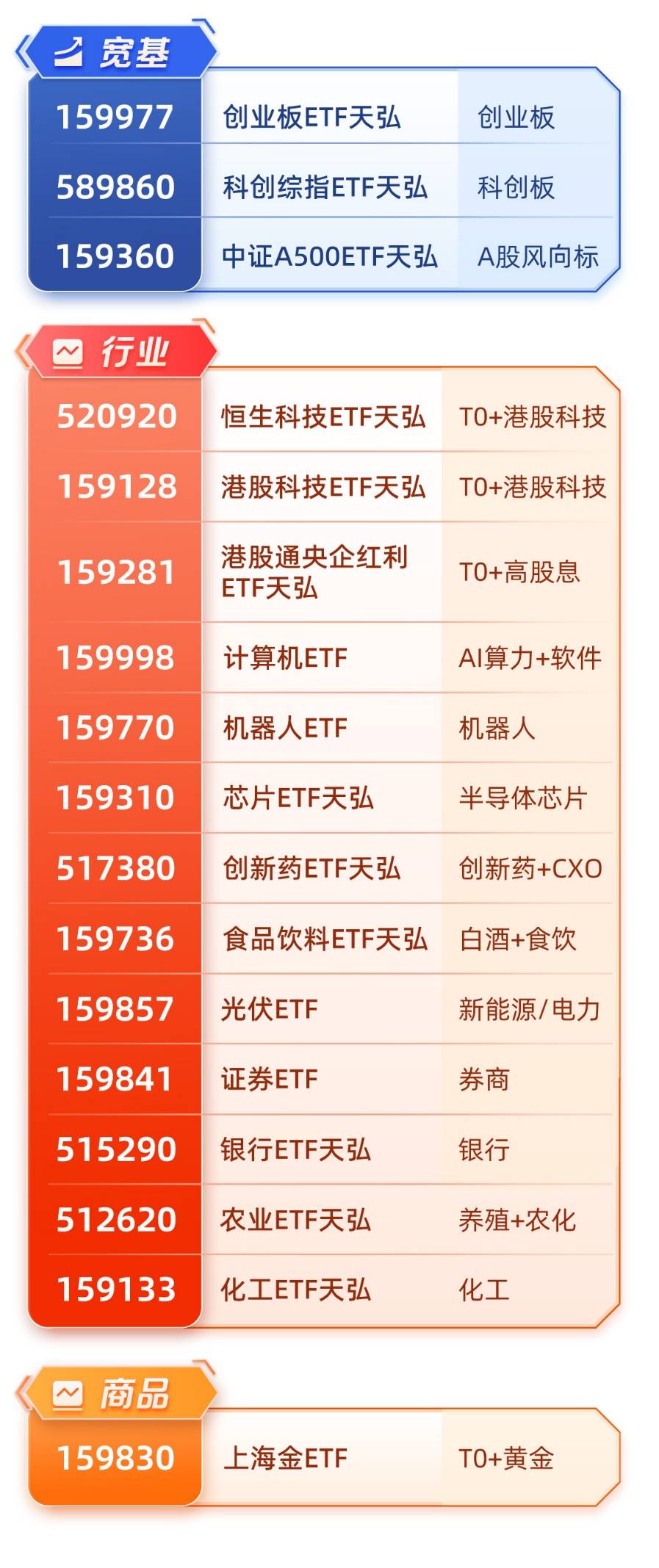
传统化工行业迎供给侧优化窗口!化工ETF天弘(159133)标的指数盘中涨超2%,连续11日“吸金”2.33亿元
Sou Hu Cai Jing· 2026-01-15 02:35
Core Viewpoint - The chemical ETF Tianhong (159133) has seen significant inflows and performance, reflecting a positive outlook for the chemical industry as it undergoes structural changes and optimization [2][3]. Group 1: ETF Performance - As of January 14, the chemical ETF Tianhong (159133) reached a new high with a total size of 843 million yuan and 735 million shares outstanding [2]. - The ETF has experienced continuous net inflows over the past 11 days, accumulating a total of 233 million yuan [2]. Group 2: Industry Trends - The Ministry of Finance announced the cancellation of the 13% export tax rebate on PVC powder starting April 1, 2026, which is expected to increase export costs by approximately 75 USD per ton. This may lead to a short-term surge in exports and a long-term shift towards high-value products and overseas capacity [2]. - The chemical industry is currently at a historical low point, with a shift from capacity expansion to optimization driven by "anti-involution" policies. Key sectors such as coal chemical, organic silicon, and pesticides are expected to see a supply-demand reversal [3]. Group 3: Investment Opportunities - Leading companies in the chemical sector are anticipated to benefit from the ongoing exit of low-efficiency capacity and the transition to high-value products, with potential profit recovery expected [3]. - Sub-industries with resource attributes or technical barriers, such as phosphorus chemicals and refrigerants, may present opportunities for value reassessment [3].


受俄乌、委内瑞拉地缘政治博弈影响,12月油价震荡下跌 | 投研报告
Sou Hu Cai Jing· 2026-01-06 02:42
Core Insights - In December 2025, the average price of Brent crude oil futures was $61.6 per barrel, a decrease of $2.0 per barrel month-on-month, with a month-end price of $60.9 per barrel. WTI crude oil futures averaged $57.9 per barrel, down $1.6 per barrel month-on-month, closing at $57.4 per barrel [1] - OPEC+ plans to completely exit a voluntary production cut of 2.2 million barrels per day from April to September 2025, and on September 7, 2025, it was decided to lift the voluntary production cut agreement of 1.66 million barrels per day reached in April 2023 within 12 months [1] Supply Side - OPEC+ announced a pause in production increases for the first quarter of 2026 due to seasonal reasons, despite plans to increase production by 137,000 barrels per day from October to December 2025 [1] - The IEA indicated that there would be a significant oversupply in the oil market next year, contributing to price fluctuations [1] Demand Side - Major international energy agencies project an increase in global oil demand of 830,000 to 1.3 million barrels per day in 2025, with demand estimates from OPEC, IEA, and EIA for 2025 being 105.14, 103.85, and 103.94 million barrels per day respectively, reflecting increases of 130, 83, and 114 thousand barrels per day compared to 2024 [2] - For 2026, oil demand is expected to grow by 860,000 to 1.38 million barrels per day, with estimates of 106.52, 104.71, and 105.17 million barrels per day from the same agencies [2] Industry Outlook - The Chinese petrochemical industry is facing an overall surplus in refining capacity, with a focus on optimizing supply-side dynamics through strict control of new refining capacity and a scientific approach to the release of new ethylene and paraxylene capacities [3] - The expected price range for Brent crude oil in 2026 is projected to be between $55 and $65 per barrel, while WTI crude oil is expected to range from $52 to $62 per barrel, influenced by high fiscal balance oil price costs from OPEC+ and elevated new well costs in U.S. shale oil [3] - Recommended stocks include China National Offshore Oil Corporation, China Petroleum, Satellite Chemical, and CNOOC Development [3]




建筑材料行业:中央经济工作会议举行,着力稳定房地产市场、继续反内卷
GF SECURITIES· 2025-12-14 13:29
Core Insights - The central economic work conference emphasizes stabilizing the real estate market and combating "involution" in competition, aiming to promote the construction of "good houses" and accelerate the establishment of a new model for real estate development [6][15] - The report suggests that the cement, glass, and certain consumer building materials industries may see continued optimization in supply-side dynamics, leading to increased concentration and improved profitability [6][15] Consumer Building Materials - The consumer building materials sector is experiencing a recovery in retail due to high demand for second-hand housing and supportive subsidy policies, with leading companies showing strong operational resilience [6][31] - Long-term demand stability and increasing industry concentration provide significant growth potential for quality leading companies in the consumer building materials sector [6][31] - Key companies to watch include Sanke Tree, Rabbit Baby, Hanhai Group, Dongfang Yuhong, China Liansu, Beixin Building Materials, Weixing New Materials, and others [6][31] Cement - National cement market prices increased by 0.05% week-on-week, with the average price at 355 RMB/ton as of December 12, 2025, reflecting a year-on-year decrease of 69.17% [6][31] - The report anticipates that cement prices will maintain a slight fluctuation in the future, with industry valuations at historical lows, highlighting companies like Huaxin Cement, Conch Cement, and others for potential investment [6][31] Glass - Float glass prices are showing mixed trends, while photovoltaic glass inventories continue to rise, with the average price of float glass at 1156 RMB/ton, down 1.0% month-on-month and 18.0% year-on-year [6][31] - The report indicates that leading glass companies have low valuations and suggests focusing on Qibin Group, Xinyi Solar, and others for investment opportunities [6][31] Fiberglass/Carbon-based Composites - The market for fiberglass is stable, with direct yarn prices holding steady, while electronic yarn prices have stabilized after previous increases [6][31] - The report identifies leading companies in the fiberglass sector, including China Jushi and others, as having a significant competitive edge [6][31] Market Data and Trends - The report notes that the consumer building materials sector has seen a year-on-year revenue decline of 4.2% in the first three quarters of 2025, with a notable improvement in revenue growth rates for leading companies [33][34] - The profitability of the consumer building materials sector is stabilizing, with net profit margins hovering at the bottom, indicating potential for recovery as market conditions improve [34][41]