
利率上行

Search documents
全球通胀压力升温,利率上行施压黄金
Dong Zheng Qi Huo· 2026-03-15 11:15
Group 1: Report Industry Investment Rating - The investment rating for the gold industry is "Oscillating" [2] Group 2: Core Viewpoints of the Report - Global inflation pressure is rising, and rising interest rates are putting pressure on gold [1] - Short - term gold price trends are weakly oscillating, and investors should wait for a pull - back to buy. The slowdown in RMB appreciation may keep the domestic gold market at a small premium [5] Group 3: Summary of Each Section 1. Gold High - Frequency Data Weekly Changes - The domestic basis (spot - futures) was - 1.75 yuan/gram, with a weekly change of 0.59 yuan and a change rate of - 25.2%. The domestic - foreign futures price difference (domestic - foreign) was 18.19 yuan/gram, with a change of 26.49 yuan and a change rate of - 319.1%. The Shanghai Futures Exchange gold inventory increased by 0.4% to 105,417 kg, and the COMEX gold inventory decreased by 1.60% to 32,551,562 ounces. The SPDR ETF holding decreased by 0.16% to 1,071.56 tons. The CFTC gold speculative net long position increased by 1.4% to 102,236 lots. The U.S. Treasury yield rose 3.1% to 4.28%, the dollar index rose 1.56% to 100.50, the SOFR decreased by 0.3% to 3.65%, the U.S. 10 - year break - even interest rate rose 1.17% to 2.3796%, the S&P 500 index fell 1.6% to 6,632, the VIX volatility index fell 7.8% to 27.2, the gold cross - market arbitrage trading increased 2.4% to 7.0, and the U.S. 10 - year real interest rate rose 6.2% to 1.90% [11] 2. Financial Market - Related Data Tracking 2.1 U.S. Financial Market - The dollar index rose 1.39%, and the U.S. Treasury yield rose to 4.28%. The S&P 500 index fell 1.6%, and the VIX index fell to 27. The U.S. overnight secured financing rate was 3.65%, and the oil price rose 9.8% with the U.S. inflation expectation at 2.38% [15][17] 2.2 Global Financial Market - Stocks, Bonds, Currencies, and Commodities - Developed country stock markets mostly fell, with the S&P 500 down 1.6%. Developing country stock markets mostly fell, with the Shanghai Composite Index down 0.7%. The real interest rate rose to 1.89%, and the gold price fell 2.9%. The spot commodity index rose, and the dollar index rose 1.39%. The euro depreciated 1.77%, the pound depreciated 1.38%, the yen depreciated 1.24%, and the Swiss franc depreciated 1.95%. The U.S. and German bonds rose, with a U.S. - German yield spread of 1.29%. The UK Treasury yield was 4.82%, and the Japanese bond yield was 2.26%. The dollar index rose 1.41% to 98.9, and non - U.S. currencies depreciated [21][22][27] 3. Gold Trading - Level Data Tracking - Gold speculative position data is presented, and the SPDR gold ETF holding fell to 1,071 tons. The RMB stopped appreciating and started to depreciate, and the domestic market turned to a premium. Gold and silver prices fell, and the gold - silver ratio rose to 62.3 [34][37] 4. Weekly Economic Calendar - Monday: China's February retail sales and industrial added - value data; Tuesday: Reserve Bank of Australia interest rate meeting decision; Wednesday: U.S. February PPI and Bank of Canada interest rate meeting decision; Thursday: Federal Reserve, ECB, and Bank of England interest rate meetings; Friday: China's March LPR [37]
【笔记20260313— 赢了!】
债券笔记· 2026-03-13 10:14
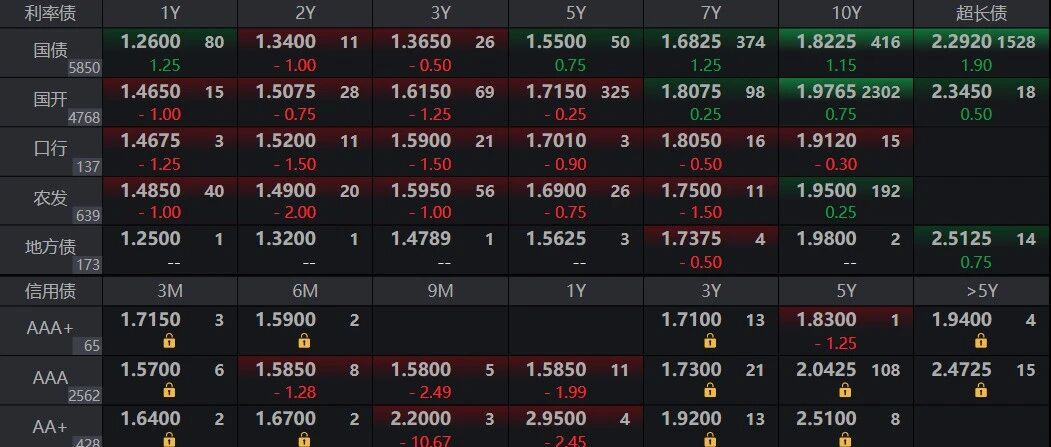
Core Viewpoint - The market is compared to a river, where investment flows in the direction of least resistance, indicating that overcoming resistance points will determine future market directions [1] Group 1: Financial Market Overview - The central bank conducted a 375 billion yuan 7-day reverse repurchase operation, with 448 billion yuan maturing today, resulting in a net withdrawal of 73 billion yuan [3] - A buyout reverse repurchase operation of 500 billion yuan is scheduled for March 16, with a 6-month term [3] - The funding environment is balanced and slightly loose, with the DR001 rate around 1.32% and DR007 at approximately 1.46% [3] Group 2: Interest Rates and Bond Market - The overnight interbank funding rates show slight increases, with R001 at 1.39% and R007 at 1.50%, reflecting a decrease of 5 basis points and 13 basis points respectively [4] - The 10-year government bond yield opened at 1.81% and showed weak fluctuations, with the market sentiment being cautious [5] Group 3: Company Performance - Porsche reported a staggering 92.7% year-on-year drop in operating profit for 2025, while management is cutting jobs and closing stores, yet remains adamant about not engaging in price wars and maintaining pure imports [6]

保险深度:股市及利率影响几何?
East Money Securities· 2026-03-05 03:27
Investment Rating - The report maintains a "Strong Buy" rating for the non-bank financial sector, indicating a positive outlook for investment opportunities in this industry [3]. Core Insights - The Chinese insurance industry has shown rapid growth, with total investment assets reaching 38.5 trillion yuan by the end of Q4 2025, reflecting a year-on-year growth rate of 15.7% [20][21]. - The allocation of investment assets has shifted significantly towards bonds, which increased from 33.3% in Q1 2019 to 50.4% in Q4 2025, while the share of stocks and funds rose from 12.4% to 15.4% during the same period [26][20]. - The performance of insurance companies is highly sensitive to fluctuations in equity markets and interest rates, with both static and dynamic impacts on their financial performance [36]. Summary by Sections 1. Overview of the Insurance Industry Investment Status - The insurance industry has maintained a compound annual growth rate of 18.6% in investment assets from 2004 to 2025, with a notable recovery in growth rates following a low point in 2021 [20]. - The proportion of investment assets allocated to life insurance companies has remained around 90% since 2022, indicating their dominance in the market [21]. 2. Sensitivity Analysis of Equity Market Upturn - A 10% increase in equity investment prices could lead to an average pre-tax profit increase of 38.7%, with China Pacific Insurance showing the highest sensitivity at 83.4% [2]. - If equity investment prices rise by 10% alongside a 10% increase in equity allocation, the average pre-tax profit could increase by 81.2%, with China Pacific Insurance again leading at 175.2% [2]. 3. Sensitivity Analysis of Interest Rate Increases - A 50 basis point increase in market interest rates could result in an average pre-tax profit increase of 0.7%, with China Life and China Pacific showing significant positive elasticity [2][3]. 4. Economic Assumption Sensitivity Analysis - An increase in investment return rates and risk discount rates by 50 basis points could enhance new business value by an average of 35%, with China Life and New China Life showing the highest sensitivity [12]. 5. Liability Cost Analysis - The average new policy liability cost is estimated at 2.76%, with Ping An and China Life having the lowest costs [12]. - The report suggests that effective management of liability costs will enhance the long-term profitability of insurance companies [12]. 6. Investment Recommendations - The report highlights that the insurance sector is currently undervalued and suggests a systematic allocation of investments in this sector due to its high beta elasticity and resilience [12].



【环球财经】巴西工业2025年微增0.6% 连续三年实现扩张
Xin Hua Cai Jing· 2026-02-08 08:34
Core Insights - Brazil's industrial production is projected to grow by 0.6% in 2025, marking the third consecutive year of expansion, although at a significantly slower pace compared to previous years [1] - The industrial production growth was 3.1% in 2024 and 0.1% in 2023, indicating a trend of declining growth rates [1] Industry Performance - In 2025, industrial production faced downward pressure due to rising interest rates, with a notable month-on-month decline of 1.2% in December, the weakest performance since July 2024 [1] - Among the four quarters of 2025, the industrial sector showed resilience despite economic challenges, with 15 out of 25 industrial categories experiencing expansion [1] - The production of consumer goods and intermediate goods grew by 2.5% and 1.5% respectively, indicating sustained growth in certain areas, while capital goods and durable consumer goods contracted [1] - Significant growth was observed in the extraction and food production sectors, highlighting specific areas of strength within the industrial landscape [1] Economic Context - The Brazilian Central Bank has been raising the benchmark interest rate since September 2024, maintaining high rates into 2025, which has suppressed investment and credit demand, contributing to the downward pressure on industrial production [1] - Despite the complex economic conditions, the annual data reflects that the industrial sector has managed to maintain expansion [1]
日本大型银行虽亏损持续扩大 仍准备增持日本国债
Xin Lang Cai Jing· 2026-02-06 07:35
Core Viewpoint - Japan's major banks, Mitsubishi UFJ Financial Group and Sumitomo Mitsui Financial Group, plan to increase their holdings of Japanese government bonds despite ongoing unrealized losses in their existing bond portfolios, as rising interest rates are expected to yield higher returns [1][4]. Group 1: Current Market Conditions - Japanese government bond yields have significantly increased since November, driven by Prime Minister Fumio Kishida's spending plans, impacting bond valuations [2]. - The 30-year Japanese government bond yield has decreased by 32 basis points from its historical high of 3.88% on January 20 [2]. - The current 10-year Japanese government bond yield stands at 2.195% [12]. Group 2: Bank Strategies and Financial Impact - Mitsubishi UFJ Financial Group reported an unrealized loss of 200 billion yen (approximately 1.3 billion USD) in its bond portfolio at year-end, a substantial increase from 40 billion yen at the end of March [2][8]. - Sumitomo Mitsui Financial Group's unrealized losses on Japanese government bonds more than doubled to 98 billion yen over the past nine months [4]. - Both banks are cautiously planning to rebuild their Japanese government bond holdings as long-term interest rates show signs of peaking [2][4]. Group 3: Future Outlook and Profitability - Analysts predict that as the scale of long-term Japanese government bond holdings increases and yields rise, banks' profitability is expected to improve in the coming years [7][13]. - Goldman Sachs analysts have raised profit forecasts for the three major banks, reflecting the impact of recent interest rate hikes and rising bond yields [13]. - The net profit forecasts for Mitsubishi UFJ Financial Group, Sumitomo Mitsui Financial Group, and Mizuho Financial Group have been adjusted upwards by 20%, 11%, and 21% respectively [13].
景顺:美联储独立性遭考验 短期内给风险资产带来重大挑战
Sou Hu Cai Jing· 2026-01-12 09:08
Core Viewpoint - The U.S. Federal Prosecutors have launched a criminal investigation into Federal Reserve Chairman Jerome Powell regarding the renovation of the Fed's office building and whether he made false statements to Congress about the project's scale [1][2] Group 1: Investigation and Pressure on the Fed - The investigation involves the renovation project of the Federal Reserve's office building and potential false statements made by Powell to Congress [1][2] - There has been an escalation in public pressure from the U.S. government on the Federal Reserve in recent months [1][2] - The independence of central banks is considered a cornerstone for financial market stability, and any perceived weakening of this independence could undermine market confidence in monetary policy and the financial system as a whole [1][2] Group 2: Investment Implications - The latest developments are expected to pose significant challenges to risk assets in the short term, with these challenges likely to persist until clearer signals emerge regarding the situation [1][2] - The most direct investment impact may be an increase in inflation expectations, leading to upward pressure on interest rates [1][2] - Rising interest rates could suppress U.S. stock valuations, particularly in sectors and investment styles sensitive to changes in discount rates [1][2] - The U.S. dollar may come under pressure, while gold and other perceived safe-haven assets could benefit [1][2] - Non-U.S. dollar assets, such as European and Asian stocks, may become more attractive to investors [1][2] - Investors are advised to adopt a cautious approach rather than panic, considering hedging portfolio risks where appropriate and closely monitoring subsequent developments [1][2]
固收|经济工作会议后,利率为何上行
2025-12-15 01:55
Summary of Key Points from Conference Call Records Industry Overview - The records primarily discuss the bond market and monetary policy in China, focusing on the implications of recent economic meetings and market dynamics. Core Insights and Arguments 1. **Monetary Policy Outlook** - The monetary policy remains accommodative, emphasizing cost reduction and interest rate cuts, but short-term market reactions are muted due to insufficient allocation power, leading to a weak cross-year market outlook. A potential turning point is expected after January 2026 with a high probability of reserve requirement ratio (RRR) cuts to alleviate bank liabilities [1][2][3] 2. **Fiscal Policy Stance** - Fiscal policy is expected to remain stable with limited incremental changes, focusing on effectively utilizing existing policies. The broad deficit is projected to remain consistent with 2025 levels, lacking strong fiscal stimulus signals, which contributes to muted market reactions [1][4] 3. **Long-term Bond Market Dynamics** - Increased issuance and extended maturities of special government bonds and local government bonds will lead to higher supply in the long-term and ultra-long-term bond markets, exerting upward pressure on yields despite stable fiscal policies [1][5] 4. **Economic Growth Targets** - The economic growth target for 2026 is not expected to decline due to stable fiscal policies. There is a strong domestic demand for economic growth, and if mid-year performance is below expectations, policy adjustments will likely be made rather than lowering growth targets [1][6] 5. **Impact of Interest Rate Caps** - The setting of domestic interest rate caps serves as a stabilizing measure for the government bond market, allowing for controlled upward movement in rates during the current expansion phase, contrasting with rapid fiscal expansions seen in other economies [1][7] 6. **Challenges in Domestic vs. Overseas Markets** - Domestic markets face fewer pressures compared to overseas markets during fiscal expansions, with only 1.5 layers of pressure compared to four for overseas markets. This includes managing public bond yields and some price increases [1][8] 7. **Central Economic Work Conference Insights** - The conference indicated that future monetary policy will focus on supporting livelihoods and real economic development rather than merely inflating asset prices. The central bank may buy government bonds to maintain national leverage costs if rapid interest rate increases occur [1][9][10] 8. **Banking Sector Dynamics** - The banking sector's allocation power is expected to be weak at the end of the year and early 2026, influenced by discussions on next year's KPIs and the performance of insurance institutions in the equity bull market [1][11] 9. **Short-term Trading Strategies** - The TL contract is expected to fluctuate between 110 and 113.5, with potential strategies focusing on tax rate differences between old and new bonds, contingent on a stable market environment [1][12] 10. **Credit Bond Market Impact** - Recent policies, particularly regarding local government debt resolution by 2028, will significantly influence the credit bond market, with a focus on addressing hidden and financial debts through local fiscal measures and financial institution support [1][13][14] 11. **Investment Value of Credit Strategies** - Credit strategies are expected to retain investment value in 2026, with a focus on short-duration credit bonds becoming mainstream due to weaker performance in trading assets and overall bond market outlook [1][15] 12. **Trends in Convertible Bond Market** - The convertible bond market is currently experiencing volatility but may benefit from catalysts in the equity market. A balanced approach in selecting convertible bonds, particularly in the technology growth sector, is recommended [1][16][17] 13. **Investment Layout Recommendations** - A balanced investment strategy is advised, focusing on technology growth sectors while also maintaining a base in high-dividend stocks and exploring new bonds with low credit risk to mitigate uncertainties [1][18]
IMF点出掣肘?亚洲经济增长的两大因素:利率上行与美元走强
Zhi Tong Cai Jing· 2025-10-24 04:33
Core Insights - The IMF highlights two major factors that could hinder economic growth in Asia: rising interest rates and a strengthening US dollar [1][2] Group 1: Economic Conditions - A strong dollar and rising long-term US Treasury yields may increase overall debt costs in Asian markets, posing challenges for countries that have shown resilience against US tariffs [1] - Low interest rates and a weak dollar have helped Asian markets withstand tariff impacts, allowing governments and businesses to borrow at lower costs [1][3] Group 2: Future Projections - The IMF projects that Asia's economy will grow by 4.5% in 2025, slightly down from 4.6% in the previous year, but up by 0.6 percentage points from earlier forecasts due to strong export growth [2] - The growth forecast for 2026 is expected to further decline to 4.1%, indicating a downward risk for economic growth in Asia [3] Group 3: Monetary Policy - Many Asian countries may need to pursue further monetary easing to bring inflation back to target ranges and anchor inflation expectations [3] - The relative moderation of inflation in Asia compared to other regions suggests that central banks can effectively manage inflation expectations due to public trust in their independence from government interference [3]
IMF点出掣肘 亚洲经济增长的两大因素:利率上行与美元走强
Zhi Tong Cai Jing· 2025-10-24 04:19
Group 1 - The IMF warns that a strong dollar and rising long-term interest rates could challenge the resilience of Asian countries in responding to US tariffs [1][2] - A sustained strong dollar or a significant rise in long-term US Treasury yields may increase the overall debt costs for Asian markets [1][2] - Low interest rates and a weak dollar have helped Asian markets withstand the impact of US tariffs this year [1][2] Group 2 - The IMF projects that the Asian economy will grow by 4.5% in 2025, slightly down from 4.6% last year, but up by 0.6 percentage points from its April forecast due to strong export growth [2] - The IMF warns that the risks to Asian economic growth are skewed to the downside, with a further slowdown expected to 4.1% in 2026 [3] - Many Asian countries may need to pursue further monetary easing to bring inflation back to target ranges and ensure inflation expectations remain anchored [3]
IMF点出掣肘亚洲经济增长的两大因素:利率上行与美元走强
智通财经网· 2025-10-24 04:19
Core Viewpoint - The International Monetary Fund (IMF) warns that a sudden strengthening of the US dollar, combined with a significant rise in long-term interest rates, could challenge the resilience of Asian countries in responding to US tariffs [1][2]. Group 1: Financial Conditions and Impact on Asia - A strong dollar or rising long-term US Treasury yields may increase the overall debt costs for Asian markets [1]. - Low interest rates and a weak dollar have helped Asian markets withstand the impact of US tariffs this year [1]. - If the Federal Reserve continues to lower interest rates and the dollar weakens, Asian central banks could relax monetary policies to support economic growth without fearing capital outflow risks [1][2]. Group 2: Economic Growth Projections - The IMF projects that the overall Asian economy will grow by 4.5% in 2025, slightly down from 4.6% last year, but up by 0.6 percentage points from the IMF's April forecast due to strong export growth before higher US tariffs took effect [2]. - However, the IMF warns that the risks to Asian economic growth are skewed to the downside, with a further slowdown to 4.1% expected in 2026 [3]. Group 3: Monetary Policy and Inflation - Many Asian countries may need to pursue further monetary easing to bring inflation back to target ranges and ensure inflation expectations remain anchored [3]. - Despite a rebound in demand post-pandemic and rising raw material prices due to the Russia-Ukraine conflict, inflation in Asia remains relatively mild compared to other regions [3]. - The independence of central banks is crucial for achieving price stability, and they should not be burdened with excessive missions and liabilities [3].