
原油市场基本面

Search documents
原油周报:原油站在地缘与基本面的十字路口
Xin Lang Cai Jing· 2026-02-01 23:26
Market Overview - The recent oil market has experienced significant volatility, with prices showing both sharp increases and declines throughout the week, indicating a certain level of fragility in the current pricing environment [5][42] - Reports at the beginning of the year suggested that 2026 would be a year of oversupply, with fundamental price estimates around WTI $60 per barrel, but geopolitical tensions, particularly between the US and Iran, have introduced uncertainty [5][42] - The market reacted to news of potential Iranian actions in the Strait of Hormuz, which temporarily drove prices up before a pullback due to broader market conditions [5][42] Price Data - As of January 30, 2026, Brent crude futures settled at $70.69 per barrel, up $4.81 (+7.3%) from the previous week; WTI crude futures settled at $65.21 per barrel, up $4.14 (+6.78%); Dubai crude futures settled at $67.86 per barrel, up $4.05 (+6.35%) [6][43] - The price movements were influenced by increased liquidity in the market due to rising gold prices and heightened geopolitical risk premiums related to US-Iran tensions [9][43] EIA Data Analysis - The EIA reported a significant decrease in crude oil inventories, with a reduction of 2.295 million barrels; production slightly declined to 13.696 million barrels per day, while imports fell by 805,000 barrels per day and exports increased by 901,000 barrels per day, leading to a net import decrease [6][24][57] - Despite the decrease in supply, downstream refined product demand remains weak, particularly outside of gasoline, indicating a mixed outlook for the oil market [6][24][57] Terminal Demand - US highway transportation activity has shown typical seasonal adjustments, with a decrease in freight volume and capacity following the peak season, indicating limited potential demand decline [30][62] - The overall transportation situation has stabilized, although winter weather poses short-term challenges [30][62] Domestic Refinery Operations - Refinery utilization rates decreased by 2.4% to 90.90%, remaining above historical averages, indicating stable operations despite the slight decline [25][59] - The processing margins for major refineries were reported at 659.83 CNY per ton, while independent refineries saw a significant drop in profitability, down 34.75% from the previous week [35][59]


油价调整:注意,还有1天,预计上涨80元/吨,油价要涨!
Jin Tou Wang· 2026-01-19 04:03
Group 1 - The current oil price adjustment is expected to increase by 80 yuan per ton, translating to an increase of 0.06-0.07 yuan per liter, which is a rise of 5 yuan per ton compared to last Friday's prices, exceeding the adjustment threshold [1][3] - International oil prices have shown a fluctuating trend following a significant drop last Thursday, with U.S. crude oil rising by 0.12% to $59.22 per barrel and Brent crude oil increasing by 0.30% to $64.04 per barrel [3] - The market is anticipating a steady increase in domestic oil prices, with the next adjustment expected to be an upward trend, encouraging consumers to refuel in advance [3][4] Group 2 - The geopolitical situation has cooled, but potential conflict risks remain, which could affect oil prices if the U.S. does not take substantial actions [3] - The U.S. has communicated directly with Iran regarding its economic situation, suggesting that diplomatic solutions could be pursued for Iran to reintegrate into the international community [3] - Overall, international oil prices are expected to remain volatile in the short term as the market awaits further data and news [3]

原油周报:地缘再次成为焦点,伊朗与美以持续博弈
Xin Lang Cai Jing· 2026-01-18 23:25
Market Overview - The oil market experienced significant fluctuations due to ongoing tensions between the US and Iran, with prices reacting to changing expectations regarding military actions [5][41] - As of December 16, 2025, WTI crude oil futures settled at $59.4 per barrel, up $0.32 (0.54%) from the previous week, while Brent crude settled at $64.1 per barrel, up $0.79 (1.25%) [5][41] Inventory and Supply Data - The EIA reported a decrease in crude oil inventories by 3.39 million barrels, attributed to increased net imports and sustained high production levels [6][42] - Gasoline inventories saw a notable increase of 8.977 million barrels, indicating a softening demand and rising refinery utilization rates [6][42] Price Dynamics - The price differential between Brent and WTI has widened, primarily due to concerns over CPC Blend crude following an attack on a Kazakh oil tanker, alongside ongoing supply constraints from the US and increased imports from Venezuela [49] - The overall market sentiment remains cautious, with expectations of a return to a more stable pricing environment once geopolitical tensions ease [11][41] Refinery Operations - US refinery utilization rates increased slightly by 0.6% to 95.30%, maintaining historical highs, with minimal disruptions in maintenance activities [61] - The processing margins for major refineries rose by 12.53%, while independent refineries saw a decline of 24.28% in profitability [69] Demand Trends - The US transportation sector is experiencing typical seasonal adjustments, with a decrease in freight volumes and capacity following the peak season [65] - Overall, the demand for refined products remains mixed, with gasoline demand stable and significant increases in demand for distillate fuels [63]
基本面利空持续发酵国际原油价格弱势恐难改
Zhong Guo Zheng Quan Bao· 2025-10-15 20:15
Core Viewpoint - The international oil market has experienced significant volatility in October, with Brent crude futures dropping to a low of $61.5 per barrel and WTI crude futures falling below $58 per barrel, marking a decline of over 5% for the month [1][2] Market Dynamics - Short-term fluctuations in oil prices are heavily influenced by macroeconomic sentiment, with recent geopolitical developments and trade uncertainties contributing to market instability [2][3] - The global economy is showing signs of weak recovery without entering a recession, and the Federal Reserve's preventive rate cuts are providing some liquidity support to the oil market, but this is insufficient to counteract the bearish fundamentals [1][2] Supply and Demand Factors - The oil market is facing increasing pressure from both supply and demand sides, with OPEC+ continuing to increase production while demand is experiencing seasonal declines, leading to a supply surplus [1][4] - The recent ceasefire agreement in Gaza has reduced geopolitical risk support for oil prices, while ongoing uncertainties in the Russia-Ukraine conflict and Venezuela still pose potential risks [3][4] Price Support Levels - Analysts suggest that Brent crude futures are currently in a low range of $60 to $65 per barrel, with a critical support level around $60 per barrel, which corresponds to the marginal cost of U.S. shale oil production [4][5] - A potential scenario of a cold winter in Europe combined with renewed conflicts in the Middle East could push Brent crude prices above $72 per barrel [4][5] Future Outlook - The supply side will remain the dominant factor in oil pricing, with OPEC+ maintaining its production increase policy, although actual increments may not meet targets, which could weaken market impacts [5] - The expectation of a supply surplus persists, with Brent crude futures anticipated to fluctuate between $60 and $75 per barrel unless significant geopolitical disruptions occur [5]
地缘溢价减退、基本面羸弱 油价距离底部还有多远?
Xin Hua Cai Jing· 2025-08-20 06:55
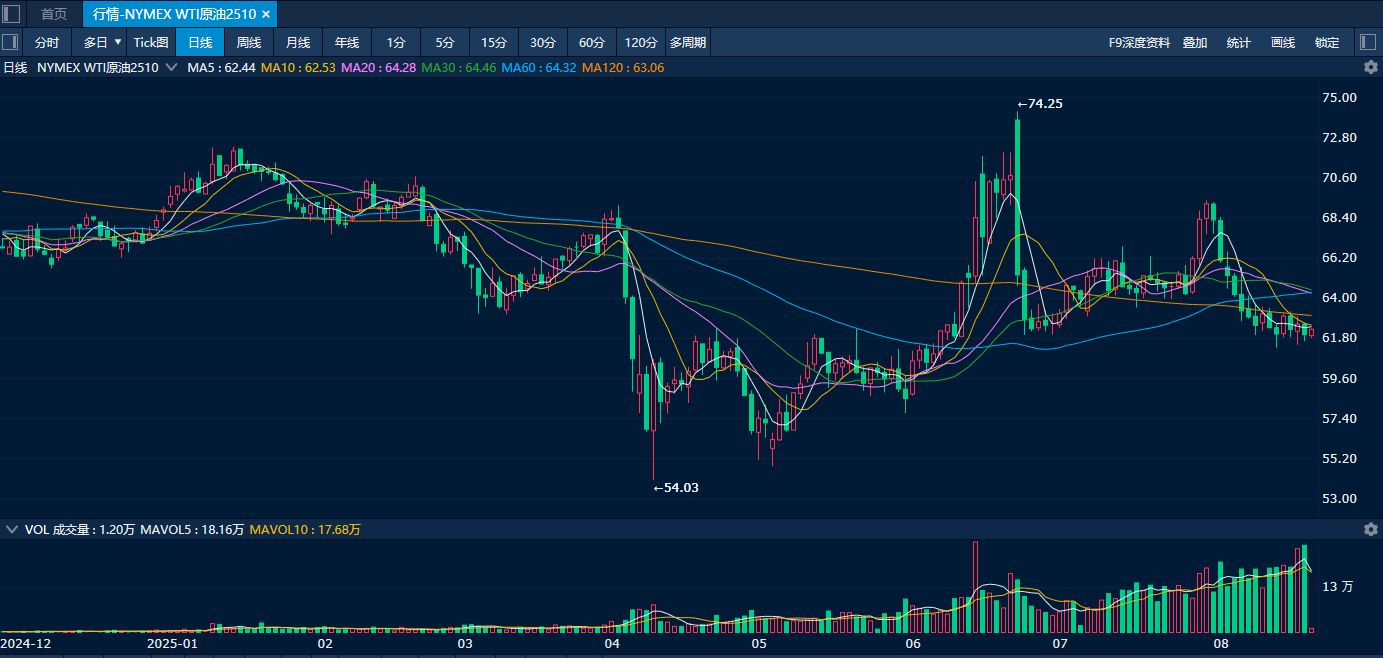
Core Viewpoint - The recent high temperatures in the Northern Hemisphere have not led to an increase in crude oil prices, which have been on a downward trend since the end of July, with WTI crude oil dropping below $62 per barrel [1][3]. Supply and Demand Dynamics - The geopolitical premium has diminished, leading to a return to fundamental factors driving oil prices. The gradual exit of OPEC+ from voluntary production cuts has weakened the oil market's fundamentals, indicating a prolonged search for a price bottom [3][4]. - Following the cessation of the "12-day war" between Israel and Iran, the geopolitical support for oil prices has weakened. The recent meeting between U.S. President Trump and Russian President Putin did not resolve the Russia-Ukraine conflict but is expected to lower geopolitical risks in the oil market, shifting focus back to fundamentals [4][5]. - OPEC+ has been rapidly advancing its production recovery plan, with an agreement to increase production by 547,000 barrels per day in September, marking a significant shift from previous voluntary cuts of 2.2 million barrels per day [5][7]. Economic Outlook and Trade Impact - The World Trade Organization has adjusted its global goods trade growth forecast for this year to 0.9%, but has lowered the 2026 growth expectation from 2.5% to 1.8%, highlighting the negative impact of tariff adjustments on global trade [5][6]. - The World Bank has also revised its 2025 global economic growth forecast down to 2.3%, citing trade barriers and an uncertain global policy environment as factors contributing to a slowdown in economic growth, which negatively affects demand for commodities, including crude oil [6]. Market Sentiment and Speculation - There is increasing concern about supply exceeding demand, with the International Energy Agency (IEA) projecting that global oil supply growth will significantly outpace demand growth in the coming years. The IEA has adjusted its 2025 and 2026 global oil supply growth forecasts upward while lowering demand growth expectations [7][9]. - Speculative positions in the WTI crude oil market have reached a 16-year low, indicating a bearish sentiment among traders [9]. Volatility Risks - The prevailing bearish sentiment in the market may amplify price volatility. Despite the negative outlook, some regions show strong economic activity, leading to a slightly optimistic forecast from OPEC regarding global economic growth [10]. - The market anticipates a weak oil price trend in the fourth quarter, but the traditional summer gasoline consumption peak and the upcoming industrial consumption season may create unpredictable price movements [10].
化工日报:终端织造加弹负荷加速下行-20250704
Hua Tai Qi Huo· 2025-07-04 06:24
Report Summary 1. Report Industry Investment Rating - PX/PTA/PF/PR are rated as neutral [5] 2. Core Viewpoints - In the short term, after the game of the Middle East conflict, the crude oil market will focus on fundamentals and tariff impacts. The pattern of strong reality and weak expectation remains unchanged. However, in the fourth quarter of this year, after the peak season ends, the demand growth elasticity will be significantly smaller than the supply side, and crude oil is expected to enter a state of oversupply [2] - In terms of gasoline and aromatics, the US gasoline crack has retreated again recently. Against the background of new energy substitution, the upside space of the gasoline crack spread is limited. The blending oil demand this year is not worth much expectation. The intermittent blending oil demand at home and abroad can basically be met by naphtha, which limits the enthusiasm of aromatics to enter the gasoline pool [2] - For PX, several domestic PX units are under maintenance recently, and the supply and demand side remains tight. With the high downstream PTA start - up and the new PTA production in the third quarter, PXN is expected to be supported [2][5] - PTA has no major fundamental contradictions, but there is an expectation of weakening on the demand side due to the bottle - chip maintenance plan. Attention should be paid to the cost and demand support [5] - For PF, the short - fiber spot is tight and the inventory is not high, but the downstream's acceptance of high raw material prices is limited, and most of them purchase on a just - in - time basis. Attention should be paid to the cost - side support [3] - For PR, the current bottle - chip profit is still low. With the gradual implementation of production cuts, the processing fee is expected to be repaired [4] 3. Summary by Directory I. Price and Basis - The report shows the TA main contract, basis, and inter - period spread trends, PX main contract trends, basis, and inter - period spread trends, PTA East China spot basis, and short - fiber 1.56D*38mm semi - bright white basis [9][10][12] II. Upstream Profits and Spreads - It includes PX processing fee PXN, PTA spot processing fee, South Korean xylene isomerization profit, and South Korean STDP selective disproportionation profit [17][22] III. International Spreads and Import - Export Profits - It involves the toluene US - Asia spread, toluene South Korea FOB - Japan naphtha CFR, and PTA export profit [24][26] IV. Upstream PX and PTA Start - up - It presents the start - up of PTA in China, South Korea, and Taiwan, as well as the start - up of PX in China and Asia [27][30][32] V. Social Inventory and Warehouse Receipts - It shows the weekly social inventory of PTA, monthly social inventory of PX, PTA total warehouse receipts + forecast volume, PTA warehouse warehouse receipts inventory, PX warehouse receipts inventory, and PF warehouse receipts inventory [35][38][39] VI. Downstream Polyester Load - It includes the production and sales of filament and short - fiber, polyester load, direct - spinning filament load, polyester staple fiber load, polyester bottle - chip load, filament factory inventory days, and the start - up rates of Jiangsu and Zhejiang looms, texturing machines, and printing and dyeing machines [46][48][57] VII. PF Detailed Data - It presents the polyester staple fiber load, polyester staple fiber factory equity inventory days, 1.4D physical inventory, 1.4D equity inventory, recycled cotton - type staple fiber load, raw - recycled spread, pure polyester yarn start - up rate, pure polyester yarn production profit, polyester - cotton yarn start - up rate, polyester - cotton yarn processing fee, pure polyester yarn factory inventory available days, and polyester - cotton yarn factory inventory available days [67][68][77] VIII. PR Fundamental Detailed Data - It includes the polyester bottle - chip load, bottle - chip factory bottle - chip inventory days, bottle - chip spot processing fee, bottle - chip export processing fee, bottle - chip export profit, East China water bottle - chip - recycled 3A - grade white bottle - chip, bottle - chip next - month spread, and bottle - chip next - next - month spread [84][86][93]
原油月报:上调供给,下调需求,三机构预测原油市场基本面更为宽松-20250704
Xinda Securities· 2025-07-04 03:33
Investment Rating - The report does not explicitly provide an investment rating for the oil processing industry Core Insights - The report indicates a more relaxed fundamental outlook for the oil market, with adjustments in supply and demand forecasts from IEA, EIA, and OPEC for 2025 and 2026 [1][2][3] Supply Overview - IEA, EIA, and OPEC predict global oil supply for 2025 to be 10,488.00, 10,434.42, and 10,410.62 million barrels per day respectively, showing increases from 2024 of +182.72, +154.73, and +175.68 million barrels per day [2][32] - For 2026, the supply predictions are 10,603.04, 10,513.81, and 10,505.26 million barrels per day, reflecting increases from 2025 of +115.04, +79.39, and +94.64 million barrels per day [2][32] - The average change in global oil supply for Q2 2025 is forecasted to be +70.56 million barrels per day, a significant increase from previous predictions [2][27] Demand Overview - Global oil demand predictions for 2025 are 10,376.27, 10,352.80, and 10,513.49 million barrels per day from IEA, EIA, and OPEC respectively, with year-on-year increases of +72.41, +78.67, and +129.49 million barrels per day [2][4] - For 2026, the demand forecasts are 10,450.19, 10,458.75, and 10,641.54 million barrels per day, indicating increases from 2025 of +73.92, +105.95, and +128.05 million barrels per day [2][4] Price Trends - As of July 2, 2025, Brent crude, WTI, Russian ESPO, and Urals crude prices are $69.11, $67.45, $62.59, and $65.49 per barrel respectively, with recent monthly changes of +6.93%, +7.89%, +3.54%, and 0.00% [9][10] - Year-to-date price changes show Brent crude at -8.98%, WTI at -7.77%, Russian ESPO at -13.01%, and Urals at -4.41% [9][10] Inventory Insights - IEA, EIA, and OPEC predict global oil inventory changes for 2025 to be +111.73, +81.62, and -102.87 million barrels per day respectively, with an average change of +30.16 million barrels per day [3][27] - For 2026, the inventory changes are forecasted at +152.85, +55.06, and -136.28 million barrels per day, averaging +23.88 million barrels per day [1][27] Related Companies - The report highlights several related companies including China National Offshore Oil Corporation (CNOOC), China Petroleum & Chemical Corporation (Sinopec), and China National Petroleum Corporation (CNPC) among others [4]