固收类资产

Search documents
荀玉根:预计26年A股各类增量资金合计2万亿
Xin Lang Cai Jing· 2026-02-28 00:24
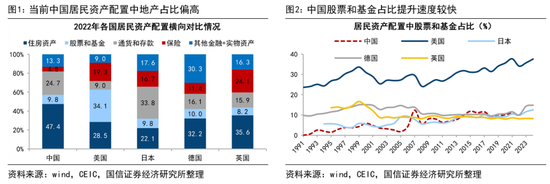
Group 1 - The core conclusion indicates that nearly half of Chinese residents' asset allocation is in real estate, with fixed income increasing significantly over the past 21 years, while equity allocation remains below 10% [1][31] - The historical context shows that from 1982 to 2000, the upgrade of the industrial structure in the U.S. drove a long bull market in U.S. stocks, alongside pension system reforms that shifted residents' asset allocation towards equities, reaching a current equity allocation of 34% [1][31] - Currently, China is in a similar phase to the early 1980s in the U.S., with a gradual shift in residents' asset allocation towards equities, and it is projected that total incremental funds in the A-share market will reach 2 trillion yuan by 2026 [1][31] Group 2 - The current state of Chinese residents' asset allocation shows a high proportion in real estate and a low proportion in equity assets, with real estate accounting for 47% of total assets in 2022, which is higher than the U.S. (29%), Japan (22%), Germany (32%), and the UK (36%) [3][33] - The proportion of equity assets held by Chinese residents has been increasing but remains significantly lower than in developed countries, with stocks and funds accounting for 9.8% of total assets in 2022, compared to 34% in the U.S. [4][34] - Since 2000, the evolution of Chinese residents' asset allocation has transitioned from real estate to fixed income, with expectations of a future tilt towards equity assets [8][36] Group 3 - The evolution of asset allocation in China can be divided into three phases: prior to 2018, where real estate was heavily favored; from 2018 to 2021, where the focus shifted towards standardized assets; and post-2021, where there is a further inclination towards fixed income [10][39] - The period from 2018 to 2021 saw a regulatory shift with the introduction of asset management regulations, leading to a significant increase in the scale of public funds from 12 trillion yuan at the beginning of 2018 to 26 trillion yuan by the end of 2021 [10][39] - Since 2021, the focus has shifted further towards fixed income due to economic challenges, with a notable decline in stock prices and a significant drop in real estate prices [12][41] Group 4 - The historical evolution of U.S. residents' asset allocation provides insights, with a pivotal shift occurring in 1980, driven by structural changes in the economy and pension reforms that encouraged investment in equities [14][43] - The long bull market in U.S. stocks from 1982 to 2000, characterized by a 15.7% annualized return, was supported by favorable macroeconomic policies and technological advancements [14][44] - Pension reforms in the U.S. during the 1980s significantly increased the scale of pension funds, which in turn led to a substantial increase in equity investments, with the share of stocks in pension fund investments rising from 3% in 1980 to 48% by 2000 [17][47] Group 5 - Currently, China's asset allocation is in a slow preparatory phase for a shift towards equities, with incremental changes expected but not a rapid transition [21][50] - The ongoing structural transformation in China's economy and improvements in policy frameworks for long-term capital entering the market are gradually progressing [22][51] - By 2026, it is anticipated that there will be an incremental increase in equity allocation, estimated at 2 trillion yuan, although the impact may be less significant compared to previous years due to the current market conditions [28][58]

早盘速递-20260227
Guan Tong Qi Huo· 2026-02-27 01:42
Group 1: Hot News - Iran-US third - round indirect talks ended. Iran's foreign minister said both sides were close to reaching a consensus in some areas, and technical talks will be held in Vienna next Monday. Oman's foreign minister said the talks "made significant progress", but media reported large differences remain [2] - In January 2026, Chinese - brand passenger cars sold 1.329 million units, a 32.1% month - on - month and 8.9% year - on - year decrease, accounting for 66.9% of the total passenger car sales, with a 1.5 - percentage - point lower share than the same period last year [2] - As of the week ending February 26, rebar production decreased from an increase, factory inventory increased for six consecutive weeks, social inventory increased for eight consecutive weeks, and apparent demand increased from a decrease. Rebar production was 165,100 tons, a 3.10% decrease from last week; apparent demand was 80,540 tons, a 95.68% increase from last week [2] - As of the week ending February 19, US 2025/2026 soybean export net sales were 407,000 tons (798,000 tons the previous week), 2026/2027 net sales were 0 tons (66,000 tons the previous week). US 2025/2026 net sales to China were 76,000 tons (416,000 tons the previous week), 2026/2027 net sales to China were 0 tons (0 tons the previous week) [3] - In January 2026, global alumina production was 13.094 million tons (12.953 million tons in the same period last year, 13.566 million tons in the previous month's revised value). China's alumina production in January was estimated at 7.86 million tons (8.17 million tons in the previous month's revised value) [3] Group 2: Key Focus - Key commodities to focus on are urea, coking coal, alumina, Shanghai copper, and PP [4] Group 3: Night - session Performance - Sector performance: Non - metallic building materials rose 2.00%, precious metals 34.12%, oilseeds 7.68%, coal - coke - steel - ore 9.80%, energy 2.61%, chemicals 10.21%, grains 1.09%, agricultural and sideline products 2.53%, soft commodities 2.78%, and non - ferrous metals 27.18% [4][5] Group 4: Sector Position - The chart shows the changes in commodity futures sector positions in the past five days [6] Group 5: Performance of Major Asset Classes - Equity: Shanghai Composite Index fell 0.01%, SSE 50 fell 0.65%, CSI 300 fell 0.19%, CSI 500 rose 0.35%, S&P 500 fell 0.54%, Hang Seng Index fell 1.44%, German DAX rose 0.45%, Nikkei 225 rose 0.29%, and UK FTSE 100 rose 0.37% [7] - Fixed - income: 10 - year Treasury bond futures fell 0.10%, 5 - year Treasury bond futures fell 0.08%, and 2 - year Treasury bond futures fell 0.03% [7] - Commodities: CRB commodity index fell 0.45%, WTI crude oil rose 0.05%, London spot gold rose 0.33%, LME copper was flat, and Wind commodity index fell 2.90% [7] - Others: US dollar index rose 0.13%, and CBOE volatility index was flat [7] Group 6: Major Commodity Trends - The document presents the trends of various commodities such as the Baltic Dry Index, CRB spot index, WTI crude oil, London spot gold and silver, LME copper, CBOT soybeans and corn, and related ratios like the gold - oil ratio and copper - gold ratio, as well as risk premiums [8]
历史收益率远超近期表现 部分银行理财收益展示反差大,有何影响?
Mei Ri Jing Ji Xin Wen· 2025-12-17 13:47
Core Viewpoint - Some banks are displaying higher annualized returns for their wealth management products than the actual recent returns, leading to concerns about transparency and accuracy in financial reporting [1][3]. Group 1: Discrepancy in Reported Returns - Investors have reported discrepancies between the annualized returns displayed on bank apps and the actual returns, with some banks showing significantly higher returns since the product's inception compared to recent performance [1][2]. - The discrepancy is attributed to a decline in bond market performance, which has affected the recent yields of wealth management products, while historical yields remain elevated due to previous market conditions [1][3]. Group 2: Regulatory and Compliance Issues - Current regulations do not explicitly prohibit banks from showcasing higher historical returns, which may lead to a preference for displaying more favorable figures [1][4]. - The China Banking Association's guidelines emphasize that past performance should accurately reflect the investment manager's capabilities and inform investors, but the current practices may inflate perceived product performance [4]. Group 3: Market Trends and Performance Analysis - The overall trend in fixed-income assets, which form the basis of many wealth management products, is downward, with recent yields significantly lower than historical averages [3][4]. - For instance, the annualized yield for bonds has dropped to 0.46% year-to-date, while the annualized yield over the past three years is 4.90% [3].



冠通期货早盘速递-20251120
Guan Tong Qi Huo· 2025-11-20 06:04
Hot News - The US Bureau of Labor Statistics will not release the October employment report and will incorporate non - farm employment data into the November report. The November report will be released on December 16 [2] - Russian Deputy Prime Minister Novak stated that the latest sanctions from the US and the West have not affected Russia's oil production, and Russia maintains its annual oil production forecast at 510 million tons, adhering to the OPEC+ agreement [2] - As of the week ending November 19, national building material production was 4.4629 million tons, up 100,300 tons from last week; total inventory was 9.0549 million tons, down 490,500 tons; apparent demand was 4.9534 million tons, up 289,100 tons. National hot - rolled coil production was 4.1258 million tons, up 10,900 tons; total inventory was 4.5417 million tons, down 60,600 tons; apparent demand was 4.1864 million tons, up 27,600 tons [2] - According to the UK Telegraph, under a US - proposed conflict - ending plan, Ukraine may be forced to "lease" part of its territory to Russia. The Trump administration's agreement would make Kiev give up control of the eastern Donbass region while retaining legal ownership, and Russia would pay an undisclosed rent for actual control [2] - An East China medium - large recycled lead smelting enterprise's application for renewing the hazardous waste business license was rejected due to incomplete transformation and installation of the MVR facility in its sewage treatment station, not meeting relevant regulations [3] Key Focus - Key commodities to focus on are urea, coking coal, lithium carbonate, industrial silicon, and crude oil [4] Night - session Performance - Non - metallic building materials had a 3.38% increase, precious metals 29.01%, oilseeds and fats 9.93%, non - ferrous metals 23.10%, soft commodities 2.67%, coal - coke - steel - ore 12.74%, energy 2.96%, chemicals 11.02%, grains 1.22%, and agricultural and sideline products 3.97% [4] Position Changes - The document shows the recent five - day position changes of commodity futures sectors, but specific data is not described in text [5] Performance of Major Asset Classes - In the equity market, the Shanghai Composite Index rose 0.18% daily, the SSE 50 rose 0.58%, the CSI 300 rose 0.44%, the CSI 500 fell 0.40%, the S&P 500 rose 0.38%, the Hang Seng Index fell 0.38%, the German DAX rose 0.13%, the Nikkei 225 fell 0.34%, and the UK FTSE 100 fell 0.47% [6] - In the fixed - income market, the 10 - year Treasury bond futures fell 0.06%, the 5 - year fell 0.03%, and the 2 - year fell 0.03% [6] - In the commodity market, the CRB commodity index fell 1.36%, WTI crude oil fell 1.99%, London spot gold rose 0.26%, LME copper rose 0.77%, and the Wind commodity index rose 2.41% [6] - Other assets: the US dollar index rose 0.53%, and the CBOE volatility index remained unchanged [6]
险资配置新动向:加码股票和基金 债券占比环比下降
Zhong Guo Zheng Quan Bao· 2025-11-17 20:08
Core Insights - The insurance sector's asset management balance continues to grow, with an increase in equity investments and a decrease in fixed-income asset allocation [1][2][5] Group 1: Asset Management Overview - As of the end of Q3 2025, the total asset management balance of insurance companies reached 37.46 trillion yuan, marking a year-on-year growth of 16.52% [2] - The balance of life insurance companies was approximately 33.73 trillion yuan, up 16.55% year-on-year, while property insurance companies had a balance of 2.39 trillion yuan, reflecting an 11.79% increase [2] Group 2: Equity Investments - Life insurance companies increased their stock investment balance to 3.41 trillion yuan, a rise of 539.4 billion yuan from the previous quarter, with the proportion of equity investments increasing to 10.12% from 8.81% [2] - Property insurance companies also saw an increase in stock investments, reaching 208.6 billion yuan, up 13.1 billion yuan, with the proportion rising to 8.74% from 8.33% [2] Group 3: Securities Investment Funds - The investment in securities investment funds by life and property insurance companies also increased, with balances of 1.78 trillion yuan and 196.4 billion yuan respectively, reflecting increases of 298.9 billion yuan and 12.7 billion yuan [3] Group 4: Fixed-Income Asset Allocation - Despite fixed-income assets being a primary allocation direction, their proportion has decreased, with total bond investments at 18.18 trillion yuan, accounting for 48.52% of the total asset management balance, down 0.79 percentage points [5] - Life insurance companies' bond investment balance was 17.21 trillion yuan, with a proportion decrease to 51.02% from 51.9% in the previous quarter [5] Group 5: Bank Deposits - Both life and property insurance companies saw a decrease in bank deposit allocations, with balances of 2.49 trillion yuan and 374.2 billion yuan respectively, down 128.3 billion yuan and 30.4 billion yuan [6] Group 6: Future Trends - The insurance industry is expected to continue growing in asset management balance, with a potential increase in equity asset allocation and a shift towards active management strategies [8] - Analysts suggest that the current low-interest-rate environment and the asymmetric reduction in insurance premium rates may lead to a greater focus on equity markets [8]
罕见大资金抄底!单日222亿元涌入ETF
Shang Hai Zheng Quan Bao· 2025-09-29 06:23
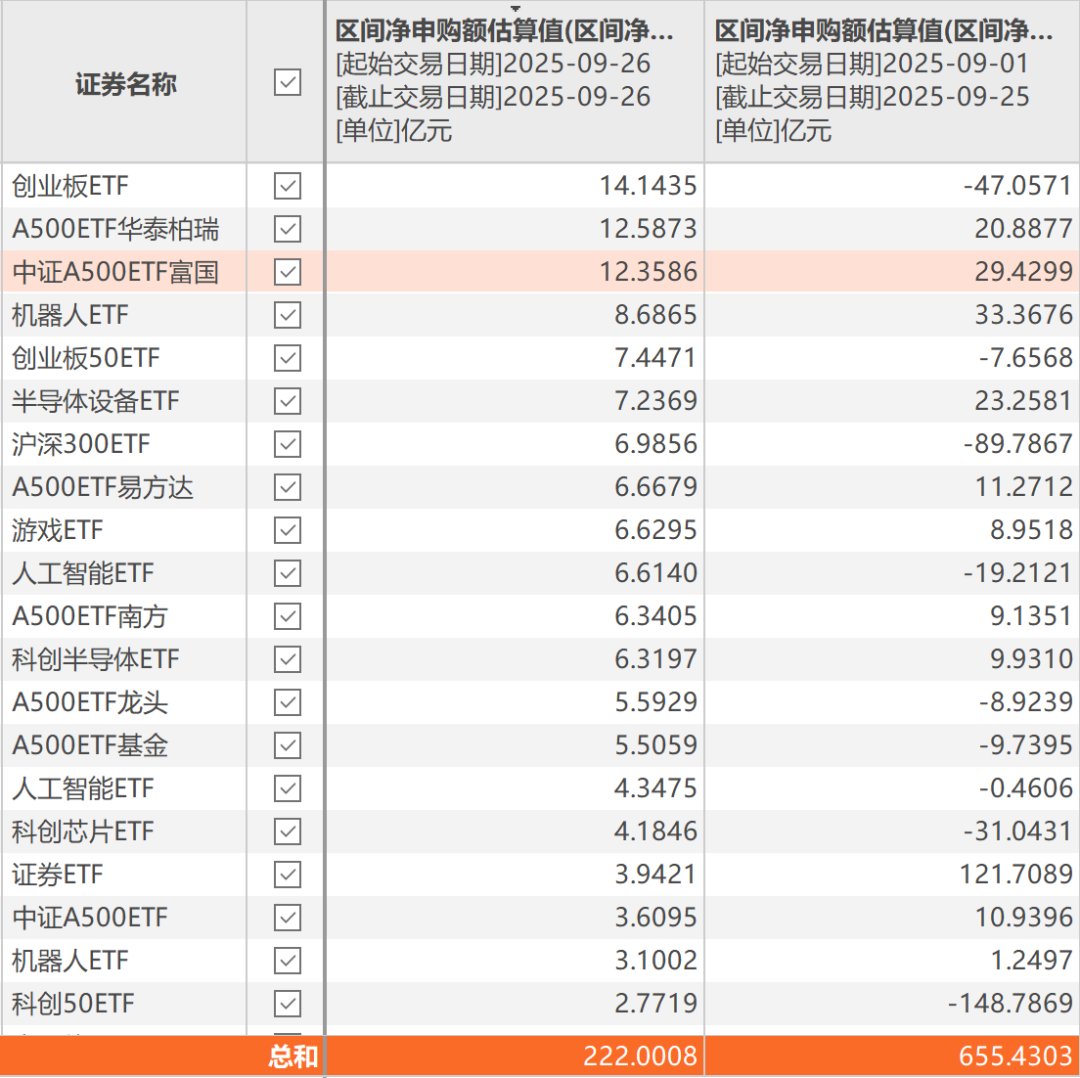
Group 1 - The upcoming National Day and Mid-Autumn Festival holidays have led to increased market focus on the question of "holding cash or holding stocks," with recent ETF subscription and redemption data suggesting a preference for equities [1][2] - On September 26, a total of 222 billion yuan flowed into equity ETFs, marking the highest single-day net subscription in over five months, second only to the 292 billion yuan recorded on April 16 of the same year [3][5] - The inflow of funds was particularly strong in sectors such as semiconductors, Hong Kong stocks, the ChiNext board, and artificial intelligence [1][5] Group 2 - The net subscription amounts for various ETFs on September 26 included over 55 billion yuan for the China A500 ETFs, with individual funds like Huatai-PB and Fuguo's China A500 ETFs each exceeding 12 billion yuan in net subscriptions [4][5] - Other notable ETFs that attracted significant inflows included the E Fund ChiNext ETF with 14.14 billion yuan and the Huatai-PB CSI 300 ETF with 7 billion yuan [5] - The overall trend indicates a shift from previous net outflows, as many investors entered the market to capitalize on perceived bargains during the market adjustment [5] Group 3 - The public fund issuance market has seen a resurgence, with new fund issuance in September reaching 1548.81 billion yuan, a significant increase of over 500 billion yuan compared to August, setting a new monthly record for the year [6][7] - Active equity funds have been particularly popular, with some funds experiencing high subscription rates, such as the招商均衡优选混合基金, which had a subscription confirmation rate of 56.67% despite a 50 billion yuan cap [7] - As of September 26, the average equity fund position was approximately 92.51%, indicating a strong commitment to equity investments as the fourth quarter approaches [7] Group 4 - Looking ahead to the fourth quarter, sectors such as tourism, dining, and entertainment are expected to remain active due to upcoming holidays and promotional events, supported by policies aimed at boosting consumer spending [8] - The A-share and Hong Kong stock markets are showing signs of recovery, with valuations in a reasonable range, which may attract more long-term global capital [8] - Investment opportunities are anticipated in cyclical sectors benefiting from economic recovery, midstream manufacturing, and AI technology driven by industry trends [8]
债券基金持续“上新” 年内近九成斩获正收益
Xin Hua Wang· 2025-08-12 05:47
Core Viewpoint - Bond funds are experiencing significant growth in the public fund market, with a notable increase in new issuances and positive performance for the majority of these funds [1][2]. Group 1: Market Activity - As of December 19, bond funds accounted for approximately 70% of all new fund issuances this year, with nearly 90% of bond funds achieving positive returns [1]. - There are currently 5,882 bond funds in the market, with a total scale exceeding 8 trillion yuan, representing over 30% of the total public fund market [1]. - In December alone, 78 new bond funds have been established, with 20 additional funds from various management companies currently in the application process [1]. Group 2: Performance Analysis - Among the 5,823 bond funds with performance data available, 5,086 funds, or 87.34%, reported positive returns this year [1]. - Seven funds achieved returns exceeding 10%, with the top three being 工银可转债债券 (12.92%), 天弘稳利定期开放A/B (12.18%), and another fund at 11.80% [1]. - Several other funds, including 蜂巢添汇纯债A/C and 诺德汇盈一年定开, also performed well with annual returns above 5% [1]. Group 3: Future Outlook - The bond market is expected to see increased demand for allocation as the year-end approaches, despite a quieter market since November due to concerns over funding market volatility [2]. - Short-term outlook remains optimistic for the bond market, supported by recent central bank actions, while the medium to long-term perspective suggests a continued need to lower social financing costs due to high domestic real interest rates [2].

机构研究周报:中国资产迎来顺风期,低利率后半程增配权益
Wind万得· 2025-03-09 22:29
Group 1: Market Overview - China assets are entering a favorable period, with both global and domestic allocation forces reaching a turning point [3] - Foreign capital is expected to return and focus on undervalued core assets, indicating that the value discovery of low-valued blue-chip stocks may just be beginning [3] - In a low-interest-rate environment, the allocation of financial assets may shift from fixed income to equity, as the worst phase of corporate earnings may have passed [4] Group 2: Sector Insights - The Hong Kong stock market remains more cost-effective compared to A-shares, with potential shifts towards high dividend and public utility stocks due to low government bond yields [5] - The military industry is showing signs of order recovery, with significant orders from listed companies, suggesting a sustainable recovery in the sector [8] - The robotics sector is still in its early development stage, and a rational investment approach of "buying on dips" is recommended [9] Group 3: Macro and Fixed Income - The central bank is unlikely to loosen monetary policy in the short term, as the financial data shows improvements but remains uncertain [13] - Convertible bonds are expected to face supply-demand challenges, and opportunities for investment in equity-like convertible bonds are recommended [14] - Bond yields are anticipated to decline in the second quarter as the economy recovers moderately, with a focus on domestic bond markets [15] Group 4: Asset Allocation - A "barbell strategy" focusing on dividends as a defensive measure and technology as a growth driver is suggested, with the low volatility dividend index showing a yield of 7.42% [17]