央企价值重估

Search documents
央企投资新范式:主题指数基金如何抢占万亿赛道?
Jin Rong Jie· 2025-12-16 07:29
Core Insights - The strategic value of state-owned enterprises (SOEs) is being redefined amid a sluggish global economic recovery and deep domestic economic adjustments, with multiple factors driving SOE investments from traditional valuation logic to a new paradigm [1] - Public funds are rapidly capturing this trend, with the total scale of SOE-related funds exceeding 300 billion yuan in 2023, reflecting a shift in investment logic and strategic positioning [1] - Bosera Fund is leveraging a diversified product system and AI technology to create a differentiated advantage in the SOE value reassessment era [1] Group 1: Policy and Market Dynamics - The dual forces of policy catalysis and industrial upgrading are reshaping the valuation system of SOEs, with the State-owned Assets Supervision and Administration Commission (SASAC) emphasizing market value management [2] - In 2024, SOE assets are projected to exceed 90 trillion yuan, with strategic emerging industry investments reaching 2.7 trillion yuan, marking a 21.8% year-on-year increase [2] - New indices like the CSI SOE Innovation-Driven Index and the CSI National New SOE Modern Energy Index have emerged to cover core assets in technology innovation and green transformation [2][3] Group 2: Product Diversification and Performance - Bosera Fund's SOE Innovation-Driven ETF and Modern Energy ETF have become important tools for investors, offering low thresholds and high liquidity to capture industrial upgrade dividends [4] - The SOE Innovation-Driven ETF has shown impressive performance, with net value growth rates of 2.8%, 40.88%, and 65.29% over the past year, three years, and five years, respectively, all exceeding benchmark returns [5] - The Modern Energy ETF, launched in July 2023, has a clear investment strategy focused on energy and public utility sectors, achieving a net value growth rate of 15.92% since inception [5] Group 3: Investment Philosophy and Technological Integration - Bosera Fund's investment philosophy prioritizes strategic over financial accounting, recognizing the potential for value reassessment in traditional resource factors and the importance of nurturing strategic emerging industries [6] - The firm has initiated AI technology exploration since 2018, establishing an AI laboratory in 2023 to enhance its investment research capabilities across various business functions [7] - The AI-driven investment research engine has achieved significant results, including smart factor allocation and deep learning factor mining, contributing to differentiated alpha generation [7] Group 4: Future Outlook and Commitment - The essence of SOE value reassessment is the capital market's revaluation of the transformation and upgrading of the real economy, with Bosera Fund committed to providing diversified products for investors to share in reform dividends [8] - The firm aims to write a new paradigm for SOE value investment through digital transformation and a long-termism approach, contributing to the high-quality development of SOEs [8]
牛市远未结束!申万宏源王胜最新专访:当很多人担心人工智能泡沫的时候,或许它就还不是真正的“泡沫”
聪明投资者· 2025-11-25 07:04
Group 1 - The core viewpoint emphasizes the necessity of pursuing artificial intelligence regardless of potential bubbles, as it is tied to major power competition [2][26] - The article suggests that while AI stocks in the US may experience significant volatility, a collapse of the AI bubble in the US stock market is unlikely given the current interest rate environment and liquidity conditions [31][30] - The long-term value of gold as an asset is highlighted, with a caution about its phase volatility, especially when leveraged funds amplify fluctuations [2][108] Group 2 - The discussion on the real estate market indicates a "dark before dawn" sentiment, similar to the stock market outlook for the first half of 2024 [2][66] - The article notes that the long-term trend for the RMB is stable with a slight upward bias against the USD, but the USD index remains strong as long as the US economy outperforms other developed nations [2][107] - The analysis of the capital market suggests that the current bull market is far from over, with structural opportunities emerging, particularly in the technology sector [5][6][72] Group 3 - The article discusses the importance of structural solutions to address market issues, emphasizing that all problems are fundamentally structural and should be approached with appropriate methods [9][19] - It highlights the significant changes in the technology sector, particularly the emergence of DeepSeek, which underscores China's technological capabilities and the role of the private sector in innovation [21][23] - The article also points out that the current bull market is supported by solid fundamentals, with a gradual transition towards a comprehensive bull market as structural opportunities develop [40][43] Group 4 - The article addresses the need for a financial strong nation to have a capital market that effectively prices future industries and reduces equity risk premiums [86][92] - It suggests that high-dividend assets still have substantial absolute return potential, with current valuations being attractive compared to historical standards [95][96] - The discussion on the Hong Kong market emphasizes the importance of professional investment strategies for ordinary investors due to its higher volatility and information asymmetry [99]


从“重”走向“轻”:中交地产(000736.SZ)剥离重资产业务,折射行业转型大势
Xin Lang Cai Jing· 2025-08-07 07:11
Core Viewpoint - The real estate industry is undergoing a structural adjustment, with companies shifting from "heavy asset development" to "light asset operation" in response to tightening financing and profit pressures [1][2]. Group 1: Strategic Divestiture - China Communications Real Estate (中交地产) announced a complete divestiture of its loss-making real estate business, focusing instead on property management and asset management, marking a significant shift towards light asset operations [2][3]. - The divested assets are primarily high-debt and cyclical projects, which will alleviate financial pressure and restore net asset safety margins for the company [2][3]. - This strategic move is not merely a reactive measure but a proactive adjustment towards building a sustainable business model, emphasizing the stability and replicability of light asset operations [2][3]. Group 2: Industry Trends - Other real estate companies have also made similar transitions, such as Huayuan Real Estate and Pearl River Shares, indicating a broader industry trend away from heavy asset models due to declining market risk appetite and stricter policy guidance [3]. - Companies that have shifted focus to light asset operations have generally experienced valuation recovery, with property management firms like China Merchants Jinling and Nandu Property showing significantly higher price-to-earnings ratios compared to traditional real estate developers [3]. Group 3: Central Enterprise Value Reassessment - As a subsidiary of China Communications Group, 中交地产 will operate its light asset business under the "China Communications Service" brand, leveraging the central enterprise's resource synergies [4]. - The company is expected to gain more opportunities for managing core assets due to the group's strategic positioning in major cities and transportation sectors [4]. - Unlike private property management firms that often expand in a scattered manner, central enterprise platforms emphasize resource integration, providing a higher starting point for operational space and project development [4]. Group 4: Conclusion - The divestiture of heavy assets is not a retreat but a repositioning for future growth, as companies like 中交地产 actively adjust to provide new valuation paradigms in the capital market [5]. - The transition to light asset operations is expected to improve financial conditions and operational efficiency, while also offering new growth potential for listed platforms [5]. - In the ongoing pursuit of high-quality development in the real estate sector, light asset operation platforms with central enterprise backgrounds and resource integration capabilities will become new focal points in the market [5].

构建央企投资新范式,博时助力把握央企价值重估新机遇
Xin Lang Ji Jin· 2025-07-04 03:07
Group 1: Core Insights - The strategic value of state-owned enterprises (SOEs) is being redefined amid a sluggish global economic recovery and deep domestic economic adjustments [1] - Public funds are rapidly increasing their investment in SOEs, with the total scale of SOE-related funds exceeding 300 billion yuan in 2023 [1] - The investment logic is shifting from single low valuation to a dual drive of high dividends and hard technology [1] Group 2: Policy and Industry Trends - The dual forces of policy catalysis and industrial upgrading are reshaping the valuation system of SOEs, with a projected asset scale of central enterprises exceeding 90 trillion yuan in 2024, a 5.9% year-on-year increase [2] - Strategic emerging industry investments reached 2.7 trillion yuan in 2024, marking a 21.8% increase and surpassing 40% of total investments for the first time [2] - New index tools like the CSI Central Enterprise Innovation-Driven Index and the CSI National New Central Enterprise Modern Energy Index have emerged to cover core assets in technology innovation and green transformation [2][4] Group 3: Fund Performance and Strategy - The CSI Central Enterprise Innovation-Driven Index has a 12-month dividend yield of 3.59%, outperforming several major indices [3] - The CSI National New Central Enterprise Modern Energy Index has shown superior performance and risk-return ratios compared to major broad-based indices since its inception [4] - The BoShi Fund's Central Enterprise Innovation-Driven ETF has achieved net value growth rates of 4.06%, 19.89%, and 66.24% over the past year, three years, and five years, respectively, all exceeding benchmark returns [5] Group 4: Investment Philosophy and AI Integration - BoShi Fund emphasizes a "strategic account prioritizing financial account" investment philosophy, recognizing the potential for value re-evaluation of traditional resource factors [8] - The company has initiated AI technology exploration since 2018, establishing an AI laboratory in 2023 to enhance its investment research capabilities [9] - AI-driven investment research is expected to create differentiated alpha factors and improve investment decision-making accuracy [10]
央企控股上市公司强化市值管理 年内回购增持实施金额逾160亿元
Zheng Quan Ri Bao· 2025-06-12 16:41
Core Viewpoint - Central enterprises are actively engaging in share buybacks and shareholder increases to enhance investor confidence and stabilize market value, with a total of 160.62 billion yuan in buybacks and increases reported as of June 12 [1][2]. Buyback and Shareholder Increase Overview - As of June 12, 65 central enterprise-controlled listed companies have conducted buybacks totaling 86.72 billion yuan, while 53 companies have seen shareholder increases amounting to 73.9 billion yuan [1]. - Among the buybacks, 15 companies have exceeded 1 billion yuan, with China COSCO Shipping Holdings and Hikvision each surpassing 10 billion yuan [2]. - The primary purposes of buybacks include equity incentive cancellations (40 companies), market value management (19 companies), and employee stock ownership plans (6 companies) [2]. Market Value Management - The increase in buybacks for market value management indicates a shift in strategy among central enterprises, moving from passive compliance to proactive market confidence maintenance [3]. - The China Securities Regulatory Commission and the State-owned Assets Supervision and Administration Commission have encouraged companies to adopt regular buyback mechanisms to reflect investment value accurately [3]. Shareholder Increases - In 2023, 25 central enterprise-controlled companies have seen shareholder increases exceeding 1 billion yuan, with China Jushi and its major shareholders contributing 16.09 billion yuan [4]. Implementation of Plans - A significant number of buyback and shareholder increase plans were announced in April, with 27 companies initiating buyback plans and 39 companies announcing 55 shareholder increase plans [5]. - The implementation of these plans is progressing, with some companies already completing their buyback and increase actions [6].


2024年报业绩盘点:大盘蓝筹业绩稳健,AI点燃电子板块增长引擎
Di Yi Cai Jing· 2025-04-27 06:46
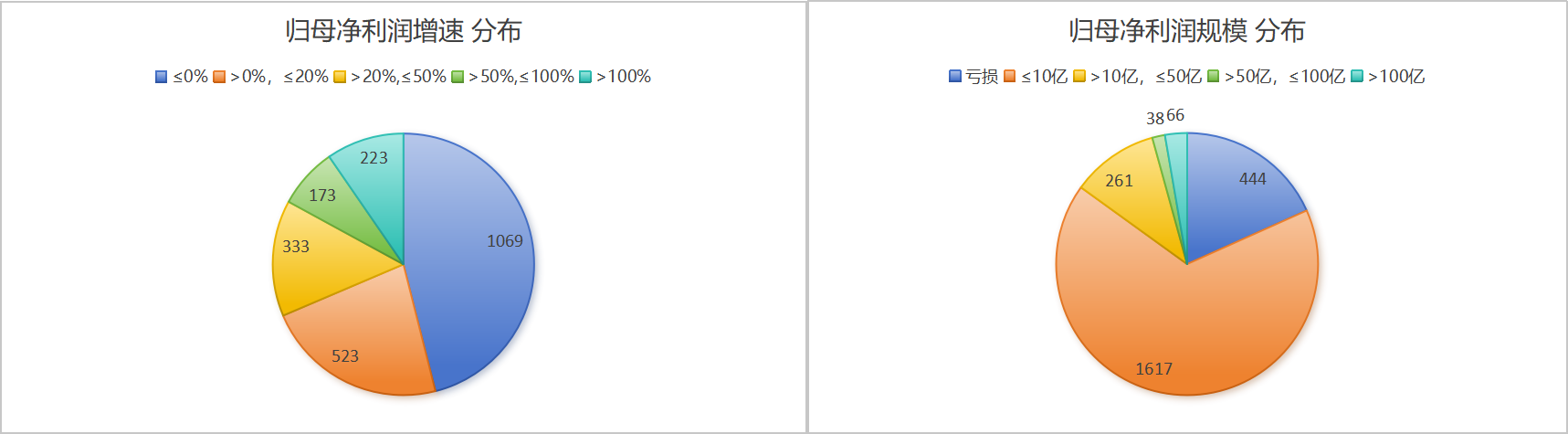
Core Insights - A-share listed companies are showing resilience in 2024 performance, with strong growth in key industries and leading enterprises, driven by technological innovation and consumption recovery [1][2] Group 1: Overall Market Performance - As of April 15, 2024, 2,426 A-share companies reported a total net profit of 4.64 trillion yuan, a year-on-year increase of 5.3% [1] - Over 700 companies achieved net profit growth exceeding 20%, while approximately 223 companies doubled their profits [2] - The Shanghai Stock Exchange 50 Index companies reported a combined net profit of 2.41 billion yuan, with a year-on-year growth of 10.65% [4] Group 2: Sector Performance - The agriculture, forestry, animal husbandry, fishery, non-bank financial, electronics, automotive, and transportation sectors all experienced over 20% year-on-year profit growth in 2024 [1] - The SW electronics sector saw a revenue increase of 20.57% and a net profit increase of 31.07% in 2024, driven by AI technology [7] - The SW automotive sector reported a revenue growth of 17.25% and a net profit growth of 26.82%, with companies like BYD and Seres leading the charge [10] Group 3: Key Company Highlights - Leading PCB supplier Shengyi Electronics reported a revenue growth of 42.2% and a net profit growth of 1,428% in 2024 [8] - Major consumer electronics companies such as GoerTek and Longying Precision achieved net profit growth of 144.9% and doubled their profits [9] - Companies like Midea Group and Haier Smart Home reported net profit growth of 14.3% and 12.9%, respectively, with Haier's overseas revenue reaching 50% of total revenue [11]