存力

Search documents
中信证券:存算上下文长度激增 显存优化不改存力爆发需求
智通财经网· 2026-03-31 01:59
Core Insights - The report from CITIC Securities highlights the optimistic outlook for the storage and computing industry in the Agent AI era, emphasizing the increasing demand for storage capacity and the ongoing shortage of mainstream to niche storage products, with price increases expected to continue until at least the end of 2027 [1] Group 1: Storage Demand and Capacity Challenges - The transition of AI from "simple dialogue" to "agents" has led to a dramatic increase in context demand, with the maximum context window growing approximately 30 times annually since mid-2023, resulting in significant increases in memory requirements [1] - The effective usage length of models has improved rapidly, with some benchmarks showing over 250 times improvement in the past nine months, while the single-card HBM capacity has only increased by about 3-4 times over three years [1] - The exponential growth in memory demand versus the slower increase in HBM capacity and costs necessitates memory optimization, which is crucial for the further development of Agent AI [1] Group 2: Solutions to Storage Bottlenecks - Major model and hardware manufacturers are addressing storage bottlenecks through quantization, hierarchical storage, and model architecture optimization [2][3] - Quantization, such as Google's TurboQuant, is a widely adopted method for memory compression, significantly reducing memory usage compared to previous standards [2] - Hierarchical storage solutions, like NVIDIA's ICMS platform, enhance GPU utilization and improve throughput by optimizing KV Cache, achieving a fivefold increase in efficiency [2] - Model architecture innovations, such as GQA/MQA and MLA, are designed to reduce KV Cache memory usage, addressing the memory bottleneck effectively [3] Group 3: Future Trends in Storage Demand - The ongoing trend of memory optimization is expected to drive increased demand for storage in the Agent AI era, as improved algorithm efficiency lowers the cost of generating tokens, leading to higher concurrency and longer contexts [4] - The concept of "Token Factory Economics" presented at NVIDIA's GTC 2026 emphasizes the strategic importance of storage in AI infrastructure, suggesting that storage metrics will become central to system upgrades and capital investments in AI [4]


电子2026年度策略:算力闭环加速,重塑价值新锚点
GOLDEN SUN SECURITIES· 2026-03-25 12:24
Investment Rating - The report maintains a "Buy" rating for the semiconductor and related sectors, indicating a positive outlook for investment opportunities in these industries [5]. Core Insights - The report emphasizes the transformative impact of AI on various sectors, particularly in storage, PCB, and semiconductor equipment, highlighting a shift towards a new growth era driven by AI and domestic production [1][2][3][4]. Storage Sector - The storage industry is entering a new growth phase, driven by AI, with companies like Nanya Technology showing significant performance improvements due to rising DDR4 prices [1]. - The demand for high-quality storage components is expected to increase, benefiting manufacturers that can secure stable supplies amid tight market conditions [1]. PCB Sector - The PCB industry is experiencing a new wave of capital expenditure driven by AI hardware architecture and performance upgrades, with expectations of sustained high demand in 2026 [2]. - New technologies and solutions are emerging, pushing the PCB materials segment into the M9 and M9+ era, which will be crucial for industry growth [2]. Domestic Computing Power - The domestic AI chip market is projected to grow significantly, with a forecasted market size of 153 billion yuan by 2025, reflecting a compound annual growth rate (CAGR) of 53% from 2020 to 2025 [3]. - The report identifies a strong upward trend in demand, policy support, and technological advancements as key drivers for investment in domestic computing power chips [3]. Semiconductor Equipment - The semiconductor equipment market is expected to reach $145 billion in sales by 2026, with domestic manufacturers gaining ground in high-end equipment due to favorable policies and external pressures [4]. - The report highlights the rapid growth of domestic semiconductor equipment companies, with a CAGR of 42% from 2020 to 2024, significantly outpacing market growth [4]. Semiconductor Materials - The global semiconductor materials market is projected to grow from $43.3 billion in 2015 to $67.5 billion in 2024, with China's market expanding at a faster rate [7]. - Domestic semiconductor material manufacturers are expected to benefit from increased wafer production capacity and a growing demand for localized supply chains [7]. Semiconductor Components - The domestic semiconductor components market is forecasted to grow from 76.54 billion yuan in 2020 to 160.52 billion yuan in 2024, with a CAGR of 20.3% [8]. - The report emphasizes the need for increased localization of components to ensure supply chain security amid geopolitical tensions [8]. Packaging and Testing - The packaging and testing sector is expected to see increased utilization rates and price hikes due to high demand for advanced packaging solutions [9]. - The report notes that the CoWoS technology is becoming increasingly critical in the AI chip market, with domestic manufacturers poised to capitalize on this trend [9]. Foundry Services - The foundry sector is experiencing a structural shortage in 8-inch capacity, with price increases anticipated in early 2026 due to strong AI demand [10]. - Major players like TSMC are expected to see robust performance driven by AI and consumer electronics, with a projected capital expenditure increase [10]. Digital IC - The digital IC sector is witnessing a growth cycle, with revenues reaching 52.6 billion yuan in Q3 2025, reflecting a year-on-year increase of 35% [11]. - The report highlights the acceleration of domestic replacements in the CIS and SoC segments, driven by AI and IoT applications [11]. Passive Components - The passive components market is projected to grow significantly, driven by AI and automotive applications, with demand for specific components like MLCC expected to surge [14]. - The report indicates a structural price increase in the passive components sector, influenced by rising costs and demand from new applications [14]. Display Panels - The display panel market is showing signs of recovery, with price increases expected as demand stabilizes ahead of major promotional events [15]. - Domestic manufacturers are exploring new growth avenues, such as perovskite technology, to enhance their competitive edge [15]. Power Components - The report highlights the increasing power demands of AI servers, necessitating advancements in power density and efficiency, with wide bandgap semiconductors like SiC and GaN becoming critical [16][17]. - The market for GaN is expected to grow significantly, driven by applications in consumer electronics and data centers [17]. Consumer Electronics - The consumer electronics sector is entering a new innovation cycle, with AI integration expected to drive growth in high-end markets [18]. - Key developments include the launch of AI-enabled devices and advancements in foldable technology, which are anticipated to boost market penetration [18].
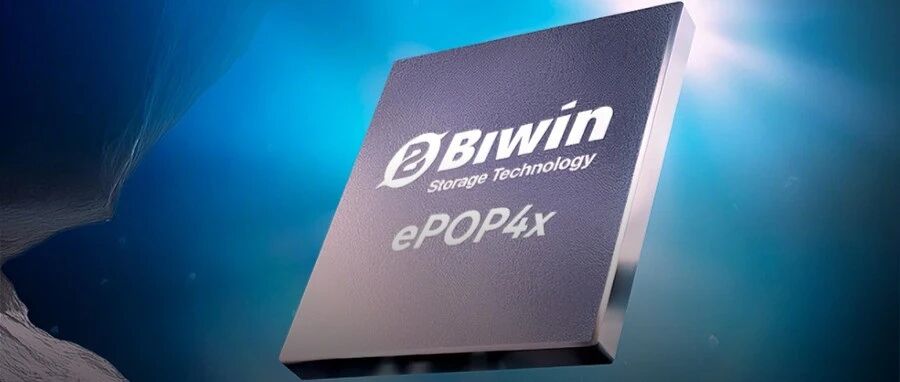
佰维存储:AI存力时代,站在需求、产品和封装的交汇点上
市值风云· 2026-03-22 07:15
Core Viewpoint - The article emphasizes the transition of the storage industry from being labeled as a "cyclical stock" to evolving into high-value system-level comprehensive storage solution providers, driven by the increasing importance of storage in AI applications [1][3]. Industry Overview - The storage sector has shown strong performance recently, with Micron announcing the mass production of HBM4 for NVIDIA's Vera Rubin platform, and TrendForce revising upward its price expectations for DRAM and NAND in Q1 2026, indicating a robust market outlook [4][8]. - The storage industry is entering a high prosperity cycle in 2026, driven by AI computing power and domestic substitution, leading to continuous price increases for DRAM and NAND due to supply shortages [7][18]. Company Performance - Baiwei Storage (688525.SH) reported a significant increase in revenue and profit for 2025, with operating income reaching 11.3 billion yuan, a year-on-year growth of 68.8%, and net profit attributable to shareholders of 850 million yuan, up 429.1% [5][6]. - For the beginning of 2026, Baiwei expects to achieve operating income between 4.0 billion to 4.5 billion yuan, representing a year-on-year growth of 340.0% to 395.0%, and net profit between 1.5 billion to 1.8 billion yuan, an increase of 921.8% to 1086.1% [5][6]. Product and Market Strategy - Baiwei is not only benefiting from price increases but also from product structure optimization, with emerging AI-related products contributing significantly to revenue [7][12]. - The company has positioned itself in the AI edge market, with its ePOP series products being utilized by major companies like Meta, Google, and Xiaomi for AI/AR glasses and smart wearables [12][14]. - Baiwei's strategy includes expanding its presence across multiple sectors, including mobile, PC, enterprise storage, and smart automotive, indicating a broad market approach rather than focusing solely on edge applications [16][17]. Future Outlook - The company is investing in advanced packaging and testing capabilities, aiming to integrate storage solutions with advanced packaging to enhance its competitive position in the AI era [22][24]. - The shift from standalone storage devices to integrated system components is highlighted as a key trend, with companies that can effectively combine storage and computing likely to gain a competitive edge in AI applications [25][26]. - Baiwei's growth narrative is evolving from merely capitalizing on cyclical market trends to establishing itself as a comprehensive storage solution provider that understands both product and integration needs in the AI landscape [32].


行业周报:token出海利好国产算力,海力士打响扩产第一枪-20260301
KAIYUAN SECURITIES· 2026-03-01 11:01
Investment Rating - The industry investment rating is "Overweight" (maintained) [1] Core Insights - The report highlights a significant increase in AI computing power demand driven by ongoing updates in large models, with expectations of total computing expenditure reaching $600 billion by 2030 [5] - The semiconductor sector is experiencing a positive outlook, with major companies like SK Hynix planning to increase production to meet global data center demands [6] - The A-share technology market is showing strength, with notable gains in the electronics sector, particularly in semiconductor and consumer electronics [4] Market Review - The international situation has impacted overseas markets, leading to a decline, while domestic technology stocks have shown significant growth. The electronics industry index rose by 4.02%, semiconductors by 2.18%, consumer electronics by 3.00%, and optical electronics by 4.19% during the week [3] - Major overseas tech stocks experienced mixed results, with notable gains in application optics, which surged by 62.98% [3] Industry Updates - Major smartphone manufacturers are expected to collectively raise prices, with Apple set to launch new products on March 4, including at least five new devices [4] - Collaboration in computing power is strengthening, with Meta and AMD signing a long-term agreement to deploy up to 6GW of GPUs [5] - SK Hynix announced plans to significantly increase HBM production and has initiated a global standardization strategy for next-generation memory solutions [6] Investment Recommendations - The report recommends stocks such as Jiangfeng Electronics, Tuojing Technology, Huyuan Technology, and Shenghong Technology as key investment targets, while suggesting stocks like Cambricon, Jingce Electronics, and Changchuan Technology as beneficiaries [6]

聚辰股份正式递表港交所,是中国唯一全系列车规级EEPROM芯片供应商
Ju Chao Zi Xun· 2026-01-27 02:47
Group 1 - The company, Juchen Semiconductor Co., Ltd., has officially submitted its application to the Hong Kong Stock Exchange, with CICC as the joint sponsor [2] - Juchen Semiconductor is a leading global designer of high-performance non-volatile storage chips, focusing on meeting the storage demands of the AI era with products such as SPD chips, EEPROM, NOR Flash, and mixed-signal chips [2] - According to Frost & Sullivan, Juchen Semiconductor is the number one EEPROM supplier in China and the second largest DDR5 SPD chip supplier globally by revenue for 2023 and 2024 [2][3] Group 2 - The company has a strong R&D capability and market position in various product segments, being the third largest EEPROM supplier globally and the first in China for 2023 and 2024 [3] - Juchen Semiconductor has established deep cooperation with a leading global memory interconnect chip supplier for DDR5 memory interface solutions, positioning itself as a core supplier for major memory companies [3] - The company is set to become the only Chinese supplier offering a full range of automotive-grade EEPROM chips by the end of 2025 [3] Group 3 - Juchen Semiconductor is actively expanding its product lines, including the development of VPD chips for next-generation high-performance storage devices, collaborating with leading storage manufacturers [4] - The company's automotive-grade storage chips meet AEC-Q100 A1-A2 standards and are widely used in various automotive systems, including visual perception and intelligent cockpit applications [4] - The deep cooperation model established by the company creates natural customer barriers and long-term binding advantages, as automotive-grade certification typically requires a lengthy verification process [4]

行业周报:台积电计划新建4座先进封装设施,CPU、存储、封测涨价
KAIYUAN SECURITIES· 2026-01-25 07:45
Investment Rating - The industry investment rating is "Overweight" (maintained) [2] Core Insights - The electronic industry index experienced a weekly change of +1.58%, with semiconductors rising by 2.7% and consumer electronics declining by 1.4% [4] - TSMC plans to build four advanced packaging facilities to enhance backend capacity, driven by strong demand for AI [6] - The AI hardware market is expected to see a surge in product launches, including OpenAI's AI audio headphones with projected shipments of 40-50 million units in the first year [5] Market Review - The semiconductor sector is witnessing a significant increase in demand, with TSMC's 3nm capacity fully booked until 2027 due to AI demand [6] - Major storage companies are entering a price increase cycle as they face unprecedented chip shortages, with Micron indicating that its HBM orders for 2026 are already filled [5] - The import value of key semiconductor equipment in China reached 15.5 billion yuan in December 2025, marking a 244% month-on-month increase [6] Industry Developments - AI infrastructure is rapidly developing, with domestic GPU manufacturers accelerating their self-sufficiency processes [5] - Companies like SK Hynix and Kioxia have reported that their chip and flash memory production capacities for 2026 are already sold out, exacerbating NAND supply pressures [5] - The Nasdaq index saw a slight decline of 0.06% this week, while notable gains were observed in companies like SanDisk (+14.56%) and AMD (+12.01%) [4]



春季行情火力全开!英伟达新架构+存储大幅涨价,半导体设备、材料等上游国产替代加速
Jin Rong Jie· 2026-01-12 02:48
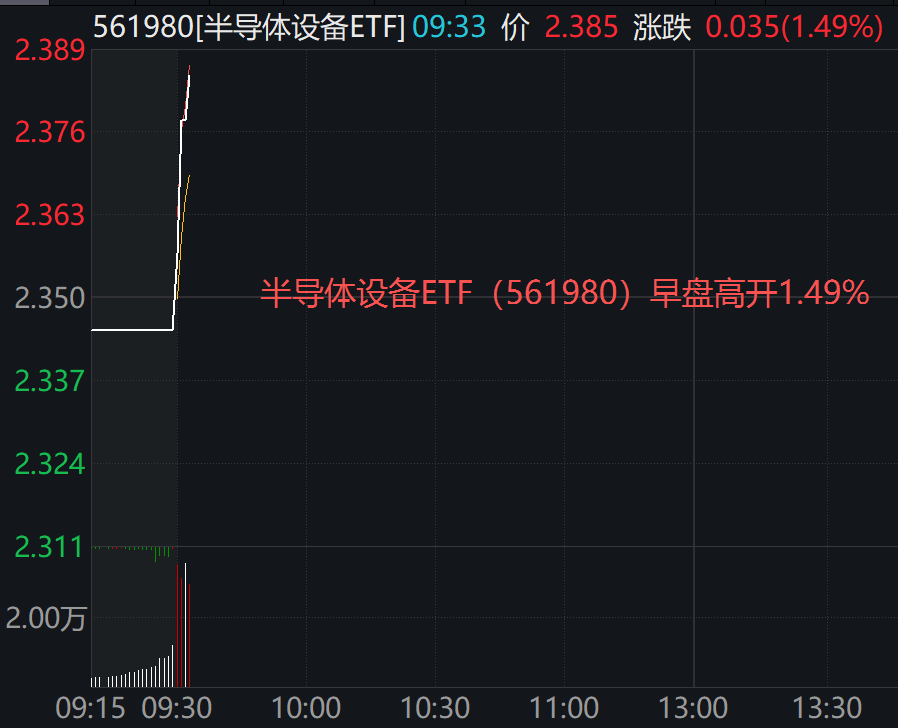
Core Viewpoint - The global semiconductor market is expected to strengthen in 2026, driven by AI demand and domestic substitution, with a notable increase in semiconductor equipment and materials [1] Group 1: Semiconductor Equipment and ETF Performance - The semiconductor equipment ETF (561980) opened up by 1.15% on January 12, with a net inflow of nearly 100 million yuan over the past two trading days [1] - The index tracked by the semiconductor equipment ETF has risen over 15% this year, outperforming mainstream semiconductor indices [3] - Key stocks such as Zhongwei Company and Cambrian have seen significant gains, with Zhongwei up nearly 4% and Jianghua Micro up over 5% [3] Group 2: Market Trends and Price Increases - A significant increase in trading volume in A-shares has initiated a spring market rally, with semiconductor equipment leading the upward trend [5] - International storage giants are expected to raise server DRAM prices by 60% to 70% in Q1 2026 compared to Q4 2025 [6] - SanDisk has proposed a unique supply contract requiring 100% cash prepayment from clients to secure storage chip allocations for 1 to 3 years [6] Group 3: Domestic Substitution and Material Demand - The domestic substitution process for semiconductor materials is advancing, with a recent anti-dumping investigation into dichlorodihydrosilane (DCS) from Japan, a key electronic chemical material [6] - The demand for semiconductor materials and electronic chemicals is expected to rise due to AI data centers and the urgent need for low-latency, high-bandwidth memory solutions [7] - The global semiconductor materials market is projected to reach approximately $70 billion by 2025, with a 6% year-on-year growth [7] Group 4: Industry Outlook and Key Players - The trend of "supply security + domestic substitution" for critical semiconductor materials is strengthening amid rising security concerns [8] - Companies with technological accumulation and capacity in high-end materials are likely to see market share and profit growth as advanced processes and domestic substitution trends continue [8] - The semiconductor equipment ETF focuses on leading companies in the sector, with over 90% of its holdings in the high-tech, high-value upstream and midstream areas of the semiconductor industry [8]
国产存储、GPU龙头上市潮,利好晶圆制造/设备
Zhong Guo Neng Yuan Wang· 2026-01-05 01:26
Market Overview - The electronic industry index decreased by 0.19% during the week of December 29, 2025, to January 2, 2026, with semiconductors down 0.20% and consumer electronics down 0.14%, while optical and optoelectronic sectors increased by 1.60% [1][2] - Hong Kong stocks rebounded strongly on January 2, 2026, with SMIC rising by 5.70% and Hua Hong Semiconductor increasing by 13.79% [1][2] - The US stock market showed slight recovery on January 2, 2026, with the Nasdaq down 1.52% for the week and the Hang Seng Tech index up 4.31%. The US storage sector saw significant gains, with SK Hynix up 13.02%, Micron up 10.80%, and SanDisk up 10.07% [1][2] Industry Updates - The upcoming CES 2026 will take place from January 6 to January 9, 2026, and for the first time, the national subsidy will include smart glasses, providing a 15% subsidy based on the product sales price [3] - Domestic GPU companies are preparing for a listing wave in Hong Kong, with Kunlun Core announcing its listing application on January 1, 2026. On January 2, 2026, Biren Technology listed in Hong Kong with a maximum increase of over 118% on its first day [4] - Samsung will not expand production of DDR4, leading to a significant increase in DDR4 spot prices, which are expected to continue rising in 2026. Changxin Technology's IPO has been accepted, aiming to raise 29.5 billion, with projected revenues of 55 to 58 billion for 2025 [4] Corporate Actions - Hua Hong Semiconductor announced plans to acquire 97.4988% of Huali Micro on December 31, 2025. TSMC is expected to raise advanced process prices for the next four years due to tight capacity below 3nm, with new pricing effective from January 1, 2026 [5] Investment Recommendations - The holiday period has seen favorable conditions for price increases and computing power, with recommended beneficiaries including SMIC, Hua Hong Semiconductor, Beijing Junzheng, Northern Huachuang, Zhongwei Company, Demingli, Shannon Chip Creation, and Zhaoyi Innovation [6]


行业周报:国产存储、GPU龙头上市潮,利好晶圆制造、设备-20260104
KAIYUAN SECURITIES· 2026-01-04 11:43
Investment Rating - The industry investment rating is "Overweight" (maintained) [1] Core Views - The semiconductor equipment, storage, and PCB markets are active, with a notable rebound in Hong Kong stocks on January 2, 2026 [4] - The storage and chip price increase trend is expected to continue, with a wave of domestic GPU listings ongoing [5] - Samsung will not expand DDR4 production, leading to a significant increase in DDR4 spot prices, while the IPO of Changxin Technology has been accepted [6] Summary by Sections Market Review - The electronic industry index fell by 0.19% during the week of December 29, 2025, to January 2, 2026, with semiconductor and consumer electronics down by 0.20% and 0.14% respectively, while optical and optoelectronic sectors rose by 1.60% [4] - Notable stock performances include a 5.70% increase for SMIC and a 13.79% increase for Hua Hong Semiconductor on January 2, 2026 [4] Industry Updates - The CES 2026 is approaching, with the first national subsidy for smart glasses set at 15% of the product sales price [5] - Domestic GPU companies are actively listing in Hong Kong, with Kunlun Chip announcing its listing application on January 1, 2026 [5] - The price of DDR4 is expected to rise as Samsung will not increase production, while Changxin Technology's IPO aims to raise 29.5 billion [6] Investment Recommendations - Beneficiaries of the price increase chain and computing power side include SMIC, Hua Hong, Beijing Junzheng, Northern Huachuang, Zhongwei, Demingli, Shannon Chip, and Zhaoyi Innovation [7]
【国信电子胡剑团队|2026年年度策略】从星星之火到全面燎原的本土硬科技收获之年
剑道电子· 2025-12-31 02:45
Core Viewpoint - The article emphasizes that 2026 is expected to be a year of significant harvest for domestic hard technology in the electronics industry, driven by advancements in AI and a consensus on performance trends within the AI industry chain [3][7]. Group 1: AI Industry Trends - The AI industry is transitioning from divergence to consensus in performance trends, with a notable recovery since the second half of 2023, marked by the return of Huawei's Mate series [3][7]. - The electronics sector has experienced a significant valuation expansion, aided by the rapid growth of passive funds and the resonance of macro policy, inventory cycles, and AI innovation cycles [3][7]. - As of December 16, 2025, the electronics sector has risen by 40.22%, ranking third among all industries [7][16]. Group 2: AI Model Evolution - The evolution of AI models is characterized by innovations in architecture, such as the mixture of experts (MoE) framework, which enhances efficiency by reducing computational load [27]. - The emergence of large models, like OpenAI's GPT-4, showcases the correlation between model size and performance, leading to significant advancements in understanding and reasoning capabilities [27]. - The demand for improved model efficiency has led to innovations in attention mechanisms, which lower computational complexity and memory requirements [27][28]. Group 3: Computing Power and Storage - The domestic chip industry is actively updating and iterating, with companies like Huawei planning to launch new chips in 2026, while the storage sector is expected to face shortages and price increases throughout the year [9]. - The demand for AI-driven storage solutions is projected to increase, with DRAM bit demand expected to rise by 26% year-on-year in 2026, driven by AI applications [9]. Group 4: Power and Connectivity - The optimization of data transfer and communication within servers is becoming a critical breakthrough for enhancing computing power, with the global high-speed interconnect chip market expected to reach $21.2 billion by 2030 [11]. - The increasing power consumption of data center chips necessitates advancements in power supply architectures, with a shift towards high-density power solutions [11]. Group 5: Semiconductor Industry - The semiconductor sector is anticipated to benefit from a recovery in demand, with a focus on domestic manufacturing and the rise of analog chips, which are expected to see increased adoption due to their potential for localization [12]. - The global semiconductor market is projected to achieve double-digit growth for three consecutive years from 2024 to 2026, driven by advancements in AI and domestic chip design [12][14].