
家电出口

Search documents
中国机电产品进出口商会:“十四五”期间中国家电年出口规模突破千亿美元
智通财经网· 2026-02-11 13:25
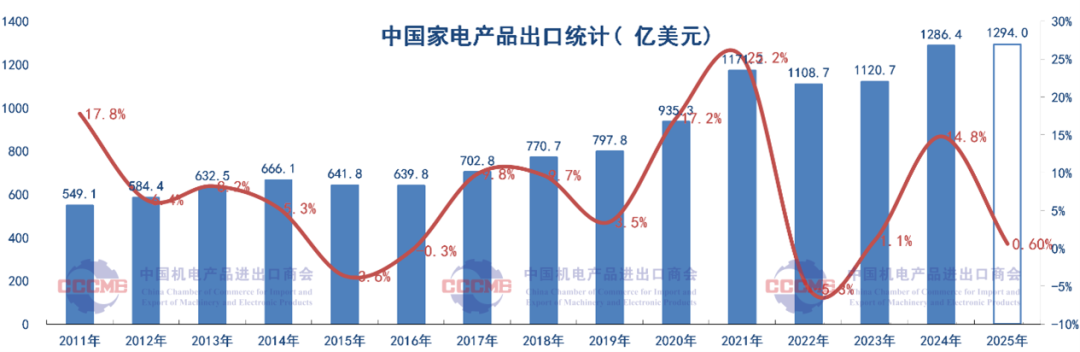
Core Insights - The report by the China Chamber of Commerce for Import and Export of Machinery and Electronic Products indicates that during the "14th Five-Year Plan" period, the overall export scale of China's home appliance industry has grown, entering a phase of high-quality exports. The export scale of home appliances is projected to increase from $93.5 billion in 2020 to $129.4 billion by 2025, achieving a compound annual growth rate (CAGR) of approximately 6.7% [1][4]. Group 1: Export Scale and Growth - The export scale of home appliances during the "14th Five-Year Plan" has surpassed $100 billion, becoming the third category of electromechanical products to do so after integrated circuits and electronic consumer goods [1][4]. - The CAGR of home appliance exports during this period is lower than the 7.8% growth rate during the "13th Five-Year Plan" and is on par with the growth rate of the "12th Five-Year Plan" [1][4]. Group 2: Market Dynamics and Challenges - The international trade environment has become increasingly complex, with trade protectionism impacting the industry. Despite these challenges, Chinese home appliance companies have maintained a focus on globalization, innovation, and brand development, acting as a stabilizer and mainstay in the foreign trade sector [1][7]. - The export volume experienced significant fluctuations, with a notable 25% increase in 2021 due to the demand from the home economy. However, a decline was observed in 2022 due to post-pandemic demand drop and geopolitical conflicts [7][8]. Group 3: Market Diversification - The primary growth regions for home appliance exports have shifted from Europe and North America to emerging markets such as ASEAN, the Middle East, Latin America, and countries along the "Belt and Road" initiative, with double-digit CAGR in these areas [8][9]. - The share of U.S. imports of Chinese home appliances has decreased from 36% in 2020 to 23% in 2025, with a significant drop in exports to the U.S. in 2025, particularly a 42.5% decline in May [9][12]. Group 4: Product Innovation and Structural Upgrades - The pace of innovation in the home appliance sector has accelerated, with a shift from traditional OEM models to ODM and OBM, reflecting a structural upgrade in export products [18][22]. - The CAGR for major appliances (5.7%), environmental appliances (8.1%), and personal care products (6.8%) has outpaced that of lifestyle appliances (3.6%) and kitchen small appliances (3.7%) [18][19]. Group 5: Specific Product Trends - The export volume of air conditioning products is projected to grow from 62.1 million units in 2020 to 82.3 million units by 2025, driven by increased demand due to global climate change [21]. - The export volume of washing machines (under 10 kg) is expected to grow at a CAGR of 10.6%, with the share of drum-type machines increasing from 40% in 2020 to 55% in 2025 [21][22].

出口链:2025M12家电出口持续承压,吸尘器、电视+14、+5%
Tai Ping Yang Zheng Quan· 2026-01-22 00:25
Investment Rating - The overall industry investment rating is neutral, indicating that the expected return over the next six months is between -5% and 5% relative to the CSI 300 index [10] Core Insights - The household appliance industry experienced a single-digit decline in export value of 7% in December 2025, with specific categories like vacuum cleaners, washing machines, and refrigerators showing growth [4][8] - White goods such as refrigerators and washing machines achieved stable growth of 4% each, while air conditioners and fans faced significant demand pressure with declines of 20% and 28% respectively [4][8] - In the black goods and smart projection segment, projectors saw a double-digit decline of 13%, while the growth rate for LCD TVs turned positive at 5% [4][8] - Kitchen appliances and electrical lighting faced challenges, with range hoods declining by 10% and demand for plugs and sockets stabilizing at a 5% decline [4][8] - Cleaning appliances, particularly vacuum cleaners, maintained a strong growth rate of 14% [4][8] - Small kitchen appliances such as toasters, blenders, microwaves, and coffee machines faced varying degrees of pressure, with declines of 21%, 16%, 10%, and 15% respectively [4][8] - Personal care small appliances like electric shavers showed a need for improvement with a decline of 21%, while hair dryers and irons had reduced declines of 6% each [4][8] Summary by Category - **White Goods**: Refrigerators and washing machines grew by 4% each, while air conditioners and fans declined by 20% and 28% respectively [4][8] - **Black Goods and Smart Projection**: Projectors declined by 13%, while LCD TVs grew by 5% [4][8] - **Kitchen Appliances and Electrical Lighting**: Range hoods declined by 10%, plugs and sockets stabilized with a 5% decline [4][8] - **Cleaning Appliances**: Vacuum cleaners grew by 14% [4][8] - **Small Kitchen Appliances**: Toasters, blenders, microwaves, and coffee machines faced declines of 21%, 16%, 10%, and 15% respectively [4][8] - **Personal Care Small Appliances**: Electric shavers declined by 21%, while hair dryers and irons had reduced declines of 6% each [4][8]
兴业证券:26Q2预计家电外销景气优于内销 推荐石头科技(688189.SH)等
智通财经网· 2025-12-10 02:58
Core Viewpoint - The report from Industrial Securities anticipates a mixed performance in the home appliance sector, with domestic sales under pressure due to policy changes and high base effects, while export sales are expected to perform better due to easing tariff impacts and recovering demand in developed and emerging markets [1] Group 1: Home Appliance Overview - The home appliance sector is experiencing internal performance differentiation, with overall operational resilience [1] - Cost factors include rising raw material prices since 2025, while shipping costs have been decreasing, keeping overall cost impacts manageable [1] - Domestic demand is supported by ongoing national subsidies, with retail sales of home appliances significantly outperforming the broader market [1] - Export growth has faced short-term disruptions from tariffs and high base effects, but leading companies are leveraging global layouts and contributions from emerging markets to maintain resilient export performance [1] - The average dividend yield for the home appliance sector is 3.2%, ranking fourth among 31 primary industries in China, highlighting the sector's attractive dividend characteristics [1] Group 2: White Goods - Domestic sales are expected to see a decline in growth rates in the second half of 2025 due to policy impacts and high base effects, with a forecast of a low-to-high growth pattern in 2026 [2] - If national subsidy policies continue in 2026, they may further enhance domestic demand and market structure [2] - Export sales are projected to improve in 2026, benefiting from lower base effects and easing tariff impacts, with leading companies expected to maintain competitive advantages and improve profitability [2] Group 3: Black Goods - The domestic TV market is undergoing structural optimization, with leading companies driving the adoption of RGB Mini LED products, which are expected to contribute to profit growth [3] - The overseas market, particularly in emerging regions, is expected to grow, with major events like the World Cup boosting demand for TVs [3] - Chinese brands are enhancing their marketing efforts and local channel structures to increase overseas market share and improve product mix [3] Group 4: Small Appliances - Domestic sales of small appliances are expected to be supported by national subsidy policies in early 2025, but demand may weaken as subsidies taper off [4] - The geopolitical situation poses risks to small appliance exports, but Chinese companies are well-positioned to manage tariff impacts due to their strong supply chain capabilities [4] Group 5: Robotic Vacuums - The demand for robotic vacuums remains strong, with the continuation of national subsidy policies in 2026 likely to enhance market penetration and improve profitability for brands [5] - Market share is expected to concentrate among leading brands, with a trend of increasing competition within the industry [5] - The overseas market for robotic vacuums is projected to maintain steady growth, although internal competition is intensifying [5]

兴业证券:26Q2预计家电外销景气优于内销 推荐石头科技等
智通财经网· 2025-12-10 02:53
Core Viewpoint - The report from Industrial Securities anticipates a mixed performance in the home appliance sector, with domestic sales under pressure due to policy changes and high base effects, while export sales are expected to perform better due to easing tariff impacts and recovering demand in developed and emerging markets [1] Group 1: Home Appliance Overview - The home appliance sector is experiencing internal performance differentiation, with overall operational resilience [1] - Cost factors include rising raw material prices since 2025, while shipping costs have been decreasing, keeping overall cost impacts manageable [1] - Domestic demand is supported by ongoing national subsidies, with retail sales of home appliances significantly outperforming the broader market [1] - Export growth has faced short-term disruptions from tariffs and high base effects, but leading companies are leveraging global layouts and contributions from emerging markets to maintain resilient export performance [1] - The average dividend yield for the home appliance sector is 3.2%, ranking fourth among 31 primary industries in China, highlighting the sector's attractive dividend characteristics [1] Group 2: White Goods - Domestic sales are expected to see a decline in growth rates in the second half of 2025 due to policy impacts and high base effects, with a forecast of a low-to-high growth pattern in 2026 [2] - Continued national subsidy policies in 2026 could further enhance domestic demand and market structure [2] - Export sales are projected to outperform domestic sales in 2026, driven by easing tariffs and increased penetration in emerging markets [2] Group 3: Black Goods - The domestic TV market is undergoing structural optimization, with leading companies driving the adoption of RGB Mini LED products, which are expected to contribute to profit growth [3] - The overseas market is benefiting from sustained growth in emerging markets, with major events like the World Cup expected to boost demand for TVs [3] - Chinese brands are enhancing their marketing efforts and local channel structures to increase overseas market share [3] Group 4: Small Appliances - Domestic sales of small appliances are expected to be supported by national subsidy policies in early 2025, but demand may weaken as subsidies taper off [4] - The geopolitical situation poses risks to small appliance exports, but Chinese companies are well-positioned to manage tariff impacts due to their strong supply chain capabilities [4] Group 5: Robotic Vacuums - The demand for robotic vacuums remains strong, with the continuation of national subsidy policies in 2026 likely to enhance domestic market penetration and improve profitability [5] - Market share is expected to concentrate among leading brands, with a trend of differentiation in marketing strategies [5] - The overseas market for robotic vacuums is projected to maintain steady growth, although internal competition is intensifying [5]
新兴市场出口维持稳健增长,家电ETF(159996)连续3日迎净流入
Mei Ri Jing Ji Xin Wen· 2025-11-24 07:28
Core Insights - The overall export of home appliances in October faced pressure, with export volume and value decreasing by 9.2% and 13.3% year-on-year respectively [1] - Specific declines were noted in air conditioners (down 29.3%), refrigerators (down 5.5%), and televisions (down 3.1%), while washing machines saw a growth of 7.7% [1] - Southeast Asia and Africa showed strong performance in home appliance exports, while North America, the Middle East, and Europe experienced declines [1] Regional Performance - Air conditioner exports in Southeast Asia increased by 13%, and television exports surged by 57% [1] - In Africa, washing machine exports grew by 21% [1] Industry Index - The home appliance ETF (159996) tracks the home appliance index (930697), which includes listed companies involved in the manufacturing and sales of products like air conditioners, refrigerators, and washing machines [1] - This index reflects the overall performance of listed companies in the home appliance sector and exhibits strong consumer attributes and cyclical characteristics [1]
10月家电出口有所承压,新兴市场维持稳健增长
SINOLINK SECURITIES· 2025-11-22 12:45
Investment Rating - The report suggests a positive outlook for the home appliance industry, particularly for leading brands that are expected to achieve stable growth due to their integrated advantages and strong pricing power [5]. Core Insights - In October, home appliance exports faced pressure, with a year-on-year decline in quantity and value of -9.2% and -13.3% respectively. However, emerging markets showed robust growth, particularly in Southeast Asia and Africa [12][14]. - The report highlights that air conditioning exports in Southeast Asia led the growth, with a year-on-year increase of 13% in October [17]. - The overall market sentiment is slightly pressured for white goods and black goods, while kitchen and bathroom appliances are stabilizing at the bottom, and vacuum cleaners maintain high prosperity [4]. Summary by Sections 1. Home Appliance Export Performance - October saw a decline in air conditioner exports by 29.3%, while washing machine exports increased by 7.7%. The total export figures for refrigerators and televisions also showed declines of 5.5% and 3.1% respectively [12]. - Southeast Asia and Africa led the growth in exports, with Southeast Asia's cold appliance export value reaching approximately 6.7 billion yuan, up 14% year-on-year [14]. - North America, the Middle East, and Europe experienced significant declines in export values, with North America down 23% and Europe down 8% [15]. 2. Market and Sector Tracking - The Shanghai and Shenzhen 300 Index fell by 3.77%, while the home appliance index decreased by 2.30% during the week [23]. - Key raw material prices showed a slight decline, with copper and aluminum prices down by 1.05% and 1.16% respectively in the week of November 17-21 [25]. - The USD to RMB exchange rate was reported at 7.09, with a weekly increase of 0.21% [30]. 3. Investment Recommendations - The report recommends leading companies such as Hisense, Midea Group, Haier, and TCL Electronics for their potential in both domestic and international markets, especially as the U.S. enters a rate-cutting cycle which may boost demand for home appliances [5][44].



家电行业2025年三季报总结:国补+自补引领家电消费,关税影响缓和
Shenwan Hongyuan Securities· 2025-11-06 12:13
Investment Rating - The report maintains a positive outlook on the home appliance industry, particularly focusing on the white goods sector and core components [3][4]. Core Insights - The home appliance industry experienced a revenue growth of 4.57% year-on-year in Q3 2025, with total revenue reaching 356.1 billion yuan. Net profit increased by 3.49% to 30.158 billion yuan [4][27]. - The report identifies three main investment themes: 1) White goods benefiting from favorable real estate policies and trade-in incentives; 2) Export-driven companies like Ousheng Electric and Dechang Co. showing stable profitability; 3) Core components suppliers like Huaxiang Co. and Shun'an Environment leading in demand due to the white goods sector's unexpected growth [4][6]. Summary by Sections 1. Industry Performance Overview - The home appliance sector underperformed compared to the broader market, with an 8.3% increase from July 1 to September 30, 2025, lagging behind the 17.9% rise of the CSI 300 index [14][19]. 2. Q3 2025 Home Appliance Industry Performance - Revenue growth of 4.57% year-on-year, with a total of 356.1 billion yuan in revenue. The net profit growth was 3.49%, totaling 30.158 billion yuan [4][27]. - The gross margin decreased by 0.68 percentage points to 25.38%, while the net margin slightly increased by 0.06 percentage points to 8.65% [30][36]. 3. Subsector Performance - **White Goods**: Revenue increased by 5.64% to 254.924 billion yuan, with net profit growth of 3.42% [48][49]. - **Kitchen Appliances**: Revenue decreased by 6.38% to 7.257 billion yuan, with a significant net profit decline of 18.66% [56][59]. - **Small Appliances**: Revenue grew by 11.36% to 36.739 billion yuan, with net profit increasing by 2.13% [4][42]. - **Black Goods**: Revenue fell by 4.02% to 26.898 billion yuan, with net profit down by 28.12% [4][12]. - **Components**: Revenue rose by 6.85% to 30.238 billion yuan, with net profit increasing by 29.07% [4][43]. 4. Key Investment Targets - The report recommends investing in leading companies in the white goods sector such as Hisense, Midea, Haier, and Gree, as well as component suppliers like Huaxiang and Shun'an Environment [4][6].


家电周报:科沃斯等发布三季报表现亮眼,海尔与Cevital集团签署战略合作-20251026
Shenwan Hongyuan Securities· 2025-10-26 14:45
Investment Rating - The report maintains a positive outlook on the home appliance sector, highlighting its potential for stable growth and high dividend yields [4]. Core Insights - The home appliance sector has shown resilience, with the sector index rising 3.3% compared to a 3.2% increase in the CSI 300 index [3][5]. - Key companies such as Ecovacs and Haier are making significant strides, with Ecovacs reporting a 26% year-on-year revenue growth in the first three quarters of 2025 [10][11]. - Strategic partnerships, such as Haier's collaboration with Cevital Group, are expected to enhance market presence in the Middle East and Africa [11][54]. Summary by Sections Sales Performance - In September, offline sales of major appliances faced challenges, with air conditioners, refrigerators, and washing machines experiencing significant declines in both retail volume and revenue [2][31][35]. - The average selling prices for these appliances also decreased, indicating a competitive market environment [31][37]. Company Dynamics - Ecovacs reported a revenue of 12.84 billion yuan in Q3 2025, marking a 142% increase in net profit year-on-year [10][52]. - Haier's strategic partnership with Cevital aims to enhance local production capabilities and expand its product offerings in the African market [11][54]. Investment Opportunities - The report identifies three main investment themes: white goods, export-driven companies, and core components, recommending companies like Hisense, Midea, and Gree for their strong market positions [4]. - The report suggests that the white goods sector is undervalued and offers high safety margins and growth potential, especially with the implementation of trade-in policies [4]. Market Trends - The report notes that the home appliance market is experiencing a shift towards high-end products and service upgrades, driven by consumer demand for innovative solutions [59][60]. - The impact of government policies, such as the trade-in program, is expected to stimulate consumer spending and support the overall market growth [64][65].

广交会外国客商云集,中国家电全球竞争力提升
Di Yi Cai Jing· 2025-10-20 01:25
Group 1 - The 138th China Import and Export Fair (Canton Fair) has attracted a significant number of foreign buyers from Europe, the Middle East, Brazil, Japan, South Korea, and Australia, indicating a positive outlook for appliance exports in Q4 and next year [1][4] - Lek Electric, a leading Chinese vacuum cleaner exporter, is expanding its product categories, focusing on overseas markets for water purifiers and coffee machines, aiming to break through growth bottlenecks [1][3] - China's white goods export value reached $90.015 billion from January to August 2025, with a year-on-year growth of 3.83%, and export volume increased by 7.91% to 6.337 billion units [2] Group 2 - Lek Electric has relocated most of its U.S. exports to production facilities in Vietnam and Thailand, enhancing its ability to cope with tariff changes, with an annual production capacity of 6 million units [3] - The company is diversifying its product offerings, showcasing a wider range of kitchen appliances at the Canton Fair, and is actively exploring new markets [3][4] - The overall competitiveness of Chinese home appliance products has improved, with prices now comparable to South Korean brands in Europe [4][5] Group 3 - Skyworth's white goods business has seen a 40% year-on-year increase in both export volume and value, with expectations of a 50% growth next year due to targeted product development for local markets [5] - The company plans to establish production bases for large white goods in Southeast Asia, aiming to reduce the current production cost gap with China from 10-15% to 8-10% [5] - Gree Electric's overseas sales revenue increased by 10.41% year-on-year, although the company anticipates a period of adjustment in the export market due to inventory digestion [5]

出口链:2025M8家电出口额个位数下滑,洗衣机、吸尘器同比均+10%
Tai Ping Yang Zheng Quan· 2025-09-24 15:24
Investment Rating - The report does not provide specific investment ratings for the home appliance industry, indicating a neutral stance across various sub-sectors [4]. Core Insights - The overall export value of the home appliance industry continued to decline in single digits, with a decrease of 7% in August 2025 [5][9]. - Among sub-sectors, cleaning appliances showed relatively better performance, while other categories faced varying degrees of growth and decline [6][9]. - Specific product categories such as washing machines and vacuum cleaners experienced double-digit growth, while air conditioners and fans faced significant demand pressure [7][9]. Summary by Relevant Sections Overall Industry Performance - The home appliance industry saw a 7% decline in export value as of August 2025, continuing a trend of single-digit decreases [5][9]. Sub-sector Analysis - **White Goods**: Washing machines saw a double-digit increase in export value (+10%), while refrigerators experienced a slight growth (+4%). However, air conditioners and fans faced substantial declines (-24% and -19% respectively) [7][9]. - **Black Goods and Smart Projection**: Audio equipment showed a modest growth (+2%), while liquid crystal TVs, microphones, and projectors faced declines (-3%, -10%, and -21% respectively) [7][9]. - **Kitchen Appliances and Electrical Lighting**: Plugs and sockets remained stable (-2%), but range hoods saw a significant drop (-19%) [7][9]. - **Cleaning Appliances**: Vacuum cleaners continued to show strong performance with a double-digit growth (+10%) [7][9]. - **Small Kitchen Appliances**: Major categories like microwaves, electric cooking utensils, and blenders experienced declines in export value (-11% to -26%) [7][9]. - **Personal Care Appliances**: Hair dryers faced a double-digit decline (-13%), while electric irons and shavers saw a narrowing of their decline (-13% and -2% respectively) [7][9].