房价趋势

Search documents
现在卖掉房子,是“聪明”还是“蠢”?内行人一语道破,终于懂了
Sou Hu Cai Jing· 2026-02-27 17:44
Core Viewpoint - The domestic real estate market in China is experiencing a long-term adjustment trend, with average housing prices declining over 30% nationwide, and various policies are being implemented to stabilize the market [1][3]. Group 1: Market Trends - The average housing price in January for 100 cities was 12,905 yuan per square meter, showing a month-on-month decline of 0.85% and a year-on-year decline of 8.67% [1]. - Housing prices in second and third-tier cities have already started to decline, and now first-tier cities like Shanghai and Shenzhen are also seeing price drops [1]. Group 2: Policy Responses - Many cities have lifted purchase restrictions, increased the ceiling for housing provident fund loans, and reduced mortgage rates to below 3.2%, with down payment ratios lowered to 20% [3]. - Tax incentives such as reductions in deed tax and value-added tax have been introduced to encourage home purchases [3]. Group 3: Selling Decisions - The decision to sell a property is influenced by three key factors: the current trend of housing prices, the price-to-income ratio, and the rental yield [6][10]. - The price-to-income ratio in second and third-tier cities is between 20-25, while in first-tier cities it is around 40, indicating that it would take decades for an average person to afford a home [10]. - The rental yield is currently low, suggesting that properties do not hold investment value, and investment demand is unlikely to enter the market until yields reach 3-4% [9].


上海走出了房价逆趋势
Sou Hu Cai Jing· 2026-01-24 16:29
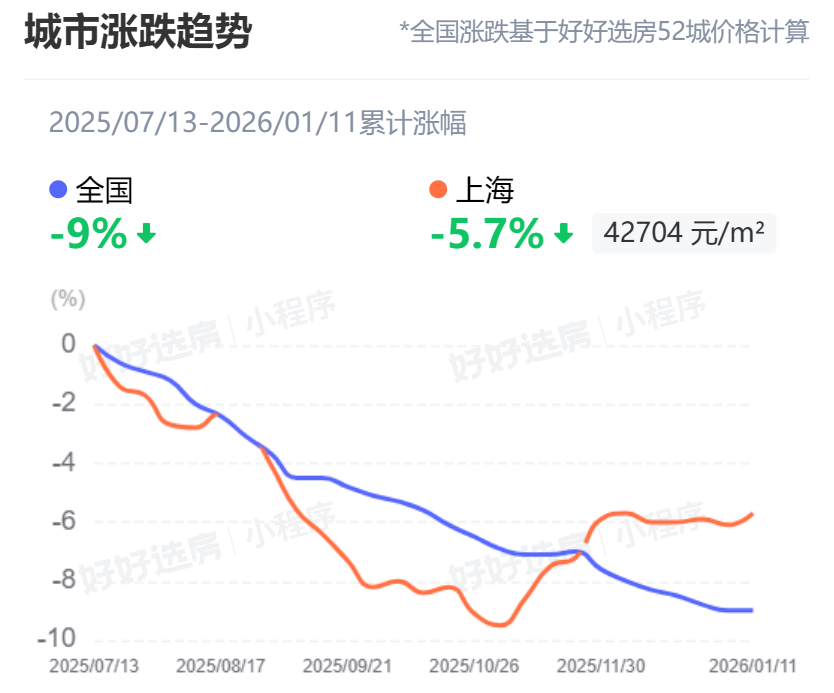
Core Viewpoint - Shanghai's real estate market is showing signs of resilience and potential recovery, driven by strong demand and a large population of 24.8 million residents, despite a generally declining market trend in other regions [2][4]. Market Trends - Since October 2025, Shanghai's transaction volume has surged, maintaining over 20,000 transactions per month, indicating a potential stabilization in prices, which have shown signs of bottoming out and even slight recovery in recent months [4][5]. - The expectation is that while the overall market may not fully recover until around 2027, certain areas and properties in Shanghai are already stabilizing and attracting buyers willing to pay a premium [4][5]. Pricing Dynamics - Current new home prices in Shanghai range from 100,000 to 130,000 per unit, while older properties from after 2000 are priced around 70,000, suggesting a significant price gap that may be reaching its limit [8]. - The price difference between new and second-hand homes in central Shanghai can reach up to 40%, indicating a potential ceiling for price increases in the market [8]. Policy and Economic Context - Recent government policies have been aimed at stabilizing the market, with expectations of a nationwide positive trend in the first half of the coming year, although no major policy changes are anticipated before the New Year [7][11]. - The lack of strong economic indicators, such as M1 and M2 growth, suggests that the housing market remains vulnerable without substantial economic improvement [7]. Investment Opportunities - There is a growing interest in properties that are expected to appreciate due to anticipated urban redevelopment, particularly in older neighborhoods, which may present investment opportunities [11]. - The market is currently characterized by a cautious optimism, with real estate agents actively engaging with potential buyers to match them with suitable properties before prices potentially rise further [5][11].
就在今天|2026居民端财富管理新趋势——国泰海通非银&银行&地产1月专题论坛
国泰海通证券研究· 2026-01-22 22:32
Group 1 - The event is a forum organized by Guotai Junan focusing on non-bank financial services, banking, and real estate, scheduled for January 23, 2026, in Shanghai [1] - The forum will feature various speakers discussing topics such as wealth management trends and housing price forecasts for 2026 [2][3] - Key presentations include insights from industry leaders on wealth management responsibilities and the future of banking operations [3] Group 2 - The forum will address the trends in housing prices across 70 key cities and provide a forecast for 2026 [3] - There will be a discussion on the importance of asset allocation from institutional to individual investors [3]


邀请函|2026居民端财富管理新趋势——国泰海通非银&银行&地产1月专题论坛
国泰海通证券研究· 2026-01-21 13:50
Group 1 - The event is a forum organized by Guotai Junan focusing on non-bank financial services, banking, and real estate, scheduled for January 23, 2026, in Shanghai [1] - The forum will feature various speakers discussing topics such as wealth management trends and housing price forecasts for 2026 [2][3] - Key presentations include insights from industry leaders on wealth management and real estate market trends, highlighting the importance of adapting to new financial landscapes [3] Group 2 - The forum will address the new trends in resident wealth management, emphasizing the evolving responsibilities of financial institutions [3] - A specific focus will be on housing price trends in 70 major cities and predictions for 2026, providing critical insights for investors [3] - The event will also cover the operational trends of banks in 2026, indicating a shift in financial strategies and consumer engagement [3]

邀请函|26年,居民端财富管理新趋势——国泰海通非银&银行&地产1月专题论坛
国泰海通证券研究· 2026-01-15 12:07
Group 1 - The event is a forum organized by Guotai Junan focusing on non-bank financial services, banking, and real estate, scheduled for January 23, 2026, in Shanghai [1] - Key speakers include industry leaders and analysts discussing topics such as wealth management trends and housing price changes in major cities [2][3] - The forum aims to address the evolving landscape of wealth management and the implications for both institutions and individual investors [3] Group 2 - The agenda includes discussions on recent trends in wealth management, housing price fluctuations in 70 key cities, and future banking operational trends [3] - Specific sessions will cover the challenges and opportunities in the real estate market, as well as the importance of asset allocation for residents [3]

若不出意外,2026年房价将出现4大趋势,买房人要注意
Sou Hu Cai Jing· 2026-01-03 15:02
Core Insights - The real estate market in 2026 is expected to exhibit four major trends, indicating a shift from the previous notion that "any property will appreciate" to a more selective approach in property investment [1][8]. Trend Analysis - **Urban Disparity**: There will be an increasing gap in property values between high-demand cities and those with declining populations. Core cities like Beijing, Shanghai, and Chengdu are expected to see stable or slightly rising prices, while third and fourth-tier cities may continue to experience price declines. For instance, new home prices in Shanghai's core areas rose by 5.6% year-on-year in 2025, while properties in less populated areas may take years to sell due to oversupply [1][3]. - **Shift to Improved Housing**: The demand for larger, more comfortable homes is rising, with properties sized between 120-144 square meters becoming increasingly popular. In the first five months of 2025, these larger units accounted for 30% of transactions in 30 major cities. Additionally, buyers are prioritizing properties that can be delivered on time, leading to a rise in the sales of completed homes, which reached 35.6% in 2025, up by 4.8 percentage points [3][5]. - **Increase in Affordable Housing**: By 2026, a dual system of affordable and market-rate housing is expected to be more established, with 60% of families potentially able to access affordable housing options. This will alleviate financial pressure on first-time buyers, as affordable housing can be priced at 20% lower than market-rate homes in the same area [5][7]. - **Supportive Policies**: The government is likely to continue implementing supportive policies to stimulate reasonable housing demand, including potential interest rate cuts and increased availability of housing subsidies. This could lead to lower monthly mortgage payments for buyers, making homeownership more accessible [5][7]. Recommendations for Buyers - Focus on acquiring core assets in major cities rather than spreading investments across multiple lower-tier properties, as evidenced by a 20% increase in second-hand home transactions in major cities in early 2025 [7]. - Pay attention to the benefits of old community renovations, as the government has allocated 33.2 billion yuan for such projects, which could enhance property values in renovated areas [7]. - First-time buyers should act promptly if suitable properties arise, especially those eligible for affordable housing, while those looking to upgrade should compare options during favorable policy conditions [7]. - Abandon speculative investment strategies, as the market is shifting towards a "housing for living" approach rather than for profit [7][8].
大家提前做好准备,如果一切正常,2026年的房价会出现5大趋势
Sou Hu Cai Jing· 2025-12-22 19:00
Core Viewpoint - The real estate market is expected to undergo significant changes by 2026, with five major trends emerging that will affect buying and selling decisions, as well as overall market stability [1] Group 1: Trends in Home Buying - Trend 1: The cost of buying a home will decrease, with policies aimed at making home purchases more affordable and reducing financial pressure on buyers. This includes potential easing of restrictions in major cities and lower mortgage rates [3] - Trend 2: Not all properties will appreciate; only homes in "good cities" and with desirable characteristics will retain value. Cities with population inflow and strong industries will support housing demand, while weaker markets may see continued price declines [4] - Trend 3: The second-hand housing market will stabilize, moving away from panic selling. As prices reach reasonable levels, buyers will enter the market, leading to a more rational pricing environment [6] Group 2: Changes in Developer Behavior - Trend 4: Demand for improved housing will rise, prompting developers to focus on quality rather than quantity. The shift towards better living conditions will lead to enhanced property features and services [7][8] - Trend 5: The real estate industry will transition from a high-debt, high-turnover model to a more sustainable approach. Developers will focus on reducing inventory and may convert unsold properties into affordable housing options, leading to a healthier market [9][11]
国家统计局8月房价数据,揭示两个信号
Hu Xiu· 2025-10-09 12:02
Core Insights - The National Bureau of Statistics released data on the housing price changes in 70 large and medium-sized cities for August 2025, indicating a notable decline in high-quality assets [1] Group 1: Market Trends - The data provided by the National Bureau of Statistics is relatively abstract, making it difficult to discern market trends directly [1] - The analysis includes a transformation of some data into charts to facilitate a more intuitive understanding of market trends [1]
马云再开金口?2025下半年,手里有存款的人,或将面临2大挑战?
Sou Hu Cai Jing· 2025-09-07 14:42
Group 1: Real Estate Market Trends - The prediction made by Jack Ma in 2017 about future housing prices being as low as "scallions" has come true, with average national housing prices now down over 30% [1][3] - Cities like Zhengzhou, Tianjin, and Shijiazhuang have seen significant price declines, followed by major cities like Shanghai and Shenzhen [3] - Prices in lower-tier cities have dropped to levels around 3,000 to 4,000 yuan per square meter, aligning with Ma's prediction [3] Group 2: Investment Risks - Investment risks are rising across various sectors, including real estate, stocks, funds, and bank products, as bank deposit rates hit historical lows [4][8] - The average loss for stock investors in 2024 is projected to be around 140,000 yuan, with public funds experiencing average losses of 20-30% [8] - The risk associated with bank wealth management products is increasing due to declining money market yields and rising bond market risks [8] Group 3: Entrepreneurship Challenges - Many individuals are withdrawing savings to invest in entrepreneurship, but the success rate is extremely low, described as "nine deaths and one life" [10] - Consumer behavior has shifted towards more rational spending post-pandemic, leading to a long-term oversupply in the market [12] - High rental costs for commercial spaces and intense competition from established companies further diminish the chances of entrepreneurial success [14]