房地产经济

Search documents
财政、货币政策协同发力 经济延续复苏态势
Zheng Quan Ri Bao· 2026-01-04 23:19
Core Viewpoint - In 2026, China's economy is expected to experience a structural adjustment with a focus on sustainable growth, supported by proactive fiscal and monetary policies [2][3][4]. Economic Growth and Indicators - The overall economic performance in 2025 laid a solid foundation for 2026, with GDP growth expected around 5.1% for 2025 [2]. - The Purchasing Managers' Index (PMI) for December 2025 showed manufacturing PMI at 50.1%, non-manufacturing PMI at 50.2%, and a composite PMI at 50.7%, indicating a recovery in economic sentiment [2]. Structural Adjustments - The "three new economies" (new industries, new business formats, new models) are projected to surpass the real estate economy in GDP contribution for the first time in 2026 [3]. - The focus for 2026 will shift towards structural adjustments rather than just quantitative growth, with policies aimed at enhancing consumption patterns and boosting consumer confidence [3]. Fiscal Policy - The central economic work conference emphasized the continuation of a more proactive fiscal policy, with specific measures including the issuance of long-term special bonds and consumer subsidies [4]. - The first batch of 62.5 billion yuan in special bonds was allocated before the New Year to support consumption during peak seasons [4]. Monetary Policy - The People's Bank of China is expected to implement interest rate cuts of up to 0.3 percentage points in 2026, with potential adjustments occurring before the Spring Festival [5]. - Structural monetary policies will focus on directing financial resources towards technology innovation, manufacturing upgrades, and supporting small and micro enterprises [5][6]. Policy Coordination - Recent policies are designed to address current economic challenges, such as weak domestic demand, while also laying the groundwork for long-term development through investments in new productive forces and social welfare [6]. - The coordinated approach of fiscal and monetary policies aims to stimulate domestic demand and accelerate industrial upgrades [6].
首席经济学家展望2026: 财政、货币政策协同发力 经济延续复苏态势
Zheng Quan Ri Bao· 2026-01-04 22:50
Core Viewpoint - In 2026, China's economy is expected to experience a structural adjustment with a focus on sustainable growth, supported by proactive fiscal and monetary policies [1][4]. Economic Growth and Indicators - The overall economic performance in 2025 laid a solid foundation for 2026, with GDP growth expected around 5.1% [2]. - The Purchasing Managers' Index (PMI) for December 2025 showed manufacturing PMI at 50.1%, non-manufacturing PMI at 50.2%, and composite PMI at 50.7%, indicating a recovery in economic sentiment [2]. Structural Adjustments and New Economic Drivers - In 2026, the "three new economies" (new industries, new business formats, and new business models) are projected to surpass the real estate economy in GDP contribution for the first time [3]. - The focus will shift from absolute growth to structural adjustments, with policies aimed at enhancing consumption patterns and boosting consumer confidence [3]. Fiscal Policy Initiatives - The central government plans to implement a more proactive fiscal policy, including the issuance of long-term special bonds and consumer subsidies to stimulate demand [4]. - The first batch of 62.5 billion yuan in special bonds was allocated before the New Year to support consumption during peak periods [4]. Monetary Policy Directions - The People's Bank of China is expected to continue with interest rate cuts, potentially reducing rates by 0.3 percentage points in 2026 [5]. - Structural monetary policies will focus on directing financial resources towards innovation, manufacturing upgrades, and supporting small and micro enterprises [5]. Policy Coordination and Long-term Growth - Recent policy measures are designed to address current economic challenges while laying a foundation for long-term growth through investment in new productive forces and social welfare [6]. - The coordinated approach of fiscal and monetary policies aims to activate domestic demand and accelerate industrial upgrades [6].
宏观策略 | 破局谋新,迈向新平衡——2026年度宏观策略展望(基本面篇)
Xin Lang Cai Jing· 2025-12-22 07:03
Group 1: Macroeconomic Trends Impacting China's Economy in 2026 - The external environment is expected to stabilize from high volatility, with trade policy uncertainty likely past its peak and geopolitical relations moving towards orderly confrontation [1][11][12] - The growth momentum is anticipated to experience a historic shift, with the "three new economies" (new industries, new business formats, new models) expected to surpass the real estate economy in GDP contribution for the first time [1][23][24] - Inflation is projected to rise moderately from around -1% to near 0%, supported by consumption stimulus and low base effects [1][33][36] - The financial cycle is expected to continue its downward trend, with significant risk prevention tasks remaining [1][38][39] Group 2: Economic Fundamentals - The global economy is forecasted to enter a "persistent low growth" phase in 2026, with inflation risks still present despite a moderate decline [2][51][52] - Domestic nominal GDP is expected to grow around 5%, with real GDP growth also projected at approximately 5% [3][40] - Consumption is anticipated to lead the recovery, with retail sales expected to grow by about 4.5% [3][40] - Investment is expected to stabilize, with infrastructure investment projected to grow moderately due to policy support [3][40] - Exports are expected to grow between 3-5%, facing both opportunities and challenges [4][40] Group 3: Policy Outlook - Fiscal policy is expected to maintain a stable overall tone, with a focus on optimizing structure and reform measures [5][6] - Monetary policy may see slight reductions in interest rates and reserve requirements, with a focus on fiscal coordination [6][39] Group 4: Asset Allocation Outlook - The market is expected to be in a complex transition period, with a defensive strategy recommended [7][10] - The stock market is likely to shift from valuation-driven to profit-driven, with a focus on technology, high-quality overseas expansion, and sectors benefiting from anti-involution policies [7][10] - The bond market is expected to experience wide fluctuations, while commodity markets will continue to show structural differentiation [7][10]


财信研究院宏观团队|目标积极务实,政策提质增效,内需主导强化——2025年中央经济工作会议解读
Xin Lang Cai Jing· 2025-12-13 07:10
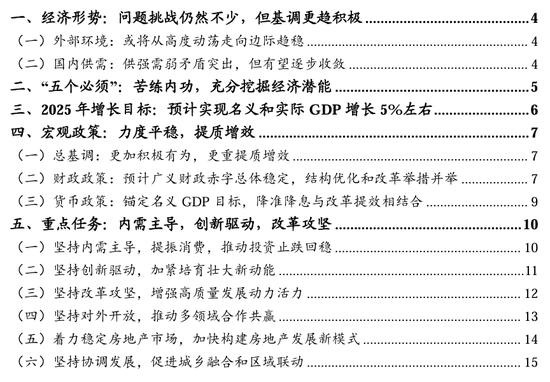
Economic Situation - The economic situation is characterized by persistent challenges, but the overall tone is becoming more positive. The external environment is expected to stabilize marginally, while domestic supply-demand imbalances are highlighted as a significant issue [2][10]. - The meeting emphasizes the need to address "development and transformation" issues, indicating that many challenges can be resolved through concerted efforts [10]. Five Musts - The meeting outlines "Five Musts" to enhance economic potential, focusing on internal capacity building to respond to external challenges and the importance of policy support alongside reform innovation [2][18]. - Key strategies include ensuring effective market regulation while promoting investment in both physical and human capital [19]. 2025 Growth Target - The growth target for 2026 is set at approximately 5% for both nominal and real GDP, reflecting a pragmatic approach to align with long-term goals and current economic conditions [3][21]. - The transition of growth drivers is expected, with the "three new economies" projected to surpass the real estate sector historically [21]. Macroeconomic Policy - The macroeconomic policy framework is shifting from "promoting stability through growth" to "enhancing quality and efficiency," indicating a focus on structural optimization rather than mere expansion [4][26]. - Fiscal policy is expected to maintain a deficit rate around 4%, with a focus on improving the efficiency of spending rather than just increasing the scale [30][31]. - Monetary policy will remain moderately accommodative, with expectations for potential rate cuts and targeted support for key sectors [36][40]. Key Tasks - The emphasis on domestic demand is paramount, with strategies to boost consumption and stabilize investment growth projected at 2-3% for 2026 [5][46]. - Innovation-driven growth is prioritized, with plans to strengthen the integration of education, technology, and talent development [6][50]. - Reforms will focus on eliminating barriers to development, enhancing market dynamics, and improving the business environment [7][57]. Real Estate Market - The policy focus is shifting towards stabilizing the real estate market, moving from demand stimulation to a balanced supply-demand approach [8][63].
中央部委定调!5月开始关于房地产,关于买房,重要信号来了
Sou Hu Cai Jing· 2025-05-07 09:36
Core Viewpoint - The importance of the real estate sector as a key driver of China's economy is increasing due to the impacts of trade and tariff wars, with a call for revitalization of the sector as a strategic response to external pressures [1][26]. Group 1: Real Estate's Economic Role - The central government has indicated significant development potential in the real estate market, emphasizing the need for stable growth in the sector during recent high-level meetings [3]. - In Q1 2023, the average price of new commercial housing in China was approximately 9,510 yuan per square meter, making home ownership a long-term financial commitment for average earners [5]. - Real estate contributes nearly 10% to national tax revenue, with a significant drop in land value tax by 17.4% year-on-year in Q1, highlighting the sector's critical role in stabilizing fiscal income [7]. Group 2: Employment and Financial Stability - The construction industry is a major employer for migrant workers, with around 42.86 million relying on real estate jobs, underscoring the sector's importance for job security [9]. - Real estate loans are a primary source of profit for the financial sector, and instability in housing prices could lead to widespread financial risks, affecting overall financial security [11]. Group 3: New National Standards - The implementation of the new national standard for residential projects starting May 1 aims to enhance safety, living space, and user-friendly designs in new housing [14][19]. - The new regulations include increased safety standards, such as mandatory smoke detectors in each unit, and improved living conditions with minimum height requirements for residential spaces [16][17]. Group 4: Considerations for Homebuyers - Homebuyers are advised to assess their mortgage repayment capabilities carefully, as financial instability could lead to severe consequences [20]. - The principle of "housing is for living, not for speculation" remains crucial, discouraging speculative investments in the real estate market [24]. - Caution is advised against purchasing properties in less developed areas, often referred to as "internet celebrity housing," which may lack essential services and infrastructure [24].