
油价调控

Search documents
13年来首次!国家对油价临时调控
21世纪经济报道· 2026-03-23 07:22
Group 1 - The core viewpoint of the article highlights the temporary adjustment of domestic refined oil prices in response to the significant increase in international oil prices due to escalating conflicts in the Middle East, marking the first such adjustment since the current pricing mechanism was implemented in 2013 [1][2] - As of March 23, 2023, the domestic prices for gasoline and diesel are set to increase by approximately 0.87 yuan and 0.95 yuan per liter, respectively, after a reduction from the calculated increase of 2205 yuan and 2120 yuan per ton [1] - The National Development and Reform Commission (NDRC) emphasizes the importance of ensuring market supply and maintaining market order by intensifying supervision and addressing violations of national pricing policies [1][2] Group 2 - The article notes that the adjustment is a timely and effective measure to mitigate the impact of soaring international oil prices on the domestic economy, which is crucial for maintaining stable economic operations [1]

大越期货原油早报-20260320
Da Yue Qi Huo· 2026-03-20 03:25
1. Report Industry Investment Rating - Not provided in the given content 2. Core View of the Report - The report analyzes the fundamentals, basis, inventory, market trends, and positions of crude oil. It indicates that due to the easing statements from various parties, negative factors have been released, but if the "blockade" of the Strait persists until the end of the month, crude oil prices may still rise. It suggests an operating range of 750 - 770 for SC2605 and waiting for opportunities to short at high prices in the long - term [3]. 3. Summary by Directory 3.1 Daily Prompt - **Fundamentals**: Trump warned Israel not to attack Iran's gas infrastructure. The US Treasury Secretary said the US would not attack Iran's energy infrastructure, may lift sanctions on Iranian oil, and release strategic reserves to suppress oil prices. The situation is neutral [3]. - **Basis**: On March 19, the spot price of Oman crude oil was $166.95 per barrel, and that of Qatar Marine crude oil was $107.51 per barrel. The basis was 25.72 yuan per barrel, with the spot price higher than the futures price, which is bullish [3]. - **Inventory**: US API crude oil inventory for the week ending March 13 increased by 6.556 million barrels (expected increase of 73,000 barrels), EIA inventory increased by 6.156 million barrels (expected increase of 383,000 barrels), and Cushing area inventory increased by 944,000 barrels. Shanghai crude oil futures inventory as of March 18 was 3.511 million barrels, unchanged. This is bearish [3]. - **Market Trends**: The 20 - day moving average is upward, and the price is above the average, which is bullish [3]. - **Positions**: As of March 10, the long positions of WTI and Brent crude oil increased, which is bullish [3]. - **Expectation**: Trump asked Israel to stop attacking Iranian energy facilities, and the US plans to release strategic reserves and lift sanctions on Iranian and Russian oil to increase supply and stabilize oil prices. Crude oil prices dropped significantly in the second half of the night, but if the Strait remains "blocked" until the end of the month, prices may rise. It is recommended to operate in the range of 750 - 770 for SC2605 and wait for opportunities to short at high prices in the long - term [3]. 3.2 Recent News - The US may lift sanctions on about 130 - 140 million barrels of Iranian "floating oil" in the next few days. The US will use Iranian oil to lower prices and will not conduct financial intervention in the futures market but increase physical supply [5]. - The IEA announced that Japan, Canada, and South Korea will be the main contributors to the large - scale emergency oil reserve release. A total of 426 million barrels of oil are being released into the market, with 172 million barrels from the US [5]. - After an attack by Iran, Saudi Aramco briefly suspended crude oil loading at the Yanbu port in the Red Sea on Thursday, and the port has since resumed operations [5]. 3.3 Long - Short Concerns - **Bullish Factors**: Difficulty in Strait passage and deterioration of the Middle East situation [6]. - **Bearish Factors**: Trump's intention to end the war quickly and the release of strategic reserves by IEA member countries [6]. - **Market Driver**: Pay attention to geopolitical changes in the short - term, and wait for the situation to ease before entering the market for reversal trading in the long - term [6]. 3.4 Fundamental Data - **Futures Market**: Brent crude oil settlement price increased from $102.92 to $103.78 (up 0.84%), WTI crude oil from $95.46 to $95.55 (up 0.09%), SC crude oil from 751.2 to 803.4 (up 6.95%), and Oman crude oil from $153.12 to $166.96 (up 9.04%) [7]. - **Spot Market**: The price of UK Brent Dtd increased from $112.85 to $117.49 (up 4.11%), WTI decreased from $96.32 to $96.14 (down 0.19%), Oman crude oil increased from $156.02 to $166.95 (up 7.01%), Shengli crude oil increased from $100.92 to $110.63 (up 9.62%), and Dubai crude oil increased from $155.69 to $166.97 (up 7.25%) [9]. - **Inventory Data**: API inventory as of March 13 was 472.774 million barrels, an increase of 6.556 million barrels; EIA inventory as of March 13 was 449.259 million barrels, an increase of 6.156 million barrels [3][11][13]. 3.5 Position Data - **WTI Crude Oil**: As of March 10, the net long position was 228,015, an increase of 55,865 [17]. - **Brent Crude Oil**: As of March 10, the net long position was 351,032, an increase of 65,438 [19].
Oil falls as U.S. weighs releasing sanctioned Iranian crude to cool prices
CNBC· 2026-03-20 00:46
Group 1 - Oil prices increased by up to 3% following Iran's attacks on energy facilities in the Middle East after a strike on its South Pars gas field [1] - U.S. oil prices continued to decline as Treasury Secretary Scott Bessent indicated that sanctions on Iranian crude stored on tankers may soon be lifted, which aims to alleviate price pressures after Iran's closure of the Strait of Hormuz [1] Group 2 - Brent crude, the international benchmark, decreased by 2% to $106 per barrel, while U.S. oil prices fell by 1.56% to $94.64 per barrel [2] - Bessent mentioned that approximately 140 million barrels of sanctioned Iranian oil on the water may be unsanctioned, which could help stabilize prices over the next 10 to 14 days [2]

甲醇日报:中东局势反复,行情极端-20260312
Guan Tong Qi Huo· 2026-03-12 09:38
Report Industry Investment Rating - No information provided Core Viewpoints - The Middle East situation is volatile, leading to extreme market conditions for methanol. The short - term volatility of crude oil has intensified, and investors should pay attention to controlling risks. They should focus on the support of the 20 - day moving average on the daily K - line of methanol, wait for the opportunity after the callback, and closely track the current US - Iran situation and crude oil trends [3] Summary by Relevant Catalogs Fundamental Analysis - As of March 4, 2026, the total inventory of methanol ports in China was 1443500 tons, a decrease of 3200 tons compared with the previous period. The inventory in East China increased by 24200 tons, while that in South China decreased by 27400 tons. This week, the methanol port inventory remained basically stable, with accumulation in East China and destocking in South China. During the period, 2.003 billion tons of external ships were included, and提货 gradually recovered compared with the Spring Festival. In Jiangsu, there was concentrated unloading of external ships, leading to inventory accumulation under increased supply. In Zhejiang, individual unloading external ships were not yet included, and the inventory decreased slightly under the background of rigid demand. In South China, the inventory showed destocking. In Guangdong, there was a small amount of imported and domestic trade ship cargo replenishment, and the提货 volume of mainstream storage areas increased steadily driven by the gradual recovery of downstream industries, resulting in inventory destocking. In Fujian, only a small amount of domestic trade ship cargo arrived at the port, and the inventory fluctuated little due to rigid demand consumption [1] Macroeconomic Analysis - The Ministry of Foreign Affairs stated that all parties are responsible for ensuring the stable and smooth energy supply. Market news indicated that Saudi Arabia, the United Arab Emirates, Iraq, and Kuwait would cut production by up to 6.7 million barrels per day. Satellite images showed that Iran was still loading crude oil at its oil terminals and transporting a large amount of oil through the Strait of Hormuz. Trump said that the oil price surge was an "expected setback" and predicted that the short - term oil price would drop rapidly after the Iranian nuclear threat was eliminated. He also said that the oil price increase was lower than his expectation, and he would temporarily lift some oil - related sanctions to reduce the oil price. If Iran blocked the oil flow in the Strait of Hormuz, it would be hit twenty times more severely. Russian President Putin said that the oil production related to the Strait of Hormuz might completely stop as early as next month, and the current high commodity prices were temporary. The Novorossiysk oil terminal in Russia resumed loading. The EU Commission spokesman said that the EU oil and gas supply - related agencies would hold a meeting on the Middle East situation on Thursday. The G7 finance ministers' meeting reached a consensus not to release the oil war reserve for the time being but was "ready at any time" to release it if necessary [2] Futures and Spot Market Analysis - The Middle East situation has not ended, and the short - term volatility of crude oil has intensified. Attention should be paid to controlling risks. For methanol, focus on the support of the 20 - day moving average on the daily K - line. Currently, wait for the opportunity after the callback, and closely track the current US - Iran situation and crude oil trends [3]
高市称将维持日本汽油价格在170日元/升
日经中文网· 2026-03-12 07:40
Core Viewpoint - Japan's Prime Minister, Sanna Takashi, announced measures to control gasoline prices at approximately 170 yen per liter (around 7.34 RMB) due to rising oil prices influenced by the situation in the Middle East [2][4]. Group 1: Price Control Measures - Starting from March 19, Japan will implement subsidies to ensure gasoline prices do not exceed 170 yen per liter [2][4]. - The Ministry of Economy, Trade and Industry will fully subsidize the portion of the retail price that exceeds 170 yen for oil products, including diesel, heavy oil, and kerosene [4]. Group 2: Economic Context and Implications - Prime Minister Takashi indicated that there is a possibility of gasoline prices rising above 200 yen per liter (approximately 8.64 RMB) [4]. - The government is closely monitoring the situation in the Middle East and the resulting oil price trends, with plans to adapt support measures if the situation persists [5]. Group 3: Strategic Actions - Japan plans to release its oil reserves ahead of any formal decision by the International Energy Agency (IEA), with the earliest release scheduled for March 16 [5]. - The country anticipates a significant reduction in crude oil imports due to the blockade of the Strait of Hormuz by Iran, which is expected to impact supply from late March [5].

IEA批准释放创纪录原油储备,4亿桶规模较2022水平高出超一倍!
美股IPO· 2026-03-12 00:38
Core Viewpoint - The International Energy Agency (IEA) has approved the largest emergency oil reserve release plan in history, responding to soaring oil prices due to the conflict between the U.S. and Iran, with a total of 400 million barrels to be released by member countries [4]. Group 1: Contributions from Member Countries - Germany will release nearly 20 million barrels of oil reserves [4][7] - The UK will contribute 13.5 million barrels of crude oil [4][7] - France plans to release up to 14.5 million barrels, with President Macron stating that the release will be arranged in the coming days [4][7] - The U.S. is set to release 172 million barrels from its strategic oil reserves, starting next week, with the process expected to last about 120 days [4][10] Group 2: Market Impact and Oil Prices - IEA's release of strategic oil reserves is expected to significantly lower oil prices, with President Trump stating that prices are already declining and will continue to do so [4][10] - Following the announcement of the record oil reserve release, oil prices briefly fell but then rose slightly, with WTI crude returning to the $90 per barrel mark [4] Group 3: Supply Chain and Market Concerns - The IEA's 32 member countries hold over 1.2 billion barrels of public emergency reserves, with an additional 600 million barrels in government-controlled corporate inventories [6] - The release details, including the speed and duration, remain uncertain, which is critical for the energy market [9] - There are concerns that the release may not fully cover the supply gap, with estimates of daily supply losses in the Persian Gulf ranging from 11 million to 16 million barrels [9][11]
集运早报-20260310
Yong An Qi Huo· 2026-03-10 05:35
Report Industry Investment Rating - Not provided in the given content Core Viewpoints - The current market sentiment is high, and the monthly spread valuation is also relatively high. Once there is negative news, there may be a significant decline. It is recommended to wait and see in the short term. Additionally, focus on fuel costs, the congestion level of the Singapore port, and the possible release of a price increase notice for April by shipping companies this week [2][24] Summary by Relevant Catalogs Contract Information - EC2604 closed at 2236.4 with a 18.19% increase, EC2605 at 2257.0 with a 19.27% increase, EC2606 at 2494.0 with a 15.39% increase, EC2607 at 2590.4 with a 14.14% increase, EC2608 at 2422.6 with a 11.13% increase, EC2609 at 1742.3 with a 10.20% increase, EC2610 at 1617.2 with a 10.84% increase, and EC2612 at 1861.0 with a 9.70% increase [2][24] - The trading volumes of EC2604, EC2605, EC2606, EC2607, EC2608, EC2609, EC2610, and EC2612 were 62636, 3291, 19008, 1154, 3608, 829, 10794, and 1652 respectively [2][24] - The open interests of EC2604, EC2605, EC2606, EC2607, EC2608, EC2609, EC2610, and EC2612 were 31202, 2019, 19423, 693, 3078, 69, 10068, and 527 respectively, with changes of -2793, -282, -896, -105, 63, 69, -949, and 193 respectively [2][24] Monthly Spread Information - The monthly spread of EC2604 - 2606 was -257.6, with a month - on - month increase of 11.6 and a week - on - week increase of 279.3 [2][24] - The monthly spread of EC2604 - 2605 was -20.6, with a month - on - month decrease of -20.4 and a week - on - week decrease of -257.2 [2][24] - The monthly spread of EC2606 - 2610 was 876.8, with a month - on - month increase of 174.4 and a week - on - week increase of 164.9 [2][24] Spot Market Information - The spot price of the European line on March 9, 2026, was 1545.46 points, with a 5.61% increase from the previous period [2][24] - The SCFI of the European line on March 6, 2026, was 1452 dollars/TEU, with a 2.25% increase from the previous period [2][24] - OOCL's online quote was 2800, YML's was 2700. The current average quotes were OA 2800, MSC 2700 (special price 2500), PA 2700, MSK 2300, and the average converted to the futures price was about 1750 points. Further adjustments need to be monitored [3][25] News - On March 9, US President Trump said it was "far from" the time to send troops to Iran [4][26] - On March 9, G7 finance ministers reached a consensus not to release oil war reserves for the time being [4][26] - On March 10, Iran planned to charge fees for some ships in the Persian Gulf. An Iranian source said the Hormuz Strait was "closed" [4][26] - On March 10, Trump said if Iran blocked oil flow in the Hormuz Strait, the US would strike Iran 20 times harder [4][26] - On March 10, Trump said the military operation against Iran would end soon and the oil price increase was lower than expected [4][26]
特朗普逼美企千亿投资委内瑞拉,雪佛龙CEO陷两难:不投就出局,投了就亏损
Hua Er Jie Jian Wen· 2026-01-20 06:23
Core Viewpoint - President Trump is pressuring the U.S. oil industry to invest $100 billion into Venezuela's outdated oil infrastructure, creating a dilemma for Chevron, the only U.S. oil giant operating in the country, as it must balance political demands with shareholder interests [1][2]. Group 1: Investment Pressure and Industry Response - Trump met with executives from about 20 oil companies, urging them to invest significantly in Venezuela to boost oil production, but received little commitment from most companies [1]. - Chevron's Vice Chairman Mark Nelson received a clear ultimatum from Trump regarding the company's future in Venezuela, emphasizing the need for a swift agreement [1][2]. - The oil industry is wary of Trump's aggressive vision, as a drop in oil prices to $50 per barrel could lead to significant losses for companies like Chevron, which would see Venezuelan heavy crude prices fall to the $30 range [1][2]. Group 2: Chevron's Operational Status and Strategic Approach - Chevron is currently the only U.S. company with active operations in Venezuela, employing around 3,000 workers and producing approximately 240,000 barrels per day, which accounts for one-third of the country's total output [4]. - While Chevron can potentially double its production using existing resources, this does not equate to the substantial infrastructure investment Trump desires [4]. - Chevron prefers to enhance production through repairs and upgrades rather than committing to new, multi-billion dollar projects, which could take 5 to 7 years to yield results [4][5]. Group 3: Legal and Regulatory Concerns - Industry executives believe that significant investments require assurances from the U.S. government regarding financial and security guarantees [6]. - There are concerns about the legality of contracts signed under pressure from the Trump administration, which could be deemed coercive, leading to potential legal challenges [6]. - The consensus among companies is to remain cautious until a legal framework is established between the U.S. and Venezuela regarding oil contracts and sanctions [6].

50美元油价的代价:特朗普的能源宏愿能否避开沙特与页岩油的夹击?
Hua Er Jie Jian Wen· 2026-01-09 13:07
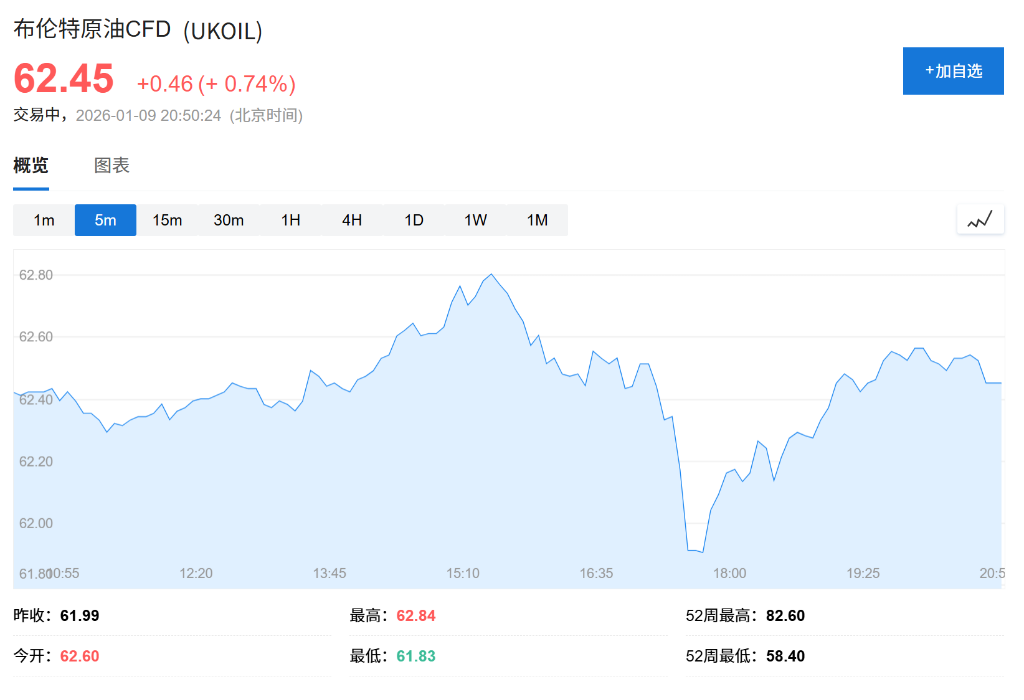
Core Viewpoint - The Trump administration's goal of achieving a $50 per barrel oil price is feasible but faces complex market dynamics and potential supply-side rebound risks [1] Group 1: Oil Price Dynamics - U.S. benchmark crude oil futures were hovering around $57 per barrel, even dipping below $60, due to strong production from Brazil, Guyana, and Canada, leading to oversupply pressures [1] - The EIA projected that global oil inventories would increase by over 2 million barrels per day by 2026, which, combined with potential production recovery in Venezuela, could further push prices down [1] - Goldman Sachs estimates that if Venezuela's production increases by 400,000 barrels per day, the average oil price could drop to $50 per barrel, despite Venezuela's current contribution being less than 1% of global production [1][2] Group 2: Venezuela's Production Potential - Venezuela currently produces about 900,000 barrels per day, and short-term recovery measures could enhance capacity significantly [2] - Analysts suggest that even a modest increase of several hundred thousand barrels per day could substantially drive prices down, with a potential 400,000 barrel increase representing half of the IEA's projected global oil demand increase by 2026 [2] Group 3: U.S. Refinery Needs - If sanctions are lifted, the U.S. could quickly access Venezuelan crude, which would not only lower benchmark prices but also alleviate the shortage of heavy crude faced by U.S. refineries [3] - The need for Venezuelan heavy crude is heightened due to declining production in Mexico and the redirection of Canadian oil to the West Coast post-pipeline expansion [3] Group 4: OPEC+ Response - Low oil prices are a concern for OPEC+ members, particularly Saudi Arabia, which requires a breakeven oil price of $86.60 per barrel by 2026 to balance its budget [4] - While OPEC+ has committed to maintaining stable production levels, the possibility of production cuts may arise if low prices lead to increased fiscal strain [4] - Historical patterns show that Saudi Arabia's decisions regarding production cuts can be unpredictable, adding uncertainty to future market directions [4] Group 5: U.S. Shale Producers' Breakeven Points - U.S. shale producers are under pressure, with a breakeven price of around $61 to $62 per barrel for new drilling to be profitable [7] - If oil prices fall below $55, significant production cuts may occur, impacting the stability of U.S. supply in the medium to long term [7] - The White House aims to balance oil prices slightly above $50 to appease consumers while ensuring the survival of major oil producers [7]
1月9日金市早评:多空因素对峙 黄金于高位等待非农“聚光灯”
Jin Tou Wang· 2026-01-09 06:11
Market Overview - The US dollar index is trading around 98.910, while spot gold opened at $4475.71 per ounce and is currently trading at approximately $4458.76 per ounce [1] - The previous trading day saw the dollar index rise by 0.14% to 98.874, and spot gold increased by 0.43% to $4332.45 per ounce [1] - Other precious metals showed mixed results, with spot silver down 1.55% at $76.96 per ounce, platinum down 0.78% at $2281.50 per ounce, and palladium up 1.50% to $1794.00 per ounce [1] Inventory Data - As of January 8, COMEX gold inventory stands at 1131.77 tons, a decrease of 0.5 tons from the previous trading day [2] - COMEX silver inventory is at 13762.66 tons, down by 101.33 tons from the prior trading day [2] - SPDR gold ETF holdings remain unchanged at 1067.13 tons, while SLV silver ETF holdings increased by 115.6 tons to 16215.43 tons [2] Economic Indicators - Initial jobless claims in the US for the week ending January 3 recorded 208,000, lower than the expected 210,000, with the previous value revised from 199,000 to 200,000 [4] - The US trade deficit for October 2025 was reported at $29.4 billion, the smallest since June 2009 [4]