滞胀逻辑

Search documents
20260323-20260329:韧性十足,静待修复契机显现
Datong Securities· 2026-03-30 13:48
Group 1 - The core viewpoint indicates that the equity market is experiencing significant volatility due to ongoing geopolitical conflicts, leading to a shift in investor sentiment from short-term fluctuations to long-term pessimism, which has resulted in widespread panic selling and capital outflows affecting global markets, including A-shares [2][9] - Despite the overall strong performance of A-share indices, the market remains sensitive to negative news, which may amplify adverse impacts and increase volatility in the short term [3][12] - The report suggests that the resilience of the A-share market is notable, with expectations for a potential recovery as negative factors are digested, indicating a wide range of fluctuations may characterize the market in the short term [3][13] Group 2 - The report recommends a short-term focus on stable dividend sectors to mitigate volatility risks, while mid to long-term attention should be directed towards innovation-driven sectors such as computing and telecommunications for recovery opportunities [5][14] - The bond market is expected to attract more funds due to reduced risk appetite from geopolitical tensions, with short-term bonds being a preferable choice for investors seeking flexibility [6][35] - In the commodity market, there is a notable fluctuation in energy and precious metals, with the potential for gold to maintain a gradual upward trend in the long term despite short-term volatility risks [7][40]
债市专题研究:阶段性回调后如何看待转债市场?
ZHESHANG SECURITIES· 2026-03-22 07:05
Group 1: Report Investment Rating - No investment rating is provided in the report. Group 2: Core Views - In the context of continued external uncertainties and high absolute valuations, the redemption negative feedback may still be in the early stage of fermentation. In terms of configuration, it is advisable to focus on defense, prioritize the layout of targets with solid bond - floor support and relatively low valuations, and avoid high - premium varieties [1][3]. - The convertible bond market accelerated its decline last week, with the core driving factors being the escalation of the Middle East geopolitical conflict and the hawkish stance of the Federal Reserve's policy, which led to a continuous weakening of global market risk appetite. The convertible bond market was pressured downwards along with the equity market. The small - cap and mid - cap convertible bond indexes had higher declines than the large - cap index, and the low - price index had a significantly lower decline than the high - price and mid - price indexes, indicating that the risk appetite for high - valuation and high - price varieties was still converging [1][10]. - The convertible bond market experienced a wide - range adjustment last week, with significant retracements in high - valuation varieties. Most style factors continued to be weak, and high - position targets with strong previous momentum faced concentrated adjustment pressure. It is recommended that investors be cautious in the current weak and volatile environment, prioritize the defensive attributes of assets, strictly control portfolio exposure, avoid high - deviation and downward - trending varieties, and moderately track and observe targets with low ZL deviation and potential pricing repair space [2][14]. - Looking ahead, the current redemption negative feedback may still be in the early stage of fermentation. The strategy should still focus on defense, and it is advisable to prioritize the layout of low - valuation targets. Overseas uncertainties have significantly increased, and the overall valuation of the convertible bond market is still in a relatively high range after the correction. It is recommended to maintain a cautious and defensive tone, focus on low - valuation varieties with solid bond - floor support, reasonable conversion premiums, and high cost - effectiveness, and strictly control portfolio risk exposure [3][21]. Group 3: Summary by Directory 1. Convertible Bond Weekly Thinking - Last week (from March 16 to March 20, 2026), the convertible bond market accelerated its decline. The core driving factors were the escalation of the Middle East geopolitical conflict and the hawkish stance of the Federal Reserve's policy, which led to a continuous weakening of global market risk appetite. The convertible bond market was pressured downwards along with the equity market. Style factors were generally under pressure, especially the momentum style. The small - cap and mid - cap convertible bond indexes had higher declines than the large - cap index, and the low - price index had a significantly lower decline than the high - price and mid - price indexes. The decline of the convertible bond market further expanded, mainly due to the double impact of the escalation of the Middle East geopolitical conflict and the hawkish signals from the Federal Reserve's March interest - rate meeting, which intensified market panic. Some fixed - income + products faced redemption pressure, leading to a "redemption - selling" negative feedback cycle. The convertible bond index showed a trend of simultaneous decline in volume and price, with significant adjustments in high - valuation and technology - themed individual bonds [10]. - The convertible bond market had a wide - range adjustment last week, with significant retracements in high - valuation varieties. Most style factors continued to be weak, and high - position targets with strong previous momentum faced concentrated adjustment pressure. Only "Aima Convertible Bond" in the liquidity style had a slight gain (+0.04%), and "Wanqing Convertible Bond" in the valuation style remained flat (0.00%). From an industry perspective, pro - cyclical sectors such as chemical raw materials and construction machinery faced obvious capital outflows. The copper and aluminum sectors related to non - ferrous metals were also weak. In contrast, "Aima Convertible Bond" in the motorcycle sector and "Wanqing Convertible Bond" in the cement sector showed certain defensive characteristics in the weak market. It is recommended that investors be cautious, prioritize the defensive attributes of assets, and track targets with low ZL deviation [14]. - Currently, convertible bonds are still in an over - valued range. It is recommended to focus on low - valuation and high - cost - effectiveness varieties. After the rapid decline, the convertible bond market is still about 10% over - valued compared to the reasonable level according to the BS and ZL models. The pressure of valuation regression is still being released. It is advisable to maintain a cautious and defensive strategy, prioritize targets with solid bond - floor support, strong underlying stock performance certainty, and relatively low valuations, and avoid high - premium varieties [17]. 2. Convertible Bond Market Aspect 2.1 Convertible Bond Market Aspect - No specific content is provided other than data sources. 2.2 Convertible Bond Individual Bond Aspect - Tables and figures show the performance of convertible bond indexes and the top - ten and bottom - ten individual bond price changes in the past week, but no detailed analysis is provided. 2.3 Convertible Bond Valuation Aspect - Figures show the valuation trends of bond - type, balanced, and stock - type convertible bonds, as well as the conversion premium rate valuation trends of convertible bonds with different parities, but no detailed analysis is provided. 2.4 Convertible Bond Price Aspect - Figures show the proportion trend of high - price bonds and the median price of convertible bonds, but no detailed analysis is provided.
资讯早班车-20260310
Bao Cheng Qi Huo· 2026-03-10 01:57
1. Report Industry Investment Rating No information provided in the content. 2. Core Views of the Report - The war between the US and Iran may end soon, which has an impact on the oil market. The US is considering taking measures to ensure oil supply and lower prices, and the G7 is discussing responses to the oil price surge [2][14]. - The Chinese economy shows certain trends in macro - data, such as changes in GDP, PMI, CPI, PPI, etc. [1][14]. - The bond market is under pressure due to inflation concerns, and the exchange rate market also has certain fluctuations [19][25]. - The stock market, including A - shares and the Hong Kong stock market, has different performances, with some sectors rising and others falling [31]. 3. Summary by Directory 3.1 Macro Data - GDP: In Q4 2025, the year - on - year growth rate of GDP at constant prices was 4.5%, lower than the previous quarter's 4.8% and the same period last year's 5.4% [1]. - PMI: In February 2026, the manufacturing PMI was 49.0%, down from 49.2% in the previous month and 50.2% in the same period last year; the non - manufacturing PMI for business activities was 49.5%, the same as the previous month but lower than 50.4% in the same period last year [1]. - Social Financing Scale: In January 2026, the monthly value of social financing scale was 7220.8 billion yuan, much higher than 817.8 billion yuan in the previous month and 7054.6 billion yuan in the same period last year [1]. - Money Supply: In January 2026, the year - on - year growth rates of M0, M1, and M2 were 2.7%, 4.9%, and 9.0% respectively, with different changes compared to the previous month and the same period last year [1]. - New RMB Loans: In January 2026, the monthly value of new RMB loans from financial institutions was 4710 billion yuan, higher than 220 billion yuan in the previous month but lower than 5130 billion yuan in the same period last year [1]. - CPI and PPI: In February 2026, CPI increased by 1.3% year - on - year, the highest in nearly three years; PPI decreased by 0.9% year - on - year, with the decline narrowing for three consecutive months [1][3][14]. - Fixed - asset Investment and Retail Sales: In December 2025, the cumulative year - on - year growth rate of fixed - asset investment was - 3.8%, and the cumulative year - on - year growth rate of total retail sales of consumer goods was 3.7% [1]. - Exports and Imports: In December 2025, the year - on - year growth rates of export and import amounts were 6.60% and 5.70% respectively, showing a decline compared to the previous month and the same period last year [1]. 3.2 Commodity Investment Reference 3.2.1 Comprehensive - The US - Iran war may end soon, causing a sharp drop in US oil prices, while Saudi Arabia's production cuts led to a sharp rise in oil prices in the Asian session. Iran warns that if the attacks on its infrastructure continue, oil prices will rise to $200 per barrel [2][14]. - The G7 finance ministers held a meeting to discuss responses to the oil price surge and decided not to release strategic oil reserves for the time being [2][15]. - In 2026, new legislative highlights include formulating and amending relevant laws for the market economy and the financial field, and strengthening legislative research in the field of artificial intelligence [3][16]. - The increase in energy prices is reshaping European interest rate trading, with the market expecting more interest rate hikes [3][4]. - The Shanghai Futures Exchange and Shanghai International Energy Exchange adjusted trading limits, margins, and fees for some futures contracts [4]. - South Korea implemented the "oil price cap system" to stabilize domestic oil prices [4]. - Saudi Aramco sold crude oil in the spot market through tender, with a total listing volume of about 4.6 million barrels [4]. - Qatar Energy postponed the commissioning time of the North Field East expansion project to after 2027 due to the shutdown of the Ras Laffan plant [4]. 3.2.2 Energy and Chemicals - The US is temporarily exempting some oil - related sanctions to ensure oil supply and lower prices, and is considering further relaxing sanctions on Russian oil [5]. - Qatar is committed to the stability of the global energy market but will take temporary preventive measures [5]. - Hungary called on the EU to lift sanctions on Russian energy [6]. 3.2.3 Metals - The London Metal Exchange plans to carry out major reforms, including re - evaluating storage requirements and adjusting warehousing rent policies [7]. - On March 9, 2026, the inventories of some domestic metal futures had different changes, such as a decrease in gold and silver inventories and an increase in aluminum, copper, and nickel inventories [7]. - The price spread of aluminum on the London Metal Exchange showed the largest inversion since 2022 [8]. - Ghana will implement a new gold royalty system [8]. - Four Chinese - funded nickel processing plants in Indonesia announced temporary shutdowns due to regulatory requirements [8]. 3.2.4 Agricultural Products - China has achieved the goal of mainly using domestic seeds for "Chinese grain" and will accelerate the replacement of new varieties [9]. - Thailand will freeze cooking gas prices until May [10]. - Brazil's state - owned oil company Petrobras kept domestic fuel prices unchanged [11]. 3.2.5 Coal, Coke, Steel, and Minerals - The night trading of domestic commodity futures closed with mixed results, and coke fell 1.76% [12]. 3.3 Financial News Compilation 3.3.1 Open Market - On March 9, 2026, the central bank conducted 48.5 billion yuan of 7 - day reverse repurchase operations, with a net withdrawal of 86.5 billion yuan [13]. 3.3.2 Important News - China's CPI in February 2026 increased by 1.3% year - on - year, and PPI decreased by 0.9% year - on - year, with the decline narrowing [14]. - The US - Iran war may end soon, affecting oil prices [14]. - The G7 finance ministers discussed responses to the oil price surge and decided not to release strategic oil reserves for the time being [15]. - In 2026, new legislative highlights include formulating and amending relevant laws for the market economy and the financial field, and strengthening legislative research in the field of artificial intelligence [16]. - China's foreign minister called for an end to the war and ensuring energy supply stability [15][16]. - Some small and medium - sized banks in China lowered deposit interest rates, and some had an inverted long - short - term deposit interest rate phenomenon [17]. - The Bank of Korea will buy up to 3 trillion won of Korean treasury bonds [17]. - There were some bond - related events, such as the recruitment of restructuring investors, resumption of trading, cancellation of issuance, and redemption of bonds [17][18]. - Some overseas credit ratings were adjusted [18]. 3.3.3 Bond Market Review - The inter - bank bond market in China adjusted significantly, with the yields of interest - rate bonds rising across the board. The bond market was under pressure due to inflation concerns [19]. - The exchange - traded bond market had different performances, with some bonds rising and some falling. The real - estate bond index fell, and the high - yield urban investment bond index rose [20]. - The convertible bond index fell, with some convertible bonds rising and some falling [20]. - Most money - market interest rates rose, and the yields of some financial bonds were determined through bidding [21][23]. - European and US bond yields had different trends [23][24]. 3.3.4 Foreign Exchange Market - The on - shore RMB against the US dollar closed down, and the RMB central parity rate was adjusted downwards. The US dollar index fell slightly, and non - US currencies had mixed performances [25][26]. 3.3.5 Research Report Highlights - CITIC Securities believes that new policy - based financial tools have expanded significantly, and attention should be paid to their impact on investment and credit [27]. - Huatai Fixed - Income believes that price recovery and "price increases" are the core themes this year. The US - Israel - Iran conflict has a profound impact, and the trading logic has shifted from a risk - aversion logic to a stagflation logic [27]. - Xingzheng Fixed - Income believes that the Middle East situation has led to a significant increase in international oil prices, which may push up domestic inflation readings but is not likely to be the main contradiction in the domestic bond market. The Middle East situation may be beneficial to the Chinese bond market [28]. 3.4 Stock Market News - On Monday, the A - share market opened lower and then recovered. The Shanghai Composite Index fell 0.67%, the Shenzhen Component Index fell 0.74%, and the ChiNext Index fell 0.64%. The oil and gas, coal sectors rose, while the computing power hardware and semiconductor concept stocks were under pressure [31]. - The Hong Kong stock market fluctuated significantly. The Hang Seng Index fell 1.35%, the Hang Seng Tech Index fell slightly, and the Hang Seng China Enterprises Index fell 0.54%. "Lobster" concept stocks rose sharply, and southbound funds had a record - high net purchase [31].
海外降息背景下对于黄金股投资价值的映射,黄金股票ETF基金(159322)备受关注
Xin Lang Cai Jing· 2025-08-25 02:31
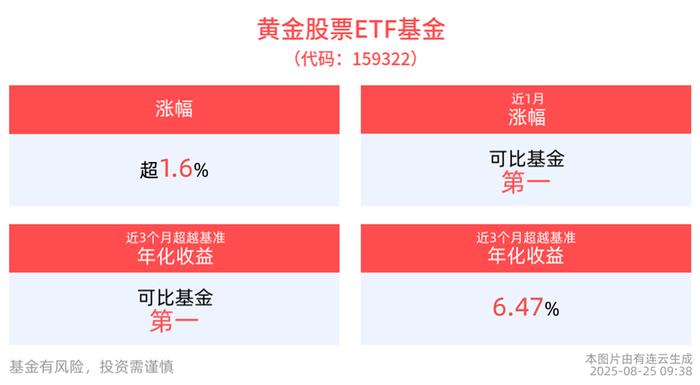
Group 1 - Federal Reserve Chairman Powell signaled a dovish stance at the Jackson Hole meeting, indicating increased risks in the job market and hinting at a higher likelihood of interest rate cuts in September, which boosted market expectations for rate cuts [1] - Analysts noted that gold is currently experiencing low volatility and low market attention, providing space for a potential price reversal, supported by a stagflation scenario of weakening economy and persistent inflationary pressures [1] - In the medium to long term, the ongoing loosening of global monetary and fiscal discipline, along with a weakening trend in dollar credit, is expected to support an upward shift in gold prices [1] Group 2 - As of August 25, 2025, the CSI Hong Kong-Shenzhen Gold Industry Stock Index (931238) rose by 2.05%, with constituent stocks like Jiangxi Copper (00358) up by 8.25% and Zijin Mining (02899) up by 4.72% [2] - The Gold Stock ETF (159322) increased by 1.68%, with a recent price of 1.27 yuan, and has seen a cumulative increase of 2.04% over the past month, ranking 1/6 among comparable funds [2] - The Gold Stock ETF has a net value increase of 29.66% over the past year, with a maximum monthly return of 16.59% since inception and a historical one-year profit probability of 100% [3] Group 3 - The top ten weighted stocks in the CSI Hong Kong-Shenzhen Gold Industry Stock Index account for 66.02% of the index, with Zijin Mining (601899) and Shandong Gold (600547) being the largest contributors [5] - The Gold Stock ETF closely tracks the CSI Hong Kong-Shenzhen Gold Industry Stock Index, which includes 50 large-cap companies involved in gold mining, refining, and sales [3]



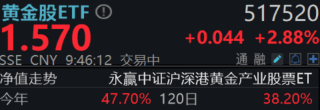
美联储降息预期提升至90%,黄金股涨近3%超黄金
Sou Hu Cai Jing· 2025-08-25 02:15
Group 1 - The core viewpoint of the articles highlights a strong performance in the gold industry stocks, particularly driven by the recent comments from the Federal Reserve Chairman Jerome Powell regarding potential interest rate cuts and a flexible inflation targeting framework [2][3] - The China Securities Index for gold industry stocks (931238) saw significant gains, with notable increases in stocks such as Jiangxi Copper Co., Ltd. (up 8.56%), Hunan Silver (up 7.14%), and Zijin Mining (up 5.54%) [1] - The expectation of interest rate cuts and the prevailing economic conditions are seen as supportive factors for gold prices, with analysts suggesting that the market may experience upward momentum rather than downward [2] Group 2 - The Northeast Securities analysis indicates that low volatility and economic weakness combined with rising inflation and potential rate cuts create a favorable environment for gold prices to rise [2] - The article emphasizes that the largest gold stock ETF (517520) serves as an efficient tool for investors to gain exposure to the gold sector, allowing them to capture the benefits of rising gold prices and share in the growth of quality gold mining companies [3] - The investment in the Yongying Gold Stock ETF and its linked funds (A class: 020411 / C class: 020412) is presented as a strategy to effectively diversify individual stock risks while participating in the overall gold industry [3]