
生猪价格波动

Search documents
卓创资讯:北方降温降雪提振,生猪价格上涨
Cai Jing Wang· 2026-01-19 06:18
Core Viewpoint - Recent cold weather and snowfall in northern regions have disrupted the transportation of live pigs, leading to increased purchasing difficulties for downstream slaughter enterprises and a subsequent rise in pig prices [1] Group 1: Price Dynamics - The price of live pigs has increased due to transportation challenges caused by adverse weather conditions in northern regions [1] - The bullish market sentiment, driven by rising prices in the north, has also initiated an upward trend in pig prices in southern regions [1] Group 2: Future Outlook - Despite the short-term price increase due to weather impacts, it is anticipated that as road conditions improve and transportation normalizes, pig prices may experience a high-level correction [1] - According to Zhuochuang Information, live pig prices are expected to rise initially and then decline over the next week [1]

价格周报|本周生猪均价反弹,生猪交易均重上涨
Xin Lang Cai Jing· 2026-01-17 06:17
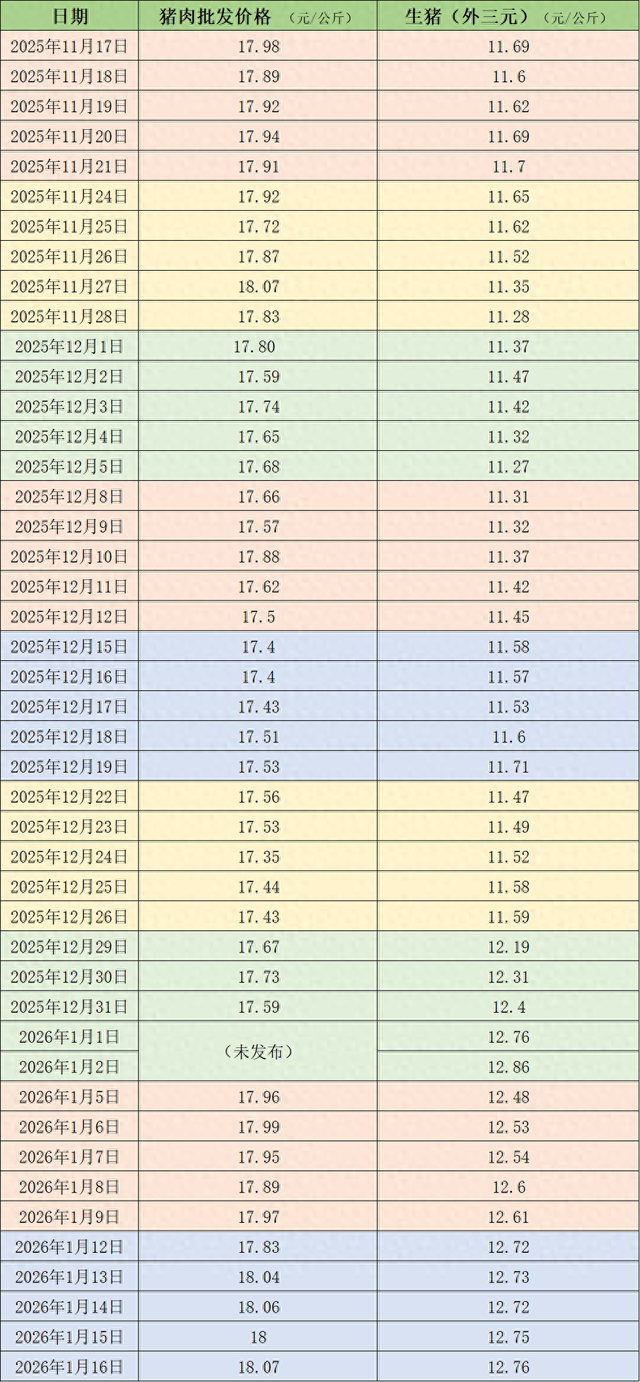
Group 1 - The average wholesale price of pork in China increased to 18.07 yuan/kg on January 16, up 0.6% from 17.97 yuan/kg on January 9, and the weekly average price rose by 0.3% compared to the previous week [1] - The average price of live pigs (external three yuan) was 12.76 yuan/kg on January 16, reflecting a 1.2% increase from 12.61 yuan/kg on January 9, with a weekly average price increase of 1.5% [1] - The average trading weight of live pigs increased to 124.58 kg, up 0.16% week-on-week, indicating a trend of heavier pigs being sold due to market conditions [3] Group 2 - Major pig farming companies, such as Muyuan Foods and Wens Foodstuff Group, forecast a decline in net profits for 2025, with Muyuan's expected profit between 14.7 billion to 15.7 billion yuan, down 12.2% to 17.79%, and Wens' expected profit between 5 billion to 5.5 billion yuan, down 40.73% to 46.12% [4] - The supply of theoretical standard pigs is expected to remain high in the first quarter, but the price gap between fat and standard pigs is leading to tighter market conditions [4] - The demand for slaughtering is anticipated to increase as the Chinese New Year approaches, which will be a critical period for assessing supply and demand dynamics [4] Group 3 - The national market for live pigs is expected to experience fluctuations, with initial price increases in the north due to limited supply, while the south may see price declines [5] - Slaughtering enterprises report slow sales of pork, which is limiting the potential for price increases [6]


生猪暴涨昙花一现?猪价或将大跌、暴跌?
Xin Lang Cai Jing· 2025-11-19 01:46
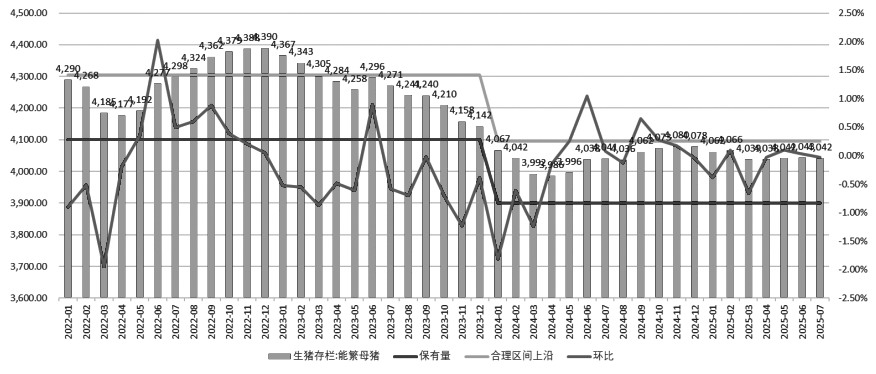
Price Trends - The current mainstream pig prices are showing a weak downward trend, with significant price drops observed in both major sales and supply areas across the country [1] - In mid-October, pig prices rebounded strongly in northern regions, with the national average price rising from 11.17 yuan/kg to 12.49 yuan/kg, an increase of 11.8% driven by factors such as farmers holding back pigs and seasonal consumption recovery [1] - However, by early November, prices began to decline again, with many regions experiencing price drops due to increased supply from large-scale farms and slaughterhouses taking advantage of the situation to lower prices [1] Demand Factors - Demand for fresh pork has been weak entering November, with a lack of festive atmosphere and limited consumer spending, particularly in urban dining, leading to overall poor pork sales [1][2] - Although the upcoming腌腊 season may boost demand, the overall growth in consumption remains limited, as younger consumers prefer alternatives like chicken breast and older consumers reduce fatty meat intake for health reasons [2] Supply Issues - The high number of breeding sows (40.38 million) and improved breeding efficiency (over 24 piglets per sow annually) indicate an oversupply of pigs in the market [1] - Farmers are holding back heavier pigs, which could lead to a price crash if there is a concentrated release of these pigs into the market [3] Industry Challenges - The process of reducing production capacity is slow, as lower feed costs prolong the time farmers can endure losses, meaning that even if sows are eliminated now, supply reductions may not be seen until the second half of 2026 [4] - The government's frozen pork storage program is limited in scale (35,000 tons), providing only short-term price stabilization, with long-term improvements relying on supply-demand dynamics [5] Market Outlook - In the short term, pig prices are expected to continue fluctuating downward, with attention needed on the slaughtering pace of large pig enterprises and disease risks [6] - In the long term, if production capacity continues to decrease alongside seasonal demand recovery, a turning point may be reached in the second half of 2026 [7]
生猪行业动态跟踪报告(月度):10月上市猪企出栏量同环比均增加,售价同环比走低-20251118
Western Securities· 2025-11-18 06:34
Investment Rating - The industry investment rating is "Overweight" [5][26] Core Insights - In October 2025, the total slaughter volume of listed pig companies reached 18.8143 million heads, representing a year-on-year increase of 30.28% and a month-on-month increase of 23.03%. The increase is attributed to higher supply during the consumption peak season and significant capacity expansion in 2024 [10][11] - The average selling price of pigs in October 2025 decreased by 11.85% month-on-month and 34.66% year-on-year, primarily due to abundant supply and weak demand during the peak season [20][21] - The cumulative revenue of listed pig companies from January to October 2025 was CNY 246.6 billion, reflecting a year-on-year increase of 4.33%, despite lower average selling prices compared to the previous year [12][11] Summary by Sections Slaughter Volume - In October 2025, listed pig companies accelerated their slaughter volume, achieving a total of 18.8143 million heads, with significant increases from leading companies such as Muyuan Foods, Wens Foodstuffs, and New Hope Liuhe [10][11] - The cumulative slaughter volume from January to October 2025 was 158 million heads, with a year-on-year increase of 21.25% [11] Revenue and Pricing - The revenue for listed pig companies in October 2025 was CNY 23.729 billion, showing a year-on-year decrease of 16.36% but a month-on-month increase of 9.62% [2][11] - The average selling price for pigs in October 2025 was CNY 11.57 per kilogram, down 34.66% year-on-year [20][21] Weight and Demand - The average weight of pigs slaughtered in October 2025 was 106.17 kg per head, which is an increase of 1.08% month-on-month and 3.65% year-on-year, indicating strong demand for heavier pigs during the consumption peak [20][21]

农业板块上扬,猪肉股表现亮眼,得利斯、傲农生物涨停
Zheng Quan Shi Bao Wang· 2025-09-15 07:03
Group 1 - The agricultural sector saw a significant rise on the 15th, with notable performance from pork stocks, including companies like Delisi (002330) and Aonong Biological (603363) hitting the daily limit, while Lihua (300761) and Tiankang Biological (002100) rose over 8% [1] - The average weight of pigs sold last week was 128.32 kg per head, with a slowdown in the selling pace due to falling prices and cooler weather, which may lead to a temporary rebound in pig prices [1] - Since May, piglet prices have been declining as the corresponding selling time falls into the off-season next year, leading to decreased purchasing enthusiasm [1] Group 2 - Current pig prices have led to losses for companies with poor cost structures, prompting them to reduce production capacity, while supply pressure remains significant [2] - If the industry can orderly adjust capacity, a decrease in the number of breeding sows is expected, potentially raising the mid-term profitability of the industry [2] - After a period of adjustment, valuations of pig farming companies are at a bottom range, with leading companies still achieving good profitability and improving balance sheets [2] - The industry is expected to stabilize at a low point, with leading firms benefiting from cost advantages and increasing market share despite supply pressures [2] - The pig farming industry still has a promising mid-term profit margin, with many companies having expanded capacity poorly post-African swine fever, leading to significant cost variances [2]




生猪 维持区间操作
Qi Huo Ri Bao· 2025-09-03 00:56
Core Viewpoint - The recent fluctuations in national pork reserves and declining pig prices indicate a critical phase for the pork industry, with the pig-to-grain ratio falling below the warning line, prompting government intervention to stabilize prices and encourage quality production [1] Group 1: Market Dynamics - The National Development and Reform Commission auctioned 10,000 tons of domestic frozen pork at prices between 19.90 to 20.00 yuan per kilogram, translating to a live pig price of approximately 13.6 to 13.8 yuan per kilogram, marking a temporary bottom for current pork prices [1] - The agricultural sector is actively working to optimize production capacity by eliminating inefficient sows and controlling weights, although the overall impact on capacity reduction remains limited [2][3] Group 2: Production and Capacity - In July, the number of sows eliminated increased by 2.1% month-on-month, while the total breeding sow inventory decreased by 10,000 heads to 40.42 million heads [2] - Major companies are reducing costs and improving efficiency, with leading firms achieving production costs around 12 yuan per kilogram, while others hover around 13 yuan per kilogram [3] Group 3: Price Trends and Forecasts - As of mid-2025, live pig inventory reached 42.447 million heads, with a year-on-year increase of 2.2%, but prices have dropped to a five-year low of 14,677 yuan per ton due to weak demand and high slaughter losses [5] - The market is expected to face increased supply pressure in the second half of the year, with a predicted rise in commodity pig supply from September to November, limiting significant price fluctuations [5][6] Group 4: Future Considerations - The uncertainty in the market largely hinges on whether producers will continue to follow policy guidance to reduce weights, with average weights for pigs being monitored closely [6] - Short-term price increases may occur due to seasonal factors, but a return to a demand lull post-holidays is anticipated, which could suppress prices [6]
神农集团股价微跌0.54% 生猪行业收储政策或缓解成本压力
Jin Rong Jie· 2025-08-22 18:08
Company Overview - Shennong Group's stock price is reported at 33.02 yuan as of August 22, 2025, with a decline of 0.54% from the previous trading day and a trading volume of 185 million yuan, resulting in a turnover rate of 1.07% [1] - The stock experienced a trading range of 4.34%, with a low of 32.70 yuan and a high of 34.14 yuan during the day [1] Business Performance - Shennong Group's main business includes pig farming and meat processing, categorized under the agriculture, animal husbandry, and fishery sector [1] - The company has achieved significant cost control, with the complete cost per kilogram dropping to 12.3 yuan in April, nearing the level of leading enterprises in the industry [1] Industry Context - The National Development and Reform Commission announced the initiation of the second central frozen pork reserve collection this year to address the ongoing low prices of live pigs [1] - Current national average price for live pigs is reported at 13.72 yuan per kilogram, with profits from external piglet farming at their lowest level in the past three years [1] - The Ministry of Agriculture and Rural Affairs recently held a meeting to mandate the reasonable elimination of breeding sows and strict control over new production capacity [1] Capital Flow - On August 22, the main capital outflow was 16.83 million yuan, with a cumulative net outflow of 36.17 million yuan over the past five days [1]

7月生猪数据及产业情况解读
2025-08-14 14:48
Summary of Key Points from the Conference Call Industry Overview - The conference call primarily discusses the **pig farming industry** in China, focusing on the current state of pig prices, production capacity, and market dynamics related to breeding sows and piglets [1][2][3]. Core Insights and Arguments - **Pig Prices**: Pig prices have fallen below 14 RMB/kg, currently around 13.8 RMB/kg, due to unmet market expectations, concentrated slaughtering by major companies, and weak consumer demand. A rebound is anticipated, but prices are not expected to remain below 14 RMB for long [1][8][10]. - **Breeding Sow Sales**: Sales of breeding sows have shown a significant year-on-year decline of 24% in July, indicating a potential reduction in the number of sows among small-scale farmers, while larger farms maintain a slight increase [1][3]. - **Production Capacity**: The overall production capacity remains stable, with a slight decrease compared to the previous year. Small farms (under 5,000 sows) have seen a 1.1% decrease in capacity, while medium and large farms have experienced slight increases of 0.5% and 0.6%, respectively [1][7][14]. - **Government Policies**: The government aims to stabilize production capacity, with a target to maintain the breeding sow population around 39.5 million. A reduction of 1 million sows is planned, but the timeline is not yet defined [1][20][21]. Additional Important Content - **Export and Domestic Use**: Combined exports and domestic use of pigs have decreased by 20% year-on-year in July, reflecting a 7% decline from January to July compared to the previous year [5]. - **Cost and Profitability**: The current monitoring cost is approximately 14 RMB/kg, with most farms still profitable. However, if prices drop below 13.8 RMB/kg, some farms may start incurring losses [27][29]. - **Environmental Regulations**: Stricter environmental regulations are impacting the industry, requiring better waste management and potentially increasing production costs [22][24]. - **Future Supply and Demand**: Predictions indicate a slight increase in piglet numbers from October to January, but overall supply is expected to match demand. The price range for the upcoming months is projected to be between 14 and 16 RMB/kg [11][12]. - **Market Dynamics**: The market is experiencing a shift towards larger farms, with smaller farms struggling to maintain capacity. The trend indicates a consolidation in the industry, with larger players gaining market share [2][7][23]. Conclusion - The pig farming industry is currently facing challenges with falling prices and stricter regulations, but there are signs of potential recovery and consolidation among larger farms. The government's intervention and market dynamics will play crucial roles in shaping the future landscape of the industry [32].
生猪市场周报:出栏节奏主导价格-20250801
Rui Da Qi Huo· 2025-08-01 09:01
Report Industry Investment Rating - No information provided in the report Core Viewpoints - The short - term price of live pigs is dominated by the slaughter rhythm, with possible repeated fluctuations. It is expected that the slaughter volume will first decrease and then increase in the short term, and the price will fluctuate slightly weaker [6]. Summary by Directory 1. Week - ly Key Points Summary - **Market Review**: The live pig price declined, with the main contract dropping 2.29% weekly [6][10]. - **Market Outlook**: On the supply side, farmers may reduce the supply at the beginning of the month, but the supply may resume later as they may slaughter pigs at a lower weight. The demand has slightly recovered in some areas, and the slaughterhouse operation rate has slightly increased, but high temperatures still suppress consumers' willingness to buy pork, resulting in a limited increase. Overall, short - term prices are dominated by the slaughter rhythm and are expected to fluctuate slightly weaker [6]. 2. Futures and Spot Markets Futures Market - **Price Movement**: The futures price declined this week, with the main contract dropping 2.29% weekly [10]. - **Net Position and Warehouse Receipts**: As of August 1, the net short position of the top 20 holders decreased, and there were 3000 futures warehouse receipts, an increase of 16 from last week [17]. Spot Market - **Live Pig and Piglet Prices**: The national average live pig price was 14.23 yuan/kg this week, down 0.58 yuan/kg from last week and 5.51% from last month. The average price of 15 - kg weaned piglets was 32.72 yuan/kg, down 1.14 yuan/kg from last week and 3.85% from last month [28]. - **Pork and Breeding Sow Prices**: As of July 24, the national average pork price was 25.37 yuan/kg, down 0.07 yuan/kg from the previous week. The average price of binary sows was 32.52 yuan/kg, unchanged from the previous week [32]. - **Pig - grain Ratio**: As of July 23, the pig - grain ratio was 6.16, down 0.07 from the previous week, below the break - even point [36]. 3. Industry Situation Upstream Situation - **Breeding Sow Inventory**: In June, the inventory of breeding sows increased month - on - month, reaching 103.7% of the normal level. According to Mysteel data, the inventory of large - scale farms and small and medium - sized farms increased slightly [41]. - **Live Pig Inventory**: In Q2 2023, the live pig inventory increased year - on - year. In June, according to Mysteel data, the inventory of large - scale and small and medium - sized farms increased month - on - month [44]. - **Slaughter Volume and Weight**: In June, the slaughter volume of large - scale farms increased month - on - month, while that of small and medium - sized farms decreased slightly. The average slaughter weight decreased [47]. Industry Profit - **Live Pig and Poultry Farming Profit**: As of August 1, the profit of purchasing piglets for farming was a loss of 116.78 yuan/head, with the loss widening by 45.39 yuan/head. The profit of self - breeding and self - raising was 43.85 yuan/head, a decrease of 18.3 yuan/head. The profit of laying hens was a loss of 0.16 yuan/head, with the loss widening by 0.1 yuan/head, and the profit of 817 meat - hybrid chickens was 0.19 yuan/head [52]. Domestic Market - **Pork Imports**: In the first six months of 2025, China imported a total of 540,000 tons of pork, with a monthly average of 90,000 tons, a year - on - year increase of 5.88%, at a historically low level [53][57]. Substitute Products - **White - striped Chicken Price and Standard - Fat Price Difference**: As of August 1, the price of white - striped chicken was 13.70 yuan/kg, unchanged from last week. As of July 31, the average price difference between standard and fat pigs was - 0.41 yuan/kg, a decrease of 0.14 yuan/kg from last week [60]. Feed Market - **Feed Raw Material Prices**: As of August 1, the price of soybean meal increased by 14.57 yuan/ton to 2977.71 yuan/ton, while the price of corn decreased by 5.09 yuan/ton to 2402.75 yuan/ton [66]. - **Feed Index and Spot Price**: As of August 1, the DCE pig feed cost index closed at 935.61, a decrease of 0.82% from last week. The price of finishing pig compound feed was 3.35 yuan/kg, unchanged from last week [70]. - **Feed Production**: As of June 2025, the monthly feed production was 2.9377 million tons, an increase of 175,600 tons month - on - month [75]. CPI - As of June 2025, China's CPI increased by 0.1% year - on - year [79]. Downstream Situation - **Slaughterhouse Operation**: In the 31st week, the slaughterhouse operation rate was 26.83%, an increase of 0.43 percentage points from last week. The fresh - sales rate decreased slightly, and the frozen - product storage rate increased slightly [82]. - **Slaughter Volume and Catering Consumption**: As of June 2025, the slaughter volume of designated pig slaughterhouses decreased by 6.53% month - on - month. In June, the national catering revenue was 47.076 billion yuan, a year - on - year increase of 0.9% [87]. Live Pig - related Stocks - The report mentions the stock trends of Muyuan Co., Ltd. and Wens Co., Ltd., but no specific data is provided [88].
生猪市场周报:预计生猪价格区间波动-20250718
Rui Da Qi Huo· 2025-07-18 10:21
Report Overview - Report Title: "2025.07.18 - Weekly Report on the Pig Market: Expected Range-bound Fluctuations in Pig Prices" [2] - Researcher: Zhang Xin - Industry: Pig Market 1. Report Industry Investment Rating - Not provided in the report 2. Core Viewpoints - Pig prices showed a trend of first falling and then rising, with the main contract declining by 1.46% on a weekly basis. In the short term, increased supply and weak demand will suppress price fluctuations. However, as prices weaken, it may stimulate the sentiment of farmers to hold prices and attract secondary fattening, and the slaughter rhythm may slow down again at the end of the month, limiting the downside space. Overall, the market is expected to show a volatile trend, and short - term prices will change with the slaughter and secondary fattening entry and exit rhythms. The recommended strategy is range trading or waiting and seeing [7]. 3. Summary by Directory 3.1 Weekly Summary - **Market Review**: Pig prices first declined and then rose, with the main contract down 1.46% weekly [7]. - **Market Outlook**: Supply increased as the slaughter rhythm of farmers recovered in mid - month and the proportion of large pigs for slaughter accelerated due to high - temperature and rainy weather in the South. Demand was weak as high temperatures reduced people's willingness to buy pork, schools were on holiday, and the terminal sales were slow, leading to a continuous decline in the slaughterhouse operating rate, although it was higher than the same period last year. Overall, short - term supply increase and weak demand will suppress price fluctuations, but lower prices may stimulate farmers' price - holding sentiment and attract secondary fattening, and the slaughter rhythm may slow down at the end of the month, limiting the downside space. - **Strategy Recommendation**: Range trading or waiting and seeing [7]. 3.2 Futures Market - **Price Trend**: Futures prices first declined and then rose, with the main contract down 1.46% weekly [11]. - **Net Position and Warehouse Receipts**: As of July 18, the net short position of the top 20 holders in pig futures was 16,156 lots, a decrease of 721 lots from the previous week, and the number of futures warehouse receipts was 284, a decrease of 3 from the previous week [17]. 3.3 Spot Market - **Base Difference**: The basis of the September contract was 65 yuan/ton, and the basis of the November contract was 565 yuan/ton this week [21]. - **Pig and Piglet Prices**: The national average price of live pigs was 14.81 yuan/kg this week, a decrease of 0.11 yuan/kg from the previous week but an increase of 2.35% from the previous month. The average price of 15 - kg weaned piglets was 34.03 yuan/kg, unchanged from the previous week and the same period last month [28]. - **Pork and Sow Prices**: On July 10, the national average market price of pork was 25.35 yuan/kg, an increase of 0.11 yuan/kg from the previous week. The average market price of binary sows was 32.52 yuan/kg, unchanged from the previous week [32]. - **Pig - Grain Ratio**: As of the week of July 9, 2025, the pig - grain ratio was 6.27, an increase of 0.06 from the previous week, but still below the break - even point [36]. 3.4 Industry Situation 3.4.1 Upstream - **Sow Inventory**: In May 2025, the inventory of breeding sows was 40.42 million heads, a month - on - month increase of 40,000 heads (0.1%) and a year - on - year increase of 1.15%, reaching 103.6% of the normal inventory. In June, according to Mysteel data, the inventory of breeding sows in large - scale farms increased slightly by 0.29% month - on - month and 4.20% year - on - year, and in small and medium - sized farms, it increased slightly by 0.17% month - on - month and 7.05% year - on - year [41]. - **Pig Inventory**: In Q2 2023, the national pig inventory was 424.47 million heads, an increase of 7.16 million heads from the end of the previous quarter and 9.14 million heads year - on - year. In May, according to Mysteel data, the inventory of commercial pigs in large - scale farms increased by 0.30% month - on - month, and in small and medium - sized farms, it increased by 0.57% month - on - month [44]. - **Slaughter Volume**: In June, according to Mysteel data, the slaughter volume of commercial pigs in large - scale farms was 10.7682 million heads, a month - on - month increase of 1.60% and a year - on - year increase of 23.60%, while in small and medium - sized farms, it was 487,700 heads, a month - on - month decrease of 0.40% but a year - on - year increase of 57.41%. The average slaughter weight of live pigs this week was 123.49 kg, a slight decrease of 0.01 kg from the previous week [47]. 3.4.2 Industry Profit - **Pig Farming Profit**: As of July 18, the profit of purchasing piglets for farming was a loss of 18.66 yuan/head, a decrease of 50.26 yuan/head from the previous week; the profit of self - breeding and self - raising pigs was 90.89 yuan/head, a decrease of 42.98 yuan/head from the previous week [52]. - **Poultry Farming Profit**: As of July 18, the profit of egg - laying hens was a loss of 0.47 yuan/head, a decrease in loss of 0.22 yuan/head from the previous week, and the profit of 817 meat - hybrid chickens was a loss of 0.56 yuan/head [52]. 3.4.3 Import - In the first six months of 2025, China imported a total of 540,000 tons of pork, with an average monthly import of 90,000 tons, a year - on - year increase of 5.88%, which was at a historically low level during the same period [57]. 3.4.4 Substitutes - As of the week of July 11, the price of white - striped chickens was 13.20 yuan/kg, unchanged from the previous week. As of the week of July 17, the average price difference between standard and fat pigs was - 0.19 yuan/kg, a decrease of 0.05 yuan/kg from the previous week [61]. 3.4.5 Feed - **Feed Price**: As of July 17, the spot price of soybean meal was 2938.86 yuan/ton, an increase of 24 yuan/ton from the previous week, and the price of corn was 2409.12 yuan/ton, a decrease of 12.45 yuan/ton from the previous week [66]. - **Feed Index and Price**: As of July 18, the closing price of the Dalian Commodity Exchange pig feed cost index was 944.59, an increase of 0.7% from the previous week. This week, the price of finishing pig compound feed was 3.35 yuan/kg, unchanged from the previous week [70]. - **Feed Output**: As of June 2025, the monthly feed output was 2.9377 million tons, a month - on - month increase of 175,600 tons [75]. 3.4.6 CPI - As of June 2025, the year - on - year increase in CPI was 0.1% [79]. 3.4.7 Downstream - **Slaughterhouse Operating Rate and Cold Storage Capacity**: In the 29th week, the operating rate of slaughterhouses was 25.15%, a decrease of 0.07 percentage points from the previous week but 5.94 percentage points higher than the same period last year. As of Thursday this week, the cold storage capacity of key domestic slaughterhouses was 17.44%, an increase of 0.02 percentage points from the previous week [82]. - **Slaughter Volume and Catering Consumption**: As of May 2025, the slaughter volume of designated pig slaughtering enterprises was 32.16 million heads, a month - on - month increase of 4.52%. In June 2025, the national catering revenue was 47.076 billion yuan, a year - on - year increase of 0.9% [87]. 3.5 Pig - Related Stocks - The report mentions the stock trends of Muyuan Co., Ltd. and Wens Co., Ltd., but no specific analysis is provided [88].