
结构性供需失衡

Search documents
白银反弹4%,此前为何突然暴跌?对冲基金老将警示了五大短期风险
华尔街见闻· 2025-12-30 12:45
Core Viewpoint - The silver market is experiencing significant volatility, with recent price fluctuations highlighting both short-term risks and long-term bullish fundamentals [1][3][4]. Short-term Risks - The first risk is tax-driven selling, as investors holding substantial unrealized gains may sell before December 31 to benefit from long-term capital gains tax rates, leading to selling pressure in late December [6]. - The second risk involves a potential strengthening of the US dollar, driven by strong GDP growth data, which typically exerts pressure on dollar-denominated commodities [7]. - The third risk is the increase in margin requirements announced by the Chicago Mercantile Exchange, which could reduce leverage and speculative demand, although current margin levels are significantly higher than during the 2011 silver price crash [8][9][10]. - The fourth risk is technical selling due to silver being in an "overbought" condition, although this assessment is contested by some analysts who attribute price increases to structural demand rather than mere technical factors [11]. - The fifth risk is the threat of copper substitution in solar manufacturing, which could lead to technical selling despite the long lead time required for such a transition [13][14]. Market Dynamics - The Bloomberg Commodity Index is set for a significant rebalancing in January 2026, which may force passive funds to sell approximately 9% of their silver futures positions, exacerbating market volatility [15][16]. Long-term Fundamentals - Despite short-term risks, the long-term outlook for silver remains strong, supported by structural supply-demand imbalances. Current spot prices in various markets indicate significant premiums over futures prices, suggesting physical market tightness [17][18]. - Investment demand is not overly crowded, with speculative net long positions in silver at 19% of open interest compared to 31% in gold, indicating potential for further price increases [19]. - The solar industry is projected to significantly increase its silver demand, with expectations of 290 million ounces in 2025 and 450 million ounces by 2030, fundamentally altering the silver market landscape [21]. - The rising power demand from data centers and artificial intelligence further reinforces the silver market's dynamics, as solar energy, which requires silver, becomes increasingly critical [21].


黄金、白银遭遇“黑色星期一”
Xin Lang Cai Jing· 2025-12-29 23:33
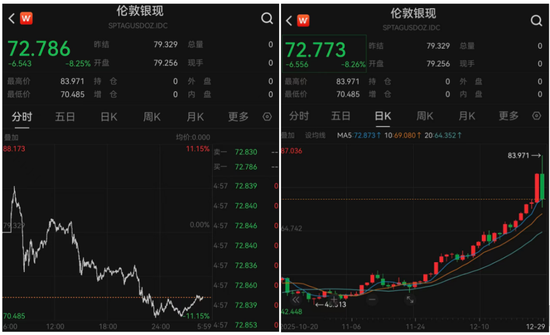
Core Viewpoint - The recent surge in metal prices, led by silver, faced a significant correction, with notable declines in silver, gold, platinum, and palladium futures and spot prices [1][3][15] Group 1: Market Movements - Spot silver initially rose nearly 6% but then fell over 8%, with an intraday drop of nearly 11%, resulting in a volatility exceeding 16 percentage points [1][15] - Spot gold and Comex gold experienced a decline of nearly $200, with a daily drop exceeding 4% [3][15] - Platinum and palladium saw declines of nearly 13% and over 15%, respectively [3][15] Group 2: Margin Adjustments - CME Group announced an increase in margin requirements for silver, gold, platinum, palladium, and lithium carbonate contracts, effective after the close on December 29 [3][15] - This adjustment is a typical response to speculative trading in futures markets, aimed at reducing market disorder risks [5][17] Group 3: Historical Context - Historical peaks in silver prices in 1980 and 2011 were closely associated with CME's margin adjustments, which led to significant market corrections [5][18] - The infamous "Hunt brothers silver crisis" in the 1970s involved massive speculation that drove silver prices from $6 to nearly $50, prompting the NYMEX to raise margins and restrict trading [7][20] Group 4: Supply and Demand Dynamics - Unlike previous speculative-driven surges, the current rise in silver prices is supported by tightening physical supply, indicating a structural supply-demand imbalance [8][21] - Silver's industrial applications, particularly in solar panels and electric vehicles, contribute to its demand, while its lower price compared to gold makes it attractive to retail consumers [8][21] Group 5: Market Size and Strategic Reserves - The total value of silver stored in London is approximately $65 billion, significantly smaller than gold's nearly $1.3 trillion value [12][24] - Unlike gold, which has substantial strategic reserves held by central banks, silver lacks such a safety net, making it more vulnerable to market fluctuations [12][24]
黄金、白银遭遇“黑色星期一”
财联社· 2025-12-29 23:30
Core Viewpoint - The recent surge in metal prices, particularly silver, has faced a significant correction, with notable declines in both futures and spot markets for precious metals [1][3]. Group 1: Market Movements - Silver experienced a dramatic fluctuation, initially rising nearly 6% before dropping over 8%, with an intraday decline of nearly 11%, resulting in a volatility exceeding 16 percentage points [1]. - Gold also saw a substantial drop, with spot and Comex gold prices falling nearly $200, representing a daily decline of over 4% [3]. - Platinum and palladium products recorded declines of nearly 13% and over 15%, respectively [3]. Group 2: Margin Adjustments - The Chicago Mercantile Exchange (CME) announced an increase in margin requirements for popular contracts including silver, gold, platinum, and palladium, effective after the close on December 29 [3]. - This adjustment is a typical response to speculative trading in futures markets, aimed at reducing market disorder risks [5]. Group 3: Historical Context - Historical instances of silver price surges, particularly in 1980 and 2011, were closely linked to CME's margin adjustments, which were implemented to curb excessive leverage in the market [5]. - The infamous "Hunt brothers silver crisis" in the 1970s involved significant speculation that led to rapid price increases, followed by drastic margin hikes that forced liquidation [8][9]. Group 4: Supply and Demand Dynamics - Unlike previous speculative-driven surges, the current increase in silver prices is supported by a tightening of physical supply, indicating a structural supply-demand imbalance [10]. - Silver's industrial applications, particularly in electronics and solar energy, contribute to its demand, while its lower price compared to gold makes it attractive to retail consumers [10]. - The profitability of the solar industry has significantly decreased, with profits dropping from $31 billion to $16 billion over the past year, raising concerns about the sustainability of high silver prices [10]. Group 5: Market Size and Liquidity - The total value of silver stored in London is approximately $65 billion, significantly smaller than gold's value of nearly $1.3 trillion, which affects market dynamics [14]. - Unlike gold, silver lacks a strategic reserve that can be leveraged during liquidity crises, making its market more susceptible to volatility [14].

贵金属“巨震星期一”:现货白银从+6%到-8%,金铂钯同步跳水
Feng Huang Wang· 2025-12-29 22:52
Core Viewpoint - The recent surge in metal prices, particularly silver, has faced a significant correction, with notable declines in both futures and spot markets for silver, gold, platinum, and palladium [1][3]. Group 1: Market Movements - Spot silver initially rose nearly 6% but then fell over 8%, with an intraday drop of nearly 11%, resulting in a volatility exceeding 16 percentage points [1]. - Spot gold and Comex gold experienced a decline of nearly $200, with a daily drop exceeding 4% [3]. - Platinum and palladium saw declines of nearly 13% and over 15%, respectively [3]. Group 2: Margin Adjustments - The CME Group announced an increase in margin requirements for popular contracts including silver, gold, platinum, and palladium, effective after the close on December 29 [3]. - Historically, the CME has raised margins to reduce market disorder risks during periods of speculative trading [4]. Group 3: Historical Context - Previous surges in silver prices in 1980 and 2011 were closely linked to the CME's actions, which included multiple margin increases that led to significant price corrections [4][7]. - The "Hunt brothers' silver crisis" in the 1970s exemplifies how speculative trading can lead to drastic market corrections when exchanges impose trading restrictions [7]. Group 4: Supply and Demand Dynamics - Unlike past speculative-driven surges, the current increase in silver prices is supported by a tightening of physical supply, indicating a structural supply-demand imbalance [8]. - Silver's industrial applications, particularly in solar energy and electronics, contribute to its demand, while its lower price compared to gold makes it attractive to retail consumers [8]. - The total value of silver stored in London is approximately $65 billion, significantly smaller than gold's nearly $1.3 trillion, which affects market liquidity and stability [10].
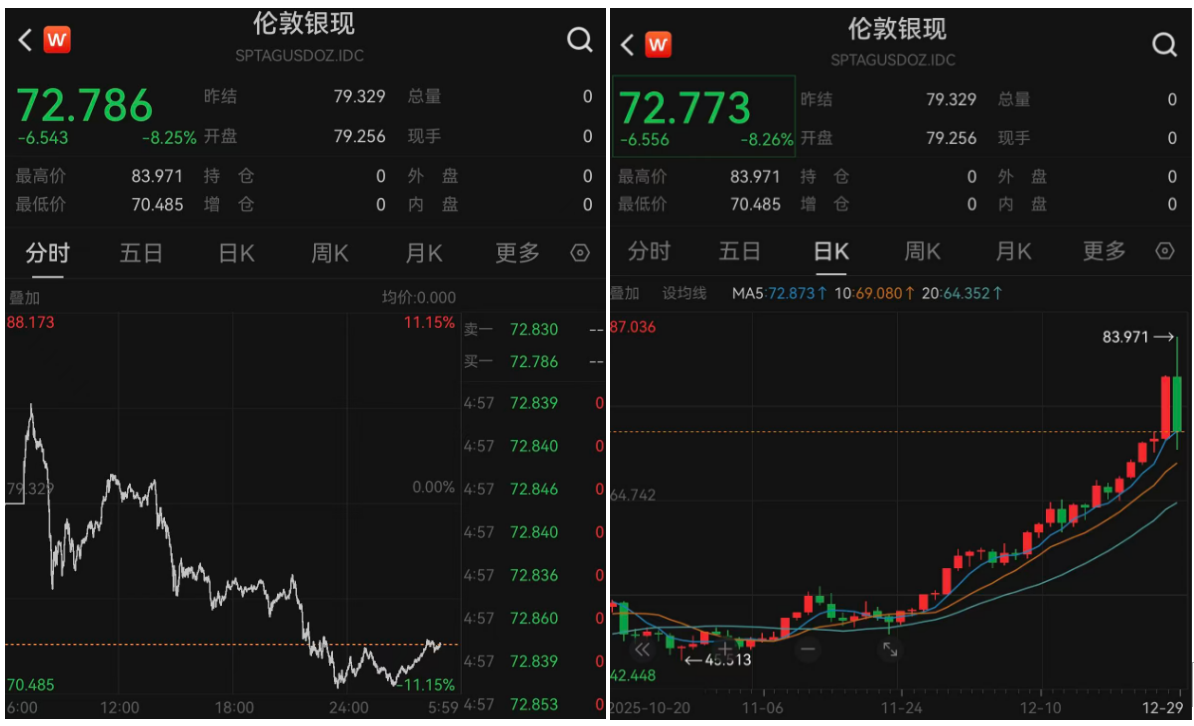
白银狂飙后跳水
Di Yi Cai Jing Zi Xun· 2025-12-29 08:24
Core Viewpoint - Silver prices have surged significantly in 2023, driven by increased global central bank purchases, ETF inflows, and the Federal Reserve's interest rate cuts, with a potential annual increase of over 160% [2][3] Group 1: Market Dynamics - Geopolitical tensions and a weakening dollar have boosted demand for silver as a safe-haven asset, contributing to its price increase [3] - The current market is characterized by a severe structural supply-demand imbalance, with global silver demand at 1.24 billion ounces and supply at only 1.01 billion ounces [3][4] - Retail investors are heavily investing in physical silver, silver ETFs, and derivatives, leading to increased trading volumes and market volatility [3][4] Group 2: Speculation and Risk - The recent price volatility has raised concerns about speculation and high leverage risks in the silver market, with analysts warning of potential market corrections [5][6] - The London silver market exhibits significant leverage, with the volume of paper silver certificates far exceeding the available physical silver, creating pressure on limited inventories [5][6] - Historical precedents indicate that similar leverage conditions have led to sharp market corrections in the past [6][7] Group 3: Regulatory Responses - The Chicago Mercantile Exchange (CME) has raised silver margin requirements by 10% and announced further increases, which could lead to forced liquidations in the market [6][7] - The Shanghai Futures Exchange has also implemented measures to adjust trading limits and margin requirements for silver futures, indicating heightened regulatory scrutiny [6][7] Group 4: Industrial Implications - The soaring silver prices and increased volatility pose challenges for industrial sectors that rely on silver, as highlighted by industry leaders like Elon Musk [7]
STARTRADER:现货白银价格现大幅波动 日内振幅近9美元!
Sou Hu Cai Jing· 2025-12-29 04:02
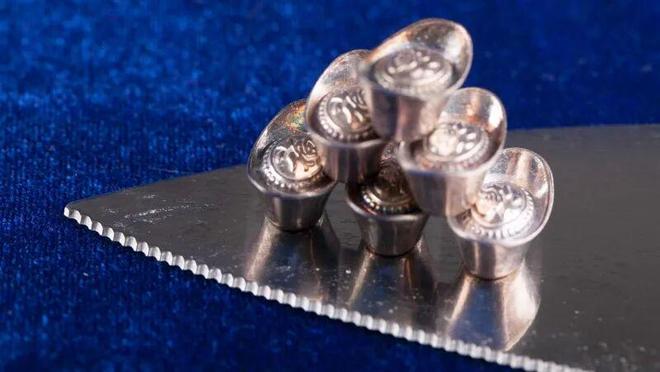
Core Viewpoint - The silver market has experienced significant volatility, with prices reaching historical highs before a sharp decline, influenced by geopolitical tensions, weak dollar performance, and year-end liquidity issues [2][3][4]. Group 1: Silver Price Movements - On December 29, spot silver prices opened rapidly, breaking through $80 per ounce and peaking at $83 per ounce, marking a daily increase of over 5% and a cumulative annual increase of $52 [1]. - Following this peak, silver prices quickly retreated, with a maximum drop of over $6 within 30 minutes, resulting in a daily fluctuation of $9, ultimately settling at $76.5 per ounce, reflecting a daily decrease of over 3% [1]. Group 2: Market Dynamics and Influences - Geopolitical tensions and a weak dollar have contributed to a strong demand for precious metals, maintaining their historical upward trend as year-end liquidity remains thin [3]. - Analysts from UBS have indicated that precious metal prices are currently at high levels, with increased short-term trading risks as investors may seek to take profits [3]. - The demand for safe-haven assets remains robust, supporting investment in gold and silver, while thin market liquidity amplifies price volatility [3]. Group 3: Supply and Demand Factors - A significant amount of liquid silver is stored in New York, awaiting results from a key U.S. Department of Commerce investigation regarding mineral imports, which could lead to adjustments in silver tariffs and other trade restrictions [3]. - Commodity analyst Manav Modi noted that the high volume of paper silver trading requires physical silver support, and current physical silver supply is insufficient to meet demand, impacting paper trading [3]. Group 4: Industrial Demand and Future Outlook - Silver prices are influenced by its industrial applications, including electrification, solar panels, electric vehicles, and data centers, with demand in these sectors driving inventory depletion [4]. - A substantial influx of capital into the precious metals market has led to rising silver prices, supported by expectations of multiple interest rate cuts by the Federal Reserve in 2026 [4]. - The primary driver of recent silver price increases is a structural supply-demand imbalance, with physical silver in short supply prompting concentrated market purchases [4]. Group 5: Investor Sentiment - According to a Kitco News annual silver survey, a majority of retail traders are optimistic about silver's performance in 2026, with expectations for further price increases [4]. - Among surveyed retail traders, 57% anticipate silver prices will exceed $100 per ounce in 2026 [5]. - Additionally, 27% expect prices to range between $80 and $100 per ounce, while 11% predict a high of $60 to $80 per ounce [6]. - A small minority, 5%, believe prices will retreat to the $40 to $60 per ounce range seen in late 2025 [7].
11月TDI出口量创单月历史最高,中国合成树脂协会倡议规范聚甲醛行业秩序:基础化工行业周报-20251228
Huafu Securities· 2025-12-28 07:48
Investment Rating - The report indicates a positive investment outlook for the basic chemical industry, with significant growth in specific sub-sectors such as TDI and synthetic resins [1][2]. Core Insights - The TDI export volume reached a historical high in November, with 56,500 tons exported, significantly exceeding previous years' totals, and is projected to continue growing [2]. - The China Synthetic Resin Association has called for the regulation of the polyoxymethylene industry to address structural supply-demand imbalances, with projected production capacity reaching 1.51 million tons per year against a demand of only 950,000 tons by 2025 [2]. - The chemical sector overall has shown strong performance, with the CITIC Basic Chemical Index rising by 5.41% this week, outperforming other indices [1][10]. Market Performance - The Shanghai Composite Index increased by 1.88%, while the ChiNext Index rose by 3.9%, indicating a bullish trend in the market [1][10]. - The top-performing sub-sectors in the chemical industry this week included membrane materials (12.18%), synthetic resins (8.23%), and phosphate fertilizers (6.5%) [1][13]. Sub-sector Summaries TDI - November TDI exports reached 56,500 tons, with a cumulative export of 506,300 tons from January to November, marking a 56.2% year-on-year increase [2]. - The average export price for TDI in October was $1,527 per ton, with a total export value of $67.1 million [2]. Polyoxymethylene - The industry faces challenges due to a projected capacity of 1.51 million tons against a demand of only 950,000 tons, leading to potential oversupply issues [2]. Tires - Domestic tire manufacturers are becoming increasingly competitive, with a focus on growth opportunities in the tire sector [2]. Phosphate Chemicals - The phosphate chemical sector is expected to benefit from environmental policies limiting supply, coupled with increasing demand from the new energy sector [4]. Vitamins - The market for vitamins is experiencing supply disruptions, particularly for Vitamin A and E, due to unforeseen circumstances affecting production [5].
比高盛乐观!花旗看好铜价至1.2万美元,锡价到4万美元
Hua Er Jie Jian Wen· 2025-10-09 07:51
Group 1 - Citi has released a bullish report on commodity prices, predicting copper prices will rise to $11,000 per ton within 0-3 months and reach an average of $12,000 per ton by Q2 2026, which is more aggressive than Goldman Sachs' forecast [1][2] - The report identifies six potential catalysts that could accelerate the $12,000 target, contrasting with Goldman Sachs' range of $10,000 to $11,000 per ton [1][2] - Citi's forecast for tin prices has been raised to $40,000 per ton, with expectations for this price level to be achieved by Q4 2025 and maintained throughout 2026, driven by Indonesia's crackdown on informal mining [2] Group 2 - Goldman Sachs views $10,000 as a "new bottom" for copper prices, supported by structural challenges in supply, with expected annual growth of only 1.5% from 2025 to 2030 [3] - The firm also identifies a "ceiling" at $11,000 due to short-term market concerns, predicting a slight surplus of 180,000 tons in 2026 [3] - Strategic reserves from countries like the US and China could absorb excess inventory, providing downward price protection, but insufficient reserves could risk prices falling below $10,000 [3]