
人民币汇率走强

Search documents
宋清辉:中国经济向好预期增强,为人民币走强提供了坚实底层支撑
Sou Hu Cai Jing· 2026-01-07 04:00
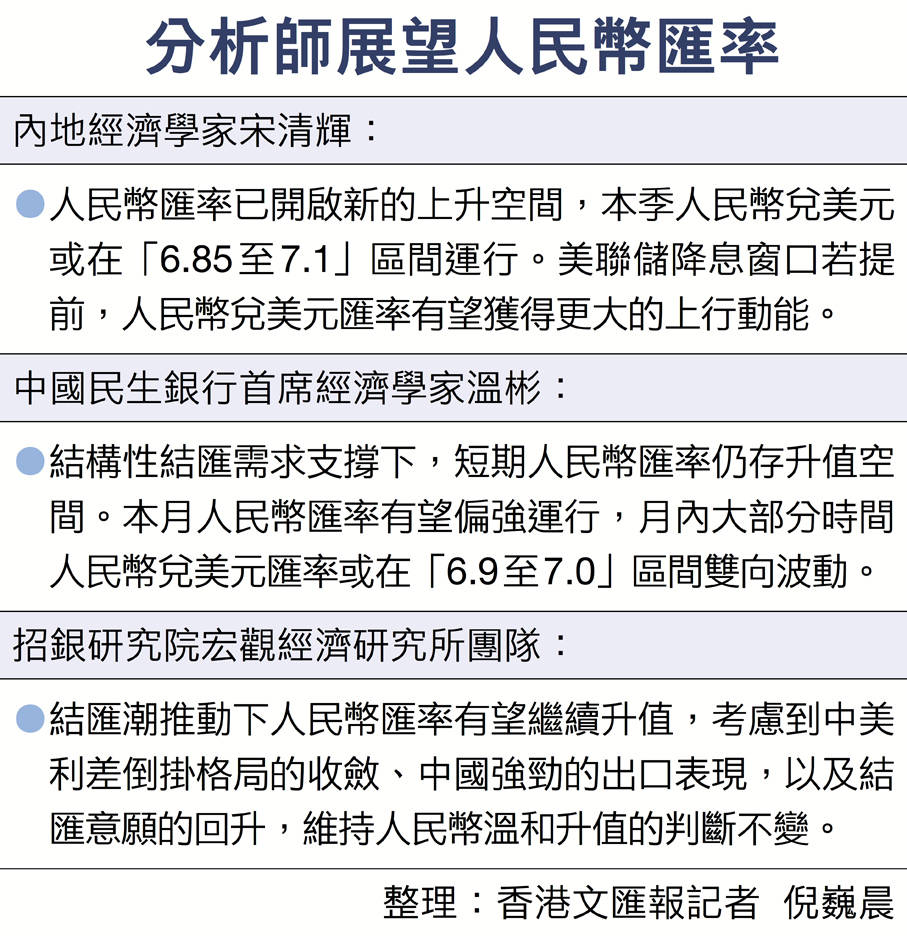
Group 1 - The core viewpoint is that multiple favorable factors are supporting the appreciation of the Renminbi, including improved macroeconomic data and increased foreign capital inflow into Chinese assets [1][3][4] - The Chinese economy is showing resilience due to the effectiveness of counter-cyclical adjustment policies, which enhances expectations for economic improvement and provides solid support for the Renminbi [1][4] - The year-end and early-year peak in corporate foreign exchange settlement activity is driving the Renminbi's appreciation against the US dollar [1][4][8] Group 2 - The recent softening of the US dollar index, which has dropped from high levels, is a significant factor contributing to the Renminbi's strength [5][6] - The A-share and Hong Kong stock markets have both started the year positively, attracting long-term foreign investment, which further benefits the Renminbi [1][3][4] - The expectation of further interest rate cuts by the Federal Reserve is influencing market sentiment and contributing to the Renminbi's appreciation [5][6] Group 3 - The Renminbi's central parity rate has reached a 15-month high, with the onshore and offshore rates also showing significant appreciation [3][6] - The recent geopolitical tensions, such as the US military action in Venezuela, have increased global risk aversion, leading to a rise in demand for safe-haven assets, including the Renminbi [7][8] - Analysts predict that the Renminbi will continue to appreciate in the short term, with potential fluctuations between 6.85 and 7.1 against the US dollar [8]

如何看待近期人民币汇率持续走强
Ren Min Ri Bao· 2025-12-30 22:10
Group 1 - The onshore RMB against the USD has strengthened, breaking the 7.0 mark for the first time since May 2023, with a rise from approximately 7.35 to around 7.01 since April 2025 [1] - The offshore RMB also broke the 7.0 mark on December 25, marking the first occurrence since September 2024 [1] - Factors driving the recent strength of the RMB include increased expectations for US Federal Reserve interest rate cuts, leading to a decline in the US dollar index by about 2.0% since late November, and a resilient Chinese economy that has prompted foreign institutions to raise their growth forecasts for China [1] Group 2 - The Central Economic Work Conference emphasized maintaining the RMB exchange rate at a reasonable and balanced level, with a focus on preventing excessive fluctuations [2] - The People's Bank of China highlighted the need for a dual-directional fluctuation and increased elasticity of the RMB exchange rate as a norm, aiming to enhance the resilience of the foreign exchange market and stabilize market expectations [2]
专家:人民币汇率走强 出口企业将面临直接压力
Xin Lang Cai Jing· 2025-12-29 11:39
Group 1 - The appreciation of the RMB will directly pressure export companies, leading to reduced foreign exchange profits during settlement [1] - Manufacturing companies that rely on imported raw materials and components will benefit significantly from the appreciation, as it lowers import costs and improves profitability [1] - Cross-border investment companies may see their returns discounted due to foreign exchange factors [1] Group 2 - The 7.0 level is a critical point for market divergence regarding the RMB exchange rate, with reduced consensus expectations after the RMB broke this level, adding uncertainty to future exchange rate trends [1] - It is likely that the RMB exchange rate will not exhibit a one-sided trend but will fluctuate around the 7.0 level [1]
股指期货周报-20251226
Rui Da Qi Huo· 2025-12-26 08:29
Report Summary 1. Investment Rating No investment rating for the industry is provided in the report. 2. Core View - A - share major indices rose collectively this week, with gains exceeding 2% for all except the Shanghai Composite Index. The four stock - index futures also rose collectively, and small - and medium - cap stocks outperformed large - cap blue - chip stocks. Market trading activity significantly rebounded compared to last week. - Overseas, Trump's statement strengthened the market's expectation that the new Fed Chairman would cut interest rates. Domestically, the economic fundamentals in November were weak, with deflation pressure remaining. The 12 - month LPR quote remained unchanged, which was in line with market expectations. Although the weak economic indicators in November exerted pressure on A - shares, positive tones from political meetings provided bottom support [7][94]. 3. Summary by Directory 3.1. Market Review | Futures/Spot | Contract/Index Name | Weekly Change (%) | Friday Change (%) | Closing Price | | --- | --- | --- | --- | --- | | Futures | IF2603 | 2.46 | 0.48 | 4638.4 | | | IH2603 | 1.50 | 0.51 | 3051.4 | | | IC2603 | 4.71 | 0.80 | 7388.0 | | | IM2603 | 4.63 | 0.57 | 7472.4 | | Spot | CSI 300 | 1.95 | 0.32 | 4657.24 | | | SSE 50 | 1.37 | 0.41 | 3045.40 | | | CSI 500 | 4.03 | 0.65 | 7458.84 | | | CSI 1000 | 3.76 | 0.35 | 7605.53 | [10] 3.2. News Overview - The 1 - year and 5 - year - plus LPR remained unchanged, which is neutral [13]. - Trump hoped the next Fed Chairman would cut interest rates when the economy and market perform well, which is neutral - to - bullish [13]. - The PBC's Q4 2025 monetary policy committee meeting proposed measures to maintain capital market stability, which is neutral - to - bullish [13]. - A large number of A - share listed companies completed private placements this year, which is neutral [13]. 3.3. Weekly Market Data - **Domestic Major Indices**: The Shanghai Composite Index rose 1.88%, the Shenzhen Component Index rose 3.53%, the STAR 50 Index rose 2.85%, the SME 100 Index rose 3.88%, and the ChiNext Index rose 3.90% [16]. - **Overseas Major Indices (as of Thursday)**: The S&P 500 rose 1.43%, the FTSE 100 fell 0.27%, the Nikkei 225 rose 2.33%, and the Hang Seng Index rose 0.50% [17]. - **Industry Sectors**: Most industry sectors rose, with non - ferrous metals and national defense and military industries leading the gains. Most industry sectors saw net outflows of main funds, with significant net outflows in computer and national defense and military industries, and significant net inflows in power equipment [21][25]. - **SHIBOR Short - term Interest Rates**: SHIBOR short - term interest rates showed differentiation, and the capital price was at a low level [29]. - **Restricted Share Unlock and Northbound Capital Transactions**: This week, major shareholders net - sold 1.1102 billion yuan in the secondary market, the restricted share unlock market value was 192.473 billion yuan, and northbound capital traded a total of 529.777 billion yuan [32]. - **Futures Basis and Spread**: The basis of the main contracts of IF, IH, IC, and IM strengthened [40][43][46][49]. 3.4. Market Outlook and Strategy - The A - share major indices rose collectively this week, and the four stock - index futures also rose. Small - and medium - cap stocks were stronger than large - cap blue - chip stocks, and market trading activity rebounded. - Overseas, Trump's statement strengthened the expectation of interest rate cuts. Domestically, the economic fundamentals in November were weak, and the 12 - month LPR remained unchanged. Although the weak economic indicators in November pressured A - shares, positive policy tones provided bottom support. The expectation of a dovish Fed Chairman led to a weaker dollar and a stronger RMB, supporting the expectation of loose monetary policy in January 2026 [94].

方正证券:人民币汇率走强 造纸板块有望受益
智通财经网· 2025-12-26 06:53
Group 1 - The core viewpoint of the report from Founder Securities indicates that rising raw material prices and a strong currency are likely to improve profitability in the paper industry, particularly benefiting integrated pulp and paper companies with high self-sourcing ratios [1] - As of December 25, 2025, the Shenwan Paper Industry Index rose by 3.68%, ranking third among Shenwan's secondary industry indices for the day [1] - The appreciation of the Renminbi is expected to benefit pulp and paper companies on the cost side, as the industry relies on approximately 60% imported pulp, leading to optimized procurement costs due to the recent currency strengthening [1] Group 2 - Overseas pulp manufacturers have continued to raise prices, with Brazil's Suzano announcing a price increase of $20 per ton for the Asian market, marking the fourth price hike in 2025 [2] - Chile's Arauco also announced a $20 per ton increase for both softwood and hardwood pulp, providing cost support for domestic paper price increases [2] Group 3 - Domestic paper companies are issuing price increase notices in response to rising raw material costs, with companies like Sun Paper, Asia Pacific Forest Products, APP (China), and Bohui Paper raising prices by 200 yuan per ton starting January 1, 2026 [3]


21社论丨增强外汇市场韧性,稳定市场预期
21世纪经济报道· 2025-12-25 23:34
Group 1 - The recent strengthening of the RMB exchange rate is attributed to a combination of internal and external factors, with a weakening US dollar index creating a favorable external environment for the RMB's appreciation [1] - The Federal Reserve's anticipated interest rate cuts, with the target range for the federal funds rate expected to drop to 3.50%-3.75% by December 2025, have contributed to a nearly 10% decline in the dollar index this year, providing passive appreciation space for non-USD currencies, including the RMB [1] Group 2 - The supply of foreign exchange from the real economy has provided short-term driving forces for the recent strengthening of the RMB, with banks reporting a cumulative settlement amount of 16.28 trillion yuan and a cumulative sale amount of 15.59 trillion yuan, resulting in a continuous surplus for seven months [2] - As the year-end approaches, foreign exchange net inflow momentum is further released, driven by foreign trade enterprises converting their foreign exchange income into RMB and some companies accelerating their settlement operations to lock in favorable exchange rates [2] Group 3 - The resilience of the Chinese economy and proactive medium- to long-term policies support the RMB's appreciation, with the Central Economic Work Conference indicating a more proactive macro policy for 2026, including continued fiscal and monetary policy support [2] - The combination of policies aimed at stabilizing growth and expanding domestic demand, along with China's advantages in market size, industrial systems, and talent, will contribute to steady economic progress, providing fundamental support for the RMB exchange rate [2] Group 4 - The strengthening of the RMB enhances the value of RMB-denominated financial assets, positively impacting China's stock and bond markets, with international investors benefiting from both asset returns and additional exchange rate gains [3] - For import enterprises, a stronger RMB reduces costs for energy, raw materials, and high-end consumer goods, while export enterprises may face pricing competition challenges, necessitating the use of foreign exchange derivatives for risk management [3] Group 5 - The People's Bank of China emphasizes the importance of guiding market expectations to prevent one-sided trends in the RMB exchange rate, with measures in place to stabilize market expectations and mitigate risks of excessive fluctuations [4] - The central bank has sufficient policy tools for timely counter-cyclical adjustments to offset market behaviors during periods of rapid and significant exchange rate movements, aiming for a stable and predictable exchange rate environment [4]
21社论丨增强外汇市场韧性,稳定市场预期
Sou Hu Cai Jing· 2025-12-25 23:10
Group 1 - The recent strengthening of the RMB exchange rate is attributed to a combination of internal and external factors, including a weakening US dollar index and favorable economic conditions in China [1][2] - The US dollar index has declined nearly 10% this year, creating a supportive environment for the appreciation of non-USD currencies, including the RMB [1] - The People's Bank of China emphasizes the importance of stabilizing market expectations and preventing one-sided trends in the RMB exchange rate, indicating readiness for counter-cyclical adjustments [4] Group 2 - The supply of foreign exchange from the real economy has provided short-term support for the RMB's appreciation, with banks reporting a cumulative settlement surplus for seven consecutive months [2] - China's economic resilience and proactive medium- to long-term policies, including more active fiscal and monetary policies, are fundamental supports for the RMB's strength [2] - The strengthening RMB enhances the value of RMB-denominated financial assets, positively impacting China's stock and bond markets, while also affecting import and export businesses differently [3][4]
中信证券:债市仍有修复空间
Sou Hu Cai Jing· 2025-12-24 00:45
Core Viewpoint - The bond market sentiment has improved recently, with the yield on 10-year government bonds stabilizing below 1.85%, and a recovery trend observed in long-term bonds, particularly a 6 basis points decline in the yield of 30-year government bonds from its recent high, reigniting expectations for a "cross-year market" [1] Group 1 - The recent strengthening of the RMB exchange rate has positively impacted the bond market, enhancing the attractiveness of RMB-denominated assets [1] - The monetary easing space has opened up, indicating potential for further recovery in the bond market [1] - Long-term bonds are expected to benefit from the narrowing of the term spread, making them more cost-effective [1]

商业航天概念股拉升,人民币对美元汇率走强
Qi Huo Ri Bao· 2025-12-16 09:35
Group 1 - A-shares experienced a collective decline on December 16, with the Shanghai Composite Index down by 1.11%, the Shenzhen Component Index down by 1.51%, and the ChiNext Index down by 2.1%, with a total market turnover of approximately 1.74 trillion yuan [1] - Aerospace electronic stocks surged, with Aerospace Electronic (600879) hitting the daily limit and achieving a turnover exceeding 10 billion yuan, closing with over 180,000 hands of orders [1] - Aerospace Electronic announced a cash capital increase of 727.5 million yuan for its subsidiary, Aerospace Changzheng Rocket Technology Co., aiming to enhance its comprehensive capabilities and address funding needs for key technology research and development [1] Group 2 - The recent strengthening of the RMB against the USD is attributed to several factors, including the Federal Reserve's interest rate cuts leading to a weaker dollar and a robust current account surplus in China, which supports the RMB's fundamentals [2] - The RMB has been considered undervalued since 2017, with a potential systemic undervaluation of approximately 6% compared to the weakening of the USD index, suggesting a significant appreciation of the RMB against the USD in the next 6 to 12 months [2]

人民币走强有助提振资本市场信心 2026年有望继续呈现双向波动
Sou Hu Cai Jing· 2025-12-02 13:52
Core Viewpoint - The recent strengthening of the RMB against the USD has garnered significant market attention, attributed to a combination of domestic economic stability and external monetary policy shifts [1][3]. Group 1: RMB Exchange Rate Dynamics - On December 1, the People's Bank of China reported the RMB's central parity rate at 7.0759 against the USD, marking a 30 basis point increase from the previous trading day, reaching its highest level in over a year [1]. - In November, the RMB appreciated nearly 0.48% against the USD, with an intra-day peak of 7.0738, the highest since October of the previous year [1]. - Factors contributing to the RMB's strength include a solid domestic economic foundation, with a bank settlement surplus of USD 80.9 billion in the first ten months, and a resilient export sector driving continuous demand for currency exchange [1][3]. Group 2: Impact of US Monetary Policy - Recent statements from several Federal Reserve officials have reinforced expectations for policy easing, with an 80% probability of a 25 basis point rate cut in December [2][3]. - The Fed's dovish stance, including two rate cuts since September and expectations for further easing, supports the RMB's appreciation against the backdrop of a declining USD index [1][2]. Group 3: Implications for A-shares - The strengthening RMB is expected to positively impact A-shares by enhancing the attractiveness of RMB-denominated assets, potentially leading to increased foreign capital inflows [4]. - Historical data indicates that previous RMB appreciation cycles have coincided with bullish trends in A-shares, with the CSI 300 index showing a median annualized return of 29.8% during such periods [4]. - However, the relationship between stock and currency markets has weakened in recent years, with A-share performance increasingly dependent on economic fundamentals and industry competitiveness [4]. Group 4: Future Outlook for RMB and Economic Resilience - Short-term forecasts suggest the RMB will maintain a strong position, with limited likelihood of breaching the 7.0 mark before year-end, while medium to long-term trends may benefit from improved cross-border payment systems and accelerated de-dollarization [3][4]. - Analysts predict that by 2026, the RMB may experience a dual-directional fluctuation around a reasonable equilibrium level, supported by robust domestic economic fundamentals and effective regulatory measures [4].