
美国债务担忧

Search documents
机构看金市:11月14日
Xin Hua Cai Jing· 2025-11-14 03:23
Core Viewpoint - The long-term logic of precious metals remains unchanged, but the market is entering a data-dependent phase, leading to increased volatility and caution in investment timing [1]. Group 1: Market Analysis - The precious metals market experienced significant volatility, with a notable rise during Asian trading hours followed by a decline in U.S. trading hours, influenced by the simultaneous drop in U.S. stocks, bonds, and the dollar [1]. - The end of the U.S. government shutdown has led to uncertainty regarding economic data, with concerns that the upcoming non-farm payroll and inflation data may never be released, impacting market sentiment [2]. - The recent government shutdown has raised fears about potential weaknesses in U.S. economic and employment data, contributing to instability in risk assets and a simultaneous decline in both the dollar and gold prices [2]. Group 2: Future Outlook - The unsustainable growth of U.S. government debt is becoming a focal point for the precious metals market, with expectations that this political environment will favor hard assets like gold and silver [3]. - The recent surge in gold prices is attributed to structural changes globally rather than speculative frenzy or inflation fears, indicating that the rise is just the beginning of a longer trend [4]. - Long-term supporting factors for gold, such as sovereign debt, currency devaluation, geopolitical tensions, and the weaponization of the monetary system, are intensifying and remain unresolved [4].
金价,突发!史上首次!
Hang Zhou Ri Bao· 2025-10-07 03:45
Core Viewpoint - International gold prices have reached a historic high, touching $4000.1 per ounce for the first time, driven by various geopolitical and economic factors, including the ongoing U.S. government shutdown and expectations of multiple interest rate cuts by the Federal Reserve [1][3]. Group 1: Market Dynamics - The recent surge in gold prices is attributed to increased investor demand for safe-haven assets amid geopolitical tensions and economic uncertainties [3]. - As of October 7, 2023, the December gold futures price on the New York Commodity Exchange was reported at $3999.9 per ounce, reflecting a 0.59% increase [3]. Group 2: Future Price Predictions - BMO Capital Markets has significantly raised its price forecasts for gold and silver, predicting an average gold price of $3900 per ounce in Q4 2025, an 8% increase from previous estimates, and $4400 per ounce in 2026, a 26% increase [4]. - UBS has also released a bullish outlook for the gold market, forecasting that gold prices will reach $4200 per ounce by mid-2026, supported by a weaker dollar, central bank purchases, and increased ETF investments [4].


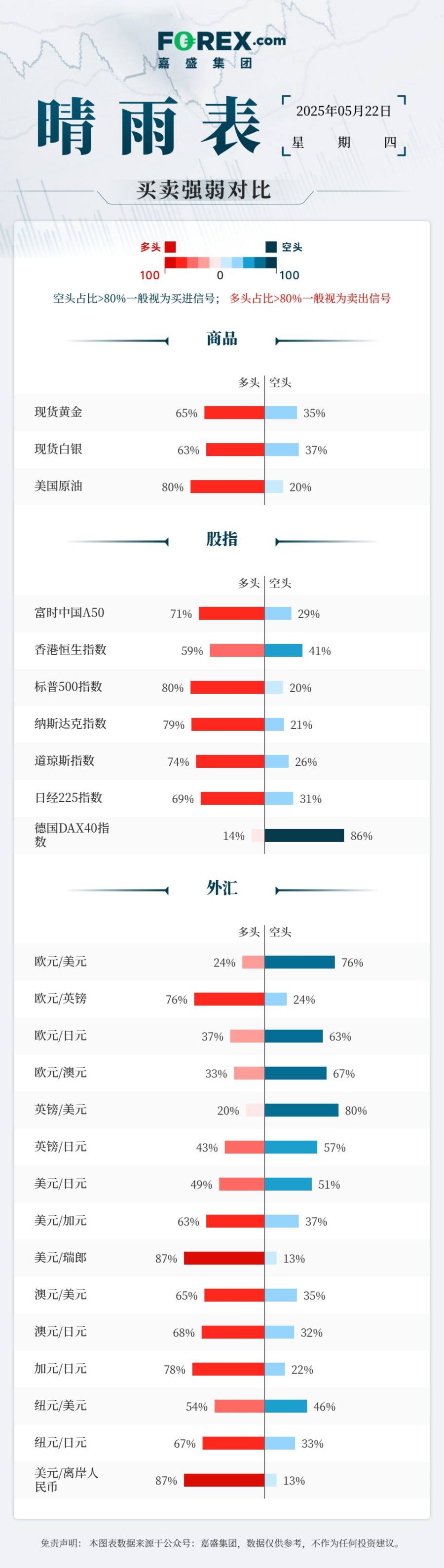
美国债务担忧加剧,投资者从国债中撤资,转向避险黄金,不确定性扩散为黄金多头撑腰、施压美股股指,纳指卖出信号逼近,后市情绪如何?欢迎前往“数据库-嘉盛市场晴雨表”查看并订阅(数据每10分钟更新1次)
news flash· 2025-05-22 02:34
Group 1 - Concerns over U.S. debt are increasing, leading investors to withdraw from government bonds and shift towards safe-haven gold [1] - The uncertainty in the market is supporting bullish sentiment for gold while putting pressure on U.S. stock indices, with sell signals approaching for the Nasdaq [1] Group 2 - The Hang Seng Index shows a bullish sentiment of 41% and bearish sentiment of 59% [3] - The S&P 500 Index has a bullish sentiment of 20% and bearish sentiment of 80% [3] - The Nasdaq Index indicates a strong bullish sentiment of 79% and a bearish sentiment of 21% [3] - The Dow Jones Index has a bullish sentiment of 74% and bearish sentiment of 26% [3] - The Nikkei 225 Index shows a bullish sentiment of 69% and bearish sentiment of 31% [3] - The DAX 40 Index has a bullish sentiment of 14% and bearish sentiment of 86% [3] Group 3 - In the forex market, the Euro/USD pair has a bullish sentiment of 24% and bearish sentiment of 76% [3] - The Euro/GBP pair shows a bullish sentiment of 76% and bearish sentiment of 24% [3] - The Euro/JPY pair has a bullish sentiment of 37% and bearish sentiment of 63% [3] - The Euro/AUD pair indicates a bullish sentiment of 33% and bearish sentiment of 67% [3] - The GBP/USD pair shows a bullish sentiment of 20% and bearish sentiment of 80% [3] - The GBP/JPY pair has a bullish sentiment of 43% and bearish sentiment of 57% [3] - The USD/JPY pair indicates a nearly balanced sentiment with 49% bullish and 51% bearish [3] - The USD/CAD pair shows a bullish sentiment of 63% and bearish sentiment of 37% [3] - The USD/CHF pair has a bullish sentiment of 13% and bearish sentiment of 87% [3] Group 4 - The AUD/USD pair shows a bullish sentiment of 35% and bearish sentiment of 65% [4] - The AUD/JPY pair has a bullish sentiment of 32% and bearish sentiment of 68% [4] - The CAD/JPY pair indicates a bullish sentiment of 22% and bearish sentiment of 78% [4] - The NZD/USD pair shows a bullish sentiment of 54% and bearish sentiment of 46% [4] - The NZD/JPY pair has a bullish sentiment of 67% and bearish sentiment of 33% [4] - The USD/CNH pair indicates a strong bullish sentiment of 87% and bearish sentiment of 13% [4]
穆迪降级引发震动!30年期美债收益率升至5%,“抛售美国”交易卷土重来
智通财经网· 2025-05-19 07:09
Core Viewpoint - Moody's downgrade of the U.S. sovereign credit rating from Aaa to Aa1 has intensified concerns regarding U.S. debt, leading to a rise in long-term U.S. Treasury yields, which briefly reached the psychological level of 5% [1] Group 1: Impact of Credit Rating Downgrade - The downgrade is attributed to the expanding U.S. budget deficit, with little sign of contraction, as noted by Moody's [1] - Major investors are beginning to shift from U.S. Treasuries to other safe-haven assets, which may lead to rising debt servicing costs and a potential dangerous upward spiral in bond yields [2] - Analysts expect 10-year and 30-year U.S. Treasury yields to rise by an additional 5-10 basis points due to the downgrade [2] Group 2: Market Reactions - The S&P 500 futures fell nearly 1%, and Nasdaq 100 futures dropped by 1.2% following the downgrade announcement [3] - The Bloomberg Dollar Index is nearing its low from April, reflecting a pessimistic sentiment among options traders, the lowest in five years [2] Group 3: Economic Concerns - The U.S. federal budget deficit is approaching $2 trillion annually, exceeding 6% of GDP, with projections indicating that federal debt could surpass 107% of GDP by 2029 [4] - Moody's forecasts that the federal deficit will expand to nearly 9% of GDP by 2035, driven by increased debt interest payments and welfare spending [4] Group 4: Legislative Outlook - Despite the downgrade, there is an expectation that lawmakers will continue to push for a large tax and spending bill, potentially increasing federal debt by trillions [5] - Barclays analysts believe that the downgrade will not significantly alter congressional voting outcomes or trigger forced selling of U.S. Treasuries [5] Group 5: Foreign Investment Trends - Reports indicate that China reduced its holdings of U.S. Treasuries in March, raising concerns about its decreasing exposure to U.S. debt and the dollar [5] - However, data from the U.S. Treasury shows strong foreign demand for U.S. government bonds, indicating no significant aversion from investors [5]
美债压力接棒关税!穆迪下调美国评级后,“抛售美国资产”情绪小幅升温!
贝塔投资智库· 2025-05-19 04:17
Core Viewpoint - The recent downgrade of the U.S. government credit rating by Moody's has raised concerns about U.S. debt and its implications for the financial markets, leading to increased volatility in U.S. assets [1][2]. Group 1: U.S. Debt Concerns - Moody's downgraded the U.S. government credit rating from Aaa to Aa1, citing persistent budget deficits and a lack of signs of narrowing deficits [1]. - The U.S. federal budget deficit is approaching $2 trillion annually, exceeding 6% of GDP, with projections indicating it could reach nearly 9% of GDP by 2035 [4]. - The Congressional Budget Office warned that U.S. government debt could exceed post-World War II record levels, reaching 107% of GDP by 2029 [4]. Group 2: Market Reactions - Following the downgrade, U.S. stock and bond futures fell, with the 10-year U.S. Treasury yield rising to 4.49% amid low trading volumes [1]. - Analysts expect the 10-year and 30-year U.S. Treasury yields to rise by 5-10 basis points due to the downgrade, with the 30-year yield potentially exceeding 5% [2]. - The Bloomberg Dollar Index is nearing its lowest point since April, reflecting growing skepticism about the dollar amid rising debt concerns [2]. Group 3: Investor Sentiment - Large investors, including sovereign funds and institutional investors, are beginning to replace U.S. Treasuries with other safe-haven assets, which may lead to rising debt servicing costs [2]. - Despite the downgrade, Barclays analysts believe it will not significantly impact congressional voting outcomes or lead to forced selling of Treasuries [5]. - The demand for U.S. government securities remains strong, indicating no immediate signs of a sell-off, despite concerns over trade tensions and fiscal irresponsibility [5].

美债压力接棒关税!穆迪下调美国评级后,“抛售美国资产”情绪小幅升温
Zhi Tong Cai Jing· 2025-05-19 00:35
Group 1 - The core issue affecting investors is the downgrade of the US government's credit rating by Moody's from Aaa to Aa1, attributed to the growing budget deficit with no signs of narrowing [1][4][5] - The 10-year US Treasury yield rose to 4.49%, with expectations that yields for both 10-year and 30-year bonds could increase by 5-10 basis points due to the downgrade [2][6] - Concerns about the US fiscal trajectory are leading large investors to shift from US Treasuries to other safe-haven assets, potentially increasing debt repayment costs and creating a "bear steepening" spiral for US yields [2][4] Group 2 - The US federal budget deficit is projected to exceed $2 trillion annually, surpassing 6% of GDP, with expectations that it could reach nearly 9% of GDP by 2035 [4][5] - Despite the significant deficit, there are indications that lawmakers may continue to pursue a large tax and spending bill, which could add trillions to federal debt over the next decade [6] - The demand for US government securities remains strong, indicating no immediate signs of a sell-off, despite concerns about fiscal irresponsibility and trade tensions [6][7]