
负实际利率

Search documents
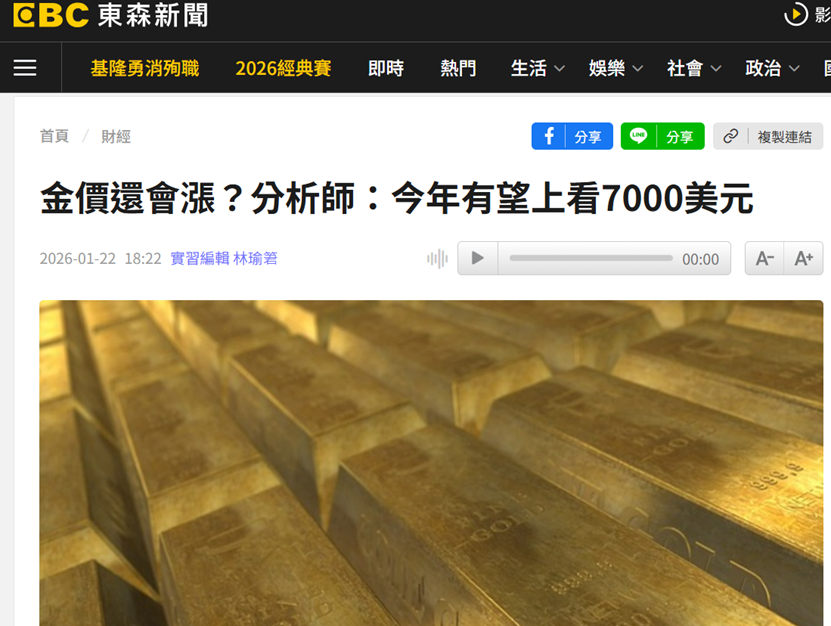
金价连续3天刷新历史新高,有分析师看高至每盎司7150美元
Huan Qiu Wang· 2026-01-23 01:16
Group 1 - International precious metals futures experienced a general increase, with COMEX gold futures rising by 2.09% to $4938.40 per ounce and COMEX silver futures increasing by 3.86% to $96.22 per ounce, driven by heightened geopolitical risks and policy uncertainties [1] - The demand for safe-haven assets has surged, leading to gold futures breaking the $4900 mark for the first time, marking a historical high for three consecutive days [1] - Analysts from the London Bullion Market Association (LBMA) predict that gold prices may exceed $5000 per ounce this year, with some forecasts suggesting a potential rise to $7150 per ounce [1] Group 2 - Central bank purchases of gold are expected to drive price increases in 2023 and 2024, with private sector demand anticipated to accelerate growth in 2025 [4] - Private investors are diversifying their gold investments through various channels, with ETF inflows being a significant indicator of this trend [4] - The precious metals market had a historically significant year, with silver prices nearly doubling and gold prices increasing by approximately 60%, although similar growth rates may not be replicated in the future [4]

当财政部与美联储决定让经济“过热”,黄金剑指6000美元?
Hua Er Jie Jian Wen· 2026-01-22 13:55
Core Viewpoint - The shift in U.S. economic policy towards aggressive stimulus strategies may drive gold prices to a historic high of $6,000 per ounce by 2026, as predicted by financial analyst Craig Hemke [1][2]. Group 1: Policy Shift - The U.S. economic policy is undergoing a fundamental reversal from fiscal tightening to a strategy aimed at "overheating" the economy to alleviate debt burdens [3]. - The current administration has abandoned previous plans for budget balancing and fiscal restraint, opting instead for rapid GDP growth to dilute debt pressure [3]. - A new Federal Reserve chair, expected to be appointed by Trump in May, is anticipated to align closely with the Treasury to stimulate short-term growth through interest rate cuts [1][3]. Group 2: Potential Tools - The aggressive growth strategy may lead to rising inflation and long-term interest rates, prompting the Federal Reserve to consider implementing yield curve control [4]. - Yield curve control would involve setting a cap on long-term interest rates, such as 4% for 10-year Treasury bonds, to maintain low nominal rates while inflation rises [4]. - This scenario could result in negative real interest rates, historically favorable for gold prices [4]. Group 3: Central Bank Demand - Global central bank demand for gold has reached record levels, driven by concerns over the safety of dollar assets, particularly following geopolitical tensions [5][6]. - The Polish central bank's recent announcement to purchase an additional 150 tons of gold highlights ongoing strong demand, which is expected to continue supporting gold prices [6]. - The combination of robust central bank buying and strong industrial demand for silver positions the precious metals market for a long-term bull market starting in 2024 [6].
日元空头共识渐成:2026年或跌破160大关,日本央行谨慎政策难解困局
Hua Er Jie Jian Wen· 2025-12-26 12:55
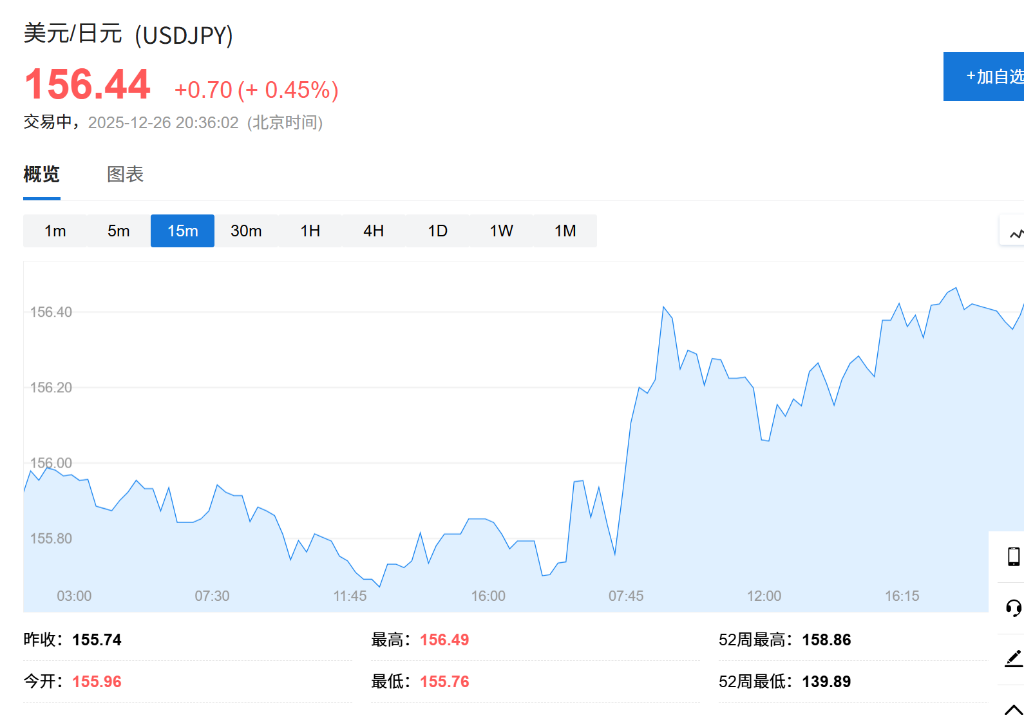
Core Viewpoint - The market sentiment towards the Japanese yen is increasingly bearish, with major institutions predicting a significant depreciation against the US dollar by the end of 2026, driven by high interest rate differentials and negative real interest rates [1][3]. Group 1: Market Predictions - Major institutions like JPMorgan and BNP Paribas forecast that the yen will fall below 160 against the dollar by the end of 2026, with some predictions as low as 164 [1][3]. - The yen has only seen a marginal increase of less than 1% against the dollar this year, failing to recover from a four-year decline, and currently hovers around 156, close to its early year low of 158.87 [1][3]. Group 2: Economic Fundamentals - The fundamental weakness of the yen is a primary concern, with predictions that this situation will not improve significantly in the near future [3][5]. - The cyclical forces are expected to turn increasingly unfavorable for the yen, as the market prices in higher interest rates in other regions, limiting the impact of the Bank of Japan's tightening policies [3][5]. Group 3: Capital Outflow - Domestic capital outflow is a significant factor pressuring the yen, with retail investors maintaining high levels of overseas stock investments, around 9.4 trillion yen (600 billion) [4]. - Japanese companies are also increasingly investing abroad, with direct investment levels remaining stable and M&A activity reaching new highs, further exacerbating the yen's depreciation [4]. Group 4: Intervention Risks - The risk of official intervention has resurfaced as the yen approaches levels that previously triggered government action, but market experts believe that mere intervention may not reverse the structural depreciation trend [6]. - Despite warnings from officials about excessive speculation, the market remains volatile, and simple smoothing operations may not be effective in changing the yen's downward trajectory [6].
困境与破局:美联储的“财政囚徒”困境与金银的宏观机遇
雪球· 2025-12-10 08:36
Core Viewpoint - The article discusses the challenges faced by the Federal Reserve in managing monetary policy amid persistent inflation and rising debt levels, suggesting a shift towards a "fiscal dominance" scenario that could benefit gold and silver as key investment assets [2][4]. Group 1: Monetary Policy Challenges - The expectation of returning to a low interest rate environment is unrealistic, as the structural changes in inflation and labor shortages make the 2% inflation target unattainable [2]. - Even if the Federal Reserve initiates rate cuts, the terminal rate is likely to remain above 3%, indicating a need to adapt to a "higher for longer" interest rate environment [2][3]. Group 2: Fiscal Implications - The U.S. faces significant fiscal challenges with a national debt of $38 trillion, projected to reach $41 trillion, leading to exponentially increasing interest payments that could exceed $1 trillion annually [3]. - If interest rates remain above 3.5%, the cost of debt servicing could consume a substantial portion of fiscal revenue, potentially leading to a debt spiral [3]. Group 3: Potential Policy Responses - Historical precedents suggest that the Federal Reserve may prioritize government credit over strict inflation targets, potentially leading to forced rate cuts even if inflation is not fully under control [3]. - This approach could result in "financial repression," where nominal interest rates are kept artificially low, diluting national debt but risking damage to the dollar's credibility and uncontrolled inflation expectations [4]. Group 4: Investment Outlook - Under the described macroeconomic conditions, gold and silver are positioned not just as traditional safe-haven assets but as essential tools against the devaluation of fiat currency, with a potential target price for gold reaching $10,000 [4].
