贵金属牛市行情

Search documents
复盘贵金属巨震!一场避险天堂的流动性压力测试
Di Yi Cai Jing Zi Xun· 2026-02-02 23:38
Core Viewpoint - The precious metals market experienced significant volatility following a panic sell-off, with silver showing over 8% price swings and other metals like platinum and palladium rebounding nearly 10% from early lows. Analysts are divided on the market outlook, with many believing the current downturn is temporary but suggesting that bottom-fishing may need to wait [1][2]. Market Performance - After a drop of over 5%, COMEX futures for February delivery recovered to $4,700, following an 11% plunge last Friday, marking the worst single-day performance since 1980. Gold futures hit a high of $5,626.80 per ounce but have since fallen 17% from that peak [2]. - UBS analysts predict gold prices will exceed $6,200 per ounce later this year, while JPMorgan forecasts a year-end price of $6,300 per ounce. Deutsche Bank maintains a $6,000 per ounce prediction based on sustained investor demand [2]. Market Dynamics - Short-term market volatility is expected to remain high, with the potential for further sell-offs due to ETF and options position liquidations triggering cascading futures market sell-offs. The risk of additional rounds of selling remains elevated, as crowded and one-sided trading positions have not been substantially reversed [3]. - Citigroup warns that gold valuations have reached extreme levels, with global gold expenditure as a percentage of GDP soaring to 0.7%, the highest in 55 years. A return to historical norms could pose a risk of significant price declines [3]. Influencing Factors - Future trends in the precious metals market will depend on the monetary policy path under the new Federal Reserve chair, the movements of the dollar and real interest rates, ETF fund flows, and central bank gold purchasing patterns [4]. - The recent sell-off resulted in an evaporation of $8 trillion in market value for gold and silver, highlighting the liquidity issues that arise when large amounts of capital attempt to exit the same type of "safe-haven" trades simultaneously [4]. Investment Behavior - The sell-off has revealed pressure on holdings in gold, while silver's performance has exposed liquidity pressures in the market. The focus should shift from "what to buy" to "what type of buyer you are" to avoid blind trading during market turmoil [5][6]. - Buyers sensitive to price, typically long-term holders, should consider transactions from a value and asset allocation perspective, while liquidity-sensitive holders, such as those using futures or options, are driven by volatility and risk management rules [6]. Market Insights - The recent precious metals crash serves as a stress test for the market, demonstrating that even traditionally safe assets can become volatile when everyone relies on them for hedging. The true "safe signal" for the market will be a decrease in volatility rather than a price rebound [6].
白银逼空到底是怎么一回事
Sou Hu Cai Jing· 2025-12-10 09:17
Group 1 - The core issue of the silver market is a short squeeze, where traders who bet on falling prices are forced to buy back contracts at higher prices due to a shortage of available silver, creating a vicious cycle of rising prices [1] - The trigger for this situation was the Diwali festival in India, where a social media influencer encouraged buying silver, leading to a surge in demand. Local silver ETFs received $500 million in buy applications in a single day, three times more than the same period in previous years [1] - Major Indian funds halted new applications due to insufficient physical silver to meet demand, further fueling the perception of scarcity and leading to a global rush for silver, with some traders even flying silver bars across the Atlantic to profit from price differences [1] Group 2 - The U.S. economy and job market are facing challenges from government shutdowns and trade tensions, while the Federal Reserve's mixed signals are increasing short-term policy uncertainty [3] - Geopolitical risks and financial institution failures are prompting central banks to increase gold holdings, which may drive a reallocation towards precious metals, potentially leading to a bull market similar to the 1970s [3] - Historical trends suggest that after reaching new highs, gold prices may face a 2-3 month consolidation period before new upward momentum develops, particularly around December [3] Group 3 - The strong U.S. dollar is adding pressure for price corrections, but there remains buying interest at lower levels, indicating potential for short-term volatility in international gold prices [4] - If gold prices drop below $3,900 (900 yuan), it may present a buying opportunity, with expectations of a primarily consolidating trend in the future [4]


俄乌和平推进慢,利好黄金
Sou Hu Cai Jing· 2025-11-28 09:15
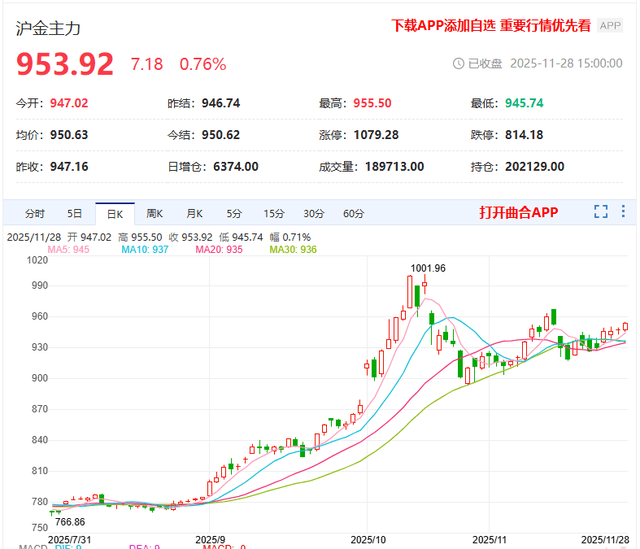
Group 1 - The likelihood of a ceasefire agreement between Russia and Ukraine in the short term is very low due to fundamental disagreements over core interests, particularly territorial and sovereignty issues [1] - Russia demands the withdrawal of Ukrainian forces from four regions and recognition of its control over these areas, while Ukraine firmly refuses to acknowledge any territorial loss [1] - Disagreements over military and alliance issues further complicate the situation, with Ukraine opposing any limitations on its military size and NATO membership, which Russia sees as essential for a ceasefire [1] Group 2 - The overall financial market continues to experience risk-averse sentiment, which is favorable for gold, as evidenced by a 0.76% increase in gold prices [2] - The U.S. economy and job market are facing challenges from government shutdowns and trade tensions, leading to increased uncertainty in monetary policy, which may drive demand for gold [4] - Historical patterns suggest that after reaching new highs, gold prices may face a 2-3 month consolidation period, with potential buying opportunities if prices drop below $3900 [5]
3大原因助推美指,黄金快跌
Sou Hu Cai Jing· 2025-11-20 08:58
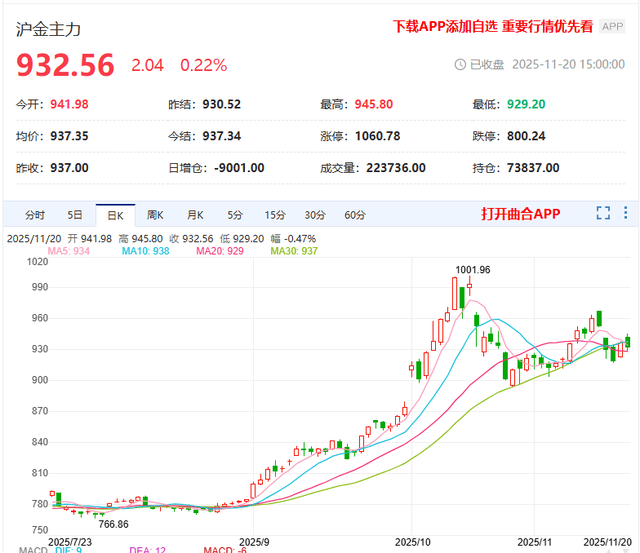
Group 1 - The US dollar index has risen above the 100 mark again, negatively impacting gold and silver prices due to three main reasons [1] - The first reason is the significant cooling of the Federal Reserve's rate cut expectations for December, with many officials suggesting maintaining rates through 2025, leading to a stronger dollar [1] - The second reason is the delayed release of non-farm payroll data, which hinders policy judgment and creates uncertainty, further strengthening the dollar [1] Group 2 - The weakness of non-US currencies has also contributed to the strength of the dollar, with the euro and British pound showing declines due to economic concerns in their respective regions [2] - The ongoing economic recovery in the Eurozone remains insufficient, and market confidence is low, which has led to a weaker euro against the dollar [2] - The British pound has also faced downward pressure due to fiscal concerns, highlighting the dollar's strength in comparison [2] Group 3 - The gold market has shown a slight increase, with prices rising by 0.22% to 932.56 yuan per gram [4] - Despite the short-term uncertainties in the market, there is potential for a long-term bullish trend in precious metals, reminiscent of the 1970s, driven by increased central bank purchases [6] - The market is expected to experience wide fluctuations in the short term, with a potential buying opportunity if gold prices drop below $3,900 (900 yuan) [6]
金价突然大涨2%!日内急涨80美元
Sou Hu Cai Jing· 2025-11-10 10:17
Core Viewpoint - Gold prices have been rising due to multiple factors including a weakening US dollar index, a shift in Federal Reserve policy, easing government shutdown concerns, increased global central bank gold purchases, and heightened geopolitical risks driving safe-haven demand [1][2][3] Group 1: Gold Price Movements - On November 10, international gold prices surged, with spot gold increasing by $80 per ounce, surpassing $4080 per ounce, marking a rise of over 2% [1] - As of the report, spot gold prices rose by 2.05% to $4082.75 per ounce, while spot silver prices increased by over 3% to $49.799 per ounce [1] - Year-to-date, gold prices have accumulated a rise of over 55%, despite a recent decline from a historical high of over $4381 per ounce on October 20 [1] Group 2: Market Analysis and Predictions - According to Guangfa Futures, the US economy and job market are under pressure from government shutdowns and trade tensions, leading to increased uncertainty in short-term policies [2] - The report suggests that more central banks are increasing gold holdings, which may drive precious metals to experience a bull market similar to the 1970s [2] - The market may face 2-3 months of consolidation after reaching new highs, with potential buying opportunities if gold prices drop below $3900 per ounce [2] Group 3: Future Outlook for Gold - CICC's research indicates that gold is expected to continue its upward trend, supported by structural and cyclical opportunities [3] - The trend of de-globalization and strategic security concerns may provide long-term support for emerging market central banks to increase gold reserves [3] - Economic growth pressures in the US may persist into the first half of next year, with the Federal Reserve potentially resuming rate cuts and ending balance sheet reduction, which could support investment demand for gold ETFs [3]
美元指数大涨,黄金驻足不前
Sou Hu Cai Jing· 2025-11-05 09:02
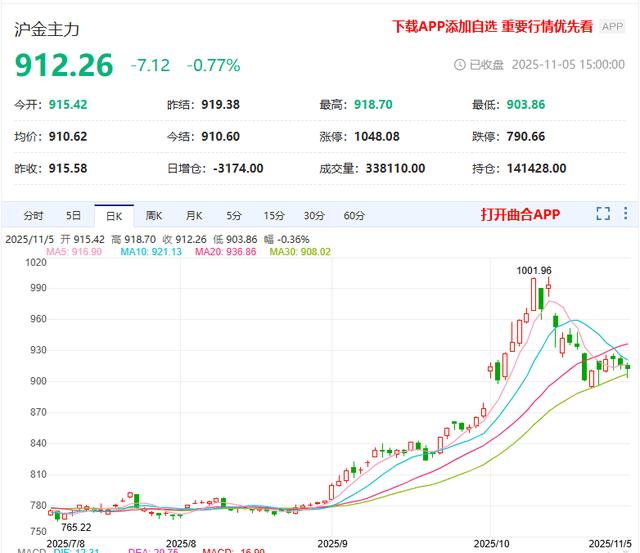
Group 1 - The core reason for the rise in the US dollar index is attributed to the Federal Reserve's hawkish stance, with market expectations for a December rate cut dropping from 95% to 67% after Powell's comments, leading to a surge in the 10-year Treasury yield from 3.8% to 4.11% [1] - The ongoing "cash crunch" in the US money market, exacerbated by the government shutdown, has led to a significant increase in secured overnight financing rates (SOFR), which rose by 18 basis points, the largest single-day increase since March 2020, enhancing the attractiveness of the dollar [1] - Weakness in non-US currencies, particularly the Japanese yen and British pound, along with a decline in the euro, has contributed to the strengthening of the dollar index [1] Group 2 - The rise in the US dollar index has limited the upward movement of gold prices, resulting in a continued correction in the gold market [2] - The Shanghai gold price has decreased by 0.77%, closing at 912.26 yuan per gram [4] Group 3 - The US economy and job market are facing challenges from the government shutdown and trade tensions, while the Federal Reserve's hawkish signals have increased short-term policy uncertainty [6] - Geopolitical risks and financial institution failures are prompting more central banks to increase gold holdings, suggesting a potential long-term bullish trend for precious metals similar to the 1970s [6] - Short-term fluctuations in international gold prices are expected, with a potential buying opportunity if prices drop below $3,900 (900 yuan), while the market is likely to experience a consolidation phase [6]
机构出现对黄金的分歧
Sou Hu Cai Jing· 2025-10-10 09:01
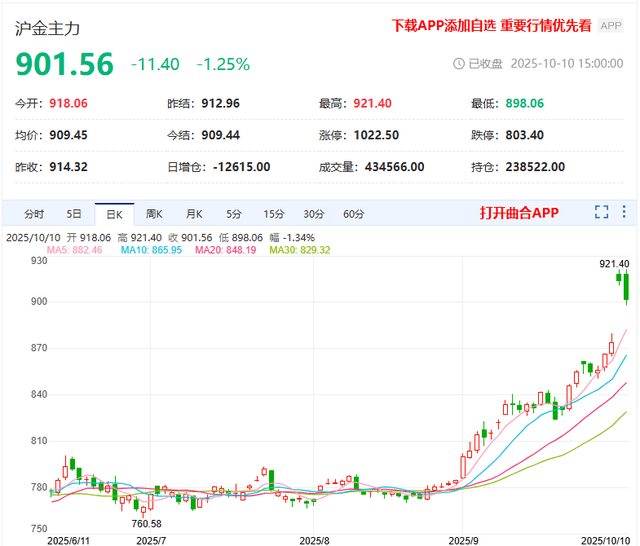
Group 1 - French Foreign Trade Bank predicts that international gold prices may face downward risks in the next two to three months, with leveraged investors needing to close positions and take partial profits, potentially leading to a 5% to 10% drop in gold prices within days [1] - According to TD Securities, lower price levels present a buying opportunity, with an upward trend in international gold prices expected to remain unchanged in the first half of 2026, potentially reaching an average price of over $4,400 per ounce in the first six months of next year [1] - The average price for the entire year is projected to be around $4,250 per ounce [1] Group 2 - On the domestic market, Shanghai gold fell by 1.25%, closing at 901.56 yuan per gram [3] - GF Futures outlook for the fourth quarter indicates that despite the resilience of the U.S. economy, the dual characteristics of "expectation strengthening - independence undermined" in the Federal Reserve's interest rate cut path are pressuring the U.S. dollar index [4] - The ongoing impact of the U.S. government shutdown and the fiscal monetary policy turmoil in developed countries like Europe and Japan is expected to reshape the asset pricing system, favoring commodities with strong financial attributes, which may lead to a bull market similar to the 1970s [4]