
美元指数上涨

Search documents
黄金暴跌
证券时报· 2026-03-23 02:02
Core Viewpoint - The article discusses the significant decline in gold prices, highlighting a drop below $4,350 per ounce, with a current price of $4,337.97 per ounce, marking a daily decrease of 3.54% [1][2]. Group 1: Gold Market Analysis - On March 23, spot gold prices fell to $4,337.97 per ounce, down 3.54% from the previous day [1][2]. - The London gold (spot gold) CFD showed a price of $4,337.97, reflecting a decrease of $159.01 or 3.54% [2]. - The gold futures contract on the New York Mercantile Exchange experienced a significant weekly decline of 9.62%, the largest drop in 15 years, while silver futures fell by 14.36% [3]. Group 2: Market Influences - Rising international oil prices have reignited concerns about global inflation, contributing to an increase in the dollar index and prompting central banks worldwide to adopt hawkish stances [3]. - The ongoing geopolitical conflicts in the Middle East have led to gold, traditionally viewed as a safe-haven asset, experiencing its third consecutive week of decline [3].

黄金白银,集体下跌!一则消息传来,油价大涨→
新华网财经· 2026-03-14 02:21
Group 1: Oil Market - The core viewpoint is that geopolitical tensions, particularly regarding U.S. military actions against Iran, have significantly impacted oil prices, leading to a notable increase in both U.S. and Brent crude oil prices [3] - On April 13, the price of light crude oil futures for April delivery closed at $98.71 per barrel, reflecting a rise of 3.11%, while Brent crude for May delivery closed at $103.14 per barrel, up by 2.67% [3] - For the week, U.S. oil prices increased by 8.59%, and Brent oil prices surged by 11.27% [3] Group 2: Precious Metals Market - The core viewpoint indicates that gold and silver prices have declined due to a cooling of interest rate cut expectations from the Federal Reserve and a rising U.S. dollar index [6] - On April 13, gold futures for April delivery settled at $5061.70 per ounce, down by 1.25%, while silver futures for May delivery closed at $81.343 per ounce, down by 4.43% [6] - For the week, international gold prices fell by 1.88%, and silver prices decreased by 3.52% [6]

白银突然急跌4%,黄金跳水
21世纪经济报道· 2026-03-03 06:27
Group 1 - The ongoing escalation of geopolitical conflicts in the Middle East has led to significant volatility in the global commodity markets, particularly affecting gold and silver prices [1][3] - On March 3, 2023, spot silver prices fell below $86 per ounce, experiencing a daily decline of 4.43%, while London gold spot prices dropped by 0.51%, falling below $5300 per ounce [1] - The decline in gold and silver prices is correlated with a rise in the US dollar index, which increased by over 1% on March 2 and continued to approach the 99 mark on March 3 [3] Group 2 - Regulatory bodies responded to the market's volatility by issuing risk warnings on March 2, advising relevant parties to prepare for potential risks due to the complex and changing situation in the Middle East [5] - As gold prices have risen, domestic gold jewelry prices have also increased, with the price of Chow Sang Sang's gold jewelry quoted at 1643 yuan per gram on March 3, up 21 yuan from the previous day, and Lao Miao's gold jewelry priced at 1662 yuan per gram, up 42 yuan [5] - The stock prices of electric vehicle companies such as Leap Motor, Xpeng, and NIO fell over 5%, indicating a broader decline in the Hong Kong stock market for new energy vehicle stocks [6]

长江有色:美元反弹美股走弱共振商品避险抛售 2日铅价或下跌
Xin Lang Cai Jing· 2026-02-02 03:32
Core Viewpoint - The lead market is experiencing significant downward pressure due to macroeconomic factors and weak demand, leading to a bearish outlook for lead prices in the short term [1][5]. Supply Side - Lead supply is characterized by a "passive contraction," with primary lead smelters reducing output due to seasonal maintenance and secondary lead producers cutting back or halting production due to industry-wide losses and weak demand [1][3]. - Despite a tightening supply of lead concentrate, the overall supply reduction has not supported prices due to a more severe contraction in demand, creating an imbalance of "supply reduction with weaker demand" [1][2]. Demand Side - The core demand for lead is significantly weak, particularly in the lead-acid battery sector, which has seen operating rates drop to their lowest point of the year, especially in the electric bicycle battery segment [2][3]. - Dealers are adopting a "light inventory" strategy, leading to an increase in social inventory of lead ingots, while emerging sectors like automotive replacement and communication storage are not providing enough support to offset the overall decline in traditional consumption [2][4]. Industry Chain - The entire lead industry chain is under pressure, with upstream supply tightness, midstream smelting enterprises (especially secondary lead) facing losses due to low prices and high costs, and downstream battery companies being cautious in raw material procurement due to high finished goods inventory and weak orders [3][4]. - Inventory pressure is transmitting from downstream to upstream, resulting in reduced activity in trade circulation and a prevalent wait-and-see sentiment among investors [3][4]. Spot Trading - The sharp decline in the futures market has quickly affected the spot market, leading to a cooling trading atmosphere [4][5]. - Traders are eager to sell, but prices are generally declining, resulting in an increase in low-priced sources while high-priced sources remain unsold, reflecting a general lack of market confidence [4][5]. Price Trend Prediction - In the short term, lead prices are expected to maintain a weak and volatile pattern due to the resonance of macroeconomic negativity and industry weakness [5][6]. - As downstream companies begin to take holidays, demand is unlikely to improve, with prices expected to fluctuate around the cost line of secondary lead, lacking rebound momentum [5][6].

黄金早参|美就业数据强劲,对伊关系缓和,金价高位震荡
Sou Hu Cai Jing· 2026-01-16 01:30
Economic Data and Market Reaction - U.S. economic data, including employment and retail sales, exceeded expectations, contributing to a stronger dollar and a decline in gold prices [1] - The COMEX gold futures fell by 0.33% to $4620.50 per ounce, with a significant intraday drop to $4584 before recovering [1] - The U.S. dollar index reached a six-week high of 99.49, closing at 99.35, reflecting a 0.28% increase [1] Employment Data Insights - The U.S. Labor Department reported a surprising decrease of 9,000 in initial jobless claims, with the seasonally adjusted figure at 198,000, significantly lower than the expected 215,000 [1] - This unexpected employment data has implications for the strength of the labor market and may influence future economic forecasts [1] Market Analyst Commentary - DRW Trading's strategist Lou Brien cautioned that the "birth-death model" used in employment data may overestimate actual growth, suggesting potential underlying weakness in the labor market [1] - This commentary indicates a possible reversal opportunity for gold, although the current strength of the dollar is a primary factor driving gold prices down [1]
金价降了没人买,金店人潮不见了,老百姓为啥不喜欢黄金了?
Sou Hu Cai Jing· 2025-11-17 18:09
Core Viewpoint - The continuous interest rate hikes by the Federal Reserve and the strong rise of the US dollar index have put significant pressure on international gold prices, which have fallen from a peak of $2078.8 per ounce in March to a low of $1618.3 per ounce last month. However, contrary to previous trends, domestic gold stores in China are experiencing poor sales despite the drop in gold prices [1][3]. Group 1: Reasons for Poor Domestic Gold Sales - The decline in international gold prices has not translated into significant price drops in domestic gold stores due to the limited decrease in domestic gold prices, which are affected by the depreciation of the Chinese yuan against the US dollar [3][5]. - The majority of gold sold in domestic stores consists of jewelry, which includes high processing and design fees that do not adjust with international gold price fluctuations, resulting in minimal price reductions for consumers [3][5]. - Domestic demand for gold has decreased significantly due to the ongoing economic downturn and the impact of repeated COVID-19 outbreaks, leading consumers to cut back on non-essential spending, including gold jewelry [5][7]. Group 2: Changing Consumer Preferences - The younger generation shows a declining interest in gold jewelry, viewing it as outdated and preferring luxury items like designer bags and high-performance cars to express their personal style and economic status [7][9]. - Consumers are becoming increasingly savvy regarding the resale of gold, often facing unfavorable buyback prices compared to their purchase prices, which diminishes their willingness to invest in gold [9].


美元指数大涨,黄金驻足不前
Sou Hu Cai Jing· 2025-11-05 09:02
Group 1 - The core reason for the rise in the US dollar index is attributed to the Federal Reserve's hawkish stance, with market expectations for a December rate cut dropping from 95% to 67% after Powell's comments, leading to a surge in the 10-year Treasury yield from 3.8% to 4.11% [1] - The ongoing "cash crunch" in the US money market, exacerbated by the government shutdown, has led to a significant increase in secured overnight financing rates (SOFR), which rose by 18 basis points, the largest single-day increase since March 2020, enhancing the attractiveness of the dollar [1] - Weakness in non-US currencies, particularly the Japanese yen and British pound, along with a decline in the euro, has contributed to the strengthening of the dollar index [1] Group 2 - The rise in the US dollar index has limited the upward movement of gold prices, resulting in a continued correction in the gold market [2] - The Shanghai gold price has decreased by 0.77%, closing at 912.26 yuan per gram [4] Group 3 - The US economy and job market are facing challenges from the government shutdown and trade tensions, while the Federal Reserve's hawkish signals have increased short-term policy uncertainty [6] - Geopolitical risks and financial institution failures are prompting more central banks to increase gold holdings, suggesting a potential long-term bullish trend for precious metals similar to the 1970s [6] - Short-term fluctuations in international gold prices are expected, with a potential buying opportunity if prices drop below $3,900 (900 yuan), while the market is likely to experience a consolidation phase [6]
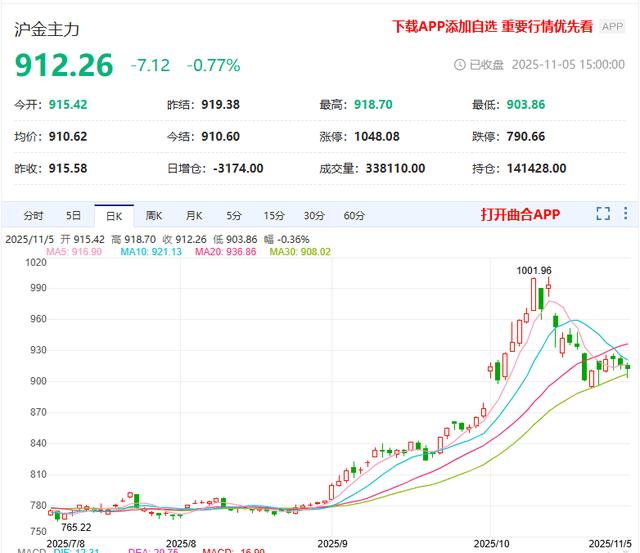
金荣中国:现货黄金震荡下跌1.7%,目前暂交投于3948美元附近
Sou Hu Cai Jing· 2025-11-05 05:57
Fundamental Analysis - Gold prices are currently hovering around $3,948 after a decline of 1.7% on November 4, closing at $3,931.78 per ounce, while December U.S. futures fell 1.3% to $3,960.50 [1][3] - The divergence among Federal Reserve officials has increased, cooling market expectations for a rate cut in December, which has helped the U.S. dollar index surpass the 100 mark, reaching a three-month high [1][3] - The ongoing U.S. government shutdown, now in its 35th day, raises concerns about economic data availability, providing some support for gold prices as a safe haven [1][4] Technical Analysis - The gold price recorded a bearish candle on the previous day, indicating pressure on recent rebounds, with a key support level around $3,920 [6] - Short-term trading is currently within a range of $3,920 to $4,030, with recent attempts to break above $4,030 failing, leading to further weakness [6] Trading Strategy - A trading strategy is suggested within the $3,925 to $4,025 range, with a stop loss of $10 and a target profit of $30 to $50 [7]

金价早盘震荡大幅下跌,关注支撑位多单布局方案
Sou Hu Cai Jing· 2025-11-04 05:50
Group 1 - Gold prices experienced a significant drop, trading around $3990 per ounce, with a decline of approximately 0.25% due to a strong US dollar at a three-month high [1] - The Federal Reserve's internal division was highlighted by a rare 10-2 vote, indicating significant disagreement among policymakers regarding future interest rate cuts [1][3] - The market's expectation for a December rate cut dropped sharply from nearly 100% to 65.3% following comments from Fed Chair Powell, who emphasized the need for caution in further easing [1][3] Group 2 - Dovish representative Milan reiterated the need for substantial rate cuts, suggesting a gradual reduction of 50 basis points until rates fall below the neutral level, citing pressures in housing and private credit markets [3] - Hawkish voices, including Chicago Fed's Goolsbee, expressed concerns over persistent inflation above target levels, indicating potential upward pressure on inflation in the coming years [3] - The ongoing government shutdown has led to a data vacuum, increasing uncertainty in the market, with key labor statistics and non-farm payroll reports on hold, complicating the Fed's policy decisions [4]

美联储降息押注减少 美元指数获坚实支撑
Jin Tou Wang· 2025-11-03 12:31
Core Viewpoint - The US dollar index is experiencing a moderate increase due to reduced bets on further interest rate cuts by the Federal Reserve, supported by hawkish comments from Fed officials [1][2]. Group 1: Federal Reserve Actions - The Federal Reserve decided to lower interest rates by 25 basis points, aligning with expectations, but Chairman Jerome Powell indicated this might be the last cut of the year without stronger economic conditions [1]. - Dallas Fed President Lorie Logan and Cleveland Fed President Beth Hammack expressed intentions to keep rates unchanged rather than further lowering the federal funds target rate range to 3.75-4.0% [1]. - Kansas City Fed President Jeff Schmied noted his preference against rate cuts due to concerns over high inflation rather than the labor market [1]. Group 2: Market Reactions - The dollar index rose to approximately 99.75 during Asian trading, reflecting a strong performance against a basket of six major currencies [1]. - Traders have reduced expectations for a December rate cut, with current pricing indicating about a 68% probability, down from 93% a week prior [1]. - The dollar index continued its upward trend, increasing by about 0.10% and reaching a near five-month high of 99.84 in the previous trading session [2].