资金抱团

Search documents
廖市无双-本轮调整何时能够结束
2026-03-24 01:27
Summary of Conference Call Records Industry or Company Involved - The discussion primarily revolves around the Chinese stock market, particularly focusing on the Shanghai Composite Index, ChiNext Index, and various industry sectors. Core Points and Arguments 1. **Market Adjustment and Key Support Levels** The current market adjustment is expected to continue until late March, with key support levels at 3,900 and 3,800 points for the Shanghai Composite Index [1][2][5] 2. **Geopolitical Impact on Oil Prices** Geopolitical conflicts, particularly in the Middle East, have led to high oil prices and a decline in global risk appetite, contributing to the market's weakness [2][3] 3. **Concentration of Capital in Few Stocks** There is a significant concentration of capital in a few large-cap stocks, particularly in the ChiNext Index, which has led to extreme market differentiation and potential for a sharp correction [2][3][4] 4. **Defensive Strategies Recommended** A defensive investment strategy is advised, with a focus on the banking sector as a preferred choice for risk aversion. Additionally, attention should be given to new and traditional energy sectors driven by geopolitical factors [1][4][12] 5. **Performance of Various Sectors** Most sectors have shown a downward trend, with 20 sectors experiencing declines over 3%. The communication sector has shown resilience with a 2.1% increase, largely due to strong performance from leading stocks in the optical module space [3][4] 6. **Outlook for Growth Indices** The ChiNext and other growth indices are expected to undergo adjustments until late April, with potential resistance around 8,400 points for the ChiNext Index [7][8] 7. **Bull Market Status** The current market adjustment does not signify the end of the bull market, as it is still considered to be in the early stages. The ongoing adjustment is viewed as the fourth wave of a bull market [9][10] 8. **Investment Strategies During Adjustments** Differentiated investment strategies are recommended, with a focus on holding positions in weight indices while avoiding aggressive buying in the ChiNext Index due to its high valuation [11][12] 9. **Investment Opportunities Identified** Potential investment opportunities include: - New and traditional energy sectors - Brokerage firms, which are expected to lead the market recovery - Defensive sectors such as banking and dividend-paying stocks [12][14] 10. **Market Style and Sector Rotation** The current market style favors stability, with a preference for large-cap stocks and sectors that provide safety and cash flow. Key sectors include telecommunications, coal, and agriculture [14][15] Other Important but Possibly Overlooked Content 1. **Gold-Oil Ratio Report** A report indicates a bearish outlook on the gold-oil ratio, suggesting that a decline in this ratio could impact tech stocks relative to value stocks in the A-share market [16] 2. **Hong Kong Market Outlook** The Hong Kong market is viewed positively due to its valuation discount compared to other markets and the potential influx of risk-averse capital [16] 3. **Industry Rotation Speed Research** A study on industry rotation speeds suggests that investment strategies should adapt based on the speed of rotation, with varying effectiveness of momentum and fundamental analysis [16]
越涨越买,资金涌入,赛道基金又走红
Zhong Guo Zheng Quan Bao· 2026-01-29 23:32
Group 1 - The core viewpoint of the articles highlights the surge in popularity and investment in sector-specific funds, particularly in areas like non-ferrous metals and AI, driven by impressive performance and investor enthusiasm [1][3] - Sector-specific funds have shown remarkable performance, with some funds experiencing growth rates exceeding 90 times their initial size within a short period, indicating a strong demand for targeted investment strategies [3][5] - The trend of sector funds is further supported by data showing that over half of the newly launched equity funds in early 2026 are sector-focused, particularly in technology, non-ferrous metals, and healthcare [5] Group 2 - The strong inflow of capital into sector-specific funds is evident, with significant net inflows reported in sector ETFs, contrasting with the outflows from broader market ETFs [3][5] - The performance of sector-specific ETFs has been outstanding, with some non-ferrous metal ETFs rising over 30% and certain gold stock ETFs increasing by more than 50%, significantly outperforming the market average [3] - Industry experts caution that while sector funds can yield high returns during favorable market conditions, they also carry inherent risks due to their concentrated exposure, which can lead to substantial losses when market conditions change [4][5]
一日惊魂之后,如何看待当前的银行股行情?
3 6 Ke· 2025-07-02 01:16
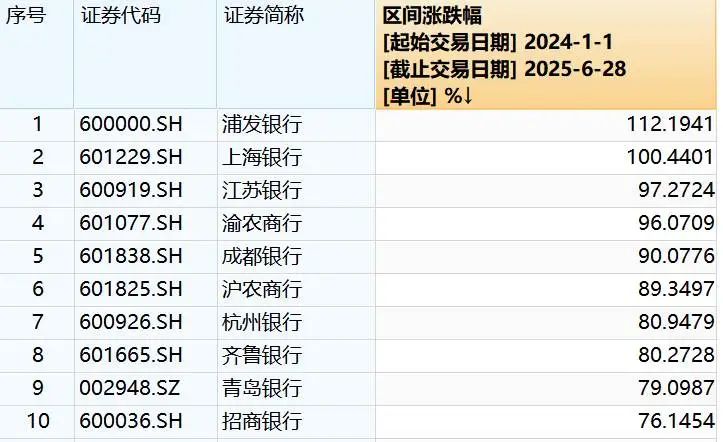
Core Viewpoint - The banking sector in A-shares has seen significant growth, with various banks experiencing substantial increases in stock prices despite a declining fundamental performance [1][3]. Group 1: Stock Performance - Since early 2025, shares of joint-stock banks, rural commercial banks, and city commercial banks have surged nearly 20%, leading the markets in Shanghai, Shenzhen, and Beijing [1]. - From 2024 onwards, specific banks like Shanghai Pudong Development Bank and Shanghai Bank have seen stock price increases exceeding 100%, while others like Jiangsu Bank and Chongqing Rural Commercial Bank have risen over 90% [1][2]. - Even the "Big Four" banks have shown over 50% growth, continuously reaching new historical highs [1]. Group 2: Fundamental Analysis - As of Q1 2025, the 42 listed banks in A-shares reported a year-on-year decline in revenue and net profit attributable to shareholders by 1.7% and 1.2%, respectively [3][5]. - The net interest margin for commercial banks hit a record low of 1.43% in Q1 2025, below the acceptable level of 1.8% as indicated by the central bank [5][3]. - The non-performing loan ratio stood at 1.51%, indicating ongoing challenges in the banking sector [5]. Group 3: Market Dynamics - The rally in bank stocks began around the end of 2023, driven by state-owned entities ("national team") actively stabilizing the market and encouraging other funds to invest in banks [9][12]. - By the end of 2024, the "national team" held over 1 trillion yuan in A-share ETFs, significantly increasing their market presence [9][12]. - The influx of funds into ETFs, particularly those weighted heavily in banking stocks, has contributed to the sector's performance [10][11]. Group 4: Future Outlook - Despite the current bullish trend, the fundamental decline in bank performance suggests that the upward trajectory may not be sustainable, leading to potential valuation corrections [15][16]. - The banking sector's price-to-book ratio (PB) is currently at 0.71, with some banks exceeding a PB of 1, indicating a potential for overvaluation [15][16]. - Future investment strategies may focus on selecting city commercial banks with growth potential and lower bad debt ratios, while avoiding poorly performing smaller banks [16][17].







投资高股息资产并不是稳赚不赔
Zheng Quan Shi Bao Wang· 2025-06-27 08:59
Group 1 - The phenomenon of "capital clustering" is significant in the current structural market of A-shares, with funds concentrating in specific sectors such as core assets, growth tracks, and high-dividend stocks, leading to substantial short-term price increases [1] - On June 27, the banking sector experienced a sharp decline, with several banks like Hangzhou Bank, Chongqing Bank, and Qingdao Bank dropping over 4%, while others like Jiangsu Bank and Agricultural Bank fell more than 3% [1] - The banking sector has seen an increase of nearly 40% in 2024 and over 15% this year, with some individual bank stocks experiencing even greater gains, driven by the low yield environment for traditional savings and investment products [1] Group 2 - Investing in high-dividend assets is not without risks, as these assets are primarily concentrated in traditional industries like energy, finance, and real estate, which are closely tied to macroeconomic cycles [2] - The excessive pursuit of high-dividend assets can lead to valuation bubbles, resulting in rapid adjustments in these assets, especially if companies lack growth momentum [2] - Companies' dividend policies are not fixed and can change due to various factors, including operational conditions and strategic planning, which may lead to reduced or suspended dividends even for historically stable dividend-paying companies [2] Group 3 - In the current low-interest-rate environment, high-dividend assets are attractive due to the potential for steady cash dividends alongside gradual price appreciation, but caution is advised to avoid falling into the "high-dividend trap" [3]





大象论股|市场摆烂,银行新高,如何解读?
Sou Hu Cai Jing· 2025-06-20 10:58
Index Level - The Shanghai Composite Index is still in a downward adjustment phase, with support around the gap at 3320 [3][4] - The ChiNext Index has fallen below its short-term moving averages, indicating potential weakness [3] - Overall market sentiment is low, with a trading volume of only 1.06 trillion, down by 185.7 billion, and a net sell-off of nearly 30 billion by domestic investors [3][4] Market Conclusion - The market is expected to continue its adjustment, and any potential rebounds should be viewed as temporary [4] - Investors should avoid chasing prices and consider maintaining around 50% of their positions [4] Sector Analysis - The banking and insurance sectors are showing strength, while brokerage firms are underperforming [5] - Consumer sectors like liquor are experiencing a rebound, but sustainability is uncertain [6] - The solid-state battery sector remains active, while some technology stocks are showing strength [5] Banking Sector Insights - The rise in bank stocks is attributed to a lack of alternative investment options, with banks offering around 4% dividend yields [7] - Investors are advised to hold existing positions in banks or cautiously enter with a portion of their capital [7] Hot Sector Breakdown - CPO is in a corrective phase but maintains an upward trend, presenting potential buying opportunities [7] - PCB shows a similar upward trend despite recent fluctuations, indicating potential for speculative opportunities [7] - The storage chip sector is in a consolidation phase, requiring further observation for potential upward movements [7] Additional Sector Observations - The innovative drug sector is in its sixth day of adjustment, with a downward trend persisting [8] - Stablecoins and digital currencies are showing signs of trend reversal, necessitating caution if they break below key support levels [8] - The solid-state battery sector is experiencing a slowdown in momentum, but short-term trading opportunities may still exist [8]

盈信量化(首源投资):利空!美国提高进口钢铝关税至50%!接下来,A股会明显回调吗
Sou Hu Cai Jing· 2025-06-05 09:11
Group 1 - The sentiment in the market is pessimistic, with a desire for a bull market but a reluctance for bank stocks to rise, as their performance is seen as a barometer for the broader financial sector [1] - The U.S. has increased tariffs on steel and aluminum products from 25% to 50%, effective June 4, 2025, which may lead to a defensive investment approach focusing on sectors like liquor, securities, and technology [3] - Despite the potential for a market correction, sectors such as liquor, securities, and insurance are expected to provide a buffer against significant declines, as the banking sector has been propping up the index [5] Group 2 - Investment strategies should align with individual profit goals; for instance, a target of 10% annual returns may be more achievable through index funds rather than individual stocks, which require careful selection [7] - The banking sector has shown limited growth, with an average increase of only 30% this year, suggesting that holding index funds may not meet higher profit expectations [7]
千万别踩雷!多只高位股股东拟减持(附股)
Feng Huang Wang Cai Jing· 2025-06-04 10:54
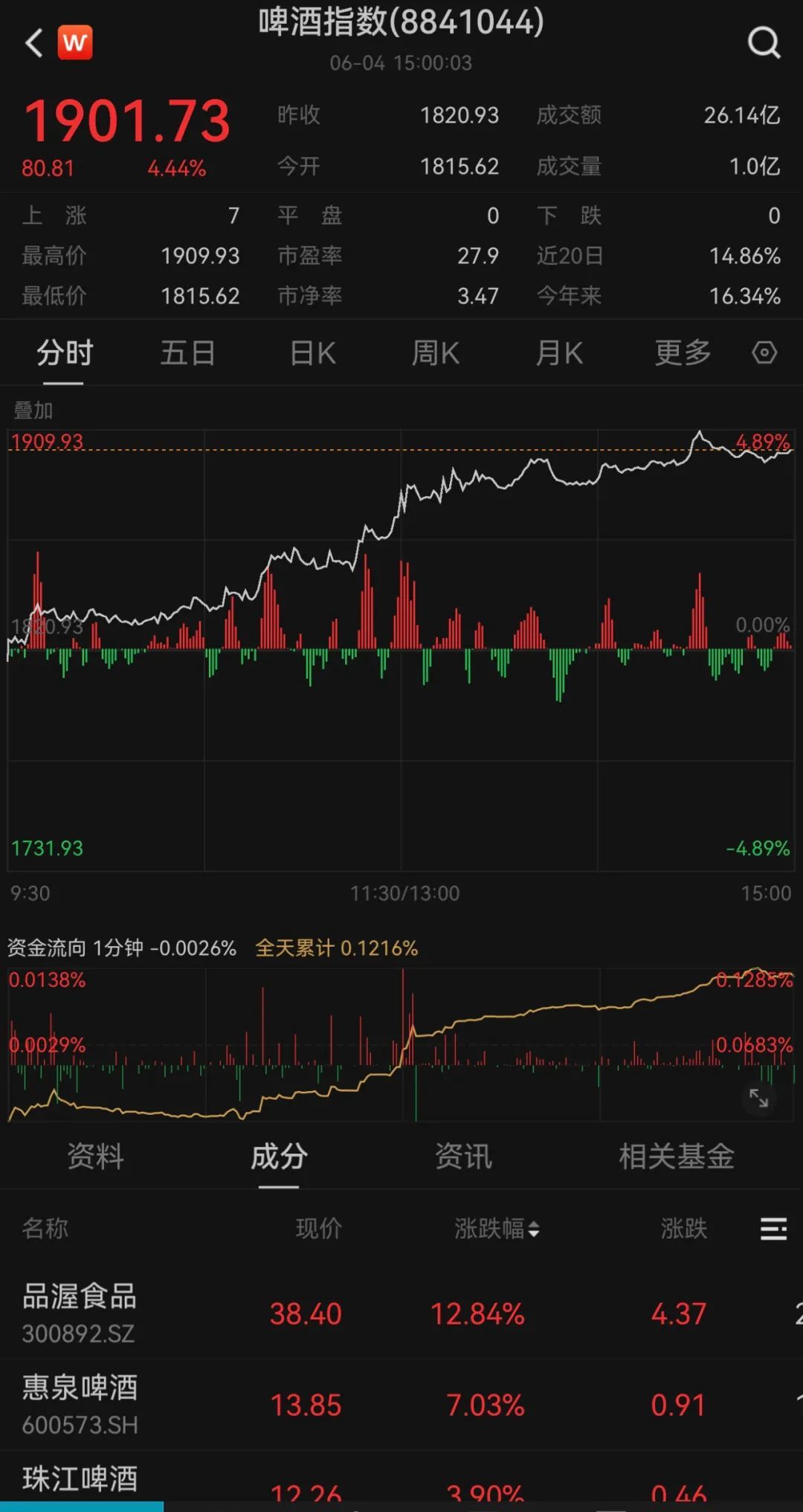
Market Overview - The three major stock indices collectively rose today, with nearly 4,000 stocks increasing in value. Key sectors showing strong performance include brokerage firms and diversified financials, as well as consumer goods and innovative pharmaceuticals [1] - The trading volume in the Shanghai and Shenzhen markets reached 1.15 trillion, indicating no significant increase in trading activity [1] Sector Performance - The beer and soft drink sectors performed well, driven by seasonal demand due to high summer temperatures. Stocks such as 嘉美包装 (Jia Mei Packaging), 乐惠国际 (Le Hui International), and 永顺泰 (Yong Shun Tai) hit their daily limit [1] - Recent trends show a concentration of capital in specific sectors, with significant interest in metals, non-metals, and mining due to rising global risk aversion and domestic resource policies. Key stocks include 紫金矿业 (Zijin Mining) and 赤峰黄金 (Chifeng Jilong Gold Mining) [5] - The electric equipment sector, particularly in renewable energy and nuclear power, is benefiting from technological breakthroughs and policy support. Notable stocks include 宁德时代 (CATL) and 中超控股 (Zhongchao Holdings) [5] Investment Trends - There is a noticeable trend of large funds "hugging" certain stocks, leading to repeated speculation on a few hot topics. This has resulted in significant short-term profit opportunities, although the sustainability of this trend is questionable [6] - High-profile stocks have seen substantial price increases without strong fundamental support, indicating that the market is driven by speculative trading rather than underlying business improvements [5][6] - Recent data shows that some high-performing stocks have experienced insider selling, with executives from 凯因科技 (Kain Technology) and 均瑶健康 (Jun Yao Health) reducing their holdings significantly [7][8]