
铜市供需

Search documents
库存增加叠加贸易不确定性,期铜自逾一周高点回落【2月23日LME收盘】
Wen Hua Cai Jing· 2026-02-24 01:10
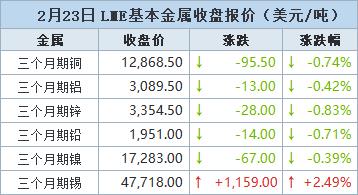
Group 1: Market Overview - LME copper prices fell by $95.5, or 0.74%, closing at $12,868.50 per ton, after reaching a one-week high of $13,050 [1] - Despite a 3% rebound over the past four trading days, copper prices remain significantly below the historical peak of $14,527.50 set on January 29 [1] Group 2: Inventory and Demand - LME copper inventory increased by 6,675 tons, or 2.84%, reaching 241,825 tons, the highest level since March 2025, with a 70% surge year-to-date [3] - The increase in inventory outside the U.S. suggests potential weakness in demand, although it remains unclear whether this is due to a shift from off-exchange warehouses or overall demand softness [3] Group 3: U.S. Tariff Uncertainty - The U.S. Supreme Court overturned a tariff order from former President Trump, leading to increased uncertainty in the metals, dollar, and stock markets [3] - Trump announced plans to raise the import tariff on global goods from 10% to 15%, with new legal tariffs to be determined in the coming months [3] Group 4: Future Supply Predictions - JPMorgan forecasts a supply deficit of 130,000 tons in the copper market by 2026, with expectations of a mild surplus in 2027 due to increased copper scrap supply and recovery of major mines [4] - The projected copper price for Q2 2026 is $13,500 per ton, decreasing to $13,000 per ton in Q3 2026 [4] Group 5: Market Sentiment - Traders are awaiting the resumption of trading on the Shanghai Futures Exchange, with market sentiment hinging on potential additional domestic demand from China [5]

市场情绪转弱 沪铜弱势运行【2月5日SHFE市场收盘评论】
Wen Hua Cai Jing· 2026-02-05 08:27
Group 1 - Copper prices in Shanghai opened lower and closed down by 3.76%, maintaining above the 100,000 yuan mark, influenced by weak market sentiment and a decline in U.S. stocks [1] - The U.S. ADP employment figures for January showed an increase of only 22,000 jobs, significantly below the expected 48,000, indicating a sluggish employment market amid low hiring and layoffs [1] - As the Chinese New Year approaches, downstream copper enterprises are beginning to halt production and stock up, but demand is expected to weaken further, limiting the upward potential for copper prices [1] Group 2 - The supply and demand situation in the copper market remains weak, with global inventories increasing to 1 million tons, and China entering a seasonal consumption lull [2] - The domestic inventory accumulation has slightly slowed down after the opening of export windows, while overseas LME deliverable stocks have been insufficient, leading to fluctuations in premiums [2] - The current price difference between London copper and U.S. copper is narrowing, and attention should be paid to changes in the COMEX copper term structure and the C-L price spread [2]
乐观情绪带动 沪铜早间走强【盘中快讯】
Wen Hua Cai Jing· 2026-01-12 01:10
Group 1 - The core viewpoint of the article indicates that both domestic and international copper prices have surged by over 3%, following the upward trend in precious metals [1] - The recent changes in the copper market's supply and demand dynamics have been limited, with high prices continuing to restrict domestic demand [1] - The rise in precious metals has generated a more optimistic sentiment in the market, leading to fluctuations in copper prices [1]
沪铜高位运行 关注后续需求表现【9月30日SHFE市场收盘评论】
Wen Hua Cai Jing· 2025-09-30 08:54
Core Viewpoint - Copper prices have reached their highest level since May of last year, driven by supply-side disruptions and improving manufacturing sentiment in China, although downstream demand remains subdued [1] Group 1: Market Performance - The night trading session for copper saw a high opening and a closing increase of 1.27%, with prices slightly retreating during the day [1] - The US dollar index is under pressure, contributing to a generally positive trend in precious metals and non-ferrous metals [1] Group 2: Economic Indicators - China's official manufacturing PMI rose by 0.4 percentage points in September, indicating continued improvement in manufacturing sentiment [1] - The Federal Reserve has initiated a rate-cutting cycle, and risks of a US government shutdown have increased, further pressuring the US dollar [1] Group 3: Supply and Demand Dynamics - The disruption at the Grasberg mine has been largely priced in, but copper prices have shifted to a higher trading range with strong support below [1] - Domestic refined copper social inventory has shown a significant increase due to high copper prices suppressing downstream demand and the end of pre-holiday stockpiling [1] - Despite being the traditional peak demand season, downstream performance in the copper market is weak, with low stocking sentiment among downstream enterprises due to high prices and short-term pricing periods [1] Group 4: Future Outlook - The Grasberg project's shutdown is expected to continue to lower the growth forecast for refined copper production in the coming years [1] - China's target for average growth in non-ferrous metal production has been adjusted down to 1.5% for the next two years, with expectations of continued production cuts in October [1] - The low social inventory levels suggest that copper prices are likely to maintain a volatile upward trend in the short term [1]
麦克莫兰铜金(FCX.US)印尼铜矿供应遇扰,铜价稳居一年高位
Zhi Tong Cai Jing· 2025-09-25 02:45
Core Viewpoint - Freeport-McMoRan's Indonesian copper mine has entered a force majeure status, yet copper prices remain near their highest levels in over a year [1] Group 1: Supply Chain Disruptions - Freeport has lowered its copper and gold sales guidance for the quarter due to an accident in the eastern Indonesian mining area, where the company is actively searching for five missing workers [1] - The incident highlights the increasing sensitivity of the global copper market to supply disruptions as demand and supply tighten [1] - Hudbay Minerals Inc. announced a suspension of operations at a smelter in Peru due to local political protests, marking another recent supply disturbance in the industry [1] Group 2: Market Reactions - Following the news of Freeport's guidance cut, copper futures prices surged by 3.9% before slightly retreating, indicating a volatile market response [1] - As of the report, copper prices on the London Metal Exchange (LME) fell by 0.66%, settling at $10,301 per ton, while prices for other metal varieties showed declines or remained stable [1]

沪铜小幅飘绿 社会库存有所增加【8月18日SHFE市场收盘评论】
Wen Hua Cai Jing· 2025-08-18 07:57
Group 1 - The core viewpoint of the article indicates that copper prices are experiencing slight fluctuations, with a minor decline of 0.01% at closing, influenced by limited macroeconomic guidance and increased social inventory at the beginning of the week [1] - Domestic copper concentrate processing fees are showing a rising trend, suggesting that demand-side expectations for price increases remain, although forward contracts for the fourth quarter are still around -40, indicating no substantial improvement in the tight supply situation [1] - As of August 18, domestic electrolytic copper inventory reached 144,200 tons, an increase of 11,800 tons compared to August 14, with significant inventory growth observed across various markets, particularly in Shanghai due to increased imports [1] Group 2 - According to Everbright Futures, copper prices are maintaining narrow fluctuations due to recent macroeconomic uncertainties, including mixed signals from tariff negotiations with the U.S. and ongoing uncertainties regarding key agreements with China [1] - The fundamental outlook for U.S. refined copper remains divided, particularly with concerns over excess inventory potentially leading to a weaker market, which could impact global copper prices [1] - Despite the potential for price weakness, the expectation of a seasonal increase in demand during September may stimulate downstream purchasing and inventory replenishment, thereby limiting the extent of price declines [1]
低价补货,刚需采购为主
Guan Tong Qi Huo· 2025-05-29 09:53
Report Summary 1. Report Industry Investment Rating - No investment rating information is provided in the report. 2. Core View of the Report - The demand side is marginally weakening, with downstream purchasers making rigid - need purchases and buying at low prices. As the demand enters the off - season, the downstream's ability to absorb is not strong. The rebound of the US dollar index suppresses copper prices, but the copper ore smelting end is tight. The macro - environment presents a mix of long and short factors, leading to narrow fluctuations in the copper market. It is expected that the copper market will mainly oscillate at a high level, awaiting new market drivers [1]. 3. Summary by Relevant Catalogs Strategy Analysis - The Shanghai copper market opened low, then fluctuated and turned positive. Antofagasta offered a copper concentrate TC/RC of -$15 per ton to Chinese smelters this week, indicating a long - term expectation of loose supply in the copper ore segment. The US dollar index rebounded from a low this week, suppressing the upward trend of copper prices. As of May 23, the spot rough smelting fee (TC) in China was -$44.3 per dry ton, and the refining fee (RC) was -4.44 cents per pound. Although the TC/RC fees are still negative, the decline has significantly slowed. In April, the output of refined copper was 1.254 million tons, a year - on - year increase of 9%, and the imported refined copper was 300,200 tons, a year - on - year decrease of 11.97%. Downstream buyers are cautious about high - priced copper. After the recent decline in copper prices, the downstream's enthusiasm for restocking has increased, but due to the approaching holiday and the consumption off - season, this enthusiasm is not sustainable [1]. Futures and Spot Market Quotes - Futures: The market opened low, fluctuated downward, and closed lower, at 78,400. The long positions of the top 20 were 115,017 lots, an increase of 1,825 lots; the short positions were 120,398 lots, an increase of 4,197 lots. Spot: The spot premium in East China was 130 yuan per ton, and in South China was 65 yuan per ton. On May 28, 2025, the LME official price was $9,633 per ton, and the spot premium was $49 per ton [3]. Supply Side - As of May 23, the spot rough smelting fee (TC) was -$44.3 per dry ton, and the spot refining fee (RC) was -4.44 cents per pound [4]. Inventory - SHFE copper inventory was 32,200 tons, a decrease of 2,700 tons from the previous period. As of May 26, the copper inventory in the Shanghai Free Trade Zone was 53,900 tons, a decrease of 5,800 tons from the previous period. LME copper inventory was 154,300 tons, a slight decrease of 43,000 tons from the previous period. COMEX copper inventory was 179,700 short tons, an increase of 30,400 short tons from the previous period [8].
综合晨报:德克萨斯制造业指标大幅下滑,七地锌锭库存增加-20250429
Dong Zheng Qi Huo· 2025-04-29 00:42
1. Report Industry Investment Ratings There is no information provided regarding the overall industry investment ratings in the given report. 2. Core Views of the Report - The US economy faces downward pressure as indicated by the significant decline in the Texas manufacturing index, leading to a weaker and volatile US dollar index [1][12]. - From late April to mid - May, treasury bond futures are expected to perform better than in the second half of April, and the strategy of buying on dips has increased cost - effectiveness [2][19]. - Steel prices are likely to continue to fluctuate in the short term, with the market being rational and cautious about administrative production cuts [3][22]. - For zinc, the medium - term supply - demand situation remains loose, and the logic of shorting on rallies is maintained, while attention should be paid to controlling positions due to potential impacts on the domestic manufacturing PMI from tariffs [4][45]. - Oil prices are fluctuating downward as the market awaits further clarification of OPEC+ policies [5][50]. 3. Summary by Relevant Catalogs 3.1 Financial News and Comments 3.1.1 Macro Strategy (Foreign Exchange Futures - US Dollar Index) - The Texas manufacturing index dropped to its lowest level since May 2020, indicating continued downward pressure on the US economy and a bearish outlook for the US dollar index in the short term [12][13]. 3.1.2 Macro Strategy (US Stock Index Futures) - The US Treasury has raised its borrowing estimates for the second and third quarters. Although the market has temporarily set aside concerns about long - term debt sustainability, the sustainability of the risk - preference repair needs further observation due to the emerging impact of tariffs [14][17]. 3.1.3 Macro Strategy (Treasury Bond Futures) - The central bank's deputy governor mentioned the potential for timely reserve requirement ratio cuts and interest rate cuts. The market's core contradiction lies between the un - falsifiable expectation of loose monetary policy and the uncertainty of the implementation time of such policies. It is recommended to focus on the strategy of buying long - term treasury bond futures on dips [18][20]. 3.2 Commodity News and Comments 3.2.1 Black Metal (Rebar/Hot - Rolled Coil) - Shanghai's major projects are accelerating. Steel prices are in a volatile pattern. The market is waiting for details of administrative production - control policies. It is recommended to view steel prices with a short - term oscillatory perspective and maintain a hedging mindset on rallies [21][23]. 3.2.2 Black Metal (Coking Coal/Coke) - In the East China market, coking coal prices are expected to oscillate weakly in the short term. Although there is some support for prices in the short term due to reduced supply and pre - holiday restocking demand, the medium - to long - term trend remains bearish [24][25]. 3.2.3 Non - ferrous Metal (Polysilicon) - After the price decline, attention should be paid to the resumption of production in Southwest China during the wet season and the silicon wafer production schedule from May to June. Different trading strategies are recommended for different contracts [28]. 3.2.4 Non - ferrous Metal (Industrial Silicon) - The operating rate of organic silicon monomers is expected to decline. The supply side may see marginal changes due to price drops. It is recommended to partially take profits on previous short positions and wait for clear signals before considering bottom - fishing [29]. 3.2.5 Non - ferrous Metal (Lithium Carbonate) - Some salt factories plan to reduce production, but the demand is not expected to exceed expectations. It is recommended to adopt a bearish strategy in the second quarter [30][31]. 3.2.6 Non - ferrous Metal (Copper) - Macro factors have a relatively neutral short - term impact on copper prices, while the short - term fundamentals are strong, supporting copper prices and the premium. It is recommended to take a bullish approach and pay attention to the Shanghai copper inter - period positive spread strategy [34][35]. 3.2.7 Non - ferrous Metal (Nickel) - It is recommended to wait for dips to buy nickel, pay attention to position management, and hedge beta risks due to potential macro - sentiment fluctuations [38][39]. 3.2.8 Non - ferrous Metal (Lead) - The short - term bearish logic for lead is dominant. It is recommended to focus on shorting opportunities on rallies and take profit on the internal - external reverse spread [40][41]. 3.2.9 Non - ferrous Metal (Zinc) - In the short term, zinc prices are supported, but the medium - term supply - demand situation remains loose. It is recommended to look for short - selling opportunities on rallies near the moving average and maintain a long - term internal - external positive spread strategy [42][45]. 3.2.10 Energy and Chemical (Liquefied Petroleum Gas) - LPG prices are expected to oscillate weakly due to the impact of tariff policies and cost - profit squeezes [46][49]. 3.2.11 Energy and Chemical (Crude Oil) - Oil prices are expected to remain volatile in the short term as the market awaits OPEC+ policies [50][51]. 3.2.12 Energy and Chemical (Asphalt) - The fundamentals of asphalt are improving, but the impact on prices is limited due to relatively high inventory levels. It is recommended to wait and see [52][53]. 3.2.13 Energy and Chemical (PTA) - PTA prices are expected to be oscillatory and slightly bullish in the short term, but the rebound height will be restricted by the demand side in the long term [55][57]. 3.2.14 Energy and Chemical (Caustic Soda) - After a short - term rebound, caustic soda prices weakened again, but the room for further decline is relatively limited [58][59]. 3.2.15 Energy and Chemical (Pulp) - Pulp is expected to be in a weakly oscillatory pattern in the short term due to the large internal - external price gap and lack of significant positive news [60][61]. 3.2.16 Energy and Chemical (PVC) - PVC is expected to be weakly oscillatory in the short term as the short - term macro - impact has subsided [62]. 3.2.17 Energy and Chemical (Styrene) - Styrene prices are oscillating weakly recently. The supply - demand structure is expected to be negatively affected by reduced supply - side disturbances and weakening downstream demand [63][65]. 3.2.18 Energy and Chemical (Bottle Chips) - The bottle chip industry shows a situation of both increasing supply and demand. Although there is no significant short - term contradiction, the supply pressure is increasing, and processing margins are under pressure [65][66]. 3.2.19 Energy and Chemical (Soda Ash) - In the medium term, a bearish view on soda ash is maintained, while short - term attention should be paid to the impact of summer maintenance on the 09 contract [67]. 3.2.20 Energy and Chemical (Float Glass) - Glass futures prices are expected to remain in a low - level range due to weak reality and lack of positive policies, and attention should be paid to real - estate policy changes [69][70].