
AI闭环

Search documents
未知机构:OpenClaw爆火AI闭环更进一步推理算力需求持续提升-20260224
未知机构· 2026-02-24 03:50
Summary of Key Points from Conference Call Industry and Company Involved - The discussion centers around the AI industry, specifically focusing on the product OpenClaw and the company 云天励飞 (CloudWalk). Core Insights and Arguments - OpenClaw is described as an advanced AI tool that functions as an all-in-one business-building intelligent robot, differentiating itself from traditional AI tools like ChatGPT, which are typically single-function and lack interconnectivity [1][2] - Traditional AI tools often lead to fragmented task completion, as they do not communicate with each other, whereas OpenClaw integrates various functionalities such as content creation, advertising design, and product development into a cohesive platform [2] - OpenClaw features an integrated AI brain with a dedicated knowledge base, allowing it to perform multiple tasks simultaneously and evolve its capabilities over time [2] - Unlike conventional databases, OpenClaw utilizes a file system, which enhances the local deployment of sensitive data and is particularly beneficial for G-end clients requiring privacy [3] Additional Important Content - The emergence of OpenClaw accelerates the transition of AI towards a closed-loop agent model, indicating a sustained increase in demand for edge inference computing power [3]
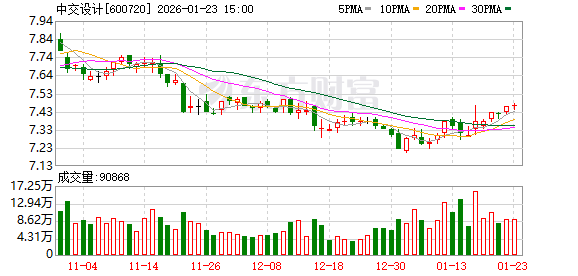
中交设计:自主研发的隧道智能巡检与灭火救援四足机器人已在天山胜利隧道验证
Zheng Quan Ri Bao· 2026-01-23 12:50
Core Viewpoint - The company has developed an intelligent four-legged robot for tunnel inspection and firefighting, which significantly enhances operational safety in tunnels [2] Group 1: Technology and Innovation - The robot utilizes domestically developed multimodal large model and intelligent agent technology for dynamic path planning and precise fire source localization [2] - It features an AI closed-loop system for "perception-decision-disposal," allowing for efficient firefighting and rescue operations [2] Group 2: Application and Impact - The robot has been successfully tested in the Tianshan Victory Tunnel, the longest highway tunnel in the world, demonstrating its capability to autonomously reach fire sources and complete initial firefighting within five minutes [2] - The integration of inspection, firefighting, and rescue operations into a single intelligent system significantly improves the safety level of tunnel operations [2]


“AI闭环”扩大:英伟达、微软联手150亿美元投资Anthropic,“OpenAI对手”的估值已达3500亿美元
华尔街见闻· 2025-11-19 02:28
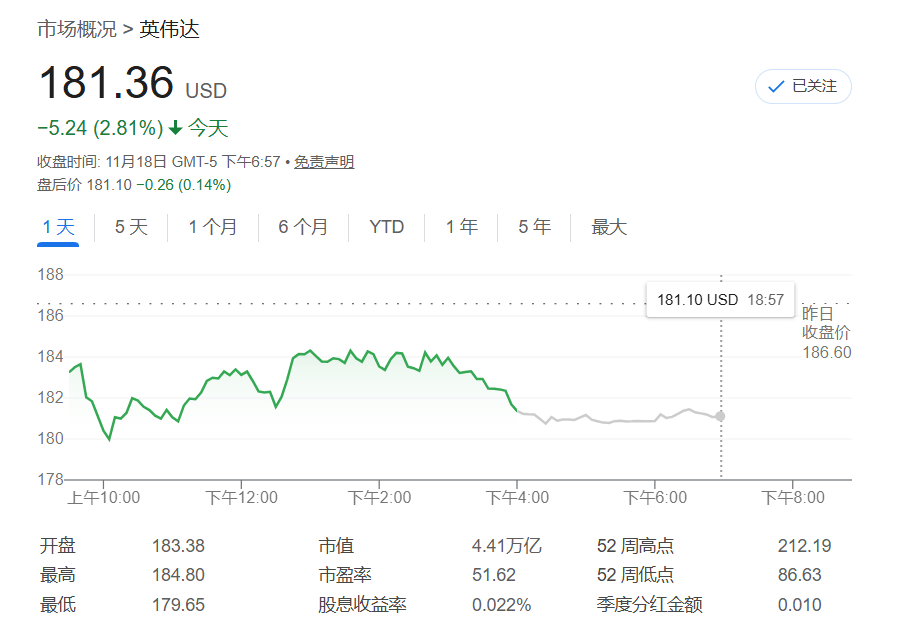
Core Insights - Microsoft, Nvidia, and Anthropic have formed a strategic partnership, creating a tightly-knit "AI Alliance" that binds capital, computing power, and models together [1][4] - The partnership involves significant investments, with Microsoft committing up to $5 billion and Nvidia up to $10 billion in Anthropic [2] - Anthropic's valuation has surged to $350 billion, marking an expansion of "closed-loop" investments in the AI sector [4] Investment and Collaboration Details - Anthropic will purchase $30 billion worth of Azure computing power from Microsoft and has signed contracts for up to 1 gigawatt of additional computing power, all running on Nvidia's AI systems [3][7] - This collaboration represents Nvidia's first deep technical partnership with Anthropic, aimed at optimizing Anthropic's products for performance and efficiency [5][6] - Anthropic's initial commitment includes acquiring up to 1 gigawatt of computing power, utilizing Nvidia's advanced architectures [7][8] Product and Market Strategy - Microsoft and Anthropic are expanding their collaboration to provide broader access to Anthropic's Claude models for enterprise users [9] - Azure AI Foundry customers will have access to Anthropic's Claude models, making Claude the only cutting-edge LLM model available on the three major cloud platforms [10] - Microsoft will continue to integrate Claude into its Copilot product suite, enhancing its offerings alongside OpenAI's models [11][12] Infrastructure and Growth Plans - Founded by former OpenAI employees, Anthropic is accelerating its infrastructure development, planning to invest $50 billion in custom data centers across the U.S. [13] - Anthropic has also secured a deal with Google to supply up to 1 million AI chips, significantly boosting its computing capabilities [13] Market Concerns and Risks - The announcement of this partnership comes amid rising skepticism about the AI investment boom, with Nvidia and Microsoft's stock prices dropping nearly 3% on the day of the announcement [14] - Concerns about a potential "AI bubble" are prevalent, with 45% of fund managers viewing it as a major risk, as the closed-loop investment model raises questions about the sustainability of AI products generating sufficient revenue [17]



“AI闭环”扩大:英伟达、微软联手150亿美元投资Anthropic,“OpenAI对手”的估值已达3500亿美元
硬AI· 2025-11-19 01:37
Core Viewpoint - The strategic partnership between Microsoft, NVIDIA, and Anthropic represents a significant investment in AI, with concerns about the sustainability of such "closed-loop" financing models in the industry [2][12]. Group 1: Partnership Details - Microsoft commits to invest up to $5 billion in Anthropic, while NVIDIA pledges up to $10 billion, leading to Anthropic's valuation soaring to $350 billion [3][5]. - Anthropic will purchase $30 billion worth of Azure computing power from Microsoft, fully utilizing NVIDIA's AI systems, including the current Grace Blackwell architecture and the upcoming Vera Rubin architecture [5][11]. Group 2: Strategic Implications - The collaboration expands Microsoft's AI offerings, allowing Azure customers access to Anthropic's Claude models, which will be available on major cloud platforms [8][9]. - Despite this new partnership, Microsoft maintains its core relationship with OpenAI, having invested heavily in it since 2019, with OpenAI's valuation reaching $135 billion [9][10]. Group 3: Market Concerns - The announcement of this partnership comes amid rising skepticism about the AI investment boom, with NVIDIA and Microsoft's stock prices dropping nearly 3% on the day of the announcement [13]. - Concerns about a potential AI bubble are prevalent, with 45% of fund managers identifying it as a significant market risk, questioning whether AI products can generate sufficient revenue to justify the massive investments [12][15].

“AI闭环”扩大:英伟达、微软联手150亿美元投资Anthropic,“OpenAI对手”的估值已达3500亿美元!
美股IPO· 2025-11-19 01:05
Core Viewpoint - A strategic partnership has been established among Microsoft, Nvidia, and AI startup Anthropic, creating a tightly-knit "AI alliance" that involves significant investments and resource sharing, marking a further expansion of "closed-loop" investments in the AI sector [2][3]. Group 1: Partnership Details - Microsoft has committed to invest up to $5 billion in Anthropic, while Nvidia has pledged up to $10 billion [2]. - Anthropic will purchase $30 billion worth of Azure computing power from Microsoft and has signed contracts for up to 1 gigawatt of additional computing capacity, all running on Nvidia's AI systems [2][3]. - This partnership has led to Anthropic's valuation soaring to $350 billion, indicating a significant shift in AI investment dynamics [2]. Group 2: Technical Collaboration - Nvidia and Anthropic will collaborate on design and engineering to optimize Anthropic's existing products for performance and efficiency [3]. - Anthropic's initial commitment includes acquiring up to 1 gigawatt of computing power based on Nvidia's advanced architectures, including Grace Blackwell and the upcoming Vera Rubin [3]. Group 3: Microsoft’s Strategy - Microsoft is expanding its collaboration with Anthropic to provide broader access to the Claude model for enterprise users, while maintaining its core partnership with OpenAI [4][5]. - Azure customers will have access to Anthropic's Claude models, enhancing Microsoft's position as an "AI platform company" [5]. Group 4: Anthropic's Growth and Infrastructure - Founded by former OpenAI employees, Anthropic has gained recognition in sectors like finance and healthcare, with a recent valuation of $1.83 trillion and 300,000 enterprise customers [6]. - The company plans to invest $50 billion in building custom data centers across various locations in the U.S. to support AI development [6]. Group 5: Market Concerns - The announcement of this partnership comes amid rising skepticism about the AI investment boom, with Nvidia and Microsoft's stock prices dropping nearly 3% on the day of the announcement [7]. - Concerns about a potential "AI bubble" have been raised, with 45% of fund managers viewing it as a significant market risk [9]. - The structure of this deal mirrors Nvidia's previous $100 billion investment in OpenAI, leading to doubts about the sustainability of such "closed-loop" financing models [9][10].
“AI闭环”扩大:英伟达、微软联手150亿美元投资Anthropic,“OpenAI对手”的估值已达3500亿美元
Sou Hu Cai Jing· 2025-11-19 00:36
Core Insights - Microsoft, Nvidia, and Anthropic have formed a strategic partnership, creating a tightly-knit "AI alliance" with mutual investments and resource sharing [1] - Microsoft will invest up to $5 billion in Anthropic, while Nvidia will invest up to $10 billion, leading to Anthropic's valuation soaring to $350 billion [1] - Anthropic will purchase $30 billion worth of Azure computing power from Microsoft, with additional commitments for up to 1 gigawatt of computing capacity based on Nvidia's AI systems [1][2] Group 1: Partnership Details - This marks the first deep technical collaboration between Nvidia and Anthropic, focusing on optimizing Anthropic's products for performance and efficiency [2] - Anthropic's initial commitment includes acquiring up to 1 gigawatt of computing power, utilizing Nvidia's advanced architectures [2] - The partnership allows Anthropic to access Nvidia's latest AI systems, including the Grace Blackwell and Vera Rubin architectures [2] Group 2: Microsoft and Anthropic Collaboration - Microsoft is expanding its collaboration with Anthropic to provide broader access to the Claude model for enterprise users [3] - Azure AI Foundry customers will have access to Anthropic's Claude models, enhancing Microsoft's AI offerings [3][4] - Microsoft will continue to integrate Claude into its Copilot product suite, maintaining its core partnership with OpenAI while diversifying its AI model offerings [4] Group 3: Anthropic's Growth and Infrastructure - Anthropic, founded by former OpenAI employees, is recognized in sectors like finance and healthcare, with a recent valuation of $1.83 trillion after raising $13 billion [6] - The company plans to invest $50 billion in building custom data centers across the U.S. to support AI development [6] - Anthropic has also secured a deal with Google for up to 1 million AI chips, significantly enhancing its computing capabilities [6] Group 4: Market Concerns - The announcement of this partnership comes amid rising skepticism about the AI investment boom, with Nvidia and Microsoft's stock prices dropping nearly 3% on the announcement day [7] - Concerns about a potential "AI bubble" are prevalent, with 45% of fund managers viewing it as a significant market risk [8] - The cyclical investment model among tech giants raises questions about the sustainability and profitability of AI products [8]
A股失守3900点!热门板块全线杀跌,盘中超100亿元抄底电池ETF、电池50ETF、化工ETF、软件ETF和半导体ETF等
Ge Long Hui· 2025-10-10 08:34
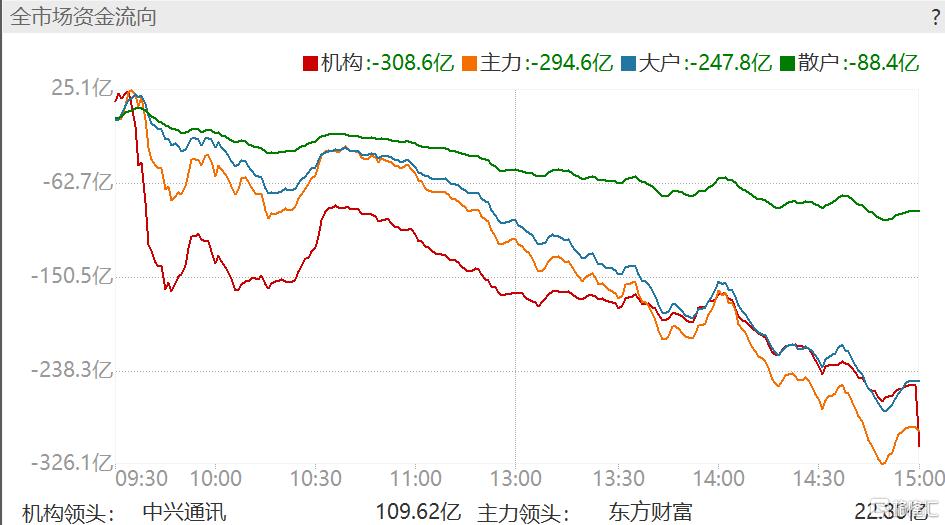
Market Overview - The A-share market experienced a collective decline, with the Shanghai Composite Index falling by 0.94% to 3897 points, losing the 3900-point mark. The Shenzhen Component Index dropped by 2.7%, and the ChiNext Index fell by 4.55%, marking the second-highest decline of the year. The STAR 50 Index decreased by 5.61% [1] - The total trading volume in the Shanghai and Shenzhen markets was 25,341 billion yuan, a decrease of 1,377 billion yuan compared to the previous day. Over 2,500 stocks in the market declined [1] Sector Performance - The semiconductor, battery, precious metals, computing hardware, and photovoltaic equipment sectors saw the largest declines. Notable stocks such as Putailai, Tianci Materials, and Guoxuan High-Tech hit the daily limit down, while companies like Xiandai Intelligent, Liyuanheng, and Yiwei Lithium Energy fell over 10% [1] - The semiconductor sector also faced significant losses, with Huahong Semiconductor, Dongxin Technology, and Baiwei Storage leading the declines [1] ETF Activity - In the ETF market, the lithium battery sector experienced a sharp drop, with lithium battery ETFs, battery ETFs, and the Battery 50 ETF all declining by over 7%. The semiconductor sector ETFs, including the Integrated Circuit ETF and the Sci-Tech Chip ETF, fell by 7.05% and 6.69%, respectively [1] - Despite the overall market downturn, there was a notable inflow of funds into certain ETFs. The Guangfa Battery ETF and the Huatai-PB Battery 50 ETF saw net subscriptions of 10.12 billion yuan and 9.43 billion yuan, respectively [3] - The ChiNext Index ETF recorded a net subscription of 3.48 billion yuan, with an estimated net subscription amount reaching 10.77 billion yuan [4] Fund Flow - Overall, the market experienced a net outflow of funds, with institutions, major players, large investors, and retail investors seeing net outflows of 30.8 billion yuan, 29.4 billion yuan, 24.7 billion yuan, and 8.8 billion yuan, respectively [1] - Specific ETFs such as the A500 ETF from Southern and the A500 ETF from E Fund faced significant net redemptions of 4.26 billion units and 0.72 billion units, respectively [8]
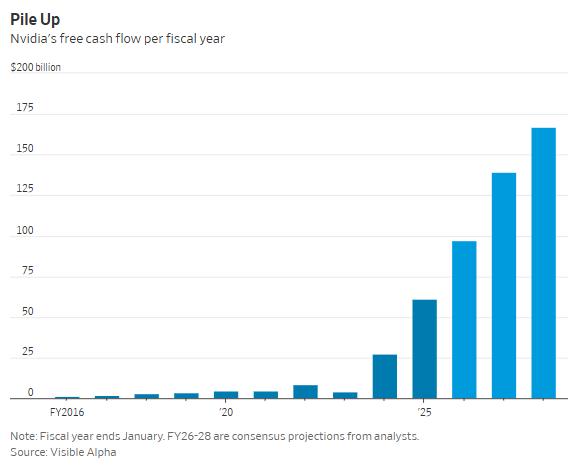
英伟达,钱多得花不完了
3 6 Ke· 2025-09-25 02:16
Core Insights - Nvidia is currently facing a "problem" that most of its competitors would envy: an excess of cash on hand [1] - Recently, Nvidia has made headlines not for soaring chip sales, but for its substantial investments, including a $5 billion stake in Intel and plans to invest up to $100 billion in OpenAI [2][9] - Nvidia's free cash flow has reached $72 billion over the past four quarters, with expectations to exceed $100 billion by the end of the fiscal year [2][5] Financial Performance - Nvidia's free cash flow for the past four quarters is significantly higher than the expected total for all other tech giants, excluding Apple, for this year [5] - The company has spent nearly $50 billion on stock buybacks in the past four quarters and has recently increased its buyback plan by an additional $60 billion [6] Investment Strategy - Despite the increase in buybacks and R&D spending, Nvidia is still struggling to effectively utilize its cash reserves [6][7] - With tightening antitrust regulations globally, the likelihood of Nvidia making significant acquisitions is low [7] - Nvidia is adopting an "AI closed-loop" investment model, focusing on smaller, strategic transactions rather than large acquisitions [8] Partnerships and Collaborations - Nvidia has supported cloud service providers and other key clients through investments and partnerships, which in turn boosts demand for its AI chips [8] - The $100 billion investment in OpenAI is expected to enhance the latter's computing capabilities, which will likely lead to increased purchases of Nvidia chips [9] - Nvidia's $5 billion stake in Intel is seen as a dual benefit, fostering local chip manufacturing while reducing reliance on TSMC [10]

光模块:从涨业绩到提升估值
GOLDEN SUN SECURITIES· 2025-08-24 09:44
Investment Rating - The report assigns a "Buy" rating to key companies in the optical module sector, including Zhongji Xuchuang and Xinyi Sheng, indicating a positive outlook for their stock performance [11]. Core Viewpoints - The optical module market is currently experiencing a transition from rapid earnings growth to valuation enhancement, marking a critical phase for the industry [22][26]. - The driving factors for stock price movements are shifting from business performance alone to a combination of earnings and valuation [22]. Summary by Sections Investment Strategy - The report emphasizes the importance of focusing on the optical module sector, which is expected to see continued growth and valuation enhancement [14]. Market Review - The communication sector has shown an upward trend, with the optical communication index performing exceptionally well, reflecting strong market sentiment [18][21]. Valuation Comparison - Domestic leaders in the optical module sector are currently valued at historical averages, with companies like Xinyi Sheng and Zhongji Xuchuang showing relatively low forward P/E ratios compared to international peers like Nvidia and AMD [2][25][26]. Valuation Enhancement Logic - Three main reasons for valuation enhancement are identified: 1. Formation of an AI closed loop, leading to increased capital expenditure from major cloud service providers and a shift in the industry towards profitability [27]. 2. Increased inflow of capital favoring high-growth and high-elasticity sectors, with a notable rise in trading volumes in the A-share market [28]. 3. Continuous innovation creating barriers for leading companies, enhancing their market position and pricing power [29]. Recommended Companies - The report recommends focusing on leading companies in the optical module sector such as Zhongji Xuchuang and Xinyi Sheng, as well as other related infrastructure providers [8][29].

