2025清华五道口全球金融论坛

Search documents
嘉宾金句⑤丨2025清华五道口全球金融论坛
清华金融评论· 2025-05-24 10:37
主题讨论九 人工智能时代下的数字金融 中国证券监督管理委员会原主席 5月17日-18日 2025清华五道口全球金融论坛 于深圳盛大召开 汇聚国内外金融界 领袖、学者及行业精英 浓缩思维干货 定位思维坐标 主题九:人工智能时代下的数字金融 主题十:全球资本市场展望与发展 这两场的嘉宾金句干货已打包完毕 快查收↓↓↓ 肖钢 张健华 清华大学五道口金融学院 金融发展与监管科技研究中心主任 莫万贵 中国人民银行金融研究所副所长 李振华 蚂蚁集团研究院院长 张鹏 北京智谱华章科技股份有限公司CEO 王正位 全球资本市场展望与发展 梁定邦 香港执业资深大律师 香港证券及期货事务监察委员会前主席 张慎峰 清华大学五道口金融学院副院长、副教授 主题讨论十 中国国际贸易促进委员会原副会长 聂庆平 中国证券金融股份有限公司原董事长 邓肯・邦菲尔德 国家主权财富基金国际论坛CEO 编辑丨兰银帆 来源丨清华五道口 审核 | 王晗 王娴 清华大学国家金融研究院副院长 清华大学五道口金融学院上市公司研究中心主任 ...

关税问题加剧国际经贸不确定性,如何寻求破局之道?
Di Yi Cai Jing· 2025-05-23 08:11
Group 1 - The global economic and trade environment is undergoing profound changes, with increasing uncertainty due to high tariffs and rising protectionism, which suppresses corporate investment decisions and innovation [4][5] - The restructuring of the international trade and investment system creates new development opportunities for global South countries, as they can attract more trade and investment due to their competitive advantages in lower costs and tariffs [4][5] - The importance of enhancing domestic circulation in China is emphasized, with suggestions to break down barriers in the unified market, evaluate macro policies effectively, and support the development of the private economy [8][6] Group 2 - The need for China to increase fiscal spending and social security to stimulate domestic demand and achieve economic rebalancing is highlighted [7][6] - The diversification of the global monetary system is anticipated, with more currencies from emerging markets participating in international transactions and an increased focus on digital currencies for cross-border trade [9]

迈克尔·斯宾塞:美国误判了自身的影响力
Sou Hu Cai Jing· 2025-05-22 00:41
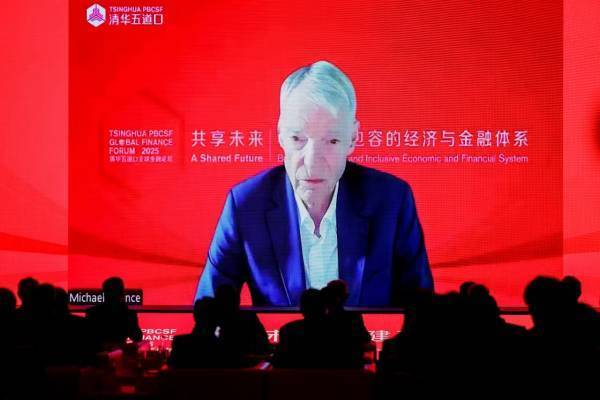
编者按:2025清华五道口全球金融论坛于5月17-18日举办。在开幕式上,2001年诺贝尔经济 学奖得主迈克尔·斯宾塞通过视频连线形式发表主旨演讲,并参与讨论了此次贸易战对全球 经济的影响、AI对于金融和经济发展的作用等议题。观察者网经清华大学五道口金融学院 授权,整理、刊载迈克尔·斯宾塞的发言。 【对话/迈克尔·斯宾塞,整理/观察者网 唐晓甫】 主持人:想先问您一个问题:中美部分关税在90天内的临时性暂停执行,我们看到这一消息提振了全球 股市,并受到市场广泛欢迎。这是一个积极的进展,但也仅仅是一个开始。我认为所有人都想知道,中 美贸易在90天之后,最差与最好的情况会是如何?我们的未来将去向何方? 迈克尔·斯宾塞:我们正处于一个充满不确定性的时代,中美刚刚达成一个短期共识,这无疑是非常积 极的进展。没有人愿意在相互伤害的道路上越走越远,这一协议也许将有助于推动双方进一步谈判并带 来更多改变。 在取消那些不合理的措施后,美方的目标或将更加聚焦于核心领域的直接投资,这或能在美国经济结构 中发挥作用,助力相关行业保持甚至提升竞争力。 4月2日掀起的关税战的最大问题在于缺乏针对性,几乎对所有领域一并征税。这种做法对美 ...
全球金融论坛|资本市场迈入高质量发展新阶段
Zhong Guo Jing Ying Bao· 2025-05-20 14:53
Group 1 - The core viewpoint emphasizes the need for China to accelerate financial system reforms in response to complex international challenges and to enhance the resilience of the financial system [1][2] - The financial system is at a critical juncture, facing external pressures such as global economic fluctuations and geopolitical risks, particularly from U.S. tariff policies [2][3] - The rapid advancement of technology, including AI and digital currencies, is reshaping the financial competitive landscape, presenting both challenges and opportunities for the financial system [2][3] Group 2 - Continuous deepening of financial reforms and promoting high-level financial openness are essential for building a strong financial nation [3][4] - The capital market plays a crucial role in China's economic modernization and high-quality development, serving as a hub for resource allocation [4] - The government has initiated a "1+N" policy framework to support the high-quality development of the capital market, marking a new phase in its evolution [4]
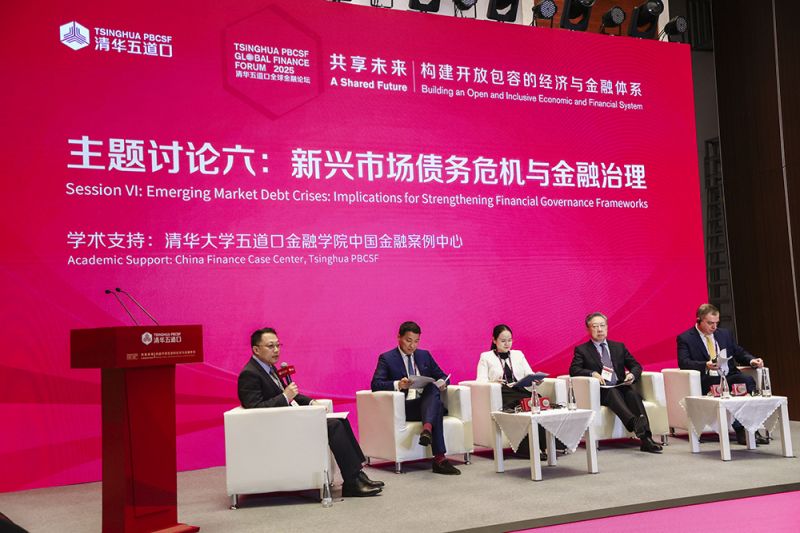
2025清华五道口全球金融论坛主题讨论六丨新兴市场债务危机与金融治理
清华金融评论· 2025-05-20 10:30
Core Viewpoint - The article discusses the emerging market debt crisis and financial governance, highlighting various countries' approaches and policies to address the issue, as presented during the Tsinghua Wudaokou Global Financial Forum held in Shenzhen [1]. Group 1: Mongolia's Experience - Mongolia's central bank vice governor shared the country's experience in managing its debt crisis, noting that government debt reached 90% of GDP in 2016, prompting international concern [6]. - The Mongolian government implemented measures such as a legal cap on external debt at 88% of GDP and established a transparent debt disclosure mechanism, enhancing market confidence [6]. - These actions reduced government debt to 60% of GDP and improved Mongolia's sovereign credit rating to B+, serving as a model for other emerging markets [6]. Group 2: Thailand's Debt Situation - Thailand's central bank official pointed out that debt levels had been rising even before the pandemic, exacerbated by COVID-19 and inflation, leading to increased debt among households and businesses [9]. - The country has initiated measures like a "prudent borrowing plan" and debt consolidation schemes to manage household debt, which is notably higher than in comparable countries [9]. - The official emphasized the challenges of achieving "healthy deleveraging" in a highly uncertain environment, complicating policy coordination and assessment [9]. Group 3: Global Debt Landscape - The director of the International Finance Research Center highlighted the severe global debt situation, with total debt expected to reach a record $318 trillion by 2024, and emerging market debt exceeding $105 trillion [12]. - Factors such as trade tensions, economic slowdown, and reduced international aid have significantly increased debt risks in emerging markets, with 15% of low-income countries already in debt distress [12]. - Recommendations include restoring international trade, enhancing G20 dialogue, and improving sovereign debt restructuring mechanisms to alleviate the debt burden on low-income countries [13]. Group 4: New Development Bank's Role - The New Development Bank, established by emerging market countries, focuses on sustainable development financing, emphasizing innovative financing models and project selection [15]. - The bank has increased the proportion of loans in local currencies to mitigate exchange rate risks and supports projects that promote both economic growth and environmental sustainability [15]. - Future plans include expanding local currency financing and directing resources towards climate adaptation and energy transition, aiming for a fair and inclusive international financial system [15].
全球金融论坛|中国金融学会副会长欧阳卫民:坚信全球经济一体化产业分工合作是大势所趋
Zhong Guo Jing Ying Bao· 2025-05-19 22:15
Group 1 - The trend of global economic fragmentation is becoming increasingly significant, driven by trade and technological decoupling, policy divergence, and rising global uncertainty [1][2] - Fragmentation is a relative concept compared to globalization and integration, characterized by weakened economic ties between countries, increased trade barriers, intentional technological decoupling, and restrictions on factor mobility [2][3] - The past 15 years have shown a continuous process of fragmentation, with recent trends indicating a clear decoupling in global trade structures, particularly highlighted by the Russia-Europe divide following the Ukraine conflict [2][3] Group 2 - The rise of populism and extremism has significantly impacted global fragmentation, with many countries believing that privatization, free markets, and trade liberalization are optimal solutions, while the era of super globalization is considered over [3] - The trade conflict between the US and China is a key driver accelerating global fragmentation, with ongoing complaints from the US regarding trade barriers, intellectual property protection, and market access issues [3] - Geopolitical factors have led to fragmentation between the US and China, with a shift in focus from economic efficiency to economic security, which may have substantial implications for future development [3] Group 3 - There is a need to establish a strong awareness of a shared human destiny and confidence in the inevitability of global economic integration and cooperation in industrial division [4] - Recommendations include encouraging technological innovation and cooperation, maintaining overall financial market stability, promoting educational reform, and enhancing policy coordination and communication [4] - A dual approach is suggested to advance globalization while addressing the challenges posed by fragmentation [4]
专访普惠金融联盟负责人:普惠金融重点已转向服务质量和深度 中国即时支付系统处于领先地位
Mei Ri Jing Ji Xin Wen· 2025-05-19 14:39
Core Insights - The Alliance for Financial Inclusion (AFI) has implemented over 920 evidence-based policy changes in the past 15 years, focusing on promoting inclusive finance strategies among member countries [1] - A key global trend in inclusive finance is the development of inclusive instant payment systems, with nearly 20 countries establishing such systems recently, and over 80 countries having implemented them [2] - China is a leader in the instant payment system space, with significant roles played by private sectors like WeChat Pay and Alipay, while the central bank oversees the core infrastructure [2] Global Trends - The rise of digital platforms and "super apps" is a significant trend, with China being a pioneer. This model is spreading to regions like Southeast Asia, South Asia, Africa, and Latin America, where payment and financial services are integrated with non-financial services [4] - The focus of inclusive finance is shifting towards the quality and depth of financial services, with an emphasis on digital payment applications in sectors like agriculture and healthcare [5][6] Future Opportunities - In the next 3 to 5 years, sectors such as agriculture, healthcare, and technology are expected to drive the development of inclusive finance, particularly through digitalization and green finance initiatives [5][6] - Small and medium-sized enterprises (SMEs) are poised to benefit from digitalization, allowing them to access global markets and reduce financing costs through enhanced competition and digital processes [7]
人工智能赋能金融未来 2025五道口金融论坛热议技术平权与监管治理
Zheng Quan Ri Bao Wang· 2025-05-19 12:01
Core Insights - The forum focused on the theme of "Digital Finance in the Age of Artificial Intelligence," discussing the current state of digital finance, technology applications, and regulatory governance [1][4] Group 1: Digital Economy Growth - In Q1 2025, China's digital economy continued to show strong growth, with core industry value-added growth reaching double digits, significantly outpacing GDP growth [1] - The value-added of digital manufacturing increased by 11.5% year-on-year, while the value-added of digital services grew faster than the overall service sector by 5 percentage points [1] - Investment in emerging fields such as artificial intelligence and humanoid robots is surging, with electronic information manufacturing and information services seeing investment growth of 10.1% and 10.5%, respectively [1] Group 2: AI and Financial Institutions - Large model applications, represented by DeepSeek, are seen as key breakthroughs in digital finance, enabling small and medium financial institutions to achieve "AI equity" [2] - Financial institutions are focusing on efficiency in technology investments, with the securities industry leading in investment intensity among sub-industries [2] - The construction of a financial data market is accelerating, with institutions exploring innovative models such as data asset securitization [2] Group 3: Regulatory Governance - A governance loop involving six stakeholders, including financial institutions, regulatory bodies, and technology companies, is recommended to address development bottlenecks [2] - Financial institutions are advised to carefully assess technology adaptability, while regulatory bodies should implement tiered management and enhance regulatory technology [2] Group 4: Future Outlook - Experts predict that digital finance will become a foundational infrastructure, enhancing service accessibility through technology, data, and regulation [3] - AI large models are expected to help Chinese financial institutions gain international competitiveness, necessitating the simultaneous improvement of regulatory frameworks [3] - The transition from "digital finance" to "smart finance" is anticipated, with an explosive growth in industry intelligence [3][4]
2025清华五道口全球金融论坛主题讨论五丨绿色发展的机遇与挑战
清华金融评论· 2025-05-19 10:30
2025年5月17-18日,2025清华五道口全球金融论坛在深圳市成功召开。主题讨论五以"绿色发展的机遇与 挑战"为主题,清华大学五道口金融学院讲席教授、绿色金融研究中心主任鞠建东,巴西央行前副行 长、国际清算银行前副总经理路易斯·佩雷拉·达席尔瓦,联合国全球契约组织驻华代表刘萌,马里前矿 业能源和水利部部长、前塞内加尔河流域开发组织负责人哈马德·塞梅加等嘉宾发表主题演讲。 论坛由法国桥智库主席周瑞主持,来自60余国的500余名政商学界代表现场参会,共同探讨绿色金融的 全球协作路径。 鞠建东 清华大学五道口金融学院讲席教授 鞠建东在演讲中直面气候危机挑战,指出全球气温升幅已突破1.5℃,若延续现有趋势,2060年或 将面临升温4℃的灾难性后果。他提出三点核心建议:一是通过南南合作对冲发达国家绿色需求下 滑,中国应成为引领力量;二是政府需以担保机制确保绿色项目投资回报率,吸引国际资本参 与;三是推动多边开发银行与新兴市场协作,解决绿色能源供需错配问题。 他强调,在发达国家绿色需求下滑的背景下,中国需通过南南合作引领新兴市场并形成正向需 求。他以非洲绿电项目为例,提出政府应通过担保机制确保年化3%-4%的投资回报 ...
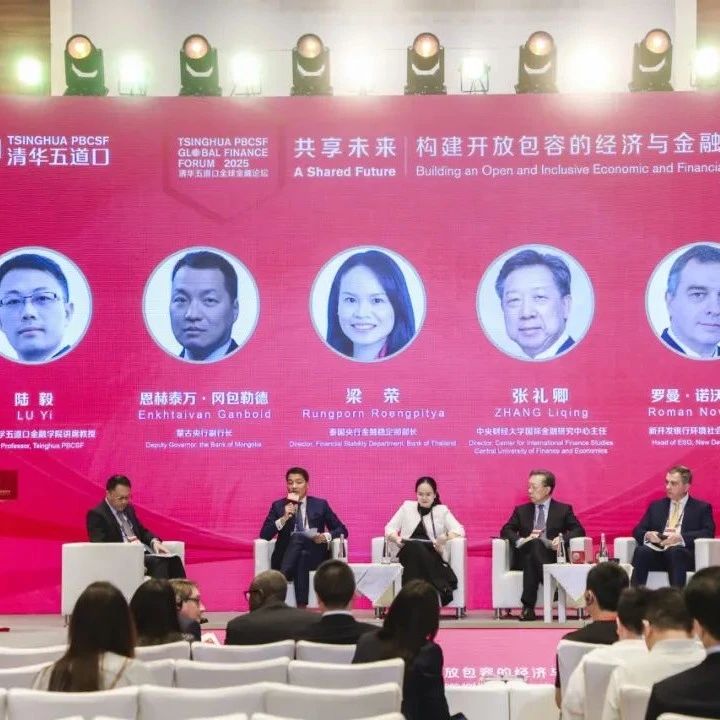
100多亿美元!新兴市场债务创新高,张礼卿:债务风险还会持续上涨
Hua Xia Shi Bao· 2025-05-19 06:34
"展望未来一个时期,受特朗普关税政策冲击、金融市场动荡以及地缘政治冲突加剧等一系列因素影响,我认为新 兴市场国家的债务风险还会持续上涨。"中央财经大学国际金融研究中心主任张礼卿在近日举办的2025清华五道口 全球金融论坛上说道。 当前,新兴市场在全球经济与生产过程中越来越重要,但受制于治理架构不完善、金融体系脆弱性等结构性瓶 颈,新兴市场在过去多年来经常会出现债务危机、金融危机,甚至是经济危机。特别是2008年全球金融危机之 后,新兴国家债务的比重持续高企,疫情后又出现进一步上升,截至2024年一季度,新兴市场的债务达到了105万 亿美元的新纪录,债务利息偿还更是成为许多新兴经济体政府预算中的重要组成部分。 在全球金融环境收紧的当下,新兴市场如何缓解偿债压力、防范风险成为本届清华五道口全球金融论坛重点关注 的议题之一,多国政策制定者及研究者在"新兴市场债务危机与金融治理"环节分享了他们的真知灼见。 恩赫泰万·冈包勒德也表示,蒙古同样面临着借贷成本在过去多年持续攀升的问题,该国需要通过举债来支持基础 设施建设、社会福利保障等等。"事实上,一系列的进出口依赖会影响我们的经常账户收支平衡,也会造成一些经 济和金融危 ...