环境和公共设施管理业

Search documents
八张图读懂基建口径调整
Guolian Minsheng Securities· 2026-03-21 12:50
Group 1: Infrastructure Adjustment Insights - The National Bureau of Statistics has adjusted the infrastructure investment reporting from a narrow to a broad scope, revealing a more comprehensive view of infrastructure investment[11] - After the adjustment, the investment growth rate for broad infrastructure has slightly increased, with a year-on-year growth rate of 11.4% for January-February 2026, compared to a range of 7.0% to 8.7% for narrow infrastructure[22] - The adjustment includes the removal of the warehousing industry and the addition of telecommunications and internet services, leading to a more refined calculation method for broad infrastructure[16] Group 2: Economic Overview and Events - The economic landscape at the start of 2026 shows a robust industrial sector, with industrial value-added growth at 6.3% year-on-year for January-February, alongside a stable consumer market with retail sales growth of 2.8%[46] - Key upcoming events include the Boao Forum from March 24 to 27, focusing on global governance and economic integration, with discussions on how to address global uncertainties[34] - The fiscal data for January-February indicates a stable overall budget revenue growth of 0.7% and a notable increase in budget expenditure by 3.6%, reflecting a proactive fiscal stance[42]
开窗见绿 推门亲水
Guang Xi Ri Bao· 2026-02-08 02:38
Group 1 - The transformation of the Yong River in Nanning is attributed to the city's commitment to the "People's City, Built by the People" concept, focusing on integrated water management and green development [1][2] - Nanning has implemented six local regulations and established a comprehensive four-level river and lake management system, investing over 40 billion yuan in watershed governance [1][2] - The city has achieved a centralized sewage collection rate of 80.11%, with 38 sections of black and odorous water bodies eliminated, and maintains a 100% compliance rate for drinking water sources [2] Group 2 - Nanning's flood prevention standards have been upgraded from a 50-year to a 200-year flood event, supported by three water conservancy hubs [2] - The city has integrated 785.33 hectares of new green space and 163 kilometers of riverside greenways, enhancing recreational areas and promoting a vibrant urban environment [2] - The Yong River has become a new landmark for cultural tourism, hosting events like the China-ASEAN International Kayak Open and attracting 4 million ASEAN tourists [2][3]
2025年郑州市GDP破1.5万亿!
Zheng Zhou Ri Bao· 2026-02-03 06:57
Core Viewpoint - In 2025, Zhengzhou's economy is projected to exceed 1.5 trillion yuan, demonstrating a stable and progressive development trend with a focus on high-quality growth [1] Economic Performance - The GDP of Zhengzhou in 2025 is estimated at 15,244.6 billion yuan, reflecting a year-on-year growth of 5.4% [1] - The primary industry added value is 189.9 billion yuan, growing by 3.7%; the secondary industry added value is 5,576.8 billion yuan, also growing by 5.4%; the tertiary industry added value is 9,477.8 billion yuan, with a growth rate of 5.4% [1] Production Supply - Agricultural production remains stable, with a total output value of agriculture, forestry, animal husbandry, and fishery increasing by 4% year-on-year [2] - The total grain output is 1.511 million tons, maintaining above 1.5 million tons for two consecutive years [2] - Industrial production shows robust growth, with the added value of large-scale industries increasing by 9% year-on-year, with over 70% of industries experiencing growth [2] Service Sector Development - The revenue of large-scale service industries increased by 10.1% year-on-year, with eight out of ten major sectors achieving positive growth [3] - Financial institutions' deposits reached 35,505.7 billion yuan, growing by 7.4%, while loans amounted to 41,660.5 billion yuan, increasing by 3.6% [3] Demand Release - Investment in major projects increased by 9.9% year-on-year, driving overall investment growth by 5.4 percentage points [4] - Industrial investment grew by 17.9% year-on-year, surpassing the provincial average by 4.6 percentage points [4] Consumer Market Growth - The total retail sales of consumer goods reached 6,629.4 billion yuan, with a year-on-year growth of 5% [5] - Retail sales of essential goods such as food and daily necessities saw significant increases, with food retail up by 21% [5] Foreign Trade - The total import and export volume reached 6,501.8 billion yuan, growing by 16.8% year-on-year, with exports increasing by 20.3% [6] Emerging Dynamics - The added value of high-tech manufacturing and strategic emerging industries grew by 14.9% and 11.8% respectively [7] - New consumption models such as live streaming and social e-commerce saw a year-on-year growth of 11.9% in retail sales through public networks [7] Quality and Efficiency Improvement - Public budget revenue reached 1,181.3 billion yuan, with social welfare and health spending increasing by 13.6% and 8% respectively [8] - Consumer price index (CPI) remained stable, with some categories experiencing price increases while others saw declines [8] Overall Economic Outlook - The economic outlook for Zhengzhou remains positive, with strong resilience and potential, although external uncertainties persist [9] - Future efforts will focus on enhancing technological innovation, industrial renewal, and urban development to support sustainable economic growth [9]
徐州未能晋级万亿GDP之城
2 1 Shi Ji Jing Ji Bao Dao· 2026-02-02 05:48
Core Insights - Xuzhou's GDP reached 953.7 billion yuan in 2024, nearing the trillion yuan target, generating high expectations for 2025 [2] - The government report indicated a GDP growth target of approximately 5.8% for 2025, without specifying a clear GDP figure [2][4] - Xuzhou's mayor emphasized the importance of focusing on development rather than being fixated on the trillion yuan milestone [4] Economic Performance - In 2025, Xuzhou's GDP is projected to be 995.72 billion yuan, reflecting a 5.8% increase year-on-year, which is below the 6% target but exceeds the national average growth rate of 5.0% [4][5] - The primary industry added value was 79.25 billion yuan, growing by 3.0%; the secondary industry reached 365.63 billion yuan, with a growth of 3.5%; and the tertiary industry achieved 550.85 billion yuan, growing by 8.0% [5] - Industrial production saw a 6.8% increase in the added value of large-scale industries, with significant growth in chemical fiber manufacturing (10.5%), agricultural and sideline food processing (13.1%), and electrical machinery manufacturing (18.6%) [5] Investment Trends - Fixed asset investment in Xuzhou decreased by 11.9% year-on-year, which is significantly lower than the national average decline of 3.8% [5] - Investment in the primary industry fell by 27.4%, the secondary industry by 11.5%, and the tertiary industry by 11.9% [5] - Notable growth in specific sectors included textile (36.5%), automotive manufacturing (18.4%), and furniture manufacturing (9.5%) [5] Consumer and Income Data - Retail sales of consumer goods in 2025 are expected to grow by 5.5%, with significant increases in food (18.5%), clothing (15.5%), and communication equipment (11.5%) [6] - The per capita disposable income in Xuzhou is projected to be 42,230 yuan, reflecting a 4.9% increase year-on-year, with urban residents earning 48,978 yuan (4.3% growth) and rural residents earning 30,639 yuan (5.6% growth) [6]

2025年河北民营经济增长贡献率为66.8%
Xin Lang Cai Jing· 2026-01-26 16:56
Group 1 - The core viewpoint of the news is that the private economy in Hebei province is a significant driver of economic growth, contributing 66.8% to the overall economic growth in 2025 [1] - In 2025, the added value of Hebei's private economy reached 32,321.0 billion yuan, growing by 5.6% year-on-year, and accounting for 65.6% of the province's GDP [1] - Private investment in Hebei increased by 8.6% in 2025, which is 6.6 percentage points faster than the previous year, and made up 47.9% of total fixed asset investment [1] Group 2 - The implementation of the "Hebei Province Private Economy Promotion Regulations" starting January 1, 2026, aims to provide long-term, stable, and predictable legal support for the development of the private economy [2] - The new regulations are expected to significantly enhance the overall strength, innovation capability, and market competitiveness of Hebei's private economy [2]
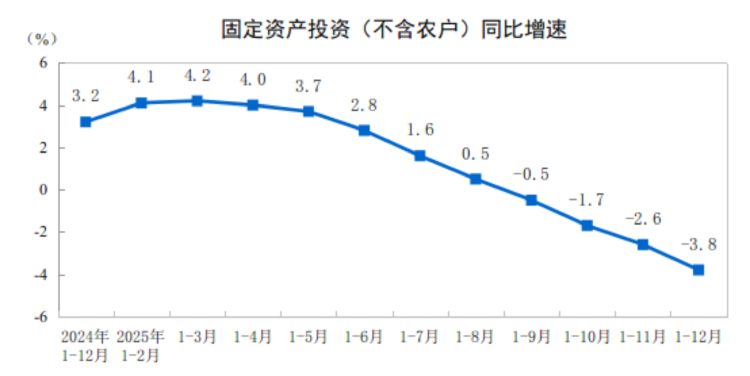
2025年全国固定资产投资485186亿元,比上年下降3.8%
Guo Jia Tong Ji Ju· 2026-01-19 02:19
Core Viewpoint - In 2025, China's fixed asset investment (excluding rural households) is projected to be 48,518.6 billion yuan, representing a decline of 3.8% compared to the previous year [1][4]. Investment by Sector - Investment in the primary industry reached 957 billion yuan, showing a growth of 2.3% year-on-year [3][4]. - Investment in the secondary industry totaled 177,368 billion yuan, with a growth of 2.5% [3][4]. - Investment in the tertiary industry was 298,248 billion yuan, reflecting a decline of 7.4% [3][4]. Secondary Industry Breakdown - Industrial investment in the secondary industry increased by 2.6% year-on-year [3]. - Mining investment grew by 2.5%, while manufacturing investment saw a modest increase of 0.6% [3]. - Investment in the electricity, heat, gas, and water production and supply industry surged by 9.1% [3]. Tertiary Industry Breakdown - Infrastructure investment (excluding electricity, heat, gas, and water production and supply) decreased by 2.2% [3]. - Notable growth was observed in pipeline transportation (36.0%), multimodal transport and agency services (22.9%), and water transportation (7.7%) [3]. Regional Investment Trends - Investment in the eastern region declined by 8.4% year-on-year [3]. - The central region experienced a decrease of 2.7%, while the western region saw a decline of 1.3% [3]. - The northeastern region faced the most significant drop at 15.5% [3]. Investment by Registration Type - Domestic enterprises' fixed asset investment fell by 3.8% [4]. - Investment from Hong Kong, Macau, and Taiwan enterprises decreased by 2.2% [4]. - Foreign enterprises experienced a substantial decline of 13.8% in fixed asset investment [4].
2025年11月中国企业信用指数162.66 持续稳中有进
Zhong Guo Jing Ji Wang· 2025-12-23 10:29
Group 1 - The corporate credit index in China for November is 162.66, indicating a steady improvement in corporate credit levels [1] - The corporate credit index increased by 1.11 points from October, reaching a peak for the second half of the year, reflecting a positive change in corporate credit levels amid stable economic performance [2] - Most regions in China showed positive growth in credit indices, with notable increases in Guangdong and Shandong, indicating enhanced self-discipline among enterprises and effective credit repair mechanisms [3] Group 2 - Nearly 80% of industries saw an increase in credit indices compared to the previous month, with the finance and manufacturing sectors leading the growth [4] - The credit index for the real estate industry has shown a continuous upward trend for four months, indicating a recovery in credit levels [4]
2025年11月中国企业信用指数较10月上升1.11点 攀升至下半年峰值
Bei Jing Shang Bao· 2025-12-23 10:17
Core Insights - The corporate credit index in China reached 162.66 in November 2025, marking an increase of 1.11 points from October, indicating a positive change in corporate credit levels amid stable economic growth [1] Industry Summary - Nearly 80% of industries experienced a month-on-month increase in their credit indices, with the top five performing sectors being finance, manufacturing, water conservancy, environmental and public facilities management, and electricity, heat, gas, and water production and supply [1] - The credit index for the resident services, repair, and other service industries saw the highest growth among all sectors, while the manufacturing sector ranked second in terms of credit index growth [1] - The real estate industry has maintained a month-on-month increase in its credit index for four consecutive months, indicating a recovery trend in credit levels [1] Regional Summary - The top five provinces in terms of credit index rankings are Anhui, Shaanxi, Tianjin, Shandong, and Chongqing, with Shandong making its first appearance in the national top five in 2025 [1]
【数据发布】2025年1—11月份全国固定资产投资基本情况
中汽协会数据· 2025-12-16 09:04
Core Viewpoint - The fixed asset investment in China (excluding rural households) for January to November 2025 is 444,035 billion yuan, showing a year-on-year decline of 2.6% [1][4]. Investment by Industry - Investment in the primary industry reached 8,770 billion yuan, with a year-on-year growth of 2.7% [3][4]. - The secondary industry saw an investment of 162,243 billion yuan, growing by 3.9% year-on-year, with industrial investment specifically increasing by 4.0% [3][4]. - The tertiary industry experienced a decline in investment to 273,022 billion yuan, down 6.3% year-on-year [3][4]. Secondary Industry Breakdown - Mining investment grew by 4.0%, while manufacturing investment increased by 1.9% [3][4]. - Notable growth was observed in the electricity, heat, gas, and water production and supply industry, which saw a 10.7% increase [3][4]. Tertiary Industry Breakdown - Infrastructure investment (excluding electricity, heat, gas, and water production and supply) decreased by 1.1% [3][4]. - Specific sectors such as pipeline transportation and water transportation saw increases of 16.8% and 8.9%, respectively [3][4]. Regional Investment Analysis - Eastern regions experienced a significant decline in investment by 6.6%, while central and western regions saw decreases of 1.7% and 0.2%, respectively [3][4]. - The northeastern region faced the largest drop at 14.0% [3][4]. Investment by Registration Type - Domestic enterprises' fixed asset investment fell by 2.6%, while investment from Hong Kong, Macau, and Taiwan enterprises decreased by 2.2% [3][4]. - Foreign enterprises experienced a substantial decline in investment by 14.1% [3][4].
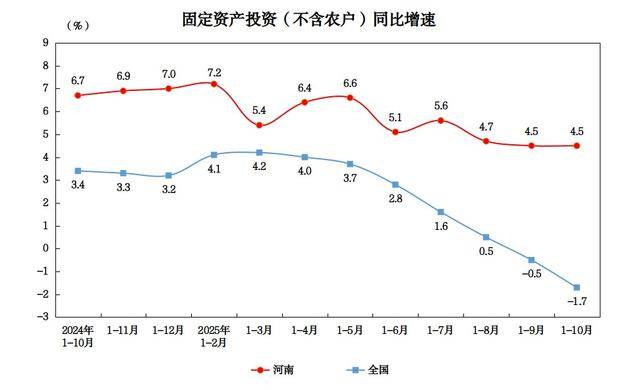
2025年1-10月份河南固定资产投资增长4.5%
Sou Hu Cai Jing· 2025-11-15 02:43
Core Insights - In the first ten months of 2025, fixed asset investment in Henan Province (excluding rural households) increased by 4.5%, surpassing the national average by 6.2 percentage points [1] - Private investment in Henan grew by 7.3% during the same period [1] Investment by Industry - Investment in the primary industry decreased by 4.9%, while the secondary industry saw an increase of 17.8%, and the tertiary industry experienced a decline of 2.7% [3] - Industrial investment rose by 17.8%, infrastructure investment (excluding electricity, heat, gas, and water production and supply) fell by 7.2%, and real estate development investment decreased by 8.3% [3] - Within industrial investment, mining investment grew by 20.3%, manufacturing investment increased by 16.9%, and investment in electricity, heat, gas, and water production and supply rose by 22.2% [3] - In infrastructure investment, water conservancy, environment, and public facilities management (excluding land management) saw a slight increase of 0.3%, while transportation and postal services investment dropped by 18.7%, and information transmission investment fell by 0.5% [3] Investment by Ownership - Central project investment increased by 2.7%, while local project investment grew by 4.5% [3]