
电信广播电视和卫星传输服务业

Search documents
高技术制造业PMI连续两个月为52.0%及以上 新动能延续扩张态势
Jing Ji Ri Bao· 2026-02-01 01:30
Group 1: Manufacturing Sector - In January 2026, the Manufacturing Purchasing Managers' Index (PMI) was reported at 49.3%, indicating a decline of 0.8 percentage points from the previous month, reflecting a decrease in economic activity [1] - The production index stood at 50.6%, indicating continued expansion, while the new orders index fell to 49.2%, suggesting a drop in market demand [2] - High-tech manufacturing PMI was at 52.0%, remaining above 52.0% for two consecutive months, indicating a positive trend in related industries [2] Group 2: Non-Manufacturing Sector - The Non-Manufacturing Business Activity Index was reported at 49.4%, down 0.8 percentage points from the previous month, indicating a general decline in the sector's economic performance [4] - The financial services sector showed strong performance with a business activity index exceeding 65%, providing a favorable financing environment for growth [4] - The service sector's business activity expectation index rose to over 57%, indicating optimism regarding the impact of the upcoming Spring Festival on service-related consumption [4][5] Group 3: Economic Outlook - Experts suggest that while manufacturing activity may slow down in February due to the Spring Festival, there are signs of stabilizing market demand and ongoing expansion in production activities [3] - The construction industry is expected to rebound post-Spring Festival, driven by policy guidance and market demand, which may enhance overall economic conditions [5]
高技术制造业PMI连续两个月为52.0%及以上—— 新动能延续扩张态势
Jing Ji Ri Bao· 2026-01-31 22:09
Group 1: Manufacturing Sector - In January 2026, the Manufacturing Purchasing Managers' Index (PMI) was reported at 49.3%, indicating a decline of 0.8 percentage points from the previous month, reflecting a decrease in economic prosperity levels [1] - The production index stood at 50.6%, indicating continued expansion in manufacturing production, while the new orders index fell to 49.2%, suggesting a drop in market demand [2] - High-tech manufacturing PMI was at 52.0%, remaining above 52.0% for two consecutive months, indicating a positive development trend in related industries [2] Group 2: Non-Manufacturing Sector - The Non-Manufacturing Business Activity Index was reported at 49.4%, down 0.8 percentage points from the previous month, indicating a decline in overall non-manufacturing prosperity levels [4] - The financial sector's business activity index rose above 65%, showing a significant increase compared to the same period last year, providing a favorable financing environment for growth [4] - The service sector's business activity expectation index rose to over 57%, indicating that businesses are optimistic about the impact of the upcoming Spring Festival on service sector demand [4][5] Group 3: Economic Outlook - The manufacturing production and operational activity expectation index was at 52.6%, remaining above the critical point, indicating strong confidence among enterprises regarding recent industry developments [3] - Seasonal factors and external influences are expected to cause fluctuations in manufacturing operations in February, but a stable recovery is anticipated post-Spring Festival [3] - Investment-related demand is expected to be released after the Spring Festival, potentially boosting the construction industry's prosperity [5]
“数”里行间感知信心!投资与消费需求释放 为全年经济良好收官奠定基础
Yang Shi Wang· 2025-12-01 07:22
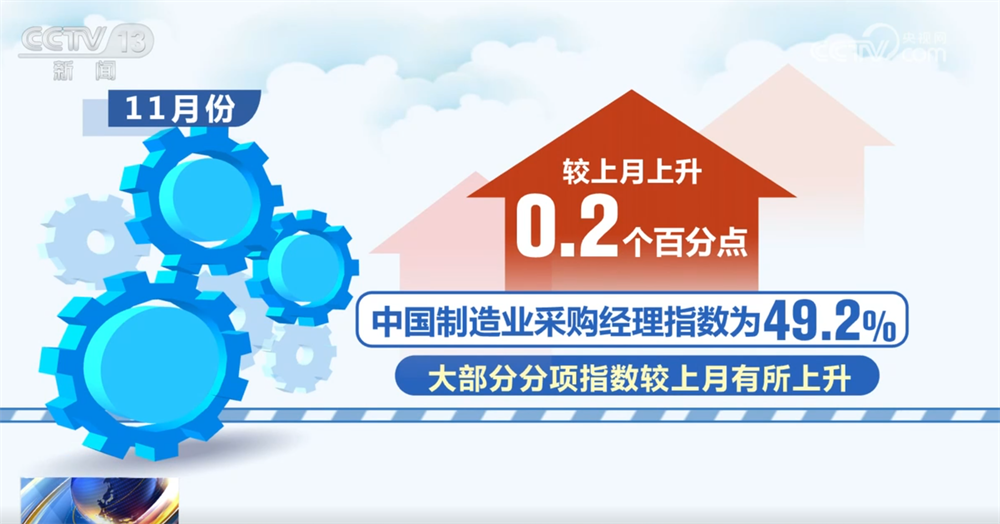
Group 1: Manufacturing Sector - The manufacturing Purchasing Managers' Index (PMI) for November is reported at 49.2%, showing a 0.2 percentage point increase from the previous month, indicating an improvement in manufacturing sentiment [1] - Both the production index and new orders index have rebounded compared to last month, with the production index reaching the critical point, suggesting improvements in both production and demand [1] - High-tech manufacturing PMI has remained above the critical point for 10 consecutive months, indicating continued growth in related industries [1] Group 2: Small and Medium Enterprises - The PMI for small and medium-sized enterprises has shown varying degrees of recovery, with the small enterprise PMI reaching a six-month high, reflecting a notable improvement in their business conditions [1] Group 3: Market Expectations - The production and business activity expectation index has increased from the previous month, indicating enhanced confidence among manufacturing enterprises regarding recent market developments [3] - Industries such as non-ferrous metal smelting and processing, as well as railway, shipbuilding, and aerospace equipment, have business activity expectation indices above 57%, reflecting optimism in these sectors [3] Group 4: Non-Manufacturing Sector - The non-manufacturing business activity index for November is reported at 49.5%, with a slowdown in overall business activity due to seasonal declines in consumer-related services [5] - Financial activities have shown robust performance, and new momentum industries are operating steadily, with stable optimistic expectations among enterprises [4][9] - The non-manufacturing business activity expectation index is at 56.2%, marking a 0.1 percentage point increase from the previous month and remaining above 56% for two consecutive months [8] Group 5: Economic Outlook - The data indicates that enterprises maintain stable optimistic expectations for future non-manufacturing development, supported by ongoing policy measures and a year-end push in supply and demand, which is expected to release investment and consumption-related demand [9]

11月份制造业PMI小幅回升 我国经济景气水平总体平稳
Jing Ji Ri Bao· 2025-12-01 00:45
Group 1: Manufacturing Sector - The manufacturing Purchasing Managers' Index (PMI) for November is 49.2%, an increase of 0.2 percentage points from the previous month, indicating a slight improvement in manufacturing sentiment [2][5] - The production index and new orders index for manufacturing are 50.0% and 49.2%, respectively, with increases of 0.3 and 0.4 percentage points from last month [2] - High-tech manufacturing continues to expand, with a PMI of 50.1%, remaining above the critical point for ten consecutive months [2] Group 2: Non-Manufacturing Sector - The non-manufacturing business activity index is 49.5%, a decrease of 0.6 percentage points from the previous month, indicating a decline in non-manufacturing sentiment [4] - The service sector's business activity index dropped to 49.5%, down 0.7 percentage points, attributed to seasonal effects following the National Day and Mid-Autumn Festival [4] - The construction sector's business activity index improved to 49.6%, an increase of 0.5 percentage points, suggesting a recovery in construction activity [4] Group 3: Economic Outlook - Experts suggest that while the manufacturing PMI shows slight recovery, it remains below the critical line, indicating ongoing downward pressure on the economy [5] - There is an expectation for increased investment and consumption demand as year-end approaches, supported by policy measures and the initiation of the 14th Five-Year Plan [6] - The overall economic stability is contingent on the effective implementation of policies to boost market confidence and demand [6]
——2025年11月PMI点评:出口改善推动制造业PMI回稳
EBSCN· 2025-11-30 12:18
Manufacturing Sector - The manufacturing PMI for November 2025 is 49.2%, a slight increase of 0.2 percentage points from the previous month, but still below the seasonal level[2][5] - New export orders index rose significantly by 1.7 percentage points to 47.6%, driven by the easing of US-China tariffs and improved trade conditions[5][19] - Small enterprise PMI increased by 2.0 percentage points to 49.1%, marking a six-month high, indicating a recovery in the external trade environment[5][12] Non-Manufacturing Sector - The non-manufacturing PMI decreased to 49.5%, down 0.7 percentage points from the previous month, reflecting a decline in service-related activities post-holiday[2][28] - The construction PMI rose by 0.5 percentage points to 49.6%, indicating a low-level recovery in building activities, supported by ongoing infrastructure projects[32][34] Price and Inventory Dynamics - Raw material purchase prices and factory gate prices indices increased to 53.6% and 48.2%, respectively, showing an improvement in the supply-demand relationship[24][25] - The finished goods inventory index fell by 0.8 percentage points to 47.3%, indicating a faster reduction in inventory levels, which may support future price increases[24][27]
透过11月份“关键经济指标”看中国制造业“稳+进” 金融活动和新动能表现良好
Yang Shi Wang· 2025-11-30 04:20
Core Viewpoint - The manufacturing sector in China shows signs of stabilization and recovery in demand, with the Purchasing Managers' Index (PMI) indicating an overall positive trend in November [1][3]. Manufacturing Sector Summary - The manufacturing PMI for November is reported at 49.2%, an increase of 0.2 percentage points from the previous month, with most sub-indices showing improvement [3]. - The production index and new orders index both increased, with the production index reaching the critical point of 50% [4]. - New export orders across four major industries and businesses of various sizes have all risen compared to the previous month, particularly high-tech manufacturing, which saw an increase of over 3 percentage points [6]. - The production index for November is at 50%, up by 0.3 percentage points, indicating stable manufacturing activity [10]. - The finished goods inventory index decreased to 47.3%, down 0.8 percentage points from the previous month, suggesting smoother sales activities for enterprises [10]. Non-Manufacturing Sector Summary - The non-manufacturing business activity index for November stands at 49.5%, reflecting a slowdown in overall business activities, particularly in consumer-related services [11]. - Financial activities and new momentum sectors are performing well, with the financial business activity index and new orders index both rising significantly above 55% [11]. - The non-manufacturing business activity expectation index is at 56.2%, up 0.1 percentage points from the previous month, indicating stable optimistic expectations among enterprises for future market development [15].
制造业PMI为何超季节性回落?:——2025年10月PMI点评
EBSCN· 2025-10-31 12:32
Manufacturing Sector - The manufacturing PMI for October 2025 is reported at 49.0%, a significant decrease of 0.8 percentage points from the previous month, which is notably higher than the seasonal average decline of 0.4 percentage points observed from 2020 to 2024[2][5] - The production index fell by 2.2 percentage points to 49.7%, while the new orders index decreased by 0.9 percentage points to 48.8%[5][15] - The new export orders index dropped to 45.9%, down 1.9 percentage points, marking the second-lowest level since the introduction of high tariffs in April 2025[5][20] - Small enterprises experienced a notable decline in PMI, falling 1.1 percentage points to 47.1%, while large enterprises' PMI decreased to 49.9%[6] Non-Manufacturing Sector - The non-manufacturing PMI for October 2025 is at 50.1%, slightly up from 50.0% in the previous month, driven by holiday consumption[2][28] - The service sector showed improvement, with indices for transportation, retail, and entertainment exceeding 60%, indicating strong performance in consumer-related services[28] - The construction PMI fell to 49.1%, but new orders and business activity expectations increased, suggesting a potential recovery in infrastructure activities[34] Economic Outlook - The report highlights that the construction sector may benefit from the introduction of 500 billion yuan in new policy financial tools and an additional 200 billion yuan in special bond issuance, which could support infrastructure investment[4][34] - The overall economic environment remains cautious due to external trade uncertainties and domestic demand stability, particularly in high-energy-consuming industries[16][20]
我国经济总体产出扩张略有加快
Jing Ji Ri Bao· 2025-10-01 05:31
Economic Overview - In September, the manufacturing Purchasing Managers' Index (PMI) was 49.8%, an increase of 0.4 percentage points from the previous month, marking two consecutive months of increase [1] - The non-manufacturing business activity index was 50.0%, a decrease of 0.3 percentage points from the previous month, while the composite PMI output index rose to 50.6%, up 0.1 percentage points [1] Manufacturing Sector - Manufacturing production activities accelerated, with the production index at 51.9%, up 1.1 percentage points from the previous month, remaining in the expansion zone for five consecutive months [1] - The new orders index for manufacturing was 49.7%, an increase of 0.2 percentage points, indicating a stabilization in market demand [1] - The new export orders index was 47.8%, up 0.6 percentage points, reflecting a narrowing decline in export demand [1] Industry Performance - In September, the PMI for equipment manufacturing, high-tech manufacturing, and consumer goods industries were 51.9%, 51.6%, and 50.6% respectively, all significantly above the manufacturing average [2] - Large enterprises showed stable growth with a PMI of 51.0%, while small enterprises improved slightly with a PMI of 48.2%, up 1.6 percentage points [2] Future Outlook - The average PMI for the manufacturing sector in Q3 was 49.5%, indicating a slight recovery compared to Q2 and the same period last year [3] - Expectations for manufacturing activities are positive, with a production and operation expectation index of 54.1%, up 0.4 percentage points, suggesting improved market outlook [2][3] - The non-manufacturing business activity index remained stable at 50%, indicating steady performance in the sector [3] Financial Sector - The financial sector's business activity index rose above 60%, with new orders also increasing, indicating strong support for the real economy [4] - The telecommunications and software services sectors maintained high business activity indices, reflecting ongoing growth in new economy sectors [4] Policy and Demand - There is an expectation for macroeconomic policies to be strengthened in Q4, which may boost market confidence and demand [5] - Seasonal factors such as holidays and promotional events are anticipated to enhance consumer demand in the coming months [3][5]
我国经济总体产出扩张略有加快 制造业采购经理指数连续2个月上升
Jing Ji Ri Bao· 2025-09-30 21:59
Economic Overview - In September, the manufacturing Purchasing Managers' Index (PMI) was 49.8%, an increase of 0.4 percentage points from the previous month, marking two consecutive months of increase [1] - The non-manufacturing business activity index was 50.0%, a decrease of 0.3 percentage points from the previous month, indicating stability in the non-manufacturing sector [1] - The comprehensive PMI output index rose to 50.6%, up 0.1 percentage points from the previous month, suggesting a slight acceleration in overall economic output [1] Manufacturing Sector - Manufacturing production activities accelerated, with the production index at 51.9%, up 1.1 percentage points from the previous month, remaining in the expansion zone for five consecutive months [1] - The new orders index for manufacturing was 49.7%, an increase of 0.2 percentage points from the previous month, indicating a stabilization in market demand [1] - The new export orders index was 47.8%, up 0.6 percentage points from the previous month, reflecting a narrowing decline in export demand [1] New Growth Drivers - In September, the PMIs for equipment manufacturing, high-tech manufacturing, and consumer goods were 51.9%, 51.6%, and 50.6% respectively, all significantly above the manufacturing average [2] - Large enterprises showed stable growth with a PMI of 51.0%, while small enterprises improved slightly with a PMI of 48.2%, up 1.6 percentage points from the previous month [2] - The manufacturing production and business activity expectation index was 54.1%, indicating positive market expectations among manufacturers [2] Non-Manufacturing Sector - The non-manufacturing business activity index remained stable at 50%, despite a slight decrease from the previous month [3] - The service sector PMI was 50.1%, down 0.4 percentage points from August, reflecting seasonal trends and the timing of the Mid-Autumn Festival [3][4] - Financial services showed strong performance with a business activity index above 60%, indicating robust support for the real economy [4] Future Outlook - The third quarter average manufacturing PMI was 49.5%, indicating a consolidation of economic recovery compared to the second quarter and the same period last year [3] - Expectations for the fourth quarter include increased macroeconomic policies to boost market confidence and demand, driven by holiday consumption and infrastructure projects [3][4] - The non-manufacturing sector is expected to stabilize and recover, supported by seasonal effects and ongoing macroeconomic adjustments [4]
制造业PMI连续两个月回升,后续怎么看?:——2025年9月PMI点评
EBSCN· 2025-09-30 10:42
Manufacturing Sector - The manufacturing PMI for September 2025 is 49.8%, an increase of 0.4 percentage points from the previous month, aligning with seasonal recovery trends[2][5] - The production index rose to 51.9%, up 1.1 percentage points from last month, indicating accelerated production activities as extreme weather impacts dissipate[5][14] - The new orders index increased slightly to 49.7%, suggesting persistent demand insufficiency, with a widening production-demand gap of 2.2 percentage points[5][14] Industry Performance - Equipment manufacturing PMI rose significantly to 51.9%, up 1.4 percentage points, while high-tech manufacturing PMI remains stable at 51.6%[5][15] - Consumer goods manufacturing PMI reached its highest level of the year at 50.6%, driven by seasonal factors like the upcoming holiday[5][15] - Traditional high-energy-consuming industries saw a decline in PMI to 47.5%, influenced by weak demand from real estate and infrastructure investments[5][15] Economic Outlook - The fourth quarter is expected to show a positive trend in manufacturing PMI due to the end of extreme weather and the onset of the traditional production peak season[5] - Recent economic stimulus measures, including policy adjustments and new financial tools, are anticipated to support economic growth in the fourth quarter[5] Service Sector - The service sector business activity index for September is 50.1%, a decrease of 0.4 percentage points from the previous month, reflecting a cooling in service consumption post-summer[31] - Financial services continue to show strength, with the business activity index rising above 60%, indicating robust support for the real economy[31] Construction Sector - The construction sector's business activity index increased slightly to 49.3%, ending a two-month decline but remaining at historically low levels due to reduced demand from real estate and infrastructure[35] - Anticipated government projects and new financial tools are expected to bolster construction activity in the upcoming quarter[35]