
自动驾驶出租车

Search documents
Robotaxi:开启万亿级城市出行新纪元
HUAXI Securities· 2026-03-25 03:33
Investment Rating - The report suggests a positive investment outlook for the Robotaxi industry, highlighting significant growth potential and key players in the market [3]. Core Insights - The Robotaxi market is projected to exceed $2 trillion by 2030, driven by advancements in technology, supportive policies, and decreasing costs [2][20]. - Major players like Tesla, Baidu, and WeRide are accelerating their operations, with Tesla leading the way in commercial deployment [2][34]. - The report identifies a turning point for the Robotaxi industry, with improvements in technology, favorable policies, and a shift towards profitability for operators [2]. Summary by Sections What is Robotaxi? - Robotaxi represents a specific application of autonomous driving technology, with varying levels of automation from L2 to L4 [5][9]. Market Space - The global Robotaxi market is expected to reach approximately $2.3 trillion by 2030, based on assumptions of urbanization and travel patterns [20][22]. Tesla's Leadership - Tesla is a key player in the Robotaxi space, utilizing a pure vision-based approach and extensive real-world data to enhance its autonomous driving capabilities [28][32]. Baidu's Business Model - Baidu's Robotaxi service, "Luo Bo Kua Pao," has proven its business model in Wuhan, achieving profitability and expanding its operations to multiple cities [41][44]. Beneficiary Stocks - Beneficiary stocks in the Robotaxi sector include leading companies in autonomous driving, chassis control, lidar, domain controllers, and smart driving chips [3].



Robotaxi混战升级:Lucid对标特斯拉、Uber疯狂圈地
汽车商业评论· 2026-03-16 23:06
Core Insights - The article discusses the recent developments in the Robotaxi sector, highlighting Lucid's introduction of the Lunar concept vehicle and Uber's partnerships with various companies to advance their autonomous taxi services [3][4][6]. Group 1: Lucid's Lunar and Strategy - Lucid has unveiled the Lunar, a dual-seat Robotaxi concept based on a mid-sized electric platform, which aims to compete directly with Tesla's Cybercab [3][6]. - The mid-sized platform is central to Lucid's growth strategy, supporting three new models priced below $50,000, including two SUVs and one undisclosed electric vehicle [7]. - The platform boasts high efficiency, with the Cosmos model achieving up to 4.5 miles per kWh, surpassing competitors like Lucid Gravity and Jaguar I-PACE [8]. Group 2: Cost Efficiency and Partnerships - Lucid claims that the operational costs of its platform are 34% lower than comparable Korean models and 10% lower than mainstream American crossovers, with a 300-mile range achievable at a lower cost compared to German and American competitors [9]. - Lucid is working on integrating its platform into Uber's Robotaxi network, with plans to deploy vehicles at a scale similar to the Gravity Robotaxi project [9]. - Lucid's CEO emphasized the need for a clearer path to profitability by leveraging technology and capital efficiency [7]. Group 3: Uber's Robotaxi Initiatives - Uber and Motional have launched a commercial Robotaxi service in Las Vegas, allowing passengers to request rides through the Uber app without additional charges [16][18]. - The initial phase includes human safety drivers, with plans for fully autonomous service by the end of 2026 [17]. - Uber has established a 10-year framework agreement with Motional, indicating a long-term commitment to integrating autonomous vehicles into its platform [19]. Group 4: Competitive Landscape - Uber has signed a multi-year agreement with Zoox to integrate its dedicated Robotaxi into the Uber platform, marking Zoox's first collaboration with a third-party ride-hailing service [26]. - Other partnerships include Nissan and Wayve, aiming to launch a Robotaxi pilot in Tokyo by the end of 2026, showcasing Uber's global expansion strategy [29][31]. - The competitive landscape is intensifying, with multiple companies like Waymo and Tesla also advancing their autonomous vehicle timelines [32][33].


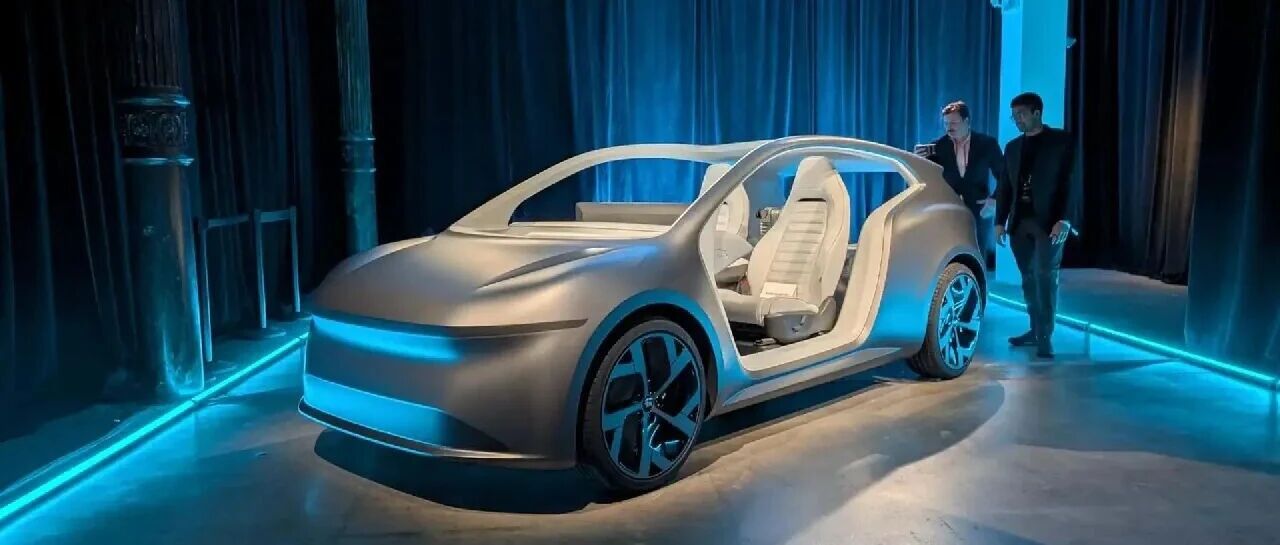
——汽车行业周报(20260308-20260315):Robotaxi系列跟踪1:政策&主要参与者商业化进展更新-20260315
Hua Yuan Zheng Quan· 2026-03-15 13:46
Investment Rating - Investment rating: Positive (maintained) [1] Core Insights - The report highlights the acceleration of Robotaxi commercialization driven by recent policy changes in both the US and China, indicating a strong growth potential for the industry in 2026 [6][26]. - Key players in the Robotaxi sector, including Tesla and Waymo, are expanding their fleets significantly, with Tesla's Robotaxi fleet reaching 447 vehicles and Waymo planning to expand its fleet to 5,000-6,000 vehicles by the end of 2026 [16][22][25]. - Domestic players such as Pony.ai and WeRide are also scaling up, with targets of over 3,000 vehicles for Pony.ai and 2,600 for WeRide in 2026 [25][26]. Policy Developments - In the US, the "SELF DRIVE Act of 2026" is expected to facilitate the commercialization of Robotaxis by allowing vehicles without steering wheels on the road and increasing the annual deployment cap from 2,500 to 90,000 vehicles [9][10]. - In China, the Ministry of Industry and Information Technology released a draft for "Safety Requirements for Autonomous Driving Systems," which aims to enhance the regulatory framework for L3/L4 autonomous vehicles [11][13]. - The implementation of the "Autonomous Vehicle Operation Service Specification" is anticipated to further standardize the industry by setting new operational requirements for service providers [14]. Industry Participants - Tesla's Robotaxi fleet has been deployed primarily in the Bay Area and Austin, with a notable focus on achieving full autonomy in Austin while expanding fleet size in the Bay Area [20][21]. - Waymo's fleet has surpassed 3,000 vehicles, with plans to increase to 5,000-6,000 by the end of 2026, and it is currently processing over 400,000 paid ride orders weekly [22][25]. - Domestic competitors like Pony.ai and WeRide have also reported significant fleet sizes and operational profitability, with plans for substantial growth in the coming years [25][26].
两会精神解读:把握低空经济与Robotaxi等主题趋势性投资机会
2026-03-11 08:11
Summary of Conference Call Notes Industry and Company Involved - **Industry**: Transportation and Low-altitude Economy - **Key Companies Mentioned**: Zhongxing Haizhi, SF Holdings, Caocao Travel, Yihang, Fengfei Aviation, WoFei Aviation, and others Core Points and Arguments 1. **Government Support for Low-altitude Economy**: The government work report emphasizes the development of new productive forces, including low-altitude economy, integrated circuits, aerospace, and biomedicine as emerging pillar industries [1][2] 2. **Long-term Investment Opportunities**: Despite short-term market fluctuations due to geopolitical tensions, the transportation technology sector presents a long-term investment opportunity, with current market conditions seen as favorable for positioning [2][3] 3. **Definition of Low-altitude Economy**: The low-altitude economy refers to activities involving manned or unmanned aerial vehicles operating below 3,000 meters, which includes general aviation, drones, and electric vertical takeoff and landing (eVTOL) aircraft [3][4] 4. **Growth of General Aviation**: General aviation in China has seen rapid growth over the past decade, with flight hours projected to reach approximately 134 hours in 2024, and the number of general aviation enterprises increasing to 760 [5][6] 5. **Comparison with the U.S.**: The U.S. general aviation sector operates at a significantly higher scale, with 28.56 million flight hours in 2023, indicating substantial growth potential for China's general aviation market [5][6] 6. **Regulatory Framework**: The establishment of a regulatory framework for low-altitude operations, including the implementation of the Interim Regulations on the Management of Unmanned Aerial Vehicle Flights, marks a significant step in promoting the low-altitude economy [4][19] 7. **Drone Market Potential**: The drone market in China is projected to reach a trillion-level market size, with applications in logistics, emergency response, and social governance [8][9] 8. **Case Studies of Drone Applications**: Successful implementations of drone logistics by companies like SF Holdings demonstrate the viability of drone delivery in various scenarios, including agricultural transport and urban logistics [9][10][11] 9. **eVTOL Aircraft Development**: China is positioned to lead in the eVTOL market, with several companies making significant advancements in aircraft design and certification processes [13][15][16] 10. **Investment Opportunities in eVTOL**: The eVTOL sector is expected to see substantial growth, with various companies obtaining necessary certifications for commercial operations, indicating a shift towards market readiness [17][20] 11. **Robotaxi Development**: The emergence of Robotaxi services, particularly with advancements in autonomous driving technology, presents new investment opportunities, with companies like Caocao Travel being highlighted for their potential [21][24] 12. **Market Dynamics and Future Outlook**: The low-altitude economy and autonomous driving sectors are expected to grow significantly over the next 5-10 years, with a projected market value reaching trillions [19][20] Other Important but Possibly Overlooked Content 1. **Regional Development Focus**: The development of general aviation is particularly emphasized for less populated regions in China, where traditional transportation infrastructure may not be feasible [6][7] 2. **Technological Advancements**: Continuous improvements in drone technology and regulatory support are crucial for the successful implementation of low-altitude operations [12][18] 3. **Investment in Supporting Industries**: Companies involved in the supply chain for drones and eVTOLs, including those producing batteries and components, are also seen as valuable investment targets [20][21] 4. **Global Market Positioning**: China's ability to supply low-altitude industry needs both domestically and internationally is highlighted, especially in regions lacking robust transportation infrastructure [18][19] This summary encapsulates the key insights and discussions from the conference call, focusing on the low-altitude economy and its associated investment opportunities.
Robotaxi系列报告三:汽车行业专题报告:中美两强竞争,全球商业化共振
Guohai Securities· 2026-03-06 08:07
Investment Rating - The report maintains a "Recommended" rating for the Robotaxi industry [2] Core Insights - The report addresses key questions regarding the evolution of Robotaxi from 2025 to present, comparisons between the US and China in Robotaxi deployment, and new players and investment opportunities in the Robotaxi sector for 2026 [7] - The US market is seeing accelerated commercialization of L4 Robotaxi, with Waymo and Tesla as the main players. Waymo has significantly increased its fleet and operational cities, aiming for over 1 million weekly orders by the end of 2026 [7][12] - In China, major cities are expanding Robotaxi operations, with companies like Xiaoma Zhixing, WeRide, and Loongrun leading the market. The focus is on transitioning from demonstration applications to operational models [7][35] - The competition in the L4 sector between the US and China is intensifying, with the US passing the 2026 Self-Driving Act to facilitate commercialization and counter China's advantages [7][29] Summary by Sections US Robotaxi Market - Waymo has expanded its operations to 10 cities, with a fleet of over 2,500 Robotaxis and a target of entering 20 more cities by the end of 2026 [12][17] - Tesla's Robotaxi service began in 2025, with plans to expand to 7 new cities in 2026, and the Cybercab model is set to launch commercially by 2027 [18][24] Chinese Robotaxi Market - Major cities like Guangzhou and Shenzhen are actively promoting Robotaxi trials and licenses, aiming to enhance operational areas and commercial viability [35][38] - Companies like Xiaoma Zhixing and WeRide are expanding their fleets and operational areas, with Xiaoma aiming for over 3,000 Robotaxis by 2026 [50][41] New Players and Investment Opportunities - New entrants in the Robotaxi market are emerging, with companies like Didi and Hello planning to scale their operations significantly by 2026 [51][55] - Investment recommendations include focusing on leading Robotaxi companies and related technology firms, with a positive outlook on the sector's growth [74]
文远知行Uber启动阿布扎比市中心Robotaxi商业运营服务
Bei Jing Shang Bao· 2026-02-12 10:29
Core Insights - WeRide and Uber have officially launched the first Robotaxi commercial operation service in downtown Abu Dhabi, marking the first deployment of autonomous vehicles in the area [1] - The Robotaxi service now covers approximately 70% of the core areas in Abu Dhabi, expanding the operational range significantly [1] - Currently, each vehicle is equipped with a safety operator, with plans to transition to fully autonomous operation in phases [1] Company Operations - WeRide has deployed over 200 Robotaxis in the Middle East region, indicating a strong presence in the autonomous vehicle market [1] - Tawasul Transport, a local transportation company, is managing the WeRide Robotaxi fleet on the Uber platform, providing fleet management services [1]
Robotaxi进入“千辆时代”:规模扩张加速 盈利路径渐现端倪
Zhong Guo Jing Ying Bao· 2026-01-30 19:59
Core Insights - The Chinese autonomous driving industry is transitioning from technical feasibility to commercial viability, with significant advancements in Robotaxi operations and fleet sizes [1][6] - Major players like Xiaoma Zhixing and Didi Chuxing are expanding their fleets and partnerships, indicating a shift towards large-scale operations and deeper collaborations across the industry [2][4] Fleet Expansion - Xiaoma Zhixing's fully autonomous Robotaxi fleet has surpassed 1,159 vehicles, marking a significant milestone in the industry [2] - The platform of Ruoqi Chuxing has over 300 Robotaxi vehicles in operation, with a cumulative safe mileage of nearly 6 million kilometers, covering multiple cities in Guangdong [1][2] Partnerships and Collaborations - Didi Chuxing and GAC Aion's R2 model delivery showcases a closed-loop acceleration from R&D to mass production, highlighting the deepening division of labor within the industry [3][4] - Xiaoma Zhixing has signed significant agreements with partners like BAIC New Energy and Aitebo, focusing on co-creating products and exploring efficient monetization paths for Robotaxi services [4] Regional Advantages - Guangdong has emerged as a hub for the Robotaxi industry, with leading companies like Xiaoma Zhixing and Ruoqi Chuxing establishing a strong presence [5] - The region's policies have lowered the barriers for companies to enter new cities, facilitating quicker expansion and operational efficiency [5] Cost and Regulatory Challenges - High operational costs are identified as the primary constraint to commercial viability, overshadowing technical maturity and liability definitions [6][7] - The current regulatory framework is lagging, with unclear standards for commercial operation capabilities and liability definitions, complicating the industry's growth [7] Future Recommendations - Industry experts suggest standardizing vehicle models and expanding pilot areas to enhance operational efficiency and reduce costs [8] - Implementing a mixed scheduling model and promoting standardized mass-produced vehicles are recommended to lower per-vehicle costs and improve service delivery [8]
Waymo遭遇鬼探头,Robotaxi在校门口把儿童给撞了
3 6 Ke· 2026-01-30 11:06
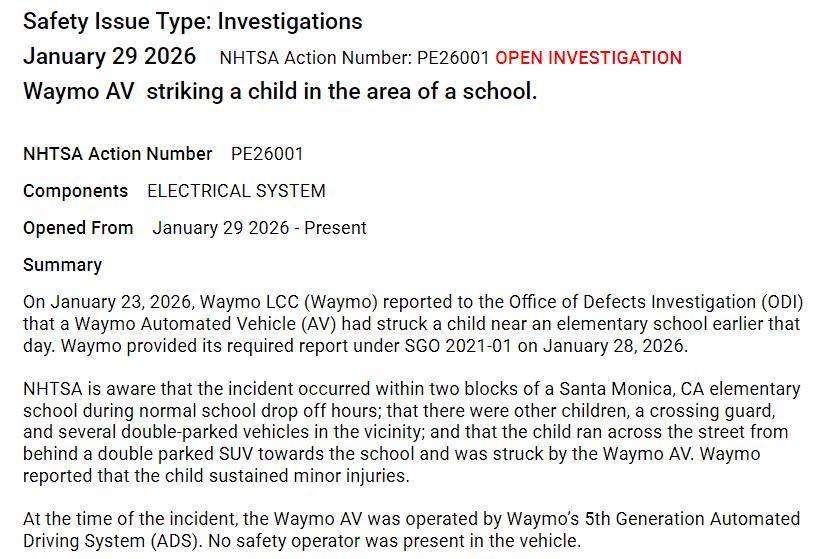
Core Viewpoint - Waymo's autonomous vehicle was involved in an accident where it struck a child near a school, raising concerns about the safety of self-driving technology, but the company argues that human drivers would have likely caused more severe injuries in a similar situation [1][2][6]. Group 1: Accident Details - The incident occurred during peak school hours when a child unexpectedly ran into the street from behind a parked SUV, leading to the collision with Waymo's fifth-generation autonomous vehicle, which had no safety driver onboard [2][5]. - Waymo reported that the vehicle's system detected the child and initiated emergency braking, reducing the speed from approximately 27.4 km/h to below 9.7 km/h before impact [5]. - Following the accident, the child was able to stand and walk to the sidewalk, and Waymo contacted law enforcement to report the incident [5]. Group 2: Safety Assessment - Waymo conducted a review using a "peer-reviewed model" to assess the safety of its autonomous driving system, concluding that a focused human driver would have collided with the child at a higher speed of 22.5 km/h, more than double the speed at which the Waymo vehicle struck [6][8]. - The National Highway Traffic Safety Administration (NHTSA) is currently evaluating whether Waymo's vehicles take appropriate precautions when encountering vulnerable road users like children [5]. Group 3: Public Perception and Future Plans - Despite the accident, some public sentiment suggests that Waymo's technology may be safer than human driving, as it aims to minimize injury in such incidents [7][11]. - Waymo is expanding its operations, recently launching Robotaxi services in Miami, marking its sixth city in the U.S. and planning to enter 12 more cities this year [12][15]. - The company is also introducing a new model of autonomous vehicle equipped with advanced sensors and technology, enhancing its service offerings [17]. Group 4: Competitive Landscape - Waymo's expansion includes entering the airport transportation sector, a lucrative market traditionally dominated by ride-hailing companies like Uber and Lyft [15]. - The company is set to launch Robotaxi services in London by the end of 2023, positioning itself against other leading players in the autonomous vehicle market [19][21]. - Comparatively, Tesla's Robotaxi service has faced scrutiny due to a significantly higher accident rate, with incidents occurring at a rate nine times greater than that of human drivers [22][24][25].
特斯拉和Waymo持续加速Robotaxi业务
CAITONG SECURITIES· 2026-01-26 07:35
Investment Rating - The report maintains an investment rating of "Positive" for the Robotaxi industry [2][10]. Core Insights - The Robotaxi industry is expected to experience rapid growth in the U.S. by 2026, driven by advancements from companies like Tesla and Waymo [6][5]. - Tesla has initiated public operations of its fully autonomous Robotaxi fleet in Austin, with plans for widespread application by the end of 2026 [6]. - Waymo is expanding its operational areas significantly, with plans to increase the number of cities it serves, including Miami and others [6]. Summary by Sections Recent Developments - Tesla's fully autonomous Robotaxi fleet began public service in Austin on January 22, 2026, with gradual increases in vehicle numbers planned [6]. - Waymo has expanded its operational area in Austin from 90 to 140 square miles and is set to launch services in additional cities [6]. Future Projections - By the end of 2026, Robotaxi services are anticipated to be widely adopted across the U.S., influencing related industries domestically [6]. - Tesla's Cybercab is expected to enter production in April 2026, with a projected cost of less than $0.20 per mile for large-scale operations [6]. Investment Recommendations - The report recommends investing in companies such as Ponyo, Horizon Robotics, and XPeng Motors, while also suggesting to monitor other players like Didi Global, Uber, and Cao Cao Mobility [6].
Robotaxi商业化进程展望
2026-01-15 01:06
Summary of Robotaxi Industry Conference Call Industry Overview - The Robotaxi industry is expected to see significant developments in 2026, particularly in major cities like Shenzhen and Shanghai, where the operational areas are projected to expand into urban districts, supported by improved legal and insurance frameworks [1][2]. Key Companies and Their Strategies - Leading domestic Robotaxi companies include Xiaoma Zhixing, Baidu's Luobo Kuaipao, and WeRide, which share similar technological routes but differ in focus: Xiaoma emphasizes stability, Luobo Kuaipao focuses on product diversity and algorithm accuracy, while WeRide excels in control systems [1][3]. - Xiaoma Zhixing is concentrating on a domestic single-vehicle profitability model, whereas WeRide is focusing on international market expansion, indicating a strategic divergence that may influence long-term competitiveness [12]. Technological Maturity and Development - The technological maturity of Robotaxi companies is categorized as follows: Waymo is at T0 level, while Xiaoma, Baidu, and WeRide are at T1 level. New entrants like XPeng and NIO are classified as T3 [4]. - The industry is approaching a plateau in technological advancement, with expectations that the gap between T0 and T1 players will diminish over the next few years [5]. Cost Structure and Future Cost Reduction - The cost of a Robotaxi is approximately 300,000 yuan, with the vehicle itself costing 120,000 to 160,000 yuan, and the remaining costs attributed to sensors and modifications [10]. - Future cost reduction strategies include using cheaper vehicle bodies, decreasing core component prices by 10%-20% annually, and reducing modification costs through increased production [10]. Regulatory and Market Dynamics - The regulatory landscape for Robotaxis is expected to become more favorable, with clearer legal frameworks and insurance policies emerging by 2026 [2]. - The transition from L2 level assisted driving to L4 level fully autonomous driving is complex and requires significant operational mileage and licensing [6]. Competitive Landscape - New entrants like Didi and Cao Cao Chuxing are currently lagging behind established players, with Didi classified in the third tier due to past regulatory setbacks [13]. - The Robotaxi industry is anticipated to shift from a technology-driven focus to an operations-driven model by 2030, where operational capabilities will become critical for success [12]. Deployment Challenges - Deploying Robotaxis in new cities typically requires at least one year, involving multiple stages such as map collection, algorithm adaptation, and road testing [15]. - Each city presents unique traffic conditions and safety requirements, necessitating tailored preparations before operational launch [16]. Future Catalysts - Significant events in 2026 may include Tesla's introduction of Robotaxis in the U.S., which could influence domestic manufacturers to follow suit, potentially altering the existing technological landscape [17][18].