
船舶与海洋工程装备

Search documents
事关老年人就业、义务教育年限、生育休假等,这场记者会信息量很大
21世纪经济报道· 2026-03-07 10:25AI Processing
国务院新闻办公室于2026年3月7日(星期六)下午3时举行吹风会,请国家发展改革委副主任郑备,国家发展改革委秘书长袁达,国 家发展改革委发展战略和规划司司长陈雷,国家发展改革委创新和高技术发展司司长白京羽,国家发展改革委社会发展司司长刘德 春解读"十五五"规划《纲要(草案)》,并答记者问。 发布会要点如下: 国家发展改革委副主任 郑备: "十五五"规划纲要草案共设18篇、62章、171节 "十五五"规划纲要草案共设18篇、62章、171节,分为三大板块。 第一板块为总论,对应第一篇,包括发展环境、指导方针和主要目标,主要是贯彻落实党中央《建议》明确的指导思想、原则和目 标要求,提出了"十五五"时期经济社会发展的20项主要指标。 第二板块是重大战略任务,对应第二篇至第十七篇,从产业发展、科技创新、数智化发展、国内市场、深化改革、对外开放、乡村 振兴、城乡区域、文化建设、人口发展、民生保障、绿色发展、安全发展、国防建设、民主法治、一国两制等16个方面阐述主要任 务和重大举措。 其中,顺应数字技术和人工智能发展大势,将提升数智化发展水平单独成篇;立足人口发展的阶段性特征,将人口 高质量发展单独成篇。 第三板块是规划 ...


从高端客滚船到深海机器人,威海打造特色船舶海工产业体系
Qi Lu Wan Bao· 2026-01-29 06:14
Core Viewpoint - The shipbuilding and marine engineering equipment industry in Weihai is a traditional advantage and a key focus for local government development, showing significant growth and potential for future expansion [1][4]. Industry Overview - Weihai has developed a comprehensive industrial system with 60 large-scale industrial enterprises in the shipbuilding and marine engineering sector, including leading companies like China Merchants Industry Weihai Shipyard and Huang Hai Shipbuilding [1]. - The industry has a strong competitive edge in high-end passenger ferries, deep-sea fishing vessels, and luxury yachts, with a total order backlog of 4.477 million deadweight tons, representing a year-on-year increase of 34.1% [1]. Financial Projections - The revenue of the shipbuilding and marine engineering industry in Weihai is expected to exceed 30 billion yuan by 2025, with profits projected to reach 2 billion yuan [1]. Strategic Development Plans - Weihai has established a three-year action plan for industrial cluster development, focusing on three major gathering areas and aiming to cultivate provincial-level characteristic industrial clusters [1]. - The key shipbuilding and marine engineering industrial park has attracted 32 enterprises, with an expected output value exceeding 10 billion yuan by 2025 [1]. Technological Advancements - Companies are encouraged to upgrade through new technologies and processes, with initiatives like the "Intelligent Transformation and Digital Upgrade" plan leading to the establishment of 8 smart manufacturing demonstration projects [2]. - The industry has seen significant advancements, including the delivery of the world's first oil-electric hybrid passenger ferry and the first 10,000-ton offshore oil-electric hybrid cargo ship [3]. Environmental Initiatives - Weihai is actively responding to the "dual carbon" strategy by implementing guidelines for carbon peak and green manufacturing systems, resulting in the establishment of 6 provincial-level green factories [3]. Market Expansion - The industry is diversifying into new fields, with successful entries into the small marine engineering equipment market and advancements in underwater robotics for marine ecological monitoring [3].

财政金融协同促内需一揽子措施出台 加大个人消费贷款和服务业经营主体贷款贴息力度
Zhong Guo Zheng Quan Bao· 2026-01-20 23:16
Group 1 - The core viewpoint of the article is the introduction of a comprehensive set of fiscal and financial policies aimed at boosting domestic demand, particularly through enhancing consumer spending and supporting private investment [1][4]. Group 2 - The optimization of the "dual subsidy" policy includes increased subsidy amounts for personal consumers, with the subsidy per transaction rising from 500 yuan to 3000 yuan, and for service industry enterprises, the loan subsidy limit increased from 1 million yuan to 10 million yuan [2]. - The implementation period for the optimized personal consumption and service industry loan subsidy policies has been extended to the end of 2026, with potential for further extension based on effectiveness [2]. - The coverage of financial institutions has expanded from over 20 national institutions to more than 500, enhancing accessibility for consumers and businesses [3]. Group 3 - The policy to stimulate private investment includes a subsidy of 1.5% on fixed asset loans for equipment updates, applicable for a maximum of two years, and covers loans issued from 2026 onwards for technology innovation [4]. - The subsidy for small and micro enterprises includes a 1.5% annual subsidy on fixed asset loans, with a maximum loan size of 50 million yuan, and is set to be implemented for one year with the possibility of extension [5]. - A special guarantee plan for private investment has been established with a total quota of 500 billion yuan, aimed at enhancing government financing guarantees and directing financial resources to support quality goods and services [5].
新型储能纳入政府投资基金投向!国家首次作出系统规范
中关村储能产业技术联盟· 2026-01-13 12:15
Core Viewpoint - The article discusses the implementation of a new regulatory framework for government investment funds in China, aimed at optimizing their layout and guiding investment directions to support national strategies and industrial upgrades [2][3][4]. Group 1: Government Investment Fund Overview - Government investment funds are established by various levels of government to guide social capital in supporting industry development and innovation through market-oriented methods such as equity investment [2][12]. - The new framework includes a systematic approach to fund layout and investment direction, marking the first national-level regulation of government investment funds [2][4]. Group 2: Supported Investment Areas - The framework identifies key investment areas, including: - Emerging and future industries such as information technology, new energy, advanced manufacturing, and artificial intelligence [2][3]. - Upgrading traditional industries and supporting high-quality development in manufacturing [3][4]. - Promoting the digital economy through initiatives like "AI+" and the application of 5G technology [3][4]. Group 3: Policy Measures - The framework outlines 14 policy measures focusing on three main aspects: where to invest, how to invest, and who manages the funds [3][4]. - It emphasizes early, small, long-term investments in hard technology and aims to prevent homogeneous competition and crowding out of social capital [11][12]. Group 4: Evaluation Management - An evaluation management method has been established to assess the investment direction of government funds, focusing on compliance with national planning and industry directories [4][5]. - The evaluation system includes three main indicators: policy compliance (60% weight), optimization of productivity layout (30% weight), and policy execution capability (10% weight) [6][7]. Group 5: Specific Evaluation Indicators - The evaluation indicators cover aspects such as support for new productivity, technology innovation, green development, and the promotion of private investment [29][33]. - Specific metrics include the proportion of investments in encouraged industries, the effectiveness of fund management, and the impact on social welfare [29][33][40].
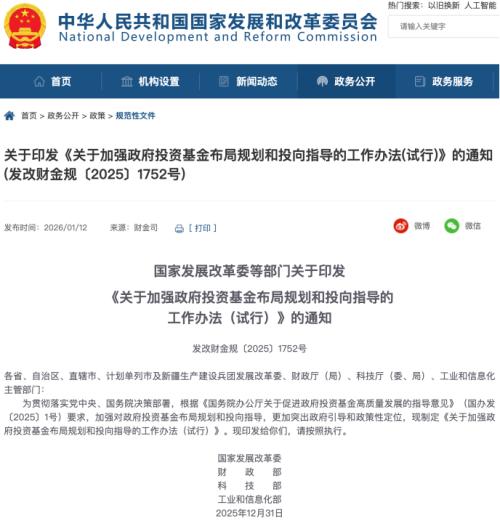
重磅利好!万亿级“国家队”投向明确了
Zhong Guo Jing Ji Wang· 2026-01-13 02:32
Core Viewpoint - The Chinese government has established a systematic framework for the development and direction of government investment funds, marking the first time such guidelines have been issued at the national level [1]. Group 1: Policy Framework - The "Work Method" outlines three main aspects: where to invest, how to invest, and who manages the funds, proposing 14 policy measures [3]. - The framework emphasizes supporting major strategies and key areas, particularly in sectors where market resources are insufficient, promoting deep integration of technological and industrial innovation, and focusing on nurturing emerging pillar industries [3]. Group 2: Investment Guidance - Funds must align with national major plans and encourage industries listed in the national industrial directory, while avoiding investments in restricted, eliminated, or prohibited sectors [3]. - Provincial development and reform departments are tasked with creating lists of key investment areas to optimize fund allocation [3]. Group 3: Evaluation Metrics - The "Management Method" establishes three primary indicators: 1. Policy compliance (60% weight), assessing the fund's role in supporting new productive forces, technological innovation, and green development [4]. 2. Optimization of productive layout (30% weight), evaluating alignment with national regional strategies and effective capacity utilization [5]. 3. Policy execution capability (10% weight), focusing on fund efficiency and the professional level of fund managers [5]. Group 4: Focus Areas - The investment focus includes emerging industries such as next-generation information technology, new energy, high-end equipment, and green technology, as well as future industries like the metaverse, brain-computer interfaces, and generative artificial intelligence [5].
利好来了!“国家队”投向明确!四部门联合发布
凤凰网财经· 2026-01-12 13:37
Core Viewpoint - The article discusses the recent issuance of guidelines by four government departments in China aimed at strengthening the planning and investment direction of government investment funds, marking a significant step in defining the future of these funds, which are crucial for supporting emerging and future industries [2][3]. Group 1: Government Investment Fund Guidelines - The guidelines, titled "Work Method for Strengthening the Layout Planning and Investment Direction of Government Investment Funds (Trial)," were jointly released by the National Development and Reform Commission, Ministry of Finance, Ministry of Science and Technology, and Ministry of Industry and Information Technology [3]. - The guidelines focus on three main aspects: where to invest, how to invest, and who manages the funds, proposing 14 policy measures to optimize fund allocation [3]. - Funds are required to support major strategies and key areas, particularly in sectors where market resources are inadequately allocated, emphasizing early, small, long-term investments in hard technology [3][5]. Group 2: Investment Direction and Evaluation - The investment direction must align with national major plans and encourage industries listed in the national industrial catalog, avoiding investments in restricted or eliminated sectors [4]. - Local development and reform departments are tasked with creating lists of key investment areas to optimize fund allocation based on regional characteristics [5]. - The guidelines also clarify the roles of national and local funds, with national funds focusing on supporting the modernization of the industrial system and overcoming key technological challenges [6]. Group 3: Evaluation Management Method - The "Management Method for Evaluating Investment Direction of Government Investment Funds (Trial)" was also released, establishing a comprehensive evaluation system that combines quantitative and qualitative assessments [6]. - The evaluation includes three primary indicators: policy compliance (60% weight), optimization of productivity layout (30% weight), and policy execution capability (10% weight) [6][7]. - The evaluation aims to ensure that funds effectively support new productive forces, technological innovation, and the development of the digital economy, among other areas [8].

船舶和海洋工程装备国际产教联盟在津成立
Zhong Guo Xin Wen Wang· 2026-01-12 11:13
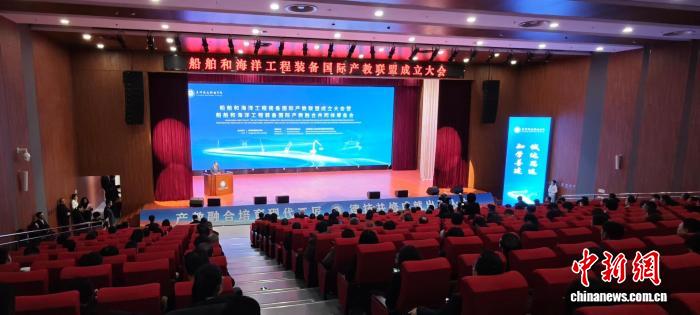
Group 1 - The International Alliance for Shipbuilding and Marine Engineering Equipment was established on January 10 in Tianjin, aiming to create a new platform for international integration of education and industry [1][4] - The alliance focuses on deep integration of the education chain, talent chain, industrial chain, and innovation chain, promoting high-quality development in the global shipbuilding and marine engineering equipment industry [2] - Four chair units and ten vice-chair units were awarded at the event, along with the signing of multiple cooperation memorandums and talent training agreements [2] Group 2 - Uzbekistan's participation in the alliance is expected to enhance practice-oriented talent cultivation, closely aligning vocational education with the actual needs of shipbuilding and marine industries [2] - Experts and representatives from countries like Bangladesh, Russia, and China discussed topics such as "international collaborative education under digital transformation" and "high-quality development paths for the shipbuilding industry under green transformation" during a roundtable session [3]
2025年中国进出口银行新发放外贸领域贷款超1.2万亿元
Yang Shi Xin Wen· 2026-01-07 10:31
Group 1 - In 2025, China Export-Import Bank issued over 1.2 trillion yuan in new loans for foreign trade, fully supporting the quality improvement and stability of foreign trade [1] - New loans for the manufacturing sector reached nearly 860 billion yuan, with a focus on advanced manufacturing industries such as shipbuilding and marine engineering equipment, rail transit equipment, new materials, and humanoid robots [1]
青岛|青岛发布“十四五”成绩单,地区生产总值预计今年突破1.7万亿元
Da Zhong Ri Bao· 2025-12-10 01:19
Economic Growth - Qingdao's GDP is expected to exceed 1.7 trillion yuan this year, achieving an average annual growth rate of 5.9% over the past five years [2] - The per capita GDP has increased to 161,000 yuan, a cumulative growth of 21.3%, reaching approximately 23,000 USD [2] - The total retail sales of consumer goods have grown at an average annual rate of 6.4%, surpassing 650 billion yuan, ranking second among northern cities after Beijing [2] Industrial Development - Qingdao has focused on developing the real economy, with a "10+1" innovative industrial system and a modern service industry contributing significantly to economic growth [3] - The city ranked seventh among the top 100 advanced manufacturing cities in China for three consecutive years from 2021 to 2023, aiming to rise to sixth place in 2024 [3] - High-tech manufacturing value added has grown at an average annual rate of 15.9%, with significant contributions from leading enterprises like BOE and Haier [3] Marine Economy - The marine economy in Qingdao has seen a production value exceeding 550 billion yuan, accounting for 33% of the GDP, ranking third among coastal cities in China [4] - Qingdao Port's cargo and container throughput have reached fourth and fifth globally, respectively, with a strong performance in international shipping [4] Innovation and Reform - Qingdao has prioritized technological innovation, with R&D expenditure growing at an average annual rate of 11.6% over the past four years [5] - The city has established numerous national and provincial key laboratories, significantly enhancing its innovation capabilities [5] - A total of 352 national and provincial reform pilot projects have been implemented, improving the business environment [6] Urban Development and Social Welfare - Qingdao's urbanization rate has reached 78.87%, with significant investments in infrastructure and urban renewal projects benefiting nearly 480,000 residents [7] - The city has maintained over 70% of its fiscal expenditure on social welfare, completing 72 municipal livelihood projects [7] - The average life expectancy in Qingdao has increased to 82.21 years, reflecting improvements in healthcare and living conditions [7]
青岛以创新驱动提升竞争力
Jing Ji Ri Bao· 2025-12-08 03:03
Group 1 - Qingdao's GDP has crossed five trillion yuan milestones since the 14th Five-Year Plan, with an expected GDP of over 1.7 trillion yuan for this year [1] - The completion of the Weizhou 11-4 CEPD platform by CNOOC Engineering (Qingdao) marks significant technological breakthroughs and sets new records for offshore oil and gas platform dimensions and weights in the Beibu Gulf region [1] - Qingdao's high-tech manufacturing industry has seen an average annual growth of 15.9% during the 14th Five-Year Plan, improving its ranking among China's top 100 advanced manufacturing cities from 11th in 2020 to 6th in 2024 [1] Group 2 - Qingdao has implemented 2,733 key projects with a total investment of 1.84 trillion yuan, significantly boosting emerging industries such as integrated circuits, new displays, artificial intelligence, and green energy [2] - The total retail sales of social consumer goods in Qingdao increased from 520.4 billion yuan in 2020 to 658.5 billion yuan in 2024, reflecting the city's efforts to enhance domestic and international dual circulation [2] - Actual foreign investment in Qingdao reached 18.47 billion USD during the 14th Five-Year Plan, demonstrating the effectiveness of the city's investment cooperation [2]