
网约车

Search documents
上汽集团旗下享道出行增资至约41.06亿元,增幅约20%
news flash· 2025-06-24 08:36
Group 1 - The core point of the article is that SAIC Group's subsidiary, Xiangdao Mobility, has increased its registered capital to approximately 4.106 billion RMB, representing an increase of about 20% [1] - The registered capital was raised from approximately 3.435 billion RMB to about 4.106 billion RMB [1] - The capital increase involved new shareholders, including Shanghai Automotive Industry (Group) Co., Ltd. and Shanghai International Automobile City (Group) Co., Ltd. [1]

【深度研报】Robotaxi对美股不同板块的⻓期影响
阿尔法工场研究院· 2025-06-24 08:35
Core Viewpoint - The success of Robotaxi will profoundly impact the US stock market and global industry landscape, with Tesla transitioning from a pure automotive manufacturer to a "mobility service + technology" company, leading to a potential restructuring of its business model and valuation system [1][10]. Group 1: Tesla's Role Transformation and Valuation Restructuring - Tesla is seen as one of the biggest potential beneficiaries of the Robotaxi era, with projections indicating that by 2029, 88% of Tesla's enterprise value will come from Robotaxi operations, while traditional electric vehicle sales will contribute only 9% [3][6]. - The successful implementation of the Robotaxi business model will allow Tesla to operate a large fleet of autonomous taxis, generating recurring revenue through per-mile or per-ride charges, which is expected to have a higher profit margin than traditional vehicle sales [5][6]. - Tesla's current market value already reflects expectations for the Robotaxi business, and once scaled, its revenue sources will diversify significantly, supporting higher sales and earnings multiples, thus driving up the company's valuation [6][10]. Group 2: Beneficiaries of the Robotaxi Industry Chain - The scale of Robotaxi will redefine automotive operations and create a vast autonomous driving ecosystem, benefiting various upstream and downstream companies, particularly in the fields of autonomous driving chips and computing platforms [12][27]. - Companies like NVIDIA are expected to see significant revenue growth from their automotive business, with projections indicating that NVIDIA's automotive revenue could exceed $5 billion by fiscal year 2026 [14]. - The global market for automotive LiDAR is projected to grow from $861 million in 2024 to $3.804 billion by 2030, with a compound annual growth rate of 28%, benefiting manufacturers in this space [18][19]. Group 3: Strategic Transformation and Challenges for Mobility Platforms - Existing ride-hailing giants like Uber and Lyft will face profound strategic changes due to the rise of Robotaxi, which could significantly lower operational costs and alter their business models [31][44]. - Uber has shifted from developing its own autonomous driving technology to forming partnerships with established tech companies like Waymo, allowing it to offer autonomous ride-hailing services without developing the technology in-house [33][36]. - Lyft has also adopted a similar strategy, partnering with Motional to provide autonomous ride-hailing services, indicating a shift towards a dual-mode operation that includes both human drivers and autonomous vehicles [37][38]. Group 4: Global Competitiveness of Chinese Robotaxi Companies - Chinese autonomous driving companies like Baidu Apollo, Pony.ai, and WeRide have demonstrated strong global competitiveness, with projections indicating that by 2030, China could have approximately 500,000 Robotaxi vehicles, compared to only 35,000 in the US [48][49]. - The collaborative "golden triangle" model involving vehicle manufacturers, technology companies, and mobility platforms has proven effective in accelerating the commercialization of Robotaxi in China [51][53]. - Chinese Robotaxi companies are beginning to expand internationally, with partnerships with Uber to deploy services in various cities, indicating their growing influence in the global market [56][60]. Group 5: Impact on Battery and Energy Sectors - The rise of Robotaxi fleets will significantly boost demand for electric vehicle batteries, benefiting companies involved in lithium, nickel, and cobalt production [66][67]. - The need for efficient charging infrastructure will accelerate the development of fast-charging and battery-swapping technologies, with companies like Baidu Apollo exploring these options [70][71]. - The integration of Robotaxi into the energy grid could lead to new business models, such as vehicle-to-grid (V2G) technology, allowing electric vehicles to act as energy storage units [75][76]. Group 6: Cloud Computing and Data Infrastructure - The success of Robotaxi relies heavily on robust cloud computing and data infrastructure, as each autonomous vehicle generates vast amounts of data that require significant processing and storage capabilities [80][81]. - Major cloud service providers like Amazon AWS, Microsoft Azure, and Google Cloud are expected to benefit from the increased demand for cloud resources to support autonomous driving data processing [83][85]. - The need for real-time communication between vehicles and cloud services will drive investments in telecommunications infrastructure, particularly in 5G networks [88][89]. Group 7: Simulation Testing Sector - The demand for simulation testing tools and services will surge as companies seek to validate autonomous driving technologies in virtual environments before real-world deployment [96][97]. - Companies specializing in simulation software and platforms are likely to see increased orders and valuations as the number of Robotaxi projects grows [100][101]. - Regulatory requirements for extensive simulation testing may further drive investment in this sector, as companies will need to provide detailed simulation data to meet safety standards [104][105]. Group 8: Cybersecurity Sector - The transition to Robotaxi will heighten the importance of cybersecurity in the automotive industry, as the absence of a human driver increases the risks associated with cyberattacks [108][109]. - Companies providing automotive cybersecurity solutions will see significant growth opportunities as the demand for secure vehicle networks and cloud services increases [112][113]. - Regulatory frameworks mandating cybersecurity measures for autonomous vehicles will further drive investment in this area, making cybersecurity a critical component of the Robotaxi ecosystem [115][116].



曹操出行港股暗盘跌超13%
news flash· 2025-06-24 08:21
曹操出行港股暗盘跌超13%,报36.3港元。招股书显示,截至2024年12月31日,曹操出行网约车业务版 图已扩展至136个城市,较2023年新增85城。公司全年实现营收147亿元,同比增幅达37.4%。曹操出行 6月17日在港交所公告称启动招股,计划全球发售4417.86万股股份,每股发售价为41.94港元,预计募资 18.53亿港元。 ...
创业板指涨逾1% 上涨个股超4100只
news flash· 2025-06-24 01:38
创业板指涨逾1% 上涨个股超4100只 智通财经6月24日电,指数走强,创业板指拉升涨逾1%,沪指涨0.22%,深成指涨0.71%,上涨个股家数 超4100只,网约车、游戏、无人驾驶、航空机场等板块指数涨幅居前。 ...

A股网约车、无人驾驶概念股盘初活跃,万马科技、浙江世宝、永安行、锦江在线等多股涨停。消息面上,特斯拉在美国得州奥斯汀正式推出无人驾驶出租车Robotaxi服务,哈啰Robotaxi业务完成超30亿元融资。
news flash· 2025-06-24 01:30
Group 1 - The core viewpoint of the article highlights the active performance of A-share ride-hailing and autonomous driving concept stocks, with several companies reaching their daily limit up [1] - Companies such as Wanma Technology, Zhejiang Shibao, Yong'anxing, and Jinjiang Online have shown significant stock price increases [1] - Tesla has officially launched its Robotaxi service in Austin, Texas, marking a significant development in the autonomous taxi sector [1] Group 2 - The financing of over 3 billion yuan for Hello Robotaxi indicates strong investor interest and confidence in the autonomous ride-hailing market [1]

网约车乘客“逃单”,司机该找谁要钱?
Ren Min Wang· 2025-06-24 00:52
Core Viewpoint - The case highlights the legal complexities surrounding ride-hailing services, particularly regarding the responsibilities of platform companies in cases of passenger fare evasion [1][6]. Group 1: Legal Relationships - The court identified three main legal relationships: between the platform company and the driver, the platform company and the passenger, and the driver and the passenger, establishing a new type of intermediary contract based on internet information services [3][4]. - The platform company is responsible for providing information to facilitate the contract between the driver and the passenger, but it does not have an obligation to cover fare losses incurred due to passenger evasion [4][6]. Group 2: Information Disclosure - The court ruled that the platform company must disclose reasonable personal information of passengers to the driver when fare evasion occurs, to allow the driver to seek remedies based on the passenger transport contract [3][4]. - The platform company argued that it only collects necessary information and is not required to provide additional personal details, which the court found valid until the driver faced issues with fare collection [3][4]. Group 3: Implications for the Industry - The case serves as a precedent for how ride-hailing platforms should handle fare evasion and the disclosure of passenger information, impacting future legal interpretations and industry practices [6][7]. - Recommendations for the industry include standardizing payment methods, improving payment reminders, and implementing consequences for fare evasion, such as sharing data across platforms to prevent repeat offenders [7].
滴滴超200城上线清凉打车优惠活动 推出“打一单得两张券”
2 1 Shi Ji Jing Ji Bao Dao· 2025-06-23 14:17
Core Viewpoint - Didi Chuxing is launching multiple promotional activities to meet the surge in travel demand during the summer, including significant subsidies for drivers and various discount coupons for users to enhance their travel experience [1][7]. Group 1: Promotional Activities - Didi is offering a "Complete One Order to Get Two Coupons" promotion, where users can earn two 50% discount coupons worth up to 15 yuan each by completing specific ride orders in 81 cities [1]. - From June 23 to July 13, users in 98 cities can participate in a "One-Click Ride with Didi, Everyone Reduces 5 Yuan and Then 10 Yuan" campaign, allowing them to receive limited 5 yuan and 10 yuan discount coupons [3]. - Users in 26 cities can access a "1 Yuan Deducts 10 Yuan" discount coupon for rides until July 6, while users in Urumqi can earn a "9.9 Yuan Deducts 30 Yuan" coupon through friend referrals [5]. Group 2: Driver Support Initiatives - Didi is distributing over 600 million yuan in summer subsidies to drivers across nearly 300 cities to help them manage increased operating costs during hot weather [7][9]. - The company encourages drivers to provide better service by offering rewards for completing rides during the subsidy period, ensuring they can earn good income while meeting passenger needs [7]. Group 3: User Experience Enhancements - Didi has implemented a "Trip Guardian" service to improve the efficiency of driver-passenger meet-ups, including features that allow users to adjust their pick-up points and receive alerts for optimal meeting locations [9]. - The company is also introducing summer-themed vehicles with special amenities like cooling seat cushions and sunshade curtains to enhance passenger comfort during rides [7]. Group 4: Collaboration with Local Events - Didi is actively collaborating with local tourism departments in cities like Nanchang, Ningbo, and Nanjing to promote travel and consumption through various initiatives, including issuing travel coupon packages and setting up dedicated ride stations [11].


高德联动生态伙伴加码“凉快行动”:多举措鼓励网约车“开空调”清凉出行
Bei Jing Shang Bao· 2025-06-23 11:47
Core Points - Alibaba's Gaode Map has upgraded its "Cool Action" initiative to enhance the travel experience for passengers during high temperatures by encouraging ride-hailing drivers to manage air conditioning and vehicle cleanliness [1][3] Group 1: Measures and Incentives - Gaode is promoting enhanced driver service quality training, focusing on maintaining vehicle cleanliness and pre-cooling the car based on passenger needs during high temperatures [3] - A summer incentive mechanism has been established for ride-hailing platforms, rewarding those that meet standards for air conditioning complaints, thereby encouraging better service quality [3] - The previous "Cool Action" included a total of 680 million yuan in "high-temperature subsidies" to alleviate drivers' costs during summer [3] Group 2: Collaborative Efforts - Various ride-hailing platforms are launching measures under Gaode's positive incentives, such as air conditioning-related reward programs for drivers with fewer complaints [4] - Driver service centers are being equipped with summer "cooling service stations" providing free refreshments and heat-relief supplies [4] - Gaode aims to foster a supportive environment for drivers' health and safety, advocating for improved labor rights protection and mutual understanding between drivers and passengers [4]

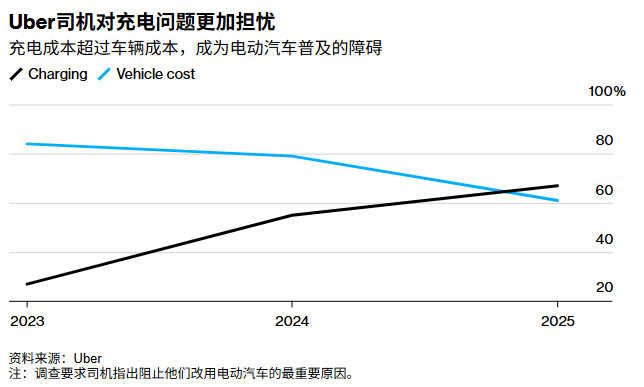
网约车电动化下半场:优步(UBER.US)充电需求预测工具上线 撬动行业基建变革
智通财经网· 2025-06-23 07:10
Core Insights - Uber is experiencing a pivotal moment in persuading millions of drivers to switch to electric vehicles (EVs), as the price barrier is no longer the main obstacle for drivers in the US and UK markets, marking a new phase in the electrification transition [1] - However, the challenge of charging infrastructure has emerged as a core issue, particularly for drivers who lack home charging capabilities, which poses a significant problem for Uber's platform [1] Group 1 - Over one-third of Uber's EV drivers in the US have access to dedicated home charging stations, while the situation is more severe in Europe, with only 27% of UK drivers and 13% of Dutch drivers having this convenience [2] - In response to the charging challenge, Uber is accelerating its investment in charging infrastructure, having appointed Rebecca Tinucci, former head of Tesla's charging business, to lead its electrification strategy [2] - Uber has made substantial progress in just nine months by collaborating with the C40 Cities Climate Leadership Group to improve charging networks for over 55,000 drivers in London, Boston, and Phoenix, and has developed a "charging demand forecasting tool" that covers 40 cities [2][3] Group 2 - The current active EV driver count on Uber's platform is approximately 230,000, reflecting a growth of over 60% since the beginning of the year [3] - Uber's investment of £5 million (approximately $6.73 million) in installing 700 EV charging stations in North and East London three years ago has resulted in usage rates at its charging stations in the Newham area being more than double the national average [3] - The "demand-driven supply" model is being replicated from North London to Boston, with charging station deployment dynamically growing based on driver activity heat maps, demonstrating Uber's commitment to addressing charging anxiety and accelerating the green transition [5]

海外2025中期策略:稳定币跑步入场,虚拟资产趋势已成
SINOLINK SECURITIES· 2025-06-23 05:24
Group 1: Virtual Assets and Stablecoins - The trend of virtual assets is continuously improving due to the enhancement of regulatory frameworks and increased institutional participation, with expectations of liquidity easing [2][18][25] - The global stablecoin market is projected to grow significantly, from approximately $5 billion in 2020 to around $200 billion by the end of 2024, indicating a clear expansion path for trading scenarios [25][26] - Various regions are implementing stablecoin policies, such as the U.S. passing the "Genius Act" and Hong Kong enacting the "Stablecoin Ordinance," which will take effect on August 1, 2025 [25][29] Group 2: Streaming Platforms - Music streaming platforms are identified as high-quality internet assets driven by domestic demand, with continuous scale effects driving profit leverage [2] - The market for music subscriptions is expected to grow, with major players like Spotify and Tencent Music holding significant market shares [33] Group 3: O2O Service Platforms - The trend of strong players becoming stronger is evident, with major platforms like Beike and Tuhu expected to increase market share amid a shrinking real estate and automotive aftermarket demand [2][39] - The used housing transaction volume in key cities showed a month-on-month decline, indicating a buyer's market, which may benefit established platforms [39] Group 4: Coffee, Tea, and E-commerce Delivery Platforms - The online retail sales of physical goods grew by 6.3% year-on-year from January to May 2025, indicating a competitive landscape where marketing expenses are rising [2][56] - The coffee and tea segment is highlighted as a key beneficiary in the delivery battle, with significant growth in order volumes and city coverage [68][75] Group 5: K12 Education and Training - The K12 education sector is experiencing a resurgence in non-subject training demand, with a significant reduction in subject-based training institutions, leading to a scarcity of quality compliant products [2][86] - Major players in the K12 sector, such as New Oriental and TAL Education, are showing strong performance with revenue growth exceeding 20% year-on-year [91]

