饮料

Search documents
香飘飘:前三季度实现营收16.84亿元 主动调整策略谋转型
Zheng Quan Shi Bao Wang· 2025-10-31 06:56
Core Viewpoint - The company reported a significant decline in revenue and net profit for the first three quarters of 2025, attributing this to a strategic adjustment in response to a challenging market environment [1][2]. Financial Performance - For the first nine months of 2025, the company achieved a revenue of 1.684 billion yuan, a year-on-year decrease of 13.12% [1]. - The net profit attributable to shareholders was a loss of 89 million yuan, representing a year-on-year decline of 603.07% [1]. Market Environment - The beverage industry is experiencing weak overall consumption, with retail sales of beverage products in China showing only a slight increase of 0.1% year-on-year, totaling 250.1 billion yuan [1]. - The overall retail sales of consumer goods grew by 4.5% during the same period, indicating a significant disparity in recovery rates among different consumer segments [1]. Strategic Adjustments - The company has proactively adjusted the shipment rhythm of its brewed products to ensure freshness for the fourth quarter and the Spring Festival peak season, leading to a delay in product shipments compared to previous years [2]. - The company has focused on channel destocking and initiated market preparations in mid to late September [2]. Research and Development - Despite the decline in revenue and profit, the company increased its R&D expenditure to 44 million yuan, a year-on-year growth of 42.45%, demonstrating a commitment to product health upgrades [2]. - The company has also implemented refined control over marketing expenses, with advertising costs decreasing by 12.66% to 6 million yuan and sales expenses down by 6.39% to 50 million yuan [2]. Business Segments - The brewed product segment, which is the core business, saw a revenue of 822 million yuan, down 25.96% year-on-year [3]. - The ready-to-drink segment emerged as a growth highlight, achieving a revenue of 833 million yuan, a year-on-year increase of 3.92%, surpassing the brewed segment [3]. - The "original leaf brewed" series, launched in 2024, has generated over 100 million yuan in sales, validating the company's health upgrade strategy and injecting new growth momentum into traditional business [3].

娃哈哈踩到的三颗地雷
3 6 Ke· 2025-10-31 02:31
Core Insights - Wahaha, a prominent Chinese brand, faces significant challenges following the death of its founder, Zong Qinghou, revealing underlying governance issues related to family, enterprise, and wealth [1][9][18] - The transition of leadership to Zong Qinghou's daughter, Zong Fuli, has been fraught with difficulties, including her recent resignation from key positions, raising questions about succession and governance [3][10][20] Group 1: Governance Issues - The lack of a structured governance system in family enterprises leads to conflicts and instability, as seen in Wahaha's case where family relationships have devolved into mere profit-driven alliances [10][11][18] - The governance model of Wahaha, which relied heavily on Zong Qinghou's personal authority, has proven fragile in his absence, exposing the vulnerabilities of a family-run business without clear succession plans [12][30][31] Group 2: Mixed Ownership Structure - Wahaha's mixed ownership structure, with approximately 46% held by local state-owned enterprises, complicates governance and accountability, especially when trust in government and corporate relationships falters [12][32][33] - The blurred lines between private wealth and state assets create legal ambiguities, which can lead to disputes over ownership and control, particularly in the wake of Zong Qinghou's death [13][14][15] Group 3: Cultural and Generational Conflicts - The generational divide between Zong Qinghou and Zong Fuli highlights the challenges of transitioning from a paternalistic leadership style to a more modern governance approach, which is often marked by emotional conflicts and power struggles [39][40][46] - The reliance on personal relationships and trust in business, characteristic of Chinese culture, becomes a liability when the central figure is no longer present, as seen in the erosion of trust among stakeholders in Wahaha [37][38] Group 4: Lessons for Future Family Enterprises - Future family businesses must establish formal governance mechanisms, such as family charters and trust structures, to ensure smoother transitions and mitigate risks associated with personal authority [20][47] - Emphasizing organizational trust over personal trust is crucial for the sustainability of leadership, particularly for female successors in a traditionally male-dominated environment [48][49]

2025年第43周:食品饮料行业周度市场观察
艾瑞咨询· 2025-10-31 00:05
Industry Environment - The coconut water beverage industry in China is rapidly growing, with retail sales expected to increase from $102 million in 2019 to $1 billion in 2024, and projected to reach $1.393 billion by 2025. The industry encompasses coconut planting, processing, and multi-channel sales [3][4]. - The new tea beverage market is shifting towards health-oriented products, with brands like Hu Shang A Yi and Cha Bai Dao launching low-sugar, health-focused series to meet rising consumer health awareness [5]. - Digital technology is reshaping the food and beverage industry, with automation and AI systems enhancing efficiency and food safety, as seen in companies like Starbucks and Feihe [6]. - The bottled water industry is experiencing significant differentiation, with companies like Nongfu Spring seeing a 22.2% increase in net profit, while others like China Resources Beverage face declines due to traditional packaging water revenue dropping by 24.1% [7]. - The fast-moving consumer goods (FMCG) sector is facing challenges of overcapacity and slowing demand, yet companies like Yanjing Beer and Dongpeng Drink are achieving growth through strategies like deep channel cooperation and product innovation [8]. Key Brand Dynamics - Gatorade is strengthening its brand through a global partnership with the NBA, while facing competition from Coca-Cola's BodyArmor and local brands like Dongpeng Drink [21]. - Jin Jiu is attempting to attract younger consumers by rebranding itself as a social drink, with a 50% sales increase in the first half of 2025, despite facing health-related controversies [22]. - Wahaha's internal competition between its brands "Wah Xiao Zong" and "Wah Xiao Zhi" highlights differing strategies targeting health-conscious youth and the lower-tier market, respectively [23]. - Wei Jia's low-priced Angus beef burger has gained popularity in Shanghai, showcasing a successful model of high cost-performance in the fast-food sector [24]. - Mars is expanding its pet care business through a multi-brand acquisition strategy, with its pet segment contributing 60% of its revenue [26]. Specialized Recommendations - The report suggests further research into the shared charging treasure industry, educational smart hardware, and the sunscreen clothing market, indicating potential growth areas [36].

71岁钟睒睒再登顶,财富纪录创新高,女首富易主钟慧娟
Sou Hu Cai Jing· 2025-10-30 16:41
Core Insights - Zhong Shanshan has regained the title of China's richest person with a wealth of 530 billion RMB, marking a record high [1][3] - The wealth rankings reflect not just individual fortunes but also broader market dynamics, including stock market recovery and rising valuations of certain companies [3][8] - The decrease in the proportion of female entrepreneurs to 22.4% highlights ongoing structural issues in entrepreneurship and resource allocation [3] Group 1: Wealth Rankings and Market Dynamics - The surge in wealth numbers is attributed to stock market recovery and the rise in valuations of specific companies, indicating a shift in capital and market opportunities [3][8] - The top position of Zhong Shanshan is a result of the combined effect of Nongfu Spring's market value and his personal shareholding changes, driven by consumer certainty and liquidity improvements [3][10] - The increase in billionaires and the number of high-net-worth individuals suggests a significant expansion of the "wealth track," driven by financialization and a recovering capital market [8][12] Group 2: Industry Trends and Company Performance - Companies like Xiaomi and Bubble Mart have seen substantial wealth growth, indicating that sectors like "IP consumption" and "AI chips" are particularly favored this year [10][12] - The performance of major players like Ma Huateng and Zhang Yiming reflects the importance of diversified business models and the ability to leverage technology for valuation increases [6][10] - The concentration of wealth in cities like Shanghai, Shenzhen, and Beijing underscores the ongoing clustering of innovation, capital, and manufacturing in these regions [8][12]
香飘飘卖不动了?扣非亏损过亿元
Shen Zhen Shang Bao· 2025-10-30 15:56
Core Viewpoint - The company, Xiangpiaopiao, once known as the "first stock of Chinese milk tea," is currently facing significant performance challenges, with a decline in revenue and profits in recent quarters [1][3]. Financial Performance - For the first three quarters of 2025, the company reported revenue of 1.684 billion CNY, a year-on-year decrease of 13.12%, and a net loss attributable to shareholders of 89.21 million CNY [1][3]. - In Q3, revenue fell by 14.53% year-on-year, and net profit decreased by 82.67% [1][3]. - Sales revenue from instant products dropped by 19.68%, while ready-to-drink products saw a decline of 4.93% [1][3]. Business Operations - The decline in performance is attributed to the company's strategic decision to adjust the shipment schedule of instant products, leading to delayed sales compared to previous years [3][4]. - The company has been actively working on inventory reduction in its distribution channels, with market activities and stock preparations starting in mid to late September [4]. Market Position and Strategy - Xiangpiaopiao's revenue has been on a downward trend from 2020 to 2022, dropping from 3.761 billion CNY to 3.128 billion CNY, primarily due to declining sales [5]. - In 2023, revenue increased to 3.625 billion CNY but has not yet returned to 2019 levels [5]. - The company is exploring new sales channels, including a trial in the restaurant sector for its ready-to-drink products, although new product sales still represent a small portion of total sales [5]. Future Developments - The company is planning to open its first offline tea shop in Hangzhou, aimed at enhancing brand experience and gathering market feedback, despite previously stating no plans for physical stores [6]. - As of October 30, 2023, the company's stock price was 13.11 CNY, with a total market capitalization of 5.413 billion CNY [7][8].

香飘飘前三季度营收16.84亿元,即饮类首次超过冲泡业务
Bei Jing Shang Bao· 2025-10-30 12:26
Core Insights - The company reported a significant decline in revenue and net profit for the first three quarters of 2025, with revenue approximately 1.684 billion yuan, a year-on-year decrease of 13.12%, and a net loss of approximately 89 million yuan, a year-on-year decline of 603.07% [1] Financial Performance - Revenue for the first three quarters was approximately 1.684 billion yuan, down 13.12% year-on-year [1] - The company experienced a net loss of approximately 89 million yuan, representing a drastic decline of 603.07% year-on-year [1] - Research and development expenses reached 44 million yuan, an increase of 42.45% year-on-year [1] - Advertising expenses decreased by 12.66% to 6 million yuan [1] - Sales expenses fell by 6.39% to 500 million yuan [1] Business Segments - The ready-to-drink segment generated revenue of 833 million yuan, showing a year-on-year growth of 3.92%, surpassing the revenue from the brewed segment, indicating strong development resilience [1]
化学老师下海创业,成新晋中国女首富!身家1410亿元远超宗馥莉
第一财经· 2025-10-30 11:51
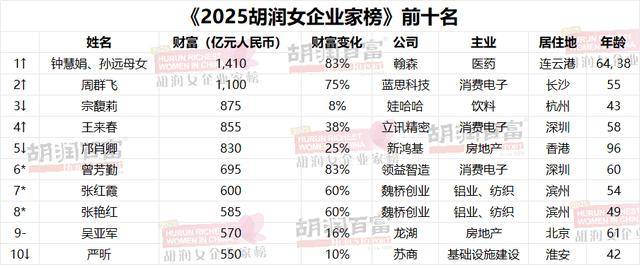
Core Insights - The 2025 Hurun Women Entrepreneurs List highlights the top 50 female entrepreneurs in China, with a significant focus on wealth growth and industry impact [3][8] - Zhong Huijuan and her daughter Sun Yuan from Hansoh Pharmaceutical have become the richest women in China with a wealth of 141 billion RMB, marking an 83% increase [4][5] - The list indicates a growing presence of female entrepreneurs in high-growth sectors, including innovative pharmaceuticals and consumer electronics [7][8] Summary by Sections Wealth Rankings - The top three female entrepreneurs are Zhong Huijuan and Sun Yuan (1410 billion RMB), Zhou Qunfei (1100 billion RMB), and Zong Fuli (875 billion RMB) [4][6] - The threshold for entering the top ten has increased by 13 billion RMB from last year, now standing at 550 billion RMB [8] Company Profiles - Hansoh Pharmaceutical, led by Zhong Huijuan, has seen its market value rise from approximately 90 billion HKD to over 200 billion HKD, with a stock price increase of over 100% this year [6][7] - Zong Fuli, the successor of Wahaha Group, remains the wealthiest woman in the food and beverage sector despite a drop in ranking [7] Industry Trends - The innovative pharmaceutical sector is experiencing significant growth, contributing to the wealth increase of female entrepreneurs like Zhong Huijuan [6][7] - New entrants in the list include entrepreneurs from electronic materials and medical aesthetics, indicating diversification in high-growth industries [7] Demographics - The list features eight "post-80s" entrepreneurs, with the youngest being Qu Fang from Xiaohongshu, highlighting a trend of younger female entrepreneurs emerging in the market [7]

香飘飘(603711) - 香飘飘2025年前三季度经营数据公告
2025-10-30 10:18
证券代码:603711 证券简称:香飘飘 公告编号:2025-041 香飘飘食品股份有限公司 2、按销售渠道分类情况: 单位:元 币种:人民币 | 渠道类型 | 2025 年 1-9 月 销售收入 | 2024 年 1-9 月 销售收入 | 增减变动幅度 (%) | | --- | --- | --- | --- | | 经销商 | 1,397,480,854.94 | 1,726,939,983.59 | -19.08 | | 电商 | 130,872,275.60 | 118,716,854.27 | 10.24 | | 出口 | 28,724,924.62 | 14,865,614.27 | 93.23 | | 直营 | 97,317,095.30 | 50,592,800.16 | 92.35 | 2025 年前三季度经营数据公告 本公司董事会及全体董事保证本公告内容不存在任何虚假记载、误导性陈述 或者重大遗漏,并对其内容的真实性、准确性和完整性承担法律责任。 根据《上海证券交易所上市公司自律监管指引第 3 号行业信息披露:第十 二号——酒制造》的相关规定,现将香飘飘食品股份有限公司(以下简称"公司" ...
2025胡润女企业家榜发布,前十山东占两席
Sou Hu Cai Jing· 2025-10-30 10:04
Group 1 - The 2025 Hurun Women Entrepreneurs List was released, featuring the top 50 female entrepreneurs in China, with Zhong Huijuan and her daughter Sun Yuan from Hansoh Pharmaceutical becoming the richest women in China with a wealth of 141 billion RMB, surpassing Zong Fuli of Wahaha [1][2] - The total wealth of the top 50 female entrepreneurs reached 1.9 trillion RMB, a significant increase of 32% compared to the previous year, with the entry threshold for the list rising to 16 billion RMB, an increase of 4 billion RMB [3] - The industrial products sector remains the largest source of wealth for female entrepreneurs, accounting for 15% of the list, followed by real estate at 13% and life health at 12% [3] Group 2 - New entrants to the list include Ye Qiongjiu from Tonghuashun with a wealth of 30.5 billion RMB, and Wang Sihan from Hongren with 24.5 billion RMB, benefiting from the surge in demand for high-end PCBs driven by the AI boom [3] - The proportion of entrepreneurs who started from scratch is 66%, while 34% inherited their wealth, indicating a strong trend of self-made wealth among female entrepreneurs [3] - The share of consumer-facing brands has decreased to 35% from 47% five years ago, reflecting a shift in the market dynamics [3]





钟慧娟,中国女首富!
券商中国· 2025-10-30 09:53
Core Insights - The 2025 Hurun Women Entrepreneurs List reveals that the total wealth of the top 50 female entrepreneurs in China reached 1.9 trillion yuan, a significant increase of 32% compared to last year [1] - The threshold for entry into the list has risen to 16 billion yuan, an increase of 40 million yuan (33%) from the previous year [1] - The average age of the top 50 female entrepreneurs is 60 years, which is 2 years older than last year, aligning with the average age of the top 50 male entrepreneurs on the Hurun Rich List [1] Wealth Distribution - The wealth of the top 50 female entrepreneurs has remained stable over the past five years but has doubled compared to ten years ago [1] - 66% of these entrepreneurs are self-made, while 34% inherited their wealth [1][7] Notable Rankings - Zhong Huijuan and her daughter Sun Yuan from Hansoh Pharmaceutical became the richest women in China with a wealth of 141 billion yuan, an increase of 640 million yuan (83%) from last year [2][3] - The second place is occupied by Zhou Qunfei of Lens Technology, whose wealth increased by 470 million yuan (75%) to 110 billion yuan [3][4] - Zong Fuli of Wahaha ranks third with a wealth of 87.5 billion yuan, a decrease of 2 places from last year [4] Industry Analysis - The industrial products sector remains the largest source of wealth for female entrepreneurs, accounting for 15% of the list [5][6] - The real estate sector follows closely with a 13% share, while the life and health sector accounts for 12% [5][6] - The food and beverage sector, along with non-ferrous metals and mining, each hold a 10% share [5][6] Comparison with Male Entrepreneurs - In contrast, the top 50 male entrepreneurs show a different industry distribution, with media and entertainment, as well as consumer goods, each accounting for 10% [7] - The proportion of self-made female entrepreneurs has increased to 66%, up from 58% last year, while those inheriting wealth decreased to 34% from 42% [7]