保险

Search documents
险资配置跟踪系列(一):2025年核心权益资产增配显著
Ping An Securities· 2026-02-25 01:48
Investment Rating - The industry investment rating is "Outperform the Market," indicating that the industry index is expected to perform better than the market by more than 5% over the next six months [31]. Core Insights - The insurance sector is experiencing significant growth in core equity asset allocation, with a notable increase in the proportion of stocks and funds within the total investment balance [5][15]. - As of Q4 2025, the total investment balance of the insurance industry reached 38.5 trillion yuan, reflecting a year-on-year growth of 15.7% [6][8]. - The allocation structure shows that bonds account for 50.4% of the total investment, while stocks and funds account for 15.4%, indicating a shift towards equity investments [8][15]. - The report highlights that the insurance sector's liabilities and assets are improving, with a focus on optimizing equity allocation and maintaining stable returns from fixed-income assets [26]. Summary by Sections 1. Insurance Fund Utilization - The insurance industry's fund utilization balance reached 38.5 trillion yuan by the end of Q4 2025, with a year-on-year increase of 15.7% [6][8]. - The allocation of major asset categories includes bank deposits (8.2%), bonds (50.4%), stocks (10.1%), and other investments (18.4%), with notable changes in year-on-year percentages [8][14]. 2. Core Equity Asset Allocation - The core equity asset allocation (stocks + funds) for life and property insurance companies reached 5.7 trillion yuan, growing by 38.9% year-on-year, and accounting for 15.4% of the total investment balance [15][20]. - The stock allocation ratio for life insurance companies increased to 10.12%, reflecting a significant rise in equity investments since Q2 2022 [15][20]. 3. Investment Recommendations - The report suggests that the insurance sector has strong long-term investment value due to improving supply and demand dynamics, with a recommendation to focus on companies like China Life and New China Life [26].
2.25犀牛财经早报:存储芯片涨价或将贯穿全年
Xi Niu Cai Jing· 2026-02-25 01:44
Group 1 - The total issuance scale of new funds in China has exceeded 209.4 billion yuan, with 227 new funds established as of February 24, 2026 [1] - 65 funds have raised over 1 billion yuan, with 15 funds exceeding 3 billion yuan, indicating strong market interest [1] - Insurance institutions are optimistic about the A-share market and plan to slightly increase their allocation to A-shares in 2026 [1] Group 2 - Over 93.2% of insurance asset management products have achieved positive returns this year, with nearly 20 products yielding over 10% [1] - The focus for insurance asset management institutions is expected to shift towards technology innovation and high-quality listed companies in key sectors [1] Group 3 - The private credit fund industry is facing warnings of potential defaults, with UBS predicting a default rate could reach 15% [2] - Concerns have been raised about the stability of private credit funds, particularly following redemption restrictions by Blue Owl Capital [2] Group 4 - The banking sector has seen a cold start to the year, with institutions expressing concerns over credit quality and lending trends [2] - Recent financial data indicates a rare year-on-year decline in credit issuance, raising questions about the banking sector's performance [2] Group 5 - The cancellation of export tax rebates for the photovoltaic industry is set to take effect on April 1, 2026, which may accelerate industry consolidation [3] - Companies are increasing production to maximize exports before the policy change, but there are concerns about demand in the second quarter [3] Group 6 - The global storage chip market is expected to see price increases starting in Q3 2025, driven by advancements in AI and computing power [4] - Chinese storage companies are making significant progress, positioning themselves as key players in the global market [4] Group 7 - HP reported a first-quarter revenue of $14.4 billion, a 6.9% increase year-on-year, with personal systems business revenue growing by 11% [6] - The company expects adjusted earnings per share for the fiscal year to be between $2.90 and $3.20 [6] Group 8 - Keep anticipates a narrowed loss of approximately 72 million yuan for the fiscal year ending December 31, 2025, compared to a larger loss in the previous year [6] - The company also expects to report an adjusted profit of around 25 million yuan for the same period [6] Group 9 - Huayi Technology has submitted an application for H-share issuance and listing on the Hong Kong Stock Exchange [7] - The application is subject to approval from regulatory bodies, indicating potential future growth opportunities [8] Group 10 - Kaipu Cloud has terminated its major asset restructuring plan to acquire a 70% stake in Nanning Taike Semiconductor due to market changes [9] - The company has committed to not planning any major asset restructuring for at least one month following the announcement [9] Group 11 - Hualian Holdings plans to acquire 100% of Argentum Lithium S.A. for approximately $175 million, pending shareholder approval [10] - The transaction is not classified as a related party or major asset restructuring, but it carries uncertainties regarding implementation [10] Group 12 - Supor reported a slight increase in revenue for 2025, but a 6.58% decline in net profit, attributed to decreased export orders and rising sales expenses [11] - The company is focusing on cost reduction and efficiency improvements to enhance profitability [11] Group 13 - Aidi Pharmaceutical reported a revenue increase of 72.49% for 2025, but still incurred a net loss of approximately 19.73 million yuan [12] - The increase in revenue is linked to higher sales of innovative HIV drugs and the consolidation of Nanda Pharmaceutical's operations [12] Group 14 - Weidong Nano reported a revenue decline of 2.52% for 2025, with a net profit decrease of 6.12%, influenced by reduced acceptance of photovoltaic equipment [13] - The company continues to invest heavily in R&D to maintain its competitive edge in new photovoltaic technologies [13] Group 15 - U.S. stock markets saw collective gains, with the Nasdaq rising by 1.04%, driven by rebounds in software and AI-related stocks [14] - The dollar index rebounded, while gold and silver prices experienced declines after recent highs [14]
现金堆到3816亿美元却成净卖方?巴菲特“最后一季”持仓大揭秘
Jin Rong Jie· 2026-02-25 01:21
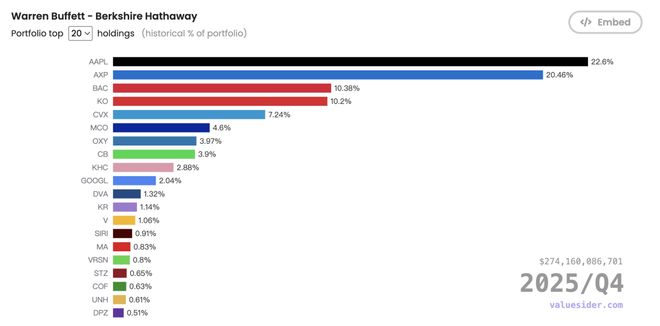
Core Insights - Berkshire Hathaway remains a net seller of stocks in Q4 2025, significantly reducing its positions in Apple, Bank of America, and nearly completely selling Amazon, while increasing holdings in Chevron and Chubb, and initiating a small position in The New York Times [1] Group 1: Portfolio Overview - The total market value of Berkshire's stock portfolio is approximately $274.16 billion [1] - The top five holdings are Apple Inc. (22.6%), American Express (20.46%), Bank of America (10.38%), The Coca-Cola Company (10.20%), and Chevron Corporation (7.24%) [3] - The financial sector dominates the portfolio with a 40.92% share, followed by technology at 24.64%, consumer staples at 14.87%, and energy at 11.21% [4] Group 2: Q4 Position Changes - Core sell-offs include: - Apple (AAPL) reduced by 4.3%, from 238.2 million shares to 227.9 million shares, decreasing in value by approximately $2.799 billion [5] - Bank of America (BAC) reduced by 8.9%, from 568.1 million shares to 517.3 million shares, with a value decrease of about $2.793 billion [5] - Amazon (AMZN) significantly reduced by 77.2%, from approximately 10 million shares to 2.28 million shares, resulting in a value decrease of about $1.783 billion [5][6] Group 3: Core Buys - Chevron (CVX) increased by 6.6%, from 122.1 million shares to 130.2 million shares, adding approximately $1.233 billion in value [7] - Chubb (CB) increased by 9.3%, from 31.33 million shares to 34.25 million shares, adding about $0.91 billion in value [7] Group 4: New Positions - A new position in The New York Times (NYT) was initiated with approximately 5.07 million shares, valued at about $0.352 billion, representing 0.13% of the total portfolio [8][9]


盘点58家财险2025年车均保费:超半数同比下降
Mei Ri Jing Ji Xin Wen· 2026-02-25 01:04
Core Insights - The insurance industry is closely monitoring the trends and developments in auto insurance as companies release their solvency reports for Q4 2025, revealing significant data on average premiums [1][7] - Over 58 insurance companies have disclosed their average auto insurance premiums, with a notable decrease in premium differences compared to previous years [2][8] - More than 50% of the insurance companies reported a decline in average premiums for 2025, indicating a stabilization in the overall premium landscape [3][10] Group 1: Average Premium Data - The average auto insurance premium reported ranges from 841.99 yuan to 5900 yuan, with most companies falling between 1000 yuan and 3000 yuan [2][8] - The disparity in average premiums among insurance companies is decreasing, with all companies previously exceeding 6000 yuan now below that threshold [2][8] - A total of 31 insurance companies experienced a decline in average premiums compared to the previous year, reflecting a trend towards stabilization [3][10] Group 2: New Energy Vehicle Insurance - The market is particularly focused on the trends in new energy vehicle insurance due to previous challenges in pricing and coverage [4][11] - Major insurance companies have begun to achieve profitability in new energy vehicle insurance, indicating a shift in the market dynamics [5][11] - The introduction of L3 conditional autonomous driving vehicles is expected to present new challenges in risk assessment and pricing models for auto insurance [12] Group 3: Future Challenges and Innovations - The transition to L3 autonomous driving will complicate risk evaluation, as new factors such as hardware reliability and software security must be considered [12] - Future pricing for new energy vehicle insurance is anticipated to become more intelligent, allowing for differentiated rates based on various factors [6][12] - Insurance companies are advised to prepare for the upcoming changes by innovating products, enhancing service efficiency, and diversifying collaboration models [6][12]
日韩股指创新高, 三星电子市值逼近万亿美元,起亚汽车涨超12%
2 1 Shi Ji Jing Ji Bao Dao· 2026-02-25 01:03
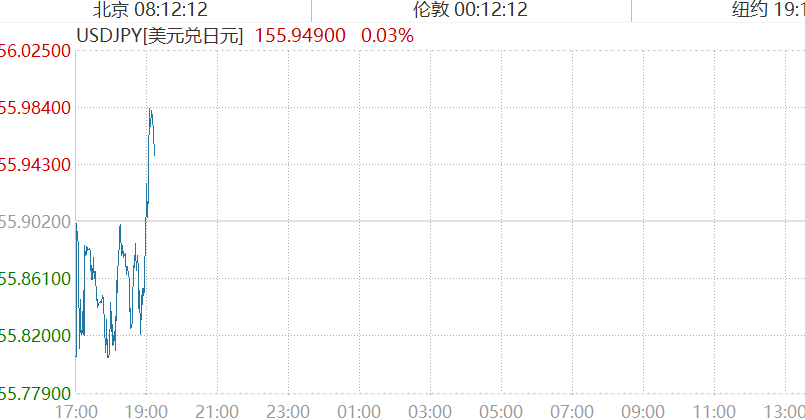
Market Performance - Japanese and South Korean stock markets reached historical highs, with the Nikkei 225 index touching 58,000 points, up approximately 1.2% [1] - The KOSPI index in South Korea opened with a 1% increase, surpassing the 6,000 points mark for the first time [1] Company Highlights - Samsung Electronics' stock rose about 1%, reaching a new historical high, with a market capitalization nearing $1 trillion. Analysts from Morgan Stanley, Citigroup, and Macquarie have collectively raised their target prices, predicting a strong price cycle for DRAM and NAND lasting at least two years, with net profits expected to grow tenfold from 2025 to 2028 [1] - SK Hynix's market capitalization is approximately $480 billion, with a slight increase of about 0.2% [2] - South Korean automotive stocks also performed well, with Kia Motors rising over 12% and Hyundai Motors increasing nearly 6% [3] Currency and Economic Policy - The Japanese yen experienced significant depreciation, with a drop of over 1% against the US dollar on February 24, leading to increased pressure on the yen's value [6] - Concerns regarding further interest rate hikes were communicated by Japanese Prime Minister Fumio Kishida to Bank of Japan Governor Kazuo Ueda, as investors reassess the central bank's monetary policy path [8] - The likelihood of a rate hike by the Bank of Japan in April is increasing, but the country faces challenges such as economic contraction, rising inflation, and declining real wages [8]
非银金融行业周报(2026年第六期):关注券商并购重组主线行业迎来估值业绩双修复
AVIC Securities· 2026-02-25 00:45
Investment Rating - The industry investment rating is "Overweight," indicating that the growth level of the industry is expected to exceed that of the CSI 300 index over the next six months [3][44]. Core Insights - The report highlights that the securities sector is experiencing a dual recovery in valuation and performance, driven by an active capital market and favorable policy conditions. The integration process within the industry is accelerating, with a clear regulatory direction emphasizing risk prevention and high-quality development [2][6]. - The report notes that the current price-to-book (PB) ratio for the brokerage sector is at 1.34 times, suggesting that valuations are still at historical lows, which, combined with ongoing policy support and improving market conditions, presents a strong case for a recovery in both valuations and performance [2][6]. - The report emphasizes the importance of mergers and acquisitions (M&A) as a key driver for the industry, with resources expected to concentrate further towards leading brokerage firms, enhancing their scale, brand, and synergy advantages [2][6]. Summary by Sections Securities Weekly Data Tracking - The average daily trading volume for A-shares was 21,111 billion yuan, reflecting a week-on-week decrease of 12.28%. The average turnover rate was 3.28%, down by 0.31 percentage points [13]. - As of February 13, 2026, the total equity financing scale reached 1,672.22 billion yuan, with IPOs contributing 148 billion yuan and additional offerings accounting for 1,524 billion yuan. The bond underwriting scale for January 2026 was 12,080.27 billion yuan, showing a year-on-year increase of 12.56% [15]. Insurance Weekly Data Tracking - The insurance sector reported a total original insurance premium income of 61,194.18 billion yuan in December 2025, marking a year-on-year increase of 7.43%. The life insurance segment saw a premium income of 46,491.44 billion yuan, up by 9.05% [29]. - The overall asset scale of the insurance industry reached 413.145 billion yuan by the end of November 2025, with a year-on-year growth of 15.06% [29]. Industry Dynamics - The report indicates that the regulatory environment is encouraging industry consolidation, which is seen as an effective means for brokerages to achieve external growth and enhance overall competitiveness [6]. - The report also mentions that the insurance sector is experiencing a recovery in profitability, driven by improved investment returns and a reduction in commission expenses due to ongoing policy reforms [8].


智通港股通资金流向统计(T+2)|2月25日
智通财经网· 2026-02-24 23:33
Key Points - The top three stocks with net inflows from southbound funds are Yingfu Fund (02800) with 3.679 billion, Tencent Holdings (00700) with 2.223 billion, and Alibaba-W (09988) with 2.194 billion [1] - The top three stocks with net outflows are China Pacific Insurance (02601) with -265 million, Yangtze Optical Fibre and Cable (06869) with -174 million, and CICC (03908) with -156 million [1] - In terms of net inflow ratios, Prudential (02378) leads with 323.30%, followed by Southern East West Select (03441) with 288.94%, and Mongol Mining (00975) with 219.66% [1] - The stocks with the highest net outflow ratios include Aidi Kang Holdings (09860) at -148.06%, Boleton (01333) at -101.59%, and Bosideng (03998) at -80.14% [1] Net Inflow Summary - Yingfu Fund (02800) had a net inflow of 3.679 billion, representing a 44.79% increase, closing at 26.800 with a decrease of 1.83% [2] - Tencent Holdings (00700) saw a net inflow of 2.223 billion, with an 11.80% increase, closing at 520.000 with a decrease of 3.35% [2] - Alibaba-W (09988) experienced a net inflow of 2.194 billion, reflecting a 17.87% increase, closing at 148.000 with a decrease of 2.76% [2] Net Outflow Summary - China Pacific Insurance (02601) had a net outflow of -265 million, with a -39.19% decrease, closing at 36.640 with a decrease of 4.53% [2] - Yangtze Optical Fibre and Cable (06869) reported a net outflow of -174 million, with a -4.65% decrease, closing at 129.200 with an increase of 1.17% [2] - CICC (03908) faced a net outflow of -156 million, representing a -53.15% decrease, closing at 21.020 with a decrease of 4.89% [2] Net Inflow Ratio Summary - Prudential (02378) had a net inflow ratio of 323.30%, with a net inflow of 15.2564 million, closing at 118.000 with a decrease of 1.50% [3] - Southern East West Select (03441) recorded a net inflow ratio of 288.94%, with a net inflow of 57.6157 million, closing at 11.720 with an increase of 0.43% [3] - Mongol Mining (00975) achieved a net inflow ratio of 219.66%, with a net inflow of 1.05 billion, closing at 12.690 with a decrease of 3.72% [3]


超九成保险资管产品实现正收益
Zhong Guo Zheng Quan Bao· 2026-02-24 23:31
Core Viewpoint - The insurance asset management products have shown strong performance in 2023, with a high percentage of products achieving positive returns, indicating a robust market environment for these financial instruments [1] Group 1: Performance Metrics - As of February 24, 2023, a total of 1,602 insurance asset management products have disclosed their latest net values, with 93.2% of these products realizing positive returns this year [1] - Among the product types, equity insurance asset management products have performed particularly well, with nearly 20 products achieving a return rate exceeding 10% year-to-date [1] Group 2: Future Outlook - Industry insiders suggest that insurance asset management institutions will continue to enhance their tracking and exploration of quality listed companies in key areas such as technological innovation and new productive forces [1]
【光大研究每日速递】20260225
光大证券研究· 2026-02-24 23:03
Group 1: Banking and Insurance Sector - The banking sector is entering a "spring sowing" time window, with expectations for a style switch before harvest time [5] - The insurance sector's fundamentals are continuously improving, and the resonance between assets and liabilities is expected to lead to further valuation upgrades [5] Group 2: Fixed Income and Convertible Bonds - The "calendar effect" may dominate short-term trends in the convertible bond market, with limited probability for valuation recovery in the short term [5] - Investors are advised to maintain moderate positions and adjust their holdings to capture more returns, especially for those with larger capital [5] Group 3: Construction and Building Materials - The highlight of the Spring Festival Gala's robot performance indicates a thematic investment value in performance and event scenarios, particularly for companies with deep cooperation with leading humanoid robot firms [6] - In the cyclical goods sector, fiberglass prices are on an upward trend, benefiting from demand driven by AI-PCB, with short-term supply constraints [6] Group 4: Electric Power and Environmental Protection - India is considering relaxing restrictions on Chinese power and coal equipment, which may positively impact companies with significant investments in India [8] - Recent economic work reports emphasize supply-side optimization and green value discovery, which could benefit the new energy system [8] Group 5: Tourism Sector - The tourism market during the Spring Festival showed high prosperity, characterized by simultaneous increases in volume and price, along with structural optimization [8] - Domestic and outbound tourism both experienced growth, supported by extended holidays, visa-free policies, and emotional consumption trends [8] Group 6: Electronic Specialty Gases - The company is projected to achieve a revenue of 2.26 billion yuan in 2025, reflecting a year-on-year growth of 15.88%, driven by demand from AI, pharmaceuticals, and new energy sectors [9] - The company's net profit attributable to shareholders is expected to reach 347 million yuan, with a year-on-year increase of 12.92% [9]
【银行】金融股又到“春播”时?——银行&保险业春节后投资展望(王一峰/董文欣/黄怡婷/赵晨阳)
光大证券研究· 2026-02-24 23:03
Core Viewpoint - The financial sector in A-shares and H-shares has shown mixed performance in early 2026, with A-share banks and non-bank financials underperforming the CSI 300 index, while Hong Kong's financial sector has seen gains [4]. Group 1: Banking Sector Investment - The banking sector is entering a "spring sowing" time window, with stable operating performance expected to support earnings in the upcoming March financial report season [4]. - The estimated revenue growth for listed banks in 2026 has been slightly revised up to around 2%, supported by a moderate expansion in credit and easing pressure on interest margins [4][5]. - The banking sector's "high dividend, low valuation" characteristics are becoming more prominent, with the upcoming "Two Sessions" likely to improve market expectations [5]. - There is significant potential for allocation in the banking sector, with insurance capital, passive index funds, and industrial capital being the main purchasing forces [5]. Group 2: Insurance Sector Investment - The insurance sector's fundamentals are improving, with strong sales of participating insurance products expected to continue due to favorable market conditions [6]. - The investment performance of listed insurance companies has seen a significant increase, with the stock market's stability likely to enhance their profitability [7]. - The high dividend strategy is becoming a core choice for insurance companies' asset allocation, which may lead to further valuation upgrades for insurance stocks [7].