茶饮

Search documents
约8成爱马仕用户在买老铺黄金;79元迷你版LABUBU即将上市;永辉上半年净亏损2.41亿元 | 品牌周报
36氪未来消费· 2025-08-24 11:51
Group 1: Old Puh Gold Performance - Old Puh Gold achieved a revenue of 14.18 billion yuan for the year ending June 30, 2025, representing a year-on-year growth of 249.4% [3] - The adjusted net profit reached 2.35 billion yuan, with a year-on-year increase of 290.6% [3] - Old Puh Gold's average sales per store in a single mall reached approximately 459 million yuan, ranking first among all jewelry brands in mainland China [3] Group 2: Customer Base and Market Position - Old Puh Gold has approximately 480,000 loyal members, an increase of 130,000 from the end of last year [3] - The overlap rate of Old Puh Gold consumers with users of luxury brands like LV, Hermes, Cartier, and Bulgari is as high as 77.3%, with a specific overlap rate of 79.3% with Hermes users [3] Group 3: Market Sentiment and Stock Performance - Following the release of its mid-year performance report, Old Puh Gold's stock price surged by 8.84%, but subsequently fell for two consecutive days [3] Group 4: Bubble Mart Performance - Bubble Mart reported a revenue of 13.88 billion yuan for the first half of the year, a year-on-year increase of 204.4% [6] - The net profit attributable to the parent company reached 4.574 billion yuan, growing by 46.37% compared to the entire year of 2024 [6] - The overseas market revenue for Bubble Mart reached 5.593 billion yuan, with a staggering year-on-year growth of 439.34% [6] Group 5: Future Projections for Bubble Mart - The founder of Bubble Mart, Wang Ning, expressed confidence in achieving a revenue target of 30 billion yuan for the year [7] - As of August 20, Bubble Mart's stock price rose by 12.54%, reaching a total market value of 424.4 billion HKD, marking a historical high [7] Group 6: Yonghui Supermarket Performance - Yonghui Supermarket reported a revenue of 29.948 billion yuan for the first half of 2025, a decline of 20.7% year-on-year [8] - The company incurred a net loss of 241 million yuan, compared to a profit of 275 million yuan in the same period last year [8] - The revenue decline was attributed to the closure of long-term loss-making stores and temporary closures during store renovations [9] Group 7: Strategic Changes at Yonghui - Yonghui closed 227 loss-making stores and opened 4 new ones, with a total of 552 operational stores as of the end of June [8] - The company is undergoing a transformation that includes a "naked procurement" model, which has led to a 40% drop in service revenue [9] Group 8: KFC's New Ventures - KFC has opened two new fried chicken stores in Shanghai, named "Fried Chicken Brothers," focusing on takeout and delivery [10] - The new stores are part of KFC's strategy to explore modular store formats and diversify its brand offerings [10] Group 9: Other Notable Performances - Under Armour reported a revenue decline of 4% to 1.1 billion USD for the first quarter of the 2026 fiscal year [20] - Estée Lauder's net profit plummeted by 390%, with a net sales figure of 14.326 billion USD, down 8% year-on-year [21] - Li Ning's revenue grew by 3.3% to 14.817 billion yuan, with badminton becoming a highlight of their business [23]


中国公司全球化周报|美团Keeta在卡塔尔上线并计划进入巴西/长城汽车巴西工厂竣工投产
3 6 Ke· 2025-08-24 11:25
Company Developments - Meituan's international delivery brand Keeta has officially launched in Doha, Qatar, with plans to expand into more Gulf Cooperation Council (GCC) countries and enter the Brazilian market in a few months [2] - Great Wall Motors has completed the construction and production launch of its factory in Brazil, located in Iracemapolis, São Paulo, with an annual production capacity of 50,000 vehicles [2] - AliExpress has launched its "overseas hosting" model in Australia, following its implementation in several other countries including the US and Mexico [2] - Cha Bai Dao has announced the opening of its first North American store in New York, marking its entry into the US market, following successful expansions in Singapore and France [2] Strategic Expansion - Lenovo Group plans to establish a regional headquarters in Riyadh, Saudi Arabia, and has begun construction on a manufacturing facility expected to start trial production in 2026 [3] - MINISO's founder expressed intentions to expand the MINISO LAND stores overseas, emphasizing the importance of proprietary IP alongside global IP [3] - Leap Motor has achieved a milestone by reporting its first half-year profit, with overseas markets becoming a significant growth driver [3] - Pop Mart aims to expand into emerging markets such as the Middle East and South Asia, expecting to exceed 200 overseas stores by the end of the year [4] Financial Performance - Pop Mart reported a revenue of 13.88 billion yuan for the first half of 2025, a year-on-year increase of 204.4%, with adjusted net profit rising by 362.8% [4] - Xiaomi's automotive division is expected to start generating profits in the second half of the year, with plans to avoid price wars [4] - XGIMI's Vietnam factory has launched its first projector, with overseas revenue projected to reach 1.086 billion yuan in 2024, marking an 18.94% year-on-year increase [5] Market Trends - The user-side energy storage market is showing signs of recovery, with a focus on high-growth new markets and a concentration of market players [8] - Chinese innovative pharmaceutical companies are transitioning from followers to leaders in the market, with a focus on internationalization [8] - The global photovoltaic industry is experiencing increased competition, prompting Chinese companies to accelerate their global expansion efforts [9][10]




联名涉及抄袭,茶颜悦色致歉
2 1 Shi Ji Jing Ji Bao Dao· 2025-08-24 11:13
Core Points - On August 22, the company launched a collaboration with the Shanghai Rainbow Chamber Choir, introducing a multi-functional notebook priced at 19.9 yuan, which quickly sold out online and was even resold at double the price on second-hand platforms [1] - On August 23, multiple bloggers accused the company of plagiarizing their designs for the new notebook, with specific claims of unauthorized use of artwork [1] - The company acknowledged the issue on August 24, admitting to unauthorized appropriation and management oversight, and has initiated contact with the original creators to apologize and rectify the situation [1] Summary by Categories Product Launch - The company released a new collaborative product, a multi-functional notebook, which sold out shortly after its launch, indicating strong consumer interest [1] Accusations of Plagiarism - Several bloggers claimed that the company copied their designs without permission, highlighting specific elements that were allegedly similar to their original works [1] Company Response - The company responded by admitting to the oversight and announced plans to establish a dedicated investigation team to review and correct any issues in their design approval process [1]
茶颜悦色道歉!
Zheng Quan Shi Bao· 2025-08-24 10:38
Core Viewpoint - The company, Cha Yan Yue Se, acknowledged unauthorized use of designs in collaboration with the Shanghai Rainbow Chamber Choir and has taken steps to address the issue [2]. Group 1: Company Response - On August 24, Cha Yan Yue Se responded to allegations of plagiarism by admitting that there was unauthorized appropriation of certain designs [2]. - The company recognized management oversight in failing to detect and prevent the issue before production [2]. - Cha Yan Yue Se has reached out to the original creators to apologize and clarify the situation [2]. Group 2: Future Actions - The company plans to establish a dedicated investigation team to conduct a comprehensive self-examination and rectify any ongoing issues [2]. - There will be a renewed review process for current projects to ensure that any problems are identified and corrected promptly [2].
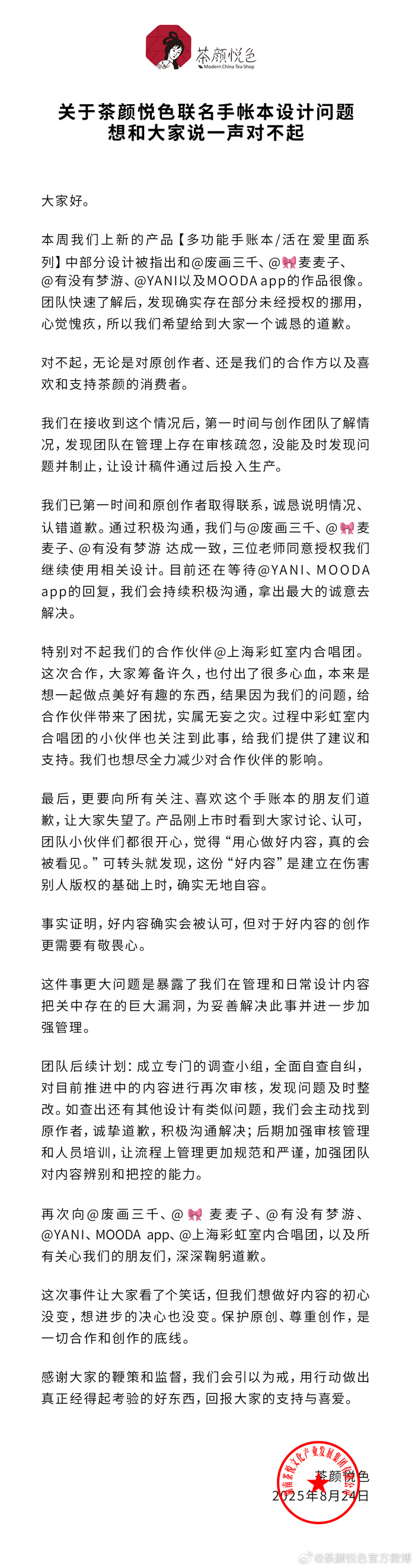
茶颜悦色道歉,回应被指抄袭:确实存在部分未经授权的挪用,在管理上存在审核疏忽,将全面自查自纠
Huan Qiu Wang· 2025-08-24 10:06
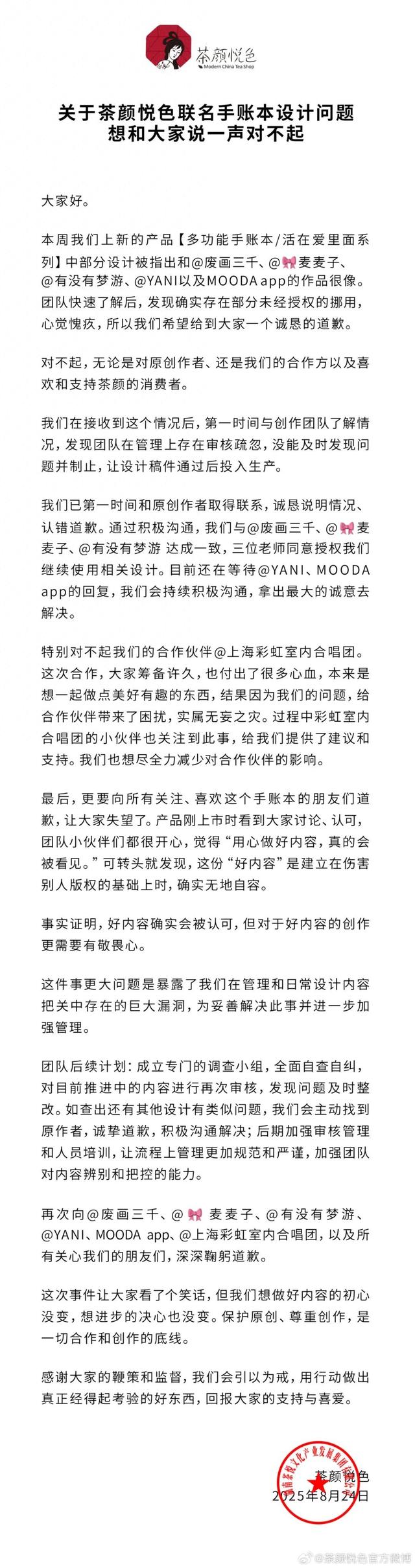
Core Viewpoint - The company Tea Yan Yue Se acknowledged unauthorized use of designs in collaboration with the Shanghai Rainbow Chamber Choir, leading to accusations of plagiarism from multiple bloggers [1][6][10]. Group 1: Incident Overview - On August 23, several bloggers accused Tea Yan Yue Se of copying their works in a new collaborative notebook with the Shanghai Rainbow Chamber Choir [1][6]. - The involved bloggers claimed that the designs included elements that were highly similar to their original works, with specific mentions of three pieces of artwork [6][10]. - The product in question was a multifunctional notebook priced at 25.9 yuan, which had gained significant popularity and was sold out in many stores [10]. Group 2: Company Response - On August 24, Tea Yan Yue Se publicly apologized, admitting to management oversights that allowed unauthorized designs to be produced [1][3]. - The company expressed regret for the impact on their partner, the Shanghai Rainbow Chamber Choir, and committed to resolving the issue with sincerity [3][4]. - Plans were announced to establish a dedicated investigation team to conduct a thorough review of current and future designs, ensuring stricter management and training processes [4][10]. Group 3: Previous Incidents - This incident is not the first for Tea Yan Yue Se; a previous case involved packaging for a snack product that closely resembled the cover design of a music album, leading to public outcry and demands for an apology [10].
被指联名文创抄袭 茶颜悦色致歉
Bei Jing Shang Bao· 2025-08-24 09:27
Core Viewpoint - The tea brand Chayan Yuese has apologized for design issues related to its new product, acknowledging unauthorized use of designs similar to those of multiple bloggers, highlighting significant management and oversight failures within the company [1][5]. Group 1: Apology and Acknowledgment - Chayan Yuese's new product "Multi-functional Notebook / Live in Love Series" was found to have designs resembling those of various bloggers, leading to an apology from the brand [1]. - The company admitted to management oversights that allowed unauthorized designs to go into production without proper review [1][5]. Group 2: Response to Partners and Community - The brand expressed regret towards its partners, particularly the Shanghai Rainbow Chamber Choir, for the distress caused by the design issues, emphasizing the collaborative effort that went into the project [3]. - Chayan Yuese acknowledged the disappointment of its customers and the community, recognizing that the perceived quality of their content was undermined by copyright violations [3]. Group 3: Future Plans and Management Improvements - The company plans to establish a dedicated investigation team to conduct a thorough self-examination and review of ongoing content to identify and rectify issues promptly [4][5]. - Chayan Yuese aims to enhance its management processes and staff training to ensure stricter oversight and better content discernment in the future [4][5]. Group 4: Previous Incidents - This incident is not the first for Chayan Yuese, as it faced similar accusations in July regarding a product design that allegedly infringed on the cover of a music album by Fang Datong, leading to a public outcry and a commitment to remove the product from shelves [6].
联名手账本被指抄袭 茶颜悦色致歉:存在审核疏忽 全面自查自纠
Xin Jing Bao· 2025-08-24 08:14
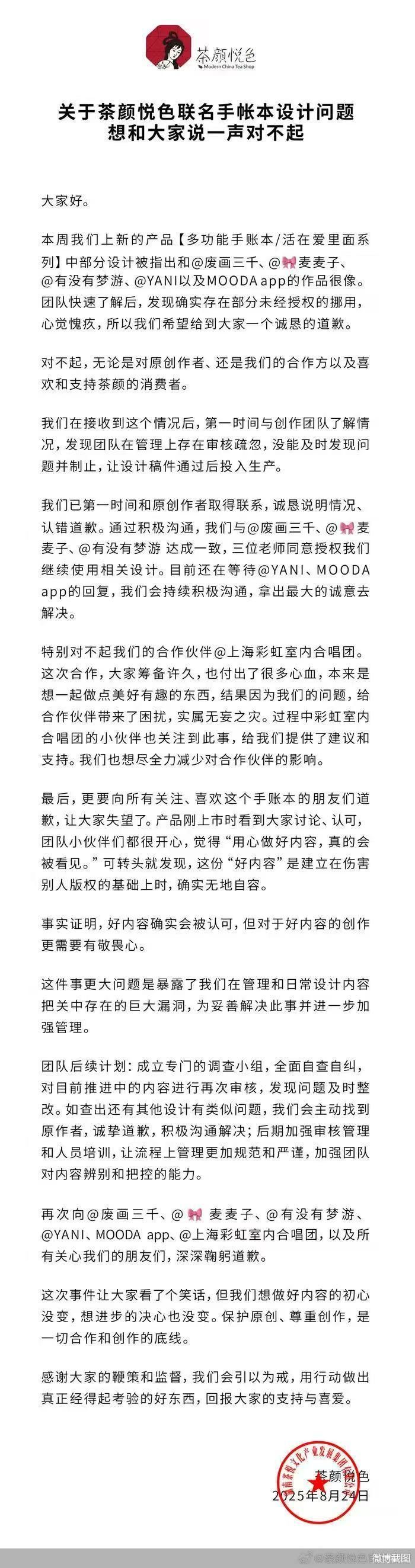
Group 1 - The company issued an apology to its partners, particularly the Shanghai Rainbow Chamber Choir, for causing inconvenience due to issues related to copyright infringement in their recent collaboration [2] - The company acknowledged the support and suggestions received from the Shanghai Rainbow Chamber Choir during the incident and expressed a commitment to minimize the impact on its partners [2] - The company recognized that while good content can be appreciated, it must be created with respect for copyright and originality, highlighting a significant management oversight in content review processes [2][4] Group 2 - The company plans to establish a dedicated investigation team to conduct a thorough self-examination and review of ongoing content to identify and rectify any similar issues [2] - If any other designs are found to have similar copyright problems, the company will proactively reach out to the original creators to apologize and seek resolution [2] - The company aims to enhance its management processes and staff training to ensure more rigorous and standardized content review, improving the team's ability to discern and control content quality [2][4]
茶颜悦色就联名手账本涉抄袭一事致歉
Mei Ri Jing Ji Xin Wen· 2025-08-24 08:02
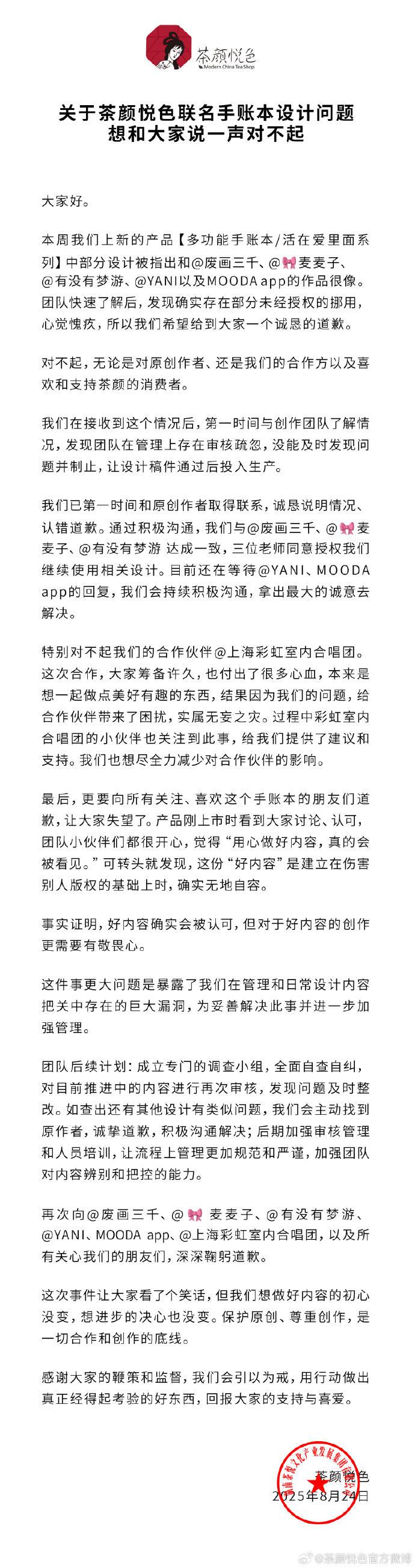
Core Points - The company Tea Yan Yue Se issued an apology regarding allegations of plagiarism related to a collaborative notebook project [1] - The collaboration with Shanghai Rainbow Chamber Choir was intended to create something beautiful and interesting, but issues arose due to the company's oversight [2] - The company acknowledged the need for better management and content oversight, revealing significant gaps in their processes [2] Group 1 - The company expressed regret for the impact on its partner, Shanghai Rainbow Chamber Choir, and recognized the support received during the incident [2] - The company plans to establish a dedicated investigation team to conduct a thorough self-examination and review of ongoing content [2] - The company committed to improving management processes and enhancing team training to ensure better content oversight in the future [2][4] Group 2 - The incident highlighted the importance of respecting copyright and the need for a more rigorous approach to content creation [4] - The company aims to learn from this experience and is determined to produce quality content that withstands scrutiny [4] - The company thanked its supporters for their feedback and pledged to uphold the principles of originality and respect for creators in future collaborations [4]
霸王茶姬联手蓝海资本,追加投资加速全球化布局
Sou Hu Wang· 2025-08-23 11:28
Group 1 - The core viewpoint of the article highlights the accelerated globalization strategy of the Chinese tea brand, Bawang Chaji, as it opens three stores in the Philippines and announces a 3 million RMB promotional fund to enhance brand visibility and market penetration [1][5][6] Group 2 - Bawang Chaji is entering three major shopping centers in Metro Manila, which are key locations for young consumers, office workers, and high-end lifestyle shoppers, indicating a strategic multi-location approach to quickly establish a presence in the Philippine tea market [2][5] - The partnership with Blue Ocean Capital plays a crucial role in this expansion, focusing on localized operations, digital marketing, and cross-cultural communication to support Bawang Chaji's global strategy [3][4] Group 3 - The additional 3 million RMB promotional fund will target four main areas: extensive media exposure through various platforms, digital traffic generation on social media, immersive offline experiences, and collaborations with local influencers to enhance brand reputation among young consumers [4][5] - The opening of these three stores is seen as a significant milestone in Bawang Chaji's overseas strategy, building on its existing presence in markets like Malaysia, Singapore, Thailand, and South Korea [5][6] Group 4 - The company aims to create a new paradigm for the global spread of Chinese tea culture by integrating brand globalization, cultural dissemination, and digital marketing, with plans for further expansion in Southeast Asia and the Middle East [6]
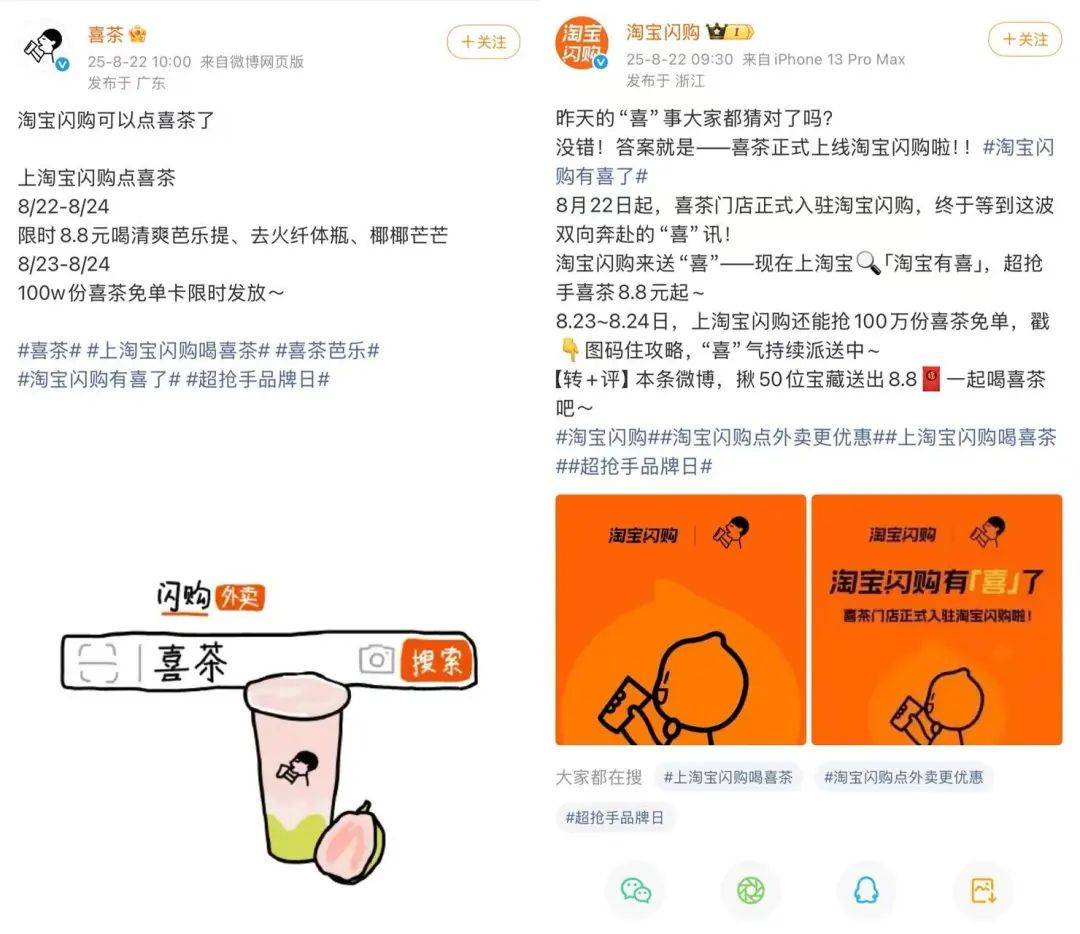
4000 家门店进驻淘宝闪购,曾只认美团的它,为何转身?
Sou Hu Cai Jing· 2025-08-22 13:17
Core Insights - The entry of Heytea into Taobao Flash Purchase marks a significant shift in the tea beverage industry, indicating that Taobao Flash Purchase is becoming an essential growth channel for brands [2][5][23] - The competitive landscape of the takeaway market has changed with the introduction of Taobao Flash Purchase, allowing tea brands to diversify their distribution channels and enhance their bargaining power [16][22] Group 1: Market Dynamics - Taobao Flash Purchase launched a series of promotional activities, including milk tea "free card" campaigns, which significantly increased consumer engagement, particularly among younger demographics [8][15] - The platform's promotional efforts during the "618" shopping festival included distributing 700,000 cups of free milk tea, further driving consumer interest and brand orders [8][15] - The competitive environment intensified in July, with the takeaway market experiencing a surge in competition among brands [9] Group 2: Financial Impact - Taobao Flash Purchase announced a substantial 50 billion yuan subsidy plan to stimulate consumer spending and support merchants, which has led to increased order volumes for tea brands [13][20] - Following the announcement of the subsidy plan, brands like Cha Bai Dao and Gu Ming saw stock price increases of up to 12%, with order volumes rising by 35% to 50% [14][20] - The financial forecasts for brands such as Mi Xue Ice City and Gu Ming have been adjusted upward, reflecting the positive impact of Taobao Flash Purchase on their profitability [14][20] Group 3: Brand Strategy - The collaboration with Taobao Flash Purchase allows tea brands to tap into a vast user base, enhancing their visibility and market reach [18][21] - The strategic importance of Taobao Flash Purchase within Alibaba's ecosystem has increased, providing brands with significant traffic and sales opportunities [18][20] - The competitive landscape has shifted from a duopoly to a more dynamic environment, enabling brands to leverage multiple platforms for greater market presence [22][23] Group 4: Consumer Engagement - The promotional activities and user engagement strategies have led to a notable increase in new customer acquisition for tea brands, with new customer numbers rising by 255% week-on-week [15][21] - The integration of promotional campaigns has created a strong association between Taobao Flash Purchase and tea consumption, establishing a solid foundation for future sales growth [8][15] - The data analytics capabilities of Taobao Flash Purchase provide brands with valuable insights into consumer preferences, allowing for targeted marketing and product development [21]