
光模块

Search documents
年内涌现53只“翻倍基”!2025年前三季度基金业绩放榜
证券时报· 2025-10-02 10:55
Core Viewpoint - The public fund industry has experienced a fruitful year in the structural bull market, with active equity funds achieving remarkable performance, particularly in the AI computing and innovative pharmaceutical sectors, leading to a significant number of funds doubling their returns [1][3]. Group 1: Performance of Active Equity Funds - A total of 53 funds have seen their returns exceed 100% year-to-date as of September 30, with 42 of these being active equity funds, highlighting the fund managers' effective strategies in popular sectors like technology growth [3][4]. - The top-performing fund, managed by Ren Jie, achieved a return of 194.49%, heavily investing in the overseas computing industry chain, with significant contributions from stocks like Shenghong Technology, which surged 581% this year [3]. - Other notable funds include Zhang Wei's fund with a 155.09% return, focusing on Hong Kong innovative pharmaceuticals, and Feng Ludan's fund with a 140.86% return, both demonstrating strong performance in their respective sectors [3]. Group 2: Gold ETFs Performance - Gold ETFs have emerged as the standout performers in the commodity fund sector, with all 14 gold ETFs showing year-to-date gains exceeding 40% as of September 30 [6]. - The top gold ETFs, managed by Zhao Xu and Rong Ying, reported returns of 41.48% and 41.47%, respectively, reflecting the strong investment value of gold amid rising international gold prices [6][7]. - Over the past three years, these gold ETFs have accumulated returns exceeding 110%, indicating their robust long-term investment potential [7]. Group 3: Asset Allocation Outlook for Q4 - Looking ahead to Q4, several fund companies have provided asset allocation recommendations, suggesting a focus on growth sectors initially, followed by cyclical and consumer stocks, and finally stable dividend-paying stocks [9][10]. - The ongoing structural opportunities in the market are expected to continue, with a particular emphasis on technology, innovative pharmaceuticals, and sectors benefiting from supply-side improvements, such as new energy and chemicals [10][12]. - Companies like Guotai Fund maintain a bullish outlook on the market, emphasizing the continued importance of emerging technologies and the potential for recovery in sectors like renewable energy due to policy changes [11][12].


年内涌现53只“翻倍基”!2025年前三季度基金业绩放榜
Sou Hu Cai Jing· 2025-10-02 07:20
Core Insights - The public fund industry has experienced a fruitful year in the structural bull market, with active equity funds making a significant comeback, particularly supported by the AI computing and innovative pharmaceutical sectors [1][2]. Group 1: Fund Performance - A total of 53 funds have achieved over 100% returns year-to-date as of September 30, with 42 of these being active equity funds, showcasing the fund managers' effective strategies in high-growth sectors [2][4]. - The top-performing fund, managed by Ren Jie, achieved a return of 194.49%, heavily investing in the overseas computing industry chain, with significant contributions from stocks like Shenghong Technology, which surged 581% this year [2][3]. - Other notable funds include Zhang Wei's fund with a 155.09% return, focusing on Hong Kong's innovative pharmaceuticals, and Feng Ludan's fund with a 140.86% return, both capitalizing on the AI industry chain [3]. Group 2: Commodity Performance - Gold ETFs have emerged as the standout performers in the commodity fund sector, with all 14 gold ETFs showing gains exceeding 40% year-to-date, driven by rising international gold prices [5][6]. - The highest-performing gold ETFs, managed by Zhao Xu and Rong Ying, reported returns of 41.48% and 41.47%, respectively, reflecting strong long-term investment value [5][6]. Group 3: Market Outlook - Looking ahead to Q4, several fund companies suggest maintaining a focus on growth sectors while also considering cyclical and consumer stocks, as the market has already seen significant gains [7][8]. - The ongoing AI technology innovation is expected to provide a premium valuation for related assets, despite potential short-term volatility [8][9]. - The overall market sentiment remains bullish, with continued optimism for emerging technologies and cyclical financial sectors, particularly in the context of the "anti-involution" policies that may enhance competition in the renewable energy sector [9].


股价暴涨、股东套现,中际旭创的高增长逻辑还能走多远?
雷峰网· 2025-10-02 00:36
Core Viewpoint - The article discusses the strong market performance of Zhongji Xuchuang, highlighting the symbiotic relationship between manufacturers in the AI and data center sectors, emphasizing the importance of deep partnerships [1]. Group 1: Market Performance - Zhongji Xuchuang's stock price surged from 92.00 yuan in early June to 416.75 yuan by September 29, achieving a cumulative increase of 353.1%, pushing the company's market value close to 460 billion yuan [2]. - The company announced a plan for its controlling shareholder to reduce holdings by up to 5.5 million shares, amounting to approximately 2.275 billion yuan, raising concerns about the high valuation amidst market enthusiasm [3]. Group 2: Shareholder Actions - The controlling shareholder's son had previously planned to sell all his unrestricted shares, and other specific shareholders also reduced their holdings during the same period [4]. - The market has seen intense debates regarding the rationality of Zhongji Xuchuang's valuation, particularly concerning the projected net profit of 25 billion yuan by 2027 [5]. Group 3: Industry Dynamics - Industry experts express uncertainty about the sustainability of demand for optical modules in the coming years, highlighting the difference between industrial logic and A-share valuation logic [6]. - The ability to achieve the 25 billion yuan profit target is contingent on the spending intensity of major North American companies like Microsoft and Meta [8]. Group 4: Financial Performance - Zhongji Xuchuang's revenue grew from 7.075 billion yuan in 2020 to 10.718 billion yuan in 2023, with a projected leap to 23.862 billion yuan in 2024, reflecting a year-on-year growth rate of 122.64% [13]. - The company's strong growth is attributed to its deep partnership with Nvidia, positioning it favorably in the AI and data center market [13]. Group 5: Technological Advancements - The company is advancing in the development of 1.6T optical modules, with expectations for mass production and delivery in the coming quarters [15]. - The emergence of CPO (Co-Packaged Optics) technology is noted, although its short-term impact on the optical module market is considered limited [9]. Group 6: Future Outlook - The optical module market is expected to continue its explosive growth for 1 to 2 years, driven by the increasing scale of data centers and the demand for AI infrastructure [16]. - The trend towards domestic production of core chips is anticipated to provide additional growth momentum for the optical module market in China [16].

悄然调仓!重仓算力的基金,筹码松动
证券时报· 2025-10-01 14:08
Core Viewpoint - The A-share market has experienced significant fluctuations since September, with a shift from a focus on AI computing power to sectors like solid-state batteries, robotics, non-ferrous metals, and gaming, indicating a rapid rotation of market themes [1] Group 1: Fund Adjustments - Some public funds have shown significant deviations between net value and holdings, suggesting early "leaks" of fund managers' latest adjustments [2] - Funds heavily invested in computing power have begun to show signs of adjustment, with examples like the Xin'ao Advantage Industry Mixed Fund, which saw a net value increase of 1.91% on a day when its major holdings fell [4] - The Yongying Technology Smart Mixed Fund, despite a drop in its major overseas computing stocks, only fell 0.94% on a day when a larger decline was expected, indicating a divergence from its holdings [4][5] Group 2: Consumer Sector Shifts - The previously underperforming consumer sector is showing signs of "stop-loss" and "defensive switching," with funds like Nanhua Ruiying experiencing significant declines despite their major holdings rising [6] - Fund managers are expressing optimism about sectors like humanoid robots and solid-state batteries, suggesting a shift in focus towards technology and innovation [7][8] Group 3: Market Dynamics - The unusual movements in fund net values reflect the extreme structural characteristics of the current A-share market, where rapid sector rotations pose challenges for fund managers [10] - Fund managers are advised to dynamically adjust their strategies in response to changing market conditions, moving away from underperforming sectors towards those with higher growth potential [11] - There is a growing interest in new marginal changes and investment directions, particularly in AI-related assets and the semiconductor sector, as the market evolves [11]

新易盛,公告!
Zhong Guo Ji Jin Bao· 2025-10-01 08:10
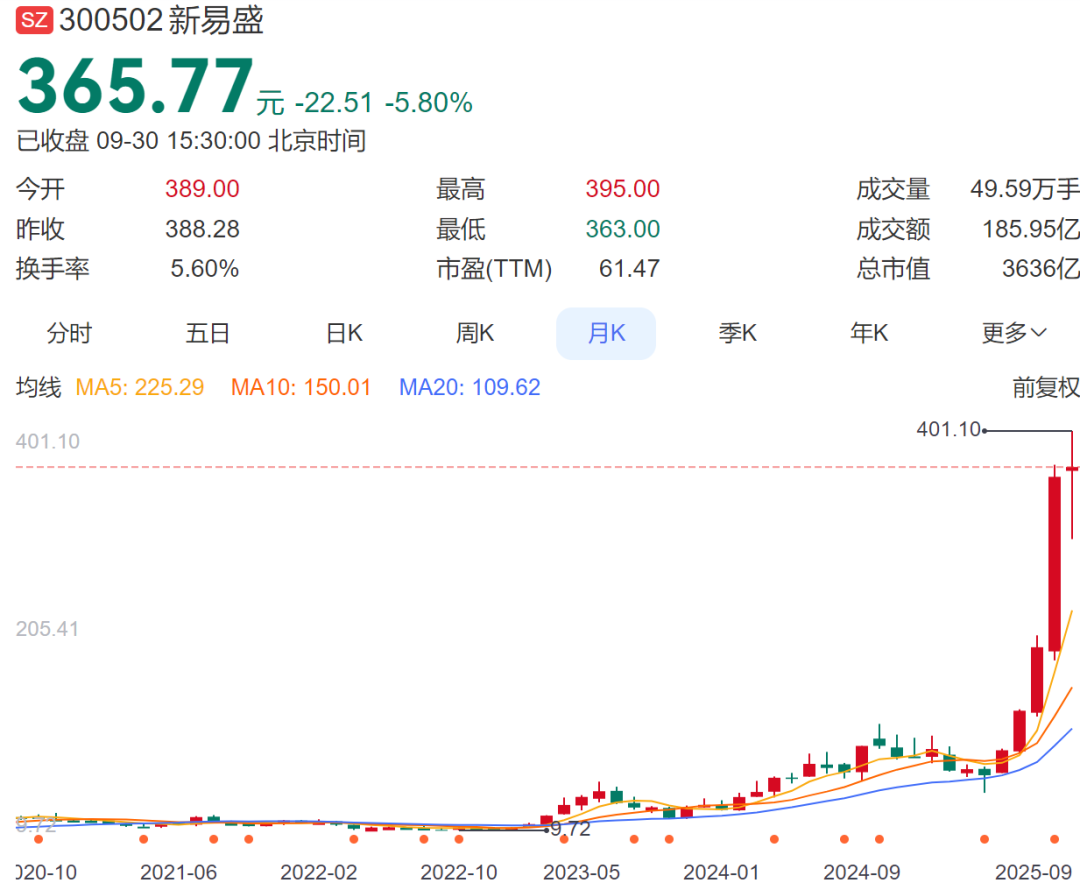
Core Viewpoint - The controlling shareholder of Xinyi Technology, Gao Guangrong, plans to transfer 1.15% of the company's shares through a price inquiry method to meet personal funding needs, primarily for investments in cutting-edge technology related to new productivity [1]. Group 1: Share Transfer Details - Gao Guangrong intends to transfer 11,430,700 shares, representing 1.15% of the total share capital of Xinyi Technology [1]. - The transfer will be a non-public transfer, not conducted through centralized bidding or block trading, and will not be considered a secondary market reduction [1]. - The minimum transfer price will be set at 70% of the average stock trading price over the previous 20 trading days before sending the subscription invitation [1]. Group 2: Shareholder Information - Gao Guangrong is the largest shareholder of Xinyi Technology, holding 7.4% of the shares, and has formed a concerted action with the second-largest shareholder, Huang Xiaolei, who holds 7.13% [3]. - Gao Guangrong has committed not to reduce his shareholding through the secondary market within 12 months after the transfer is completed [1]. Group 3: Company Performance - Xinyi Technology's revenue for 2024 is projected to be 8.647 billion yuan, a year-on-year increase of 179.15% [3]. - The net profit for 2024 is expected to increase by 312.26% year-on-year, with a further increase of 355.68% in the first half of 2025 [3]. - The company's stock price has surged from 11.62 yuan at the end of 2022 to a peak of 401.1 yuan by September 2, 2025, representing a maximum increase of over 30 times in less than three years, with a rise of over 300% this year [3]. Group 4: Industry Context - The significant growth in Xinyi Technology's performance is attributed to the explosive demand for optical modules driven by the AI wave, with a surge in capital expenditure from global cloud vendors and increased demand for NVIDIA GPU chips [4].

新易盛,公告!
中国基金报· 2025-10-01 07:49
Core Viewpoint - The article discusses the planned transfer of 1.15% of shares by Gao Guangrong, the controlling shareholder of Xinyi Technology, primarily to meet personal funding needs and to support investments in cutting-edge technology related to new productivity [2][3]. Shareholder Transfer Details - Gao Guangrong intends to transfer 11,430,682 shares, which represents 1.15% of the total share capital of Xinyi Technology [4]. - The transfer is a non-public offering and will not occur through centralized bidding or block trading, meaning it is not a secondary market reduction [4]. - The minimum transfer price is set at 70% of the average stock price over the previous 20 trading days before the issuance of the subscription invitation [4]. Shareholding Structure - Gao Guangrong holds 73,445,383 shares, accounting for 7.39% of the total share capital, while the second-largest shareholder, Huang Xiaolei, holds 70,794,280 shares, or 7.13% [6][7]. - Together, they form a concerted action group controlling Xinyi Technology [6]. Company Performance - Xinyi Technology has shown remarkable performance, with projected revenue of 8.647 billion yuan in 2024, a year-on-year increase of 179.15% [7]. - Net profit is expected to increase by 312.26% in 2024, with a further increase of 355.68% in the first half of 2025 [7]. - The stock price has surged from 11.62 yuan at the end of 2022 to a peak of 401.1 yuan by September 2, 2025, representing a maximum increase of over 30 times in less than three years [7]. Market Drivers - The growth in Xinyi Technology's performance is primarily driven by the surge in demand for optical modules due to the AI wave and increased capital expenditure from global cloud service providers [7].
6倍大牛股遭遇高位套现:董事长计划减持,减持股份最新市值超40亿元
Mei Ri Jing Ji Xin Wen· 2025-09-30 15:52
Core Viewpoint - The major shareholder of New Yisheng, Gao Guangrong, plans to transfer 11.43 million shares, accounting for 1.15% of the company's total share capital, through a pricing inquiry method, with a market value of approximately 4.18 billion yuan based on the closing price on September 30 [1][3]. Group 1: Shareholder's Reduction Plan - Gao Guangrong's share transfer is aimed at meeting personal funding needs and will primarily support investments in cutting-edge technology [4]. - The transfer will not lead to a change in the company's control and is a non-public transfer, meaning it will not occur through centralized bidding or block trading [4][5]. - The minimum transfer price will not be lower than 70% of the average stock trading price over the 20 trading days prior to the invitation for subscription [4]. Group 2: Share Performance and Historical Context - Since April, New Yisheng's stock has surged over 630%, reaching a historical high of 401.1 yuan on September 2, following a low of 46.56 yuan on April 9 [6]. - Gao Guangrong has a history of share reductions, including a total of 699.75 million shares sold between June 15 and July 21, 2023, netting approximately 463 million yuan [6]. - The company has faced regulatory scrutiny, with Gao Guangrong previously penalized for violations related to stock transfer restrictions and information disclosure [7].
光模块“高位减持”再现!中际旭创之后,新易盛控股股东高光荣拟询价转让超1100万股
Mei Ri Jing Ji Xin Wen· 2025-09-30 14:10
Core Viewpoint - The major shareholder of New Yisheng, Gao Guangrong, plans to transfer 11.43 million shares, accounting for 1.15% of the company's total share capital, through a non-public inquiry transfer method, primarily due to personal funding needs for investments in advanced technology [1][2]. Group 1: Shareholder Actions - Gao Guangrong holds approximately 73.45 million shares of New Yisheng, representing 7.39% of the total share capital, and is also the chairman of the company [2]. - This transfer will not lead to a change in control of the company, and the shares have been released from restrictions [1][2]. - The transfer price will not be lower than 70% of the average trading price over the previous 20 trading days before the invitation to subscribe is sent [1][2]. Group 2: Historical Context - Gao Guangrong has a history of share reductions, including a notable reduction of 699.75 million shares in a little over a month in 2023, resulting in cashing out approximately 463 million yuan [3]. - The stock price of New Yisheng has seen significant growth, increasing by 617.26% over a five-month period, reaching a historical high of 401.1 yuan on September 2, 2023 [3]. Group 3: Regulatory Issues - In February 2023, Gao Guangrong received an administrative penalty from the China Securities Regulatory Commission for violating stock transfer restrictions and failing to disclose shareholding information, resulting in a fine of approximately 31.5 million yuan [4]. - Gao Guangrong was also under investigation by the China Securities Regulatory Commission for similar violations, with a notice of administrative penalty issued in January 2025 [5].

“老登股”与“小登股”之争,你站那一边?
Sou Hu Cai Jing· 2025-09-30 09:58
Group 1 - The A-share market is currently experiencing a bull market, with the Shanghai Composite Index having 28 trading days above 3,800 points in 2025, a significant indicator of market strength [1] - The debate between "Old Deng stocks" and "Young Deng stocks" reflects extreme market differentiation, with "Young Deng stocks" representing technology growth sectors like AI and semiconductors, while "Old Deng stocks" include traditional industries such as liquor and real estate [1][2] - The performance of "Young Deng stocks" has been remarkable, with companies like "Yizhongtian" in the optical module sector seeing significant price increases, while traditional sectors like liquor have faced declines, as evidenced by a 5% drop in the Wande Liquor Index in 2025 [2] Group 2 - The divergence in market performance is attributed to fundamental differences in investment philosophy, with "Old Deng" investors favoring value investing principles, while "Young Deng" investors lean towards growth investing [3] - Macro and industry trends are driving this market split, with technological advancements and domestic substitution creating a favorable narrative for tech growth sectors, while traditional industries face structural challenges [4] - The self-reinforcing nature of capital flows is exacerbating market polarization, as rising prices in "Young Deng stocks" attract more short-term investors, while "Old Deng stocks" suffer from a lack of attention and declining prices [4] Group 3 - The technology growth sectors represented by "Young Deng stocks" are seen as critical for economic transformation and future development, with significant potential for world-class companies to emerge [5] - A diversified investment approach is recommended, considering the potential of both "Young Deng stocks" and quality assets within "Old Deng stocks" to capture long-term value [6] - The market's focus may shift back to undervalued "Old Deng stocks" as the bull market progresses, highlighting the importance of maintaining a long-term perspective on investment choices [6]
“牛市旗手”如愿爆发!行情要来了?别慌!一定要抓住主线
Mei Ri Jing Ji Xin Wen· 2025-09-30 05:40
Core Viewpoint - The "15th Five-Year Plan" is being formulated, focusing on stabilizing growth across key industries, with a series of measures aimed at enhancing supply capacity, expanding effective markets, and optimizing the development ecosystem [1][2]. Industry Summaries - **Key Industries for Growth**: At least nine industries have released growth stabilization plans, including electronics, power equipment, automotive, steel, non-ferrous metals, petrochemicals, building materials, machinery, and light industry, covering both high-end manufacturing and traditional raw materials [1]. - **Investment Focus Areas**: Key investment themes identified include new productive forces, "anti-involution" sectors, consumer sectors, and "dual" fields. Technology companies with genuine technological barriers are expected to be a significant investment focus under the "15th Five-Year Plan" [1]. - **Market Performance**: The A-share market saw collective gains, with the Shanghai Composite Index rising by 0.90%, and the Shenzhen Component and ChiNext Index increasing by 2.05% and 2.74%, respectively, indicating a positive market sentiment [3][4]. - **Sector Highlights**: The securities sector experienced a significant short-term surge, with the index rising nearly 7%, contributing to overall market optimism. Other sectors such as light industry, non-ferrous metals, and battery technology also showed strong performance [4][10]. - **Battery and Energy Storage Demand**: The demand for energy storage batteries is robust, with major battery manufacturers operating at full capacity and orders extending into early next year. The goal is to reach a new energy storage installation capacity of over 180 million kilowatts by 2027, driving an estimated investment of about 250 billion yuan [10]. - **AI and Robotics Sector**: The "AI+" initiative is expected to be a core driver of new productive forces, with a focus on integrating AI with the real economy for large-scale application [2][12]. The humanoid robot sector is also gaining attention, with key stocks showing significant price increases [12][13]. - **Gold and Silver Market**: The expectation of continued interest rate cuts by the Federal Reserve is driving the current bull market in gold and silver, with companies like Zijin Mining being pivotal in the performance of the non-ferrous metals sector [11].

