动力电池

Search documents
宜宾的下一个十年
Hu Xiu· 2025-05-09 06:59
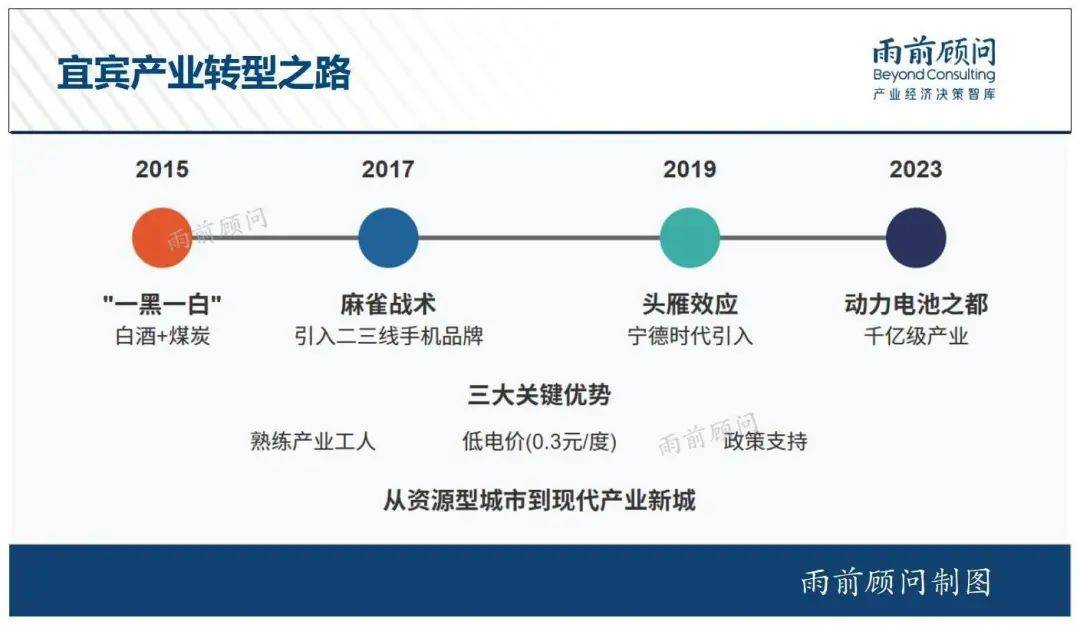
Core Viewpoint - Yibin's economic growth has significantly slowed, with a GDP growth rate of only 4.0% in Q1 2025, falling below the provincial average of 5.5% and lower than neighboring cities like Mianyang and Deyang [1][2][3]. Group 1: Historical Context and Transformation - Yibin experienced remarkable growth from 2015 to 2024, with GDP increasing from 152.59 billion to 400.58 billion, becoming the third-largest city in Sichuan [4][5]. - The city successfully transitioned from a resource-dependent economy to a modern industrial hub, achieving a significant industrial upgrade through strategic initiatives [28][79]. - The introduction of the "dual-wheel drive" strategy in 2016 aimed at upgrading traditional industries and fostering new ones, leading to the establishment of a complete industrial chain in smart terminal manufacturing [14][19]. Group 2: Current Economic Challenges - In Q1 2025, Yibin's industrial output growth was only 5.2%, lagging behind the provincial average of 7.2% and significantly lower than Mianyang's 11.7% and Deyang's 14.0% [34]. - The traditional white liquor industry, which contributes approximately 23% to Yibin's GDP, is facing a growth ceiling, with a mere 3.3% increase in Q1 2025 [36][38]. - New emerging industries, while showing high growth rates (e.g., smart connected vehicles at 55.1% and photovoltaic products at 37.5%), are still too small in scale to offset the slowdown in traditional sectors [41][43]. Group 3: Investment and Structural Issues - Fixed asset investment in Yibin decreased by 3.3% in Q1 2025, significantly below the provincial average of 4.0%, with real estate development investment dropping by 4% [47][48]. - Industrial investment growth was weak, indicating a potential decline in the internal driving force for industrial transformation [49]. - Despite a 22.7% increase in industrial electricity consumption, suggesting active industrial activity, the overall investment vitality appears to be diminishing [50]. Group 4: Future Opportunities and Strategic Directions - Yibin is focusing on leveraging its hidden assets, such as a skilled workforce of 300,000 industrial workers, low electricity costs, and strategic transportation advantages to foster future growth [59][60][61]. - The establishment of a university city is expected to inject innovation and support the transition from manufacturing to intelligent manufacturing [63][64]. - Future growth opportunities include deepening the advantages in the new energy sector, expanding digital economy applications, and enhancing the role of artificial intelligence across various industries [66][67][68].

长城证券:动力电池安全国标提高 或有利于尾部低效产能出清
Zhi Tong Cai Jing· 2025-05-09 06:19
长城证券(002939)发布研报称,当前中国锂电企业在全球动力电池产业的规模生产能力和高端技术领 先优势都较为明显,保持长期稳定增长的发展的趋势可期。一方面是因为我国国内有足够大的新能源车 市场需求,另一方面是较为完善的供应链支持有利于企业在合理的利润空间前提下参与全球竞争。此次 从国家层面提高行业安全性标准有利于强化头部集中效应,助力优质企业提升经营质量。 长城证券主要观点如下: 事件 3月28日,工信部组织制定的强制性国家标准《电动汽车用动力蓄电池安全要求》(gb38031—2025)由国 家市场监督管理总局、国家标准化管理委员会批准发布,将于2026年7月1日起开始实施。 新要求对多项动力电池的关键技术指标标准均进行了修订,将安全性放在此次国标规则提高的重中之重 国家重点推出新能源车动力电池相关安全政策,旨在提高行业生产经营质量。根据乘联会公布数据, 2025年4月初步推算本月狭义乘用车零售总市场规模175万辆左右,同比去年增长14.4%,环比上 月-9.8%,新能源零售预计可达90万,渗透率51.4%。然而4月月中整体车市折扣率约为23.7%,侧面反 映新能源车价格竞争仍较为激烈,各家车企的降本增效工 ...

宁德时代联手比亚迪,2打8,胜!
鑫椤锂电· 2025-05-09 03:33
关注公众号,点击公众号主页右上角" ··· ",设置星标 "⭐" ,关注 鑫椤锂电 资讯~ 本文来源:锂电前沿 5月7日,韩国研究机构SNE Research(下称SNE)发布最新动力电池统计数据, 今年一季度,全球动力电池装机 总量为221.8 GWh,同比增长38.8%, 增速较去年同期的22%有所回升 。 和去年同期相比, 全球前三名依旧是老面孔 ,分别是宁德时代、比亚迪和LG新能源, 第四至第九名企业位 次则发生大更迭 。 TOP10公司中,2025年一季度,除了三星SDI和松下以外,其他8家电池公司均实现了正增长。 其中,位居全球动力电池装车量榜首的宁德时代,今年一季度动力电池装车量达84.9 GWh,同比增长40.2%, 占据了全球38.3%的市场份额,是全球唯一一家市占率超过30%的企业。 韩国SK On以10.5GWh的装车量位列第四,同比增长35.6%,市场份额为4.7%。今年一季度,排名全球第四的 是韩企SK ON,其排名同比提升两位,取代了去年在此位置的松下。 中创新航以8.6GWh的装车量位列第五,同比增长31.5%,市场份额为3.9%,其排名同比前进两位。 国轩高科 以7.7GWh的 ...



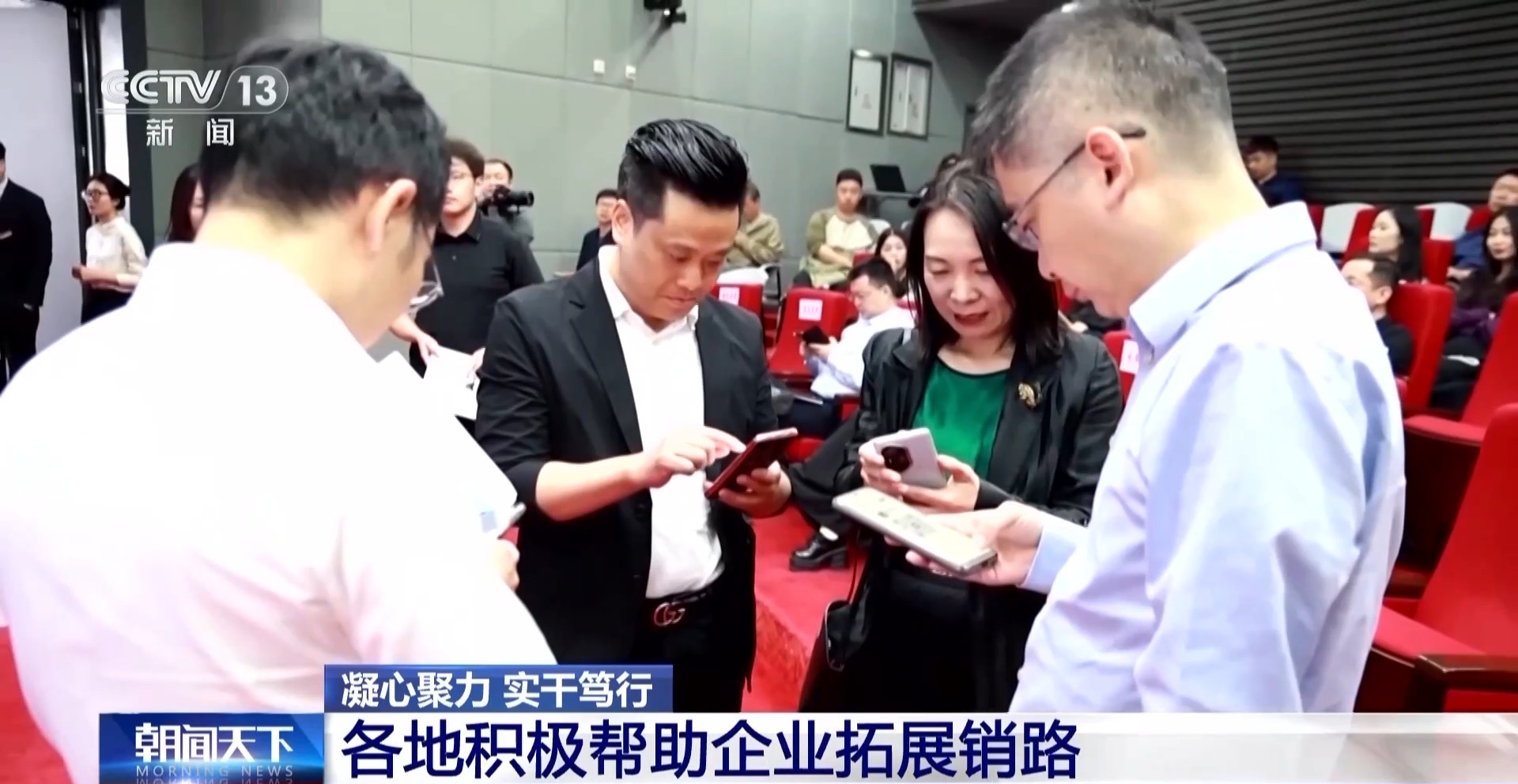
凝心聚力 实干笃行丨帮外贸企业“找销路”、注入“金融活力” 各地在行动→
Yang Shi Xin Wen· 2025-05-09 01:40
Group 1 - The central government emphasizes stabilizing employment, enterprises, markets, and expectations to respond to external uncertainties with high-quality development, marking the first mention of "stabilizing enterprises" [1] - Foreign trade enterprises are facing order losses and inventory pressure due to tariff impacts, prompting local governments to assist these companies in finding new sales channels [1][19] - In Guangdong, a "foreign trade to domestic sales" matchmaking event was organized, where many companies arrived early to seek cooperation partners [1][3] Group 2 - Retailers are directly placing orders and providing comprehensive services from warehousing to distribution for these products, leading to ongoing networking among companies after the event [3] - In Shandong, local authorities are helping enterprises expand into global markets by organizing overseas trade negotiations and exhibitions [7] - The vice president of Dishang Group reported over a 10% increase in orders from European and Japanese markets compared to the previous year, supported by local government initiatives [9] Group 3 - A survey indicated that over 60% of small and medium-sized enterprises in China reported a lack of orders as their biggest challenge in April [12] - In Zhengzhou, a "one-on-one" resource linking service was launched to help enterprises connect with upstream and downstream markets [14][16] - The Ministry of Industry and Information Technology is collaborating with 16 departments to implement 73 specific service measures to address issues like insufficient orders [18] Group 4 - Financial support is being provided to help foreign trade enterprises find sales channels, with various regions injecting "financial vitality" into businesses [19] - In Mianyang, a lithium-ion battery manufacturer received a special loan to alleviate short-term financial pressures, allowing them to stabilize production and expand market reach [21][23] - In Suzhou, a 2 billion yuan fund was established to assist enterprises in overcoming liquidity challenges and loan repayment pressures [29][31] Group 5 - Local governments are facilitating innovation and development by connecting enterprises with research teams and universities to overcome technical challenges [38][40] - In Hefei, a technology demand list was released to promote collaboration between enterprises and research institutions, enhancing innovation and industry synergy [42] - The Ministry of Industry and Information Technology is building a national service network for small and medium-sized enterprises, supporting over 100,000 companies with digital transformation initiatives [50]
孚能科技2024年营收116.8亿元大幅减亏,毛利率稳步提升
Jing Ji Guan Cha Wang· 2025-05-09 01:05
Core Viewpoint - Company Fudi Technology (孚能科技) has significantly reduced its losses in 2024, achieving a revenue of 11.68 billion yuan and a net loss of 0.332 billion yuan, marking an 82.22% reduction in losses year-on-year. The company is positioned as a leader in the global soft-pack power battery market and is set to benefit from a strategic partnership with Guangzhou Industrial Control Group, enhancing its capital strength and business expansion capabilities [1][2][5]. Financial Performance - In 2024, Fudi Technology's revenue reached 11.68 billion yuan, with a net loss of 0.332 billion yuan, reflecting an 82.22% reduction in losses compared to the previous year. The first quarter of 2025 shows a further narrowing of losses [1][2]. - The company reported a significant improvement in key financial metrics, with basic and diluted earnings per share losses narrowing by 82.35%, and cash flow from operating activities increasing by 36.86% year-on-year [2][3]. Product Development - Fudi Technology launched its SPS large soft-pack product in 2024, which features a high-integration battery system that enhances vehicle space efficiency while ensuring safety [3][7]. - The company has developed a super-fast charging lithium iron phosphate (LFP) battery capable of over 6C charging and more than 5000 cycles, suitable for various applications including PHEV and BEV [3][7]. Market Expansion - Over half of Fudi Technology's revenue comes from international clients, with significant partnerships established with companies like Mercedes-Benz and Mahindra Group. The company ranked third in China for power battery exports in 2024 [4][5]. - The establishment of a 6GWh production line in Turkey by Fudi's joint venture Siro supports its international operations and market expansion efforts [4][5]. Strategic Partnership - The acquisition of a controlling stake by Guangzhou Industrial Control Group is expected to enhance Fudi Technology's capital strength and facilitate collaboration within the local automotive supply chain, particularly with GAC Group [5][6]. - Guangzhou Industrial Control Group aims to leverage its resources to support Fudi Technology's growth in the low-altitude economy and enhance its financing capabilities [6][7]. Future Outlook - Fudi Technology is advancing its semi-solid and solid-state battery technologies, with plans to start mass production of its second-generation semi-solid battery in 2025 and to commercialize solid-state batteries in the coming years [7]. - The company anticipates that new capacity releases and product innovations in the next three years will significantly enhance its market position and growth trajectory [7].

“A+H”模式受青睐 A股公司赴港上市步伐加快
Zhong Guo Zheng Quan Bao· 2025-05-08 21:42
Group 1 - Several A-share companies, including Heng Rui Medicine and Ningde Times, have recently announced their successful completion of the Hong Kong Stock Exchange listing hearing, indicating a growing interest in the "A+H" listing model among A-share companies [1][2] - The "A+H" listing model is gaining popularity due to the establishment of a fast track for high market capitalization A-share companies by the Hong Kong Stock Exchange and the Hong Kong Securities and Futures Commission, which injects strong momentum into the development of the Hong Kong IPO market [1][6] - As of May 8, over 150 companies are in the queue for listing on the Hong Kong Stock Exchange, including more than 20 A-share companies such as Heng Rui Medicine and Ningde Times [2] Group 2 - The internationalization strategy is a key driver for many A-share companies choosing to list in Hong Kong, with Heng Rui Medicine aiming to enhance its global brand influence and optimize its capital structure through this listing [3][4] - Companies like Zhongwei Co. and Hehui Optoelectronics are also pursuing Hong Kong listings to accelerate their international strategies and enhance their overseas financing capabilities [4][5] - The first quarter of 2025 saw a strong performance in the Hong Kong IPO market, with 15 IPOs completed, raising approximately HKD 18.6 billion, positioning it as the fifth largest exchange globally [6][7] Group 3 - The "A+H" listing model is particularly appealing, with 12 new applications in the first quarter of 2025 compared to only 2 in the fourth quarter of 2024, indicating a significant increase in interest [7] - The industrial market accounts for about 50% of the companies currently processing "A+H" listing applications, while healthcare and consumer goods sectors represent 22% and 14% respectively [7] - Deloitte predicts around 80 new stocks will be listed in the Hong Kong market in 2025, with expected financing between HKD 130 billion to 150 billion, primarily from large A-share companies and leading domestic enterprises [7]



“最严动力电池安全令”发布后,首批通关的车企来了
Nan Fang Du Shi Bao· 2025-05-08 14:42
Core Viewpoint - The new national standard for electric vehicle batteries (GB 38031-2025) is set to be implemented in July 2026, with several companies, including Zeekr, becoming early adopters by obtaining the necessary certification [1][2]. Group 1: Company Developments - Zeekr has received the new national standard testing report, making it one of the first domestic new energy vehicle companies to comply with the upcoming regulations [1]. - The self-developed Shield Brick battery from Zeekr has passed 220 system-level tests and 682 component tests, with 15 tests exceeding industry standards [1]. - Other companies such as Lantu and Geely have also announced their compliance with the new national standard on the same day as Zeekr [1]. Group 2: Industry Context - The new national standard was drafted by major battery manufacturers and automakers, including CATL, BYD, and Tesla, indicating a collective industry effort towards compliance [2]. - As of April 29, CATL was the first company to officially pass the new standard, with many other companies preparing in advance [3]. - A survey indicated that 78% of surveyed vehicle and battery companies are already equipped with the technology to meet the new safety requirements [3].
广州工控正式控股孚能科技,广州新能源汽车产业再添一子
Guang Zhou Ri Bao· 2025-05-08 13:11
Group 1 - The core point of the news is the change in the controlling shareholder of Funeng Technology from Farasis Energy (Asia Pacific) Limited to Guangzhou Industrial Investment Holding Group, with the actual controller now being the Guangzhou Municipal Government [2] - Funeng Technology's effective voting rights are now 11.1454% held by Farasis Energy and its concerted actors, while Guangzhou Industrial Investment Holding Group and its concerted actors hold 16.1550%, making them the largest shareholder [2] - The new controlling shareholder is expected to provide comprehensive support to Funeng Technology in strategic, market expansion, R&D, financing, and management aspects [2] Group 2 - Funeng Technology is a leading Chinese power battery company known for its ternary soft-pack battery technology, with major clients including Mercedes-Benz and GAC Group [3] - In 2024, Funeng Technology is projected to have a battery installation volume of 3.44 GWh, with a market share of 0.63%, ranking 12th among domestic power battery companies [3] - The company's production base in Guangzhou, which began trial production in June last year, has a designed capacity of 30 GWh per year, with the first phase expected to be completed by December 2025 [3] Group 3 - Guangzhou Industrial Investment Holding Group plans to enhance Funeng Technology's development by integrating it into the local automotive industry chain, particularly by strengthening cooperation with GAC Group [4] - The group aims to leverage its resources from automotive parts companies to help Funeng Technology connect with more domestic and international automakers [4] - Funeng Technology is also positioned to lead in the low-altitude economy sector, with plans to collaborate with companies like XPeng and EHang to seize industry development opportunities [4]
出海速递 | 中国争抢的第三座迪士尼乐园落户中东背后/特朗普政府据悉拟取消拜登时代的AI芯片限制
3 6 Ke· 2025-05-08 10:56
Group 1 - Disney plans to open a new theme park and resort in Abu Dhabi, marking its first major entry into the Middle East market and its seventh global resort project [6] - The project aligns with Disney's broader strategy to invest $60 billion in its theme parks and cruise business by 2033, with approximately $30 billion allocated for expansions in Florida and California [6] - Amazon is expanding its low-cost platform, Amazon Haul, into the UK and Saudi Arabia, offering thousands of products priced at £20 or below, with many items under £10 [6] Group 2 - Hive Energy reported a significant increase in overseas installations, with a 126% year-on-year growth in overseas shipments of power batteries, totaling 0.77 GWh in April [7] - Dingdong Maicai has entered the Hong Kong market, partnering with DFI Retail Group to provide seasonal vegetables and other products, aiming for a sales target of HKD 100 million in the first year [7] - Grab is seeking to acquire Indonesian competitor GoTo for approximately $7 billion, with discussions ongoing regarding financing terms [5][6] Group 3 - Maersk has revised its global container market outlook, projecting a growth rate adjustment from 4% to a range of -1% to 4% due to increased macroeconomic and geopolitical uncertainties [8] - The company reported a 7.8% revenue growth in Q1 2025, reaching $13.3 billion, while maintaining its financial expectations for the year [8]


4月动力电池产业链观察
高工锂电· 2025-05-08 10:45
Group 1 - The article highlights the upcoming 2025 High-Performance Sodium Battery Industry Summit and the 2025 High-Performance Solid-State Battery Technology and Application Summit, both taking place in Suzhou in June [2][3] - Major domestic electric vehicle manufacturers have reported their April sales data, showing significant year-on-year growth, with BYD's sales at 373,000 units (up 19.4%), Geely at 126,000 units (up 144.2%), and XPeng at 35,000 units (up 273.1%) [3][4] - The overall performance of the new energy vehicle market in April indicates resilience, with new car manufacturers showing particularly strong growth due to new product launches and attractive pricing strategies [4] Group 2 - The increase in sales in April was somewhat anticipated, as battery companies had reported rising inventory levels in their Q1 reports, indicating preparation for strong downstream demand in Q2 [5] - There is a downward trend in prices within the industry, particularly in the upstream materials sector, with lithium carbonate prices dropping significantly, reported at 64,000 yuan per ton as of May 7 [6][7] - The decline in lithium salt material prices is more pronounced compared to other materials, which may pressure the profitability of lithium material companies in Q2, while cell manufacturers could benefit from stable cell prices and reduced material costs [8]