
汽车

Search documents
科技日报:保护主义无助于提升欧盟汽车产业竞争力
Ke Ji Ri Bao· 2026-02-25 00:12
Core Viewpoint - The European Commission plans to introduce the "Industrial Accelerator Act," which mandates that automotive companies must ensure at least 70% of their vehicle components are sourced from within the EU to qualify for subsidies and public contracts, aiming to protect the EU automotive industry from intense competition from China [1]. Group 1: Impact on the Automotive Industry - Chinese automotive companies, particularly in the electric vehicle sector, have gained significant popularity in the European market, with sales projected to exceed 810,000 vehicles in 2025, a 99% increase from 2024, and a market penetration rate nearing 10% as of December last year [1]. - Despite a 35% tariff imposed by the EU on Chinese electric vehicles, Chinese automakers have still managed to achieve an 80% year-on-year sales increase in Europe, indicating their growing market presence [1]. - The EU's requirement for local production of components aims to prevent Chinese companies from benefiting from EU subsidies while further reducing their price advantage, thereby promoting local sourcing and development of the EU automotive supply chain [1]. Group 2: Trade and Economic Implications - The EU's move is seen as a violation of international trade rules, specifically the WTO's regulations against local content requirements, which could be classified as blatant trade protectionism [2]. - The average price of electric vehicles produced by European manufacturers is around €50,000, while some Chinese models start as low as €20,000 to €34,000, highlighting the cost advantage of Chinese vehicles [2]. - The push for local sourcing may limit supplier options and increase costs, potentially leading to higher manufacturing expenses for European automakers, which could weaken their global competitiveness [2]. Group 3: Recommendations for EU Policy - Experts suggest that the EU should avoid local content requirements and instead focus on maintaining an open attitude towards international cooperation, considering global comparative advantages in production [3]. - The emphasis should be on technological innovation and policy optimization rather than erecting barriers against Chinese automotive products, as protectionism is unlikely to enhance the competitiveness of the EU automotive industry [3].
今日国际国内财经新闻精华摘要|2026年2月25日
Sou Hu Cai Jing· 2026-02-25 00:08
Group 1: International News - U.S. futures and options traders are betting that the Federal Reserve's interest rate cut cycle will last until 2027, with futures prices reflecting expectations for long-term monetary easing [1] - Major U.S. stock indices closed higher, with the Dow Jones up 0.76%, Nasdaq up 1.04%, and S&P 500 up 0.77%. Large tech stocks saw significant gains, including AMD up over 8% and Intel up over 5% [2] - The Nasdaq Golden Dragon China Index rose 1.36%, with notable increases in stocks such as Canaan Inc. up 15.90% and TIMS China up 8.57% [3] Group 2: Commodity Market - Gold prices experienced significant fluctuations, with spot gold dropping to $5,100 per ounce (down 2.49%) before rebounding above $5,150 per ounce [4] - In the oil market, U.S. API crude oil inventories increased by 11.427 million barrels, far exceeding the expected increase of 1.25 million barrels, leading to a drop in WTI crude oil prices [13] Group 3: Corporate Developments - HP's Q1 earnings exceeded expectations, with adjusted EPS of $0.81 (expected $0.77) and net revenue of $14.44 billion (expected $13.9 billion), maintaining its full-year adjusted EPS forecast of $2.90 to $3.20 [17] - Apple plans to launch a new MacBook Pro with a touchscreen and OLED technology this fall, featuring the iPhone's "Dynamic Island" functionality [15] Group 4: Mergers and Acquisitions - Warner Bros disclosed that Paramount has raised its acquisition bid to $31 per share in cash, potentially enhancing its competitive advantage [18] - Stripe is considering acquiring all or part of PayPal's business, while Google announced plans to build two new data centers in Texas and Minnesota [19][20]
巨亏252亿,“特斯拉杀手”Rivian跌下神坛
阿尔法工场研究院· 2026-02-25 00:03
Core Viewpoint - The article highlights the inflated valuations of AI companies, drawing parallels with the electric vehicle company Rivian, which experienced a significant drop in market value after failing to meet performance expectations [3][4][11]. Group 1: Rivian's Journey - Rivian raised $2.85 billion through four rounds of financing in 2019 before going public in November 2021, achieving a valuation of $120 billion, making it one of the largest IPOs in U.S. history [6]. - After its IPO, Rivian's market value soared to over $150 billion, surpassing established automakers like Daimler and Volkswagen, but subsequently plummeted by 80% within four months [6][10]. - As of now, Rivian's market value has decreased by over 90%, resulting in a loss of more than $130 billion in total market capitalization [3][10]. Group 2: Financial Performance - In Q4 2025, Rivian reported revenues of $1.286 billion, a year-over-year decline of 25.84%, with automotive revenue dropping 45% to $839 million [13]. - For the full year 2025, Rivian achieved total revenues of $5.387 billion, an 8.39% increase from $4.97 billion in the previous year, but incurred a net loss of $3.646 billion, a 23.19% increase from the prior year's loss [15]. - The software and services segment showed significant growth, with revenues increasing by 222% to $1.557 billion in 2025 [15]. Group 3: Strategic Partnerships and Future Plans - Rivian received a total investment of $5.8 billion from Volkswagen, which included the establishment of a joint venture to develop next-generation electric vehicles [8]. - The company plans to launch the R2 model in Q2 2026, which is expected to be a critical turning point for demonstrating long-term profitability [16]. - Rivian anticipates quarterly deliveries to rise significantly in the second half of 2026, with expected cash inflows of $2 billion from the joint venture with Volkswagen [16]. Group 4: Market Context and Implications - The article emphasizes that the current AI wave has generated even larger capital inflows compared to the previous electric vehicle boom, with major tech companies like Google, Meta, Microsoft, and Amazon collectively spending $650 billion this year [12]. - The narrative surrounding AI companies is compared to that of Rivian, suggesting that without solid products and technology, companies may struggle to sustain their inflated valuations [11][17]. - The conclusion drawn is that while Rivian's losses are decreasing, the timeline for achieving profitability remains uncertain, and the company must reach a break-even point to ensure its survival [17].

盘前必读丨国常会重磅定调银发经济;长芯博创拟收购布局光通信上游
Di Yi Cai Jing· 2026-02-25 00:01
Group 1 - The market is expected to maintain a sector rotation and a volatile upward trend in the short term [1][8] - The Chinese government is focusing on the development of the silver economy and elderly care services, aiming to enhance consumption capacity and create new consumption scenarios [2] - The cultural and tourism market in China saw a record high during the Spring Festival, with 596 million domestic trips and total spending of 803.48 billion yuan, an increase of 126.48 billion yuan compared to the previous year [3] Group 2 - Major technology stocks showed gains, with Apple up 2.24% after announcing a significant expansion of its Houston factory [5] - TSMC's stock rose 4.25%, with its market value surpassing 2 trillion dollars, reflecting a year-to-date increase of 26.94% [6] - AMD's stock surged 8.77% after announcing a deal to sell AI chips worth up to 60 billion dollars to Meta, which will also acquire up to 10% equity in AMD [6]


隔夜欧美·2月25日
Sou Hu Cai Jing· 2026-02-24 23:57
Market Performance - The three major U.S. stock indices closed higher, with the Dow Jones up 0.76% at 49,174.5 points, the S&P 500 up 0.77% at 6,890.07 points, and the Nasdaq up 1.04% at 22,863.68 points [1] - Major tech stocks mostly rose, with AMD increasing over 8%, Intel over 5%, and Tesla, Netflix, and Apple each rising over 2% [1] Chinese Stocks - Most Chinese stocks saw gains, with Global Data up over 6%, Century Internet over 6%, and XPeng Motors over 6% [1] - Declines were noted in companies like Hesai Technology, which fell over 2%, and Zai Lab, which dropped over 1% [1] European Market - European indices had mixed results, with Germany's DAX down 0.02% at 24,986.25 points, France's CAC40 up 0.26% at 8,519.21 points, and the UK's FTSE 100 down 0.04% at 10,680.59 points [1] Commodity Prices - International precious metal futures showed mixed results, with COMEX gold futures down 1.25% at $5,160.50 per ounce and COMEX silver futures up 0.57% at $87.07 per ounce [1] - Crude oil prices fell slightly, with the main U.S. oil contract down 0.35% at $66.08 per barrel and Brent oil down 0.06% at $71.07 per barrel [1] Currency and Debt Markets - The U.S. dollar index rose 0.17% to 97.90, while the offshore RMB against the dollar increased by 95 basis points to 6.8798 [1] - U.S. Treasury yields were mixed, with the 2-year yield up 2.73 basis points at 3.461% and the 10-year yield down 0.38 basis points at 4.031% [1] - European bond yields collectively fell, with the UK 10-year yield down 0.9 basis points at 4.304% and Germany's 10-year yield down 0.4 basis points at 2.705% [1]


雷军戴红围巾发开工红包 金额10—100元不等 有员工抽中SU7赤霞红隐藏好运卡引猜测
Sou Hu Cai Jing· 2026-02-24 23:51
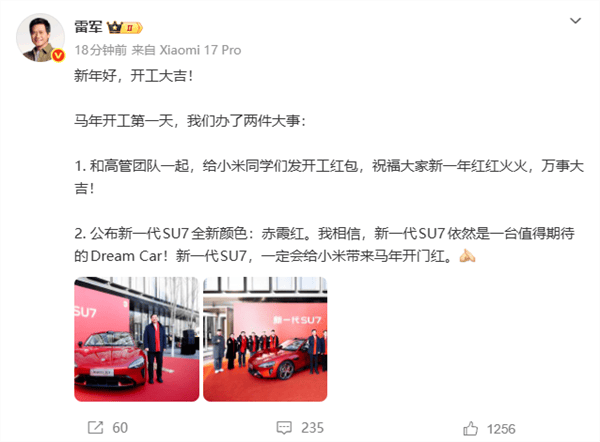
据了解,新一代小米SU7已于1月初开启小订,预售价 22.99万-30.99 万元,预计2026年4月上市。 快科技2月25日消息,每年农历新年开工首日,小米集团创始人雷军带领集团高管给员工派发新年开工 红包,这已然成为小米的一项传统。 24日上午9时33分,雷军发文称:马年开工第一天,他和高管团队一起,给小米同学们发开工红包,并祝 福大家新一年红红火火,万事大吉。 此外,有员工还晒出抽中了新一代SU7赤霞红隐藏好运卡,引发了猜想,这张卡会不会是新车试驾权、 优先提车权,或购车福利。 同时,他还正式公布新一代SU7全新颜色:赤霞红。雷军表示,相信新一代SU7依然是一台值得期待的 Dream Car,一定会给小米带来马年开门红。 据悉,雷军已连续六年亮相开工现场。从现场照片可见,雷军戴着红围巾,与一众高管一同为小米集团 员工派发开工红包。 员工们有序排队,依次领取红包并与雷军合影,脸上洋溢着藏不住的笑容。 一位小米员工回应称,雷军是当天上午在北京小米移动互联网产业园给员工发的红包,他在朋友圈看到 红包里面的金额为10到100元不等,有的红包里还装有马年纪念钞以及礼品卡。 ...

锚定目标任务,坚定信心乘势而上
Chang Sha Wan Bao· 2026-02-24 23:46
Group 1 - Changsha is focusing on building "three high grounds" to accelerate high-quality development in 2026 [1] - Liuyang aims to become a leader in county-level economy by implementing the "three highs and four new" strategy, achieving significant project investments and industrial growth [3][4] - In 2025, Liuyang introduced 166 new projects with a total investment of 42.5 billion yuan, including two projects over 10 billion yuan [3] Group 2 - Changsha Economic Development Zone attracted 126 projects with a total investment of 54.69 billion yuan in 2025, including three projects over 10 billion yuan [7] - The zone aims for an 8.35% increase in industrial output value and a 9.9% increase in public budget revenue in 2025 [7] - The zone is focusing on emerging industries like artificial intelligence and has established several innovation centers [7][8] Group 3 - BYD's contribution to Changsha's automotive industry is significant, with 2025 sales of 2.257 million electric vehicles, marking a global sales leadership [11] - BYD has established six major bases in Changsha, providing over 60,000 jobs and achieving over 100 billion yuan in revenue for four consecutive years [11] - In 2025, BYD exported 82,000 vehicles from Changsha, a 135% increase year-on-year, showcasing the city's role in the company's growth [11] Group 4 - BYD plans to leverage its technological and manufacturing advantages in conjunction with Changsha's resources to enhance its global presence and brand strength [12] - The company aims to contribute to the acceleration of Changsha's automotive industry and support the creation of a significant advanced manufacturing hub in the country [12]
美股三大指数全线上涨,中国资产表现亮眼
Zhong Guo Zheng Quan Bao· 2026-02-24 23:43
Market Performance - On February 24, US stock indices collectively rose, with the Dow Jones Industrial Average, Nasdaq, and S&P 500 increasing by 0.76%, 1.04%, and 0.77% respectively [2] - Major technology stocks mostly saw gains, with the US Tech Giants Index rising by 1.08%. Notable increases included Tesla up 2.39%, Apple up 2.24%, and Amazon up 1.60%, while Google-C experienced a slight decline of 0.25% [2] - The Nasdaq Golden Dragon China Index rose by 1.37%, indicating a positive trend for popular Chinese stocks [3] Sector Performance - Semiconductor stocks generally increased, with Advanced Micro Devices (AMD) rising over 8%, Intel up over 5%, and TSMC up over 4%. Meta announced a multi-year partnership with AMD to deploy up to 6 gigawatts of AMD GPUs for its AI data center [3] - Bank stocks showed mixed results, with JPMorgan down 0.08%, while Goldman Sachs and Morgan Stanley rose over 1%. Citigroup and Bank of America fell over 1% [2] Commodity Market - In the commodities market, spot gold prices fell by 1.86% to $5,128.32 per ounce, while COMEX gold futures dropped by 1.25% to $5,160.50 per ounce. Spot silver prices decreased by 1.23% to $87.056 per ounce [4] - Crude oil prices also declined, with NYMEX light crude futures down by $0.68 to $65.63 per barrel, a drop of 1.03%, and Brent crude futures down by $0.72 to $70.77 per barrel, a decrease of 1.01% [4]

中金 | 向高处行:马来西亚冲刺高收入国家行列
中金点睛· 2026-02-24 23:41AI Processing
中金研究 高附加值制造强国,全球 产业影响 力凸显。 马来西亚是东盟唯一拥有本土内燃机汽车品牌(宝腾和第二国产车)的国家,2024年两大国产品牌占国内整 车市场份额的62%。其电气电子行业以47%的占比主导2024年制造业出口,半导体全球市占率达7%。依托"国家半导体产业战略"(注资250亿马币) 与"2030年新工业大蓝图",马来西亚半导体产业正加速向价值链上游转移,已吸引英特尔(71亿美元)与英飞凌(54亿美元)等重大投资。据世界银行, 马来西亚的营商便利度全球排名第12位,劳动力受教育程度高(识字率达95%),且劳动生产率保持稳定增长(2015–2024年复合年增长率2.9%)。 服务业为支柱产业,经济增长动力强劲。 2024年服务业占马来西亚GDP比重达59.3%,2015–2024年复合年增长率4.8%。2024年,数字经济GDP占比为 23.4%,持续吸引全球科技巨头注资。医疗旅游呈现复苏态势,受到成本优势及JCI认证医疗机构吸引力的驱动,2024年医疗旅游人次达152万,创收5.95 亿美元。马来西亚医疗旅游理事会提出了到2030年实现120亿马币医疗旅游收入的目标。 出口导向型经济,全球市场准 ...

保护主义无助于提升欧盟汽车产业竞争力
Xin Lang Cai Jing· 2026-02-24 23:26
Core Viewpoint - The European Union's proposed "Industrial Accelerator Act" aims to protect its automotive industry from Chinese competition by mandating that at least 70% of car parts be sourced locally, which is seen as a form of trade protectionism [1][2]. Group 1: EU Automotive Industry Protection Measures - The EU Commission plans to implement a law requiring automotive companies to ensure that at least 70% of their vehicle components are produced within the EU to qualify for subsidies and public contracts [1]. - This initiative is a response to the increasing popularity of Chinese electric vehicles in Europe, with Chinese car sales projected to exceed 810,000 units in 2025, marking a 99% increase from 2024 [1]. - Despite imposing tariffs as high as 35% on Chinese electric vehicles, the EU has seen a 3.6% decline in overall new car sales, while Chinese vehicle sales in Europe have surged by 80% [1]. Group 2: Implications of Local Sourcing Requirements - The local sourcing requirement is viewed as a violation of international trade rules, specifically the WTO's regulations against discriminatory measures that favor domestic products [2]. - The average price of electric vehicles produced by European manufacturers is around €50,000, while some Chinese models start as low as €20,000 to €34,000, indicating a significant price advantage for Chinese vehicles [2]. - The push for local procurement may lead to higher manufacturing costs due to limited supplier options, potentially diminishing the global competitiveness of European automotive manufacturers [2][3]. Group 3: Recommendations for EU Policy - Experts suggest that the EU should focus on technological innovation and policy optimization rather than adopting local content requirements, which could hinder the transition of domestic industries [3]. - Maintaining an open attitude towards international cooperation is recommended to leverage global comparative advantages, rather than resorting to protectionist measures [3].