
半导体制造

Search documents
【华虹半导体(1347.HK)】3Q25指引积极,下半年开启涨价驱动量价齐升——2025年二季度业绩点评(付天姿/董馨悦)
光大证券研究· 2025-08-10 23:07
Core Viewpoint - The company reported better-than-expected gross margins and revenue growth in Q2 2025, driven by increased wafer shipments and effective cost control measures [3][4]. Group 1: Financial Performance - In Q2 2025, the company achieved revenue of $566 million, representing a year-over-year increase of 18.3% and a quarter-over-quarter increase of 4.6%, aligning with the company's guidance range of $550 to $570 million [3]. - The gross margin for Q2 2025 was 10.9%, exceeding the company's guidance of 7% to 9% and the market expectation of 8.3%, with a year-over-year increase of 0.4 percentage points and a quarter-over-quarter increase of 1.7 percentage points [3]. - The net profit attributable to shareholders in Q2 2025 was $7.95 million, falling short of the market expectation of $12.77 million, primarily due to rising R&D expenses and depreciation [3]. Group 2: Market Demand and Strategy - The company anticipates a gradual revenue contribution from its "Local for Local" strategy, which involves collaboration with overseas IDM manufacturers, with some projects already in mass production [4]. - The company reported a mild recovery in downstream demand, with revenue from the consumer electronics sector increasing by 19.8% year-over-year, accounting for 63.1% of total revenue, and industrial and automotive revenue increasing by 16.7%, accounting for 22.8% [4]. - The company initiated a low single-digit price increase for its products starting in Q2 2025, primarily focused on ICs and the 12-inch platform, with expected effects to materialize in Q3 and Q4 2025 [4]. Group 3: Capacity and Production - The company maintained a high capacity utilization rate of 108.3% in Q2 2025, a year-over-year increase of 10.4 percentage points and a quarter-over-quarter increase of 5.6 percentage points, driven by recovering downstream demand [5]. - The total capacity for Q2 2025 reached 447,000 8-inch equivalent wafers per month, with Fab 9's installed monthly capacity exceeding 40,000 wafers [5]. - The company plans to complete over 80% of Fab 9's capacity installation by the end of 2025 and aims to achieve a planned capacity of 83,000 wafers per month in the first half of 2026 [5]. Group 4: Future Guidance - The company provided a positive revenue and gross margin guidance for Q3 2025, expecting revenue between $620 million and $640 million, which corresponds to a year-over-year increase of 19.7% and a quarter-over-quarter increase of 11.3% [6]. - The gross margin guidance for Q3 2025 is set between 10% and 12%, with a midpoint indicating a year-over-year decrease of 1.2 percentage points and a quarter-over-quarter increase of 0.1 percentage points [6]. - The company expects continued revenue growth in the second half of 2025, driven by the release of 12-inch capacity and strong demand for BCD products, alongside the positive effects of price increases and cost control measures [6].


华虹半导体(1347.HK):3Q25指引积极 下半年开启涨价驱动量价齐升
Ge Long Hui· 2025-08-10 23:02
Core Viewpoint - The company reported better-than-expected gross margins for Q2 2025, driven by increased wafer shipments and a recovery in downstream demand [1][2]. Financial Performance - Q2 2025 revenue reached $566 million, a year-over-year increase of 18.3% and a quarter-over-quarter increase of 4.6%, aligning with the company's guidance of $550-570 million [1]. - The gross margin for Q2 2025 was 10.9%, exceeding the company's guidance of 7-9% and market expectations of 8.3%, with a year-over-year increase of 0.4 percentage points and a quarter-over-quarter increase of 1.7 percentage points [2]. - Net profit attributable to the parent company was $7.95 million, falling short of the market expectation of $12.77 million, primarily due to rising R&D expenses and depreciation [2]. Market Dynamics - Downstream demand showed moderate recovery, with revenue from the consumer electronics sector increasing by 19.8% year-over-year, accounting for 63.1% of total revenue, and industrial and automotive revenue increasing by 16.7%, accounting for 22.8% [2]. - The company has initiated a price increase for certain products starting in Q2 2025, primarily focused on ICs and the 12-inch platform, with expected effects to materialize in Q3 and Q4 2025 [2]. Capacity and Production - The company maintained a high capacity utilization rate of 108.3% in Q2 2025, a year-over-year increase of 10.4 percentage points and a quarter-over-quarter increase of 5.6 percentage points, driven by recovering downstream demand [3]. - Q2 2025 wafer shipments totaled 1.31 million 8-inch equivalent wafers, representing a year-over-year increase of 18% and a quarter-over-quarter increase of 6% [3]. - The company plans to continue investing in Fab 9, with capital expenditures of $408 million in Q2 2025, of which $376 million was allocated to Fab 9 [3]. Future Outlook - The company provided a positive revenue and gross margin guidance for Q3 2025, expecting revenue between $620-640 million, which corresponds to a year-over-year increase of 19.7% and a quarter-over-quarter increase of 11.3% [3]. - The gross margin guidance for Q3 2025 is set at 10-12%, with a midpoint indicating a year-over-year decrease of 1.2 percentage points but a quarter-over-quarter increase of 0.1 percentage points [3]. - The company anticipates continued revenue growth in the second half of 2025, supported by the release of 12-inch capacity and strong demand for BCD products [3].
稀土暗战!4000吨战略资源神秘赴美,台湾军工命门被锁
Sou Hu Cai Jing· 2025-08-10 15:57
Core Insights - The article highlights the dark side of rare earth gray market trade, particularly focusing on the smuggling of high-purity antimony ingots disguised as ordinary goods, aimed at U.S. military giants like Lockheed Martin [1][3]. Group 1: Smuggling Operations - Nearly 4,000 tons of rare earths have been smuggled through third countries like Thailand and Mexico to the U.S. in just five months, surpassing the total of the past three years [3]. - Antimony ingots were disguised as "iron ore," and neodymium-iron-boron magnetic powder was hidden in tile adhesive, showcasing the ingenuity of smugglers [3]. - A Thai company, "United Industries," shipped 3,366 tons of antimony products to the U.S. in six months, a 27-fold increase compared to the same period last year [3]. Group 2: Profit Margins and Market Dynamics - Prices for rare earth elements like dysprosium and terbium have surged by 200%, exceeding $3,000 per kilogram, driving U.S. companies to engage in the black market [4]. - The profit margin for rare earths through third-country transshipment has risen to 55%, with logistics companies in Thailand and Mexico taking commissions of 12% to 15% [4]. Group 3: Regulatory Responses - In May 2025, China intensified efforts to combat rare earth smuggling, implementing advanced detection technologies and stricter penalties under the new Mineral Resources Law [6]. - Following these measures, U.S. imports of rare earths through irregular channels dropped by 67% within two months [6]. Group 4: Impact on Taiwan and U.S. Military - Taiwan's military industry faces severe challenges due to China's export controls on rare earths, with 96% of its rare earth needs previously met by imports from China [7]. - The lack of critical rare earth elements has led to significant production issues for Taiwan's defense capabilities, affecting various military projects [7]. - U.S. military projects, including the F-35 and B-21, are also experiencing production disruptions due to shortages of essential rare earth materials [9]. Group 5: Challenges in Supply Chain Diversification - U.S. attempts to build a rare earth supply chain independent of China have faced significant hurdles, with production costs in Australia being 300% higher due to a lack of extraction technology [11]. - The reliance on China for rare earth processing remains high, with 80% of U.S. mined rare earths needing to be sent to China for purification [11].


华虹半导体(01347.HK):预计第三季度销售收入6.2亿美元至6.4亿美元之间 毛利率10%至12%之间
Ge Long Hui· 2025-08-09 04:47
Core Insights - Hua Hong Semiconductor (01347.HK) reported a revenue of $566.1 million for Q2 2025, representing an 18.3% year-over-year increase and a 4.6% quarter-over-quarter increase [1] - The gross margin was 10.9%, which is an increase of 0.4 percentage points year-over-year and an increase of 1.7 percentage points quarter-over-quarter [1] - The profit attributable to the parent company was $8 million, reflecting a 19.2% year-over-year increase and a significant 112.1% quarter-over-quarter increase [1] - For Q3 2025, the company expects revenue to be between $620 million and $640 million, with a projected gross margin of 10% to 12% [1]
皇庭国际股价上涨1.66% 宣布参投固态电池企业
Sou Hu Cai Jing· 2025-08-08 20:59
Group 1 - The latest stock price of Huangting International is 3.06 yuan, an increase of 0.05 yuan from the previous trading day's closing price [1] - The stock opened at 3.11 yuan, reached a high of 3.15 yuan, and a low of 3.03 yuan, with a trading volume of 655,017 hands and a transaction amount of 201 million yuan [1] - Huangting International operates in the real estate services and semiconductor sectors, focusing on the design, manufacturing, and sales of power semiconductor chips, as well as commercial real estate operation and management [1] Group 2 - The company's power semiconductor business is conducted through its subsidiary, Yifa Power, which has an annual production capacity of 360,000 pieces of 6-inch power wafers [1] - On August 7, the company announced a capital increase agreement with Shenzhen Zunguang Solid State Battery Co., Ltd., which specializes in the research and production of solid electrolytes and solid-state batteries [1] - This investment is part of the company's "123" transformation development strategy, focusing on new materials in the energy storage sector [1] Group 3 - On August 8, data showed that the net inflow of main funds into Huangting International was 10.6787 million yuan, accounting for 0.39% of the circulating market value [1] - Over the past five days, the cumulative net outflow of main funds was 8.9883 million yuan, representing 0.33% of the circulating market value [1]

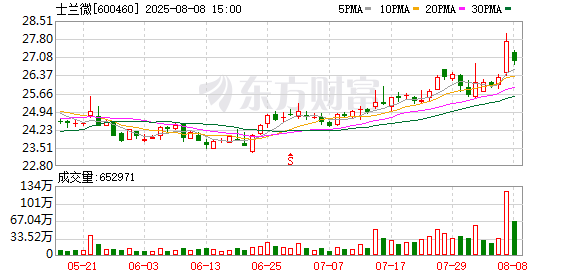
士兰微:2025年第二次临时股东大会决议公告
Zheng Quan Ri Bao· 2025-08-08 16:17
Group 1 - The company Silan Microelectronics announced the convening of its second extraordinary general meeting of shareholders for 2025 on August 8, 2025 [2] - The meeting will review and approve multiple proposals, including the proposal for amendments [2]

一天市值蒸发超650亿!中芯国际:二季度供不应求,产能拉满仍“增收不增利”
Jin Rong Jie· 2025-08-08 12:08
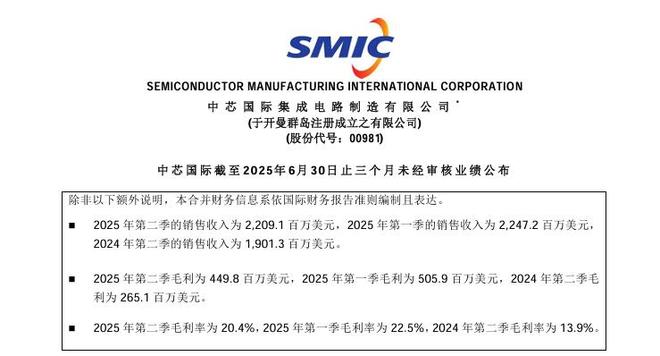
Core Viewpoint - Semiconductor Manufacturing International Corporation (SMIC) reported a mixed performance for Q2 2025, with revenue growth but significant declines in net profit, raising concerns about operational efficiency [1][2][5]. Revenue Analysis - Q2 2025 revenue reached $2.209 billion, a year-on-year increase of 16.2% but a quarter-on-quarter decrease of 1.7% [8]. - The revenue breakdown by application shows smartphones at 25.2%, computers and tablets at 15%, consumer electronics at 41%, IoT and wearables at 8.2%, and industrial and automotive at 10.6% [5][6]. Profitability Metrics - Net profit for Q2 2025 was $132 million, down 19.5% year-on-year and down 29.5% quarter-on-quarter [1][8]. - Gross margin decreased to 20.4%, a decline of 2.1 percentage points from the previous quarter, attributed to a higher proportion of lower-margin consumer electronics orders [6][8]. Capacity and Utilization - Capacity utilization reached 92.5%, an increase of 2.9% from the previous quarter, with a total monthly capacity of 991,300 8-inch equivalent wafers [2][9]. - The company shipped 2.3902 million wafers in Q2 2025, reflecting a quarter-on-quarter increase of 4.3% and a year-on-year increase of 13.2% [9]. Operating Expenses - Operating expenses surged by 52.4% quarter-on-quarter to $299.1 million, driven by increased R&D and administrative costs [7][8]. - R&D expenses rose by 22.2% to $181.9 million, while administrative expenses increased by 26.5% due to new production line costs [7]. Market Position and Challenges - SMIC's market share in China remains strong, with 84.1% of revenue coming from the Chinese market, while the U.S. and Eurasia contributed 12.9% and 3%, respectively [6][9]. - The company faces challenges such as prolonged global inventory digestion, geopolitical supply chain fragmentation, and intensified price competition in mature process technologies [10].

半导体关税、Intel、GPT-5
傅里叶的猫· 2025-08-08 11:30
Group 1: Semiconductor Tariffs - The core viewpoint is that companies building factories in the U.S. can be exempt from tariffs, benefiting firms like Apple, Nvidia, and TSMC, which have committed to expanding capacity in the U.S. [5][6] - Apple emerges as a significant winner as the tariffs help alleviate major supply chain uncertainties, despite its ongoing challenges in AI breakthroughs [6]. - In the analog chip sector, U.S. companies like Texas Instruments and Microchip may benefit, while European firms like Infineon and STMicroelectronics, with only about 15% of their business in the U.S., may face competitive disadvantages [6]. - In the foundry sector, TSMC and Samsung are expected to maintain growth momentum if they can strategically navigate the tariff impacts, while UMC, with a 15%-20% U.S. market share and lacking domestic production, may be pressured [6]. - U.S. firms like Corning and Coherent in the optical communication sector are likely to gain market share from Chinese competitors [7]. - Applied Materials, due to its significant domestic production and involvement in Apple-related projects, may benefit, while Lam Research's limited U.S. presence puts it at a relative disadvantage [7]. - The current market sentiment favors semiconductor hardware companies over software companies, reflecting a shift in investment preferences [7]. Group 2: Intel and Leadership Concerns - Former President Trump called for Intel CEO Pat Gelsinger to resign, citing conflicts of interest due to Gelsinger's extensive ties with Chinese companies, which could pose national security risks [8][9]. - Gelsinger's investments in China, reportedly exceeding $200 million, have raised concerns, especially given Intel's critical role in the U.S. semiconductor industry [9]. - The recent legal issues faced by Cadence, linked to Gelsinger's previous role as CEO, may further complicate Intel's situation if Gelsinger were to step down, potentially impacting Cadence's business prospects [9]. Group 3: AI Developments - The release of GPT-5 has not met high expectations, with users reporting no significant improvements over the previous version in text processing and search capabilities [14]. - The perceived overhype surrounding GPT-5's capabilities has led to a reassessment of the limitations of scaling laws in AI development [14].



Skywater,收购
半导体芯闻· 2025-08-08 10:54
Core Viewpoint - Skywater Technology has made a significant acquisition that is expected to double its annual revenue, despite facing challenges due to delays in federal defense funding [1][2]. Group 1: Acquisition and Financial Impact - Skywater acquired the Fab 25 semiconductor plant in Austin, Texas for $93 million, which will enhance its semiconductor manufacturing capacity in the U.S. [1] - The acquisition is expected to lead to a revenue increase, projecting $600 million in revenue by 2026, up from $342 million in 2024 [2]. - The company’s stock price surged nearly 45% to $12.85 per share following the announcement of the acquisition [1]. Group 2: Funding and Strategic Developments - Skywater received $16 million from the CHIPS Act and approximately $19 million from Minnesota's Advance Fund for capacity upgrades [2]. - The company anticipates an additional $320 million in funding through customer co-investments in the coming years [2]. - Despite a widening loss of $10 million in Q2, the company is optimistic about its strategic partnerships with the Department of Defense [2]. Group 3: Operational Highlights - The company has made progress in enhancing capabilities in the quantum computing market and installed new tools at its Florida facility [2]. - The acquisition of Fab 25 is seen as a strategic move to attract new customers and strengthen its market position [1].


7月出口增速回升,但未来压力加大
Bank of China Securities· 2025-08-08 08:46
Market Performance - The Hang Seng Index (HSI) closed at 25,082, up 0.7% for the day and 25.0% year-to-date (YTD) [1] - The MSCI Hong Kong index increased by 1.4% for the day and 26.9% YTD [1] - The KOSPI index showed a significant YTD increase of 34.5%, closing at 3,228 [1] Commodity Prices - Brent Crude oil price decreased by 0.9% to US$66 per barrel, down 8.3% YTD [2] - Gold prices rose by 0.8% to US$3,396 per ounce, with a YTD increase of 29.4% [2] - The Baltic Dry Index (BDI) surged by 92.7% YTD, closing at 1,921 [2] Economic Indicators - US consumer credit total was reported at US$5.1 billion, below the consensus of US$7.4 billion [3] - The US CPI for urban consumers increased by 0.3% month-over-month and 2.7% year-over-year [3] - The US PPI Final Demand YoY increased by 2.3%, slightly below the consensus of 2.5% [3] Trade and Exports - China's exports grew by 7.2% YoY in July, surpassing the 5.2% growth in June [5] - Imports into China increased by 4.1% YoY in July, indicating a rebound from previous months [7] - The strong export growth to non-US regions helped offset declines in exports to the US due to increased tariffs [6] Corporate Insights - China Mobile reported a 6% YoY increase in Q2 earnings to RMB53.6 billion, exceeding market expectations [13] - Hua Hong Semiconductor's Q2 results showed a gross profit margin of 10.9%, driven by a 6% QoQ increase in wafer shipments [16] - BeiGene's Q2 revenue reached US$1.32 billion, a 42% YoY increase, with significant contributions from its key products [24]

