人工智能

Search documents
AI除幻第一股海致科技登陆港交所,开盘狂飙260%
Huan Qiu Lao Hu Cai Jing· 2026-02-13 07:59
Core Viewpoint - Haizhi Technology (02706.HK), known as the "first stock to eliminate AI hallucinations," made a strong debut on the Hong Kong stock market, with its share price surging over 260% on the first day, setting a record for the highest opening increase of a new stock in Hong Kong this year [1] Group 1: IPO Details - The company issued a total of 28.03 million H-shares, with 2.803 million shares available for public offering, accounting for 10% of the total, and 25.227 million shares for international placement, accounting for 90% [1] - The IPO price was set at HKD 27.06 per share, raising approximately HKD 760 million [1] - Four cornerstone investors participated in the IPO, with a total subscription amount of about USD 15 million (approximately HKD 117 million) [1] Group 2: Company Overview - Founded in 2013, Haizhi Technology focuses on digital transformation needs across multiple sectors, specializing in developing industrial-grade intelligent agents and providing AI solutions [1] - The company's core business centers around the Atlas graph solution and the research and promotion of industrial-grade intelligent agents [1] Group 3: Market Position and Technology - According to Frost & Sullivan, Haizhi Technology ranks fifth among industrial AI intelligent agents providers in China by revenue for 2024 and holds the first position among graph-centric AI intelligent agents providers, with a market share of approximately 50% [2] - The company's competitive edge lies in its "AI hallucination elimination" technology, which addresses the issue of AI-generated content producing seemingly coherent but factually incorrect information [2] Group 4: Financial Performance - Despite continuous revenue growth, the company has not yet achieved profitability due to high initial investments in technology research and development [2] - Revenue figures for 2022 to 2024 are projected at CNY 313 million, CNY 376 million, and CNY 503 million, respectively, with a compound annual growth rate of 26.8% [2] - Net losses for the same period are expected to be CNY -178 million, CNY -266 million, and CNY -93.73 million, totaling approximately CNY -537 million [2] - The company is gradually reducing its R&D expenses, which were CNY 86.94 million in 2022 (27.8% of total revenue), CNY 72.71 million in 2023 (19.4% of total revenue), and are projected to be CNY 60.68 million in 2024 (12.1% of total revenue) [2]
经济地理丨从地方两会看2026年经济增长发力点
Sou Hu Cai Jing· 2026-02-13 07:49
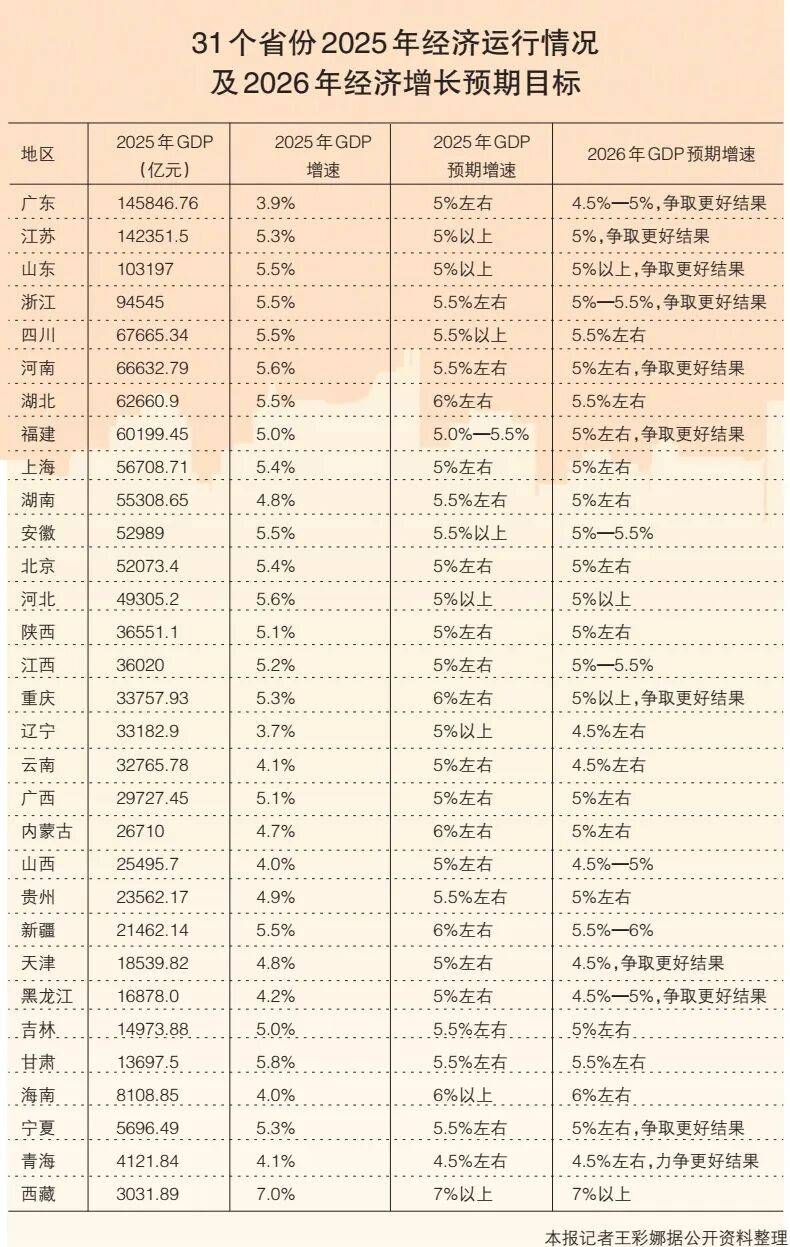
Core Viewpoint - The 2026 economic growth targets set by various provinces in China reflect a pragmatic approach, emphasizing quality over speed, with a focus on differentiated regional development strategies [1][2][3]. Group 1: Economic Growth Targets - Provinces such as Hainan and Hubei set GDP growth targets of around 6% and 5.5% respectively, while many others aim for approximately 5% [2][6]. - Only Jiangxi raised its growth target for 2026 from 5.0% to a range of 5.0%-5.5%, while 18 provinces lowered their targets or set them within a lower range [3][4]. - The overall weighted GDP growth target for all provinces is approximately 5.0%, indicating a decrease compared to 2025, with more provinces setting targets below 5% [6]. Group 2: Regional Development Strategies - A differentiated development pattern is emerging, characterized by "central regions leading, eastern regions supporting, and western regions catching up" [7]. - Central provinces are leveraging industrial transfer and domestic demand to maintain higher growth rates, while eastern provinces are focusing on high-end, intelligent, and green transformations [7]. Group 3: Innovation and Industrial Upgrading - The emphasis is on technological innovation as a core driver for economic growth, with local governments prioritizing the development of new productive forces and modern industrial systems [8][9]. - Traditional industries are being upgraded alongside the emergence of new industries, with specific targets set for technological improvements and digital transformation [8]. Group 4: Domestic Demand and Reform - The focus is on activating domestic demand through consumption and investment, with local governments implementing measures to enhance the business environment and expand high-level openness [10][11]. - Initiatives include enhancing consumer experiences and optimizing investment strategies to ensure effective and sustainable growth [10][11].

放弃火星!马斯克计划打造阿尔法月球基地
Huan Qiu Wang Zi Xun· 2026-02-13 07:46
来源:环球网 【环球网科技综合报道】2月13日,据外媒TechCrunch报道,在SpaceX与xAI完成合并、计划推进IPO之 际,特斯拉CEO埃隆·马斯克为两家公司确立了全新愿景——打造"阿尔法月球基地",以此替代搁置的 火星殖民计划,为AI与航天业务融合指明方向。这一愿景也成为xAI高管离职潮后的全新招聘筹码,马 斯克公开喊话:"若月球质量驱动器的构想吸引你,就加入xAI。" 据悉,两家公司合并后的核心协同点的是在轨AI数据中心,而马斯克将这一构想进一步延伸:要突破 地球轨道数据中心的能量局限,就必须登陆月球,建造月球城市批量生产太空计算机,并通过磁悬浮列 车将AI卫星发射至深空,甚至利用太阳能的部分能量训练和运行AI模型。 外媒报道称,这一转变源于SpaceX对火星殖民计划的务实调整。此前九年,"火星殖民"一直是SpaceX 的核心招聘和融资叙事,但该计划因缺乏商业回报、技术成本过高难以推进,如今SpaceX已将重心转 向更具可行性的月球任务,包括执行NASA价值40亿美元的登月合同、构建月球经济生态。而阿尔法月 球基地,正是马斯克为融合xAI业务打造的全新叙事,区别于行业内千篇一律的AI研发方向。 ...

大模型第一股智谱推进A股科创板IPO,港股股价已连涨五日
Nan Fang Du Shi Bao· 2026-02-13 07:46
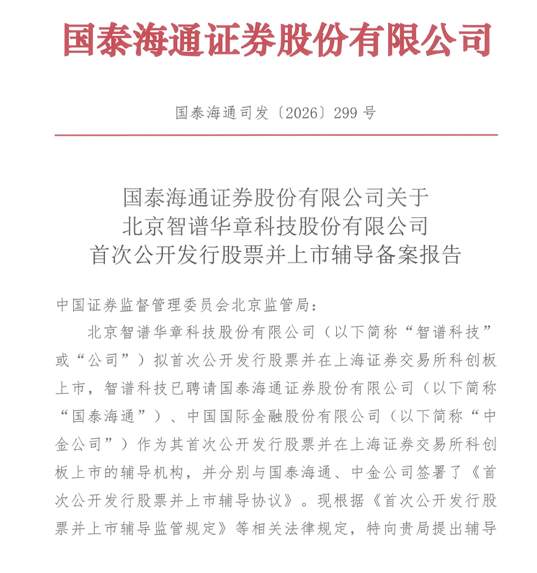
发布新模型后,智谱"A+H"上市布局有新进展?2月13日,南都N视频记者从中国证监会官网获悉,智谱撤回了 其于2025年4月提交的辅导备案,并办理了新的辅导备案登记。根据最新备案登记信息,智谱拟首次公开发行股 票并在上海证券交易所科创板上市,IPO辅导机构变更为两家券商,由原来的中金公司变更为国泰海通和中金公 司两家。 南都N视频记者向智谱方面求证,截至发稿暂无回应。值得注意的是,智谱H股股价已连续五个交易日上涨,截 至发稿,智谱2月13日股价涨超17%,报473.8港元/股,总市值达2112亿港元,为上市首日的3倍多。 智谱股价连续多个交易日上涨。 智谱去年已开启A股上市历程。2025年4月,智谱在北京证监局办理辅导备案,当时由中国国际金融股份有限公 司担任辅导机构。 今年1月8日,智谱(02513.HK)正式在香港联合交易所挂牌上市,成为"全球大模型第一股"。 智谱不断推进大模型上新进程。2月12日,南都记者获悉,此前一段时间内,让开发者社区广泛关注的代 号"Pony Alpha"匿名模型,系智谱新模型GLM-5。2月12日,新模型已在chat.z.ai平台上线,模型在Coding与 Agent能力上取得 ...
宏观经济专题:地方两会观察:内需和科技的新图景
KAIYUAN SECURITIES· 2026-02-13 07:43
Economic Growth Targets - The weighted average GDP growth target for 31 provinces in 2026 is set at 5.0%, down from 5.3% in 2025[2] - 17 provinces have lowered their targets, while 14 have kept them unchanged; 7 provinces set interval targets, indicating a likelihood of a national target range of 4.5% to 5%[2][13] - Economic powerhouses are expected to bear more responsibility for growth, with half of the top ten provinces maintaining their original targets[2][13] Investment Focus - The average fixed asset investment growth target has decreased from 6.3% to 5.1%, with all provinces either lowering or maintaining their 2025 targets[3][37] - Emphasis is placed on expanding private and livelihood investments, with many provinces encouraging private capital participation in various sectors[3][38] - Specific investment plans include a commitment of 721.46 billion yuan in Guangdong for livelihood projects[38] Consumption Trends - The weighted average target for social retail sales growth is approximately 4.8%, down from 5.4% in 2025[4] - Provinces are focusing on increasing residents' income through measures like raising basic pensions and providing subsidies[4] - New consumption models are being developed, particularly in sectors like health, culture, and entertainment, with a focus on "emotional economy"[4] Technological Development - The "Artificial Intelligence+" initiative is entering a comprehensive application phase, with local governments promoting AI in various sectors[5] - Emerging industries such as integrated circuits, aerospace, and renewable energy are prioritized, aligning with the "14th Five-Year Plan"[5] Real Estate Market - The main strategies for the real estate sector include revitalizing existing stock and improving housing quality[6] - Many provinces are initiating programs to purchase existing homes for affordable housing, marking a shift from previous strategies[6] National Conference Outlook - The national GDP growth target is likely to be set between 4.5% and 5%, with a focus on expanding domestic demand and technological breakthroughs[6] - Investment strategies will continue to support key projects and enhance livelihood investments, while the real estate sector will focus on revitalizing existing stock[6]
智谱市值创历史新高,拉动算力板块
Di Yi Cai Jing· 2026-02-13 07:37
Core Insights - The domestic AI models, particularly ByteDance's Seedance 2.0 and Zhipu's GLM-5, are gaining significant traction, pushing the industry towards the global top tier in AI capabilities [1][8] - The recent surge in stock prices for companies like Zhipu and MiniMax indicates a strong market response to advancements in AI applications [1][2] - Zhipu's decision to raise prices for its GLM Coding Plan reflects robust market demand and the need for enhanced computational resources to maintain service quality [3][5] Industry Trends - The AI application index has seen notable increases, with companies like Deep Technology and Fengyuzhu rising by 10.02% and 9.98% respectively, indicating a shift in industry focus towards computational power [1] - The semiconductor equipment index also rose by 2.02%, with specific companies like Fuchuang Precision and Jingyi Equipment experiencing gains of 11.6% and 5.92% respectively, highlighting the growing demand for AI-related infrastructure [1] Product Developments - Zhipu's GLM-5 has made significant advancements, with its parameters doubling from 355 billion to 744 billion, and pre-training data increasing from 23 terabytes to 28.5 terabytes, enhancing its capabilities [4] - The introduction of multi-modal models like Seedance 2.0 is leading to a dramatic increase in token consumption, with applications in video generation and coding consuming significantly more resources than traditional text-based models [4][8] Competitive Landscape - The competition in the AI coding space is intensifying, with Zhipu's GLM-5 directly targeting Anthropic's Claude Opus 4.5, although it still lags behind in certain advanced capabilities [8] - Chinese companies, including Zhipu and others, are rapidly closing the gap with global leaders in AI, with experts noting that the development pace of Chinese AI models may only be months behind that of the U.S. [9]

Seedance2.0“真人素材参考”功能被暂停,爆火背后有两道必答题
Huan Qiu Wang Zi Xun· 2026-02-13 07:26
Core Viewpoint - ByteDance's newly launched video model Seedance 2.0 has generated significant online discussion due to its ability to create movie-quality videos from simple prompts, raising concerns about privacy and content security as it can closely mimic real-life individuals and voices [1][6]. Group 1: Seedance 2.0 Capabilities - Seedance 2.0 addresses a common pain point in generative AI by improving content consistency, which is crucial for its application in serious film production [2][5]. - The model allows for rapid generation of complex visual effects that previously required extensive manual adjustments, significantly enhancing productivity in the film industry [2][3]. - The technology enables creators to bypass technical barriers, allowing for a focus on storytelling rather than technical execution, which could democratize high-quality film production [5][6]. Group 2: Industry Impact - The advancements in Seedance 2.0 could lead to a shift in the film industry, where high-quality effects can be produced at lower costs, making it accessible for smaller studios [5][6]. - The model's ability to generate consistent results is seen as a transformative step that could change the role of AI from a mere entertainment tool to a serious production asset [2][3]. Group 3: Privacy and Security Concerns - The rapid development of video generation technology poses new challenges for privacy protection and content security, particularly concerning deepfakes and misinformation [6][7]. - Experts emphasize the need for evolving regulatory frameworks to keep pace with technological advancements to prevent misuse, such as scams using deepfake technology [7][8]. - A collaborative approach involving technology, regulation, and legal frameworks is necessary to effectively manage the risks associated with these advanced tools [8].

暴拉!最猛散户进场扫货
Ge Long Hui· 2026-02-13 07:20
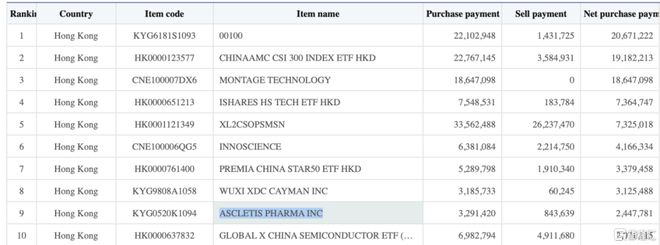
Group 1 - The core viewpoint of the news highlights the significant surge in Chinese AI model stocks, particularly with companies like Zhiyu and MiniMax experiencing substantial price increases, with Zhiyu rising over 130% in five trading days and MiniMax increasing over 40% in the same period [1] - The launch of new AI models such as GLM-5 by Zhiyu and Minimax 2.5 by MiniMax is expected to drive further interest and investment in the sector, with additional models from Alibaba and ByteDance anticipated to be released around the Chinese New Year [1] - Korean retail investors are actively purchasing Chinese AI model stocks, indicating a shift in investment preferences towards emerging technology companies, as evidenced by their buying patterns in the Hong Kong stock market [2][4] Group 2 - Data from the Korea Securities Depository shows that Korean investors have favored stocks like MiniMax and various ETFs related to Chinese technology and semiconductors, reflecting a strong interest in these sectors [2][3] - The Korean stock market has seen a remarkable increase, with the composite index rising by 130% since 2025, largely driven by a few major stocks like Samsung Electronics and SK Hynix, which have contributed significantly to the overall market performance [6][7] - The trend of Korean retail investors converting their currency to invest in foreign markets, including the Chinese stock market, has raised concerns about the depreciation of the Korean won, as highlighted by the Bank of Korea [10][11]





美团升级“问小团”AI管家参战AI大战,科创人工智能ETF华夏(589010)震荡持平
Xin Lang Cai Jing· 2026-02-13 07:02
科创人工智能ETF华夏(589010)紧密跟踪上证科创板人工智能指数,覆盖全产业链优质企业,兼具高研 发投入与政策红利支持,20%涨跌幅与中小盘弹性助力捕捉AI产业"奇点时刻"。 国联民生证券表示,临近春节互联网大厂红包营销&模型迭代催化不断,头部科技公司正凭借其数据、 场景与平台优势,加速推进AI商业化落地与价值重估。研报预计今年春节期间的AI营销大战,将加速 抢占用户心智,大幅提高C端用户渗透率。长期来看,随着推理、多模态大模型持续迭代、大厂生态融 合及各行业渗透率不断提升,Token调用量有望保持快速增长,大模型规模化商业应用及产业落地值得 期待。 截至今日14:40,科创人工智能ETF华夏(589010)午后维持震荡整理小幅回撤,最新价报1.639元,与开盘 价持平。持仓层面,该ETF跟踪的30只成分股中11只个股上涨,星环科技涨超8%领涨,云天励飞、奇 安信涨幅居前;优刻得跌超5%跌幅居前。流动性方面,该ETF成交额达1.07亿元,换手率3.95%,资金 交投节奏平稳,成交活跃度维持适中水平。 消息方面,2月12日,美团宣布升级"问小团"AI管家并加入AI大战,即日起至春节假期,用户在美团 App用 ...

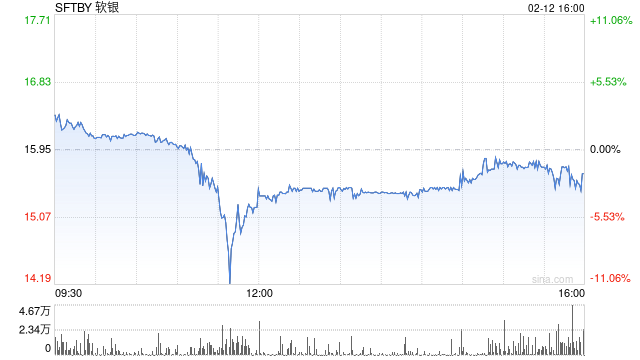
软银大举借债,为押注OpenAI筹措资金
Xin Lang Cai Jing· 2026-02-13 06:56
Core Insights - SoftBank Group's appetite for OpenAI is becoming increasingly costly, leading to more debt and divestitures [2] - The company reported a profit of $1.6 billion for the last quarter of the previous year, largely due to the valuation increase of its early investment in OpenAI [2][6] Group 1: Financial Strategies - In the last quarter, SoftBank incurred an additional debt of $27 billion [2] - The company sold NVIDIA shares for $5.8 billion and reduced its stake in T-Mobile, raising over $3.5 billion [2] - SoftBank is negotiating to invest up to an additional $30 billion in OpenAI [2][6] Group 2: Investment Performance - SoftBank's stock price has increased nearly 100% over the past year, partly due to its significant stake in OpenAI [3][7] - The company holds an 11% stake in OpenAI, making it the second-largest private shareholder after Microsoft [3][7] Group 3: Debt Management - SoftBank's debt constitutes only 20% of its total asset value, reflecting a more conservative borrowing policy established after the tech bubble burst [8] - The company has utilized margin loans against its $115 billion stake in Arm and $8 billion against its telecom operations [7][8] - Additional fundraising avenues include further bond issuance or selling stakes in other subsidiaries [8] Group 4: Market Influence - The recent election victory of Japan's Prime Minister Sanna Takagi is expected to boost strategic investments in AI and semiconductors, positively impacting SoftBank's stock [4][8]