
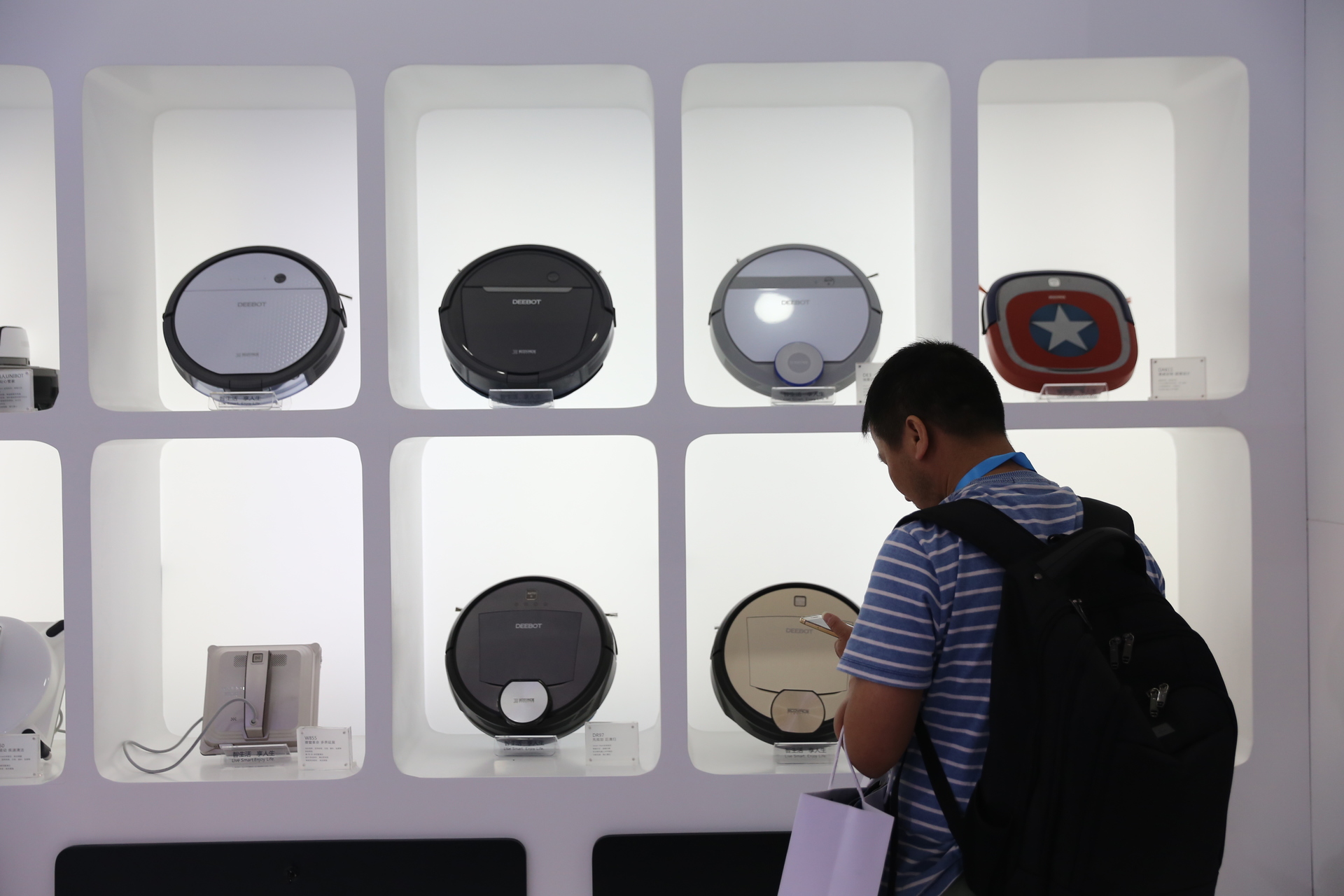
扫地机器人

Search documents
山西证券研究早观点-20250820
Shanxi Securities· 2025-08-20 00:27
Core Insights - The report highlights the significant growth in revenue and profitability for various companies in the technology and energy sectors, indicating a positive trend in their respective markets [6][23][15]. Industry Overview - The non-bank financial sector is experiencing a resurgence, with a focus on investment value as half-year reports are being released [5]. - The semiconductor and advanced packaging industries are seeing increased demand, driven by technological advancements and market expansion [8][11]. Company Analysis - **Stone Technology (688169.SH)**: The company reported a revenue of 7.903 billion, a year-on-year increase of 78.96%, but a decline in net profit by 39.55% [6]. - **Jiaocheng Ultrasonic (688392.SH)**: The company experienced a significant improvement in profitability, with a focus on scaling its advanced packaging business [8]. - **Green's Harmonics (688017.SH)**: The company achieved a revenue growth of 45.8% in the first half of 2025, driven by a recovery in the industrial robot market [15]. - **Hongyuan Co., Ltd. (920018.BJ)**: Recognized as a national champion in the electromagnetic wire industry, the company is leveraging its advantages in the ultra-high voltage sector [14]. - **JianTou Energy (000600.SZ)**: The company reported a substantial increase in net profit by 169.37% in the first half of 2025, attributed to effective cost management and stable power generation performance [23][24]. Financial Performance - **Stone Technology**: The company’s H1 revenue reached 7.903 billion, with a net profit of 678 million, reflecting a significant year-on-year revenue increase [6]. - **Jiaocheng Ultrasonic**: The company’s H1 gross margin was 44.56%, with a net margin of 8.57%, indicating improved profitability [8]. - **Green's Harmonics**: The company’s Q2 revenue grew by 69.5%, with a net profit increase of 101% [15]. - **JianTou Energy**: The company’s H1 revenue was 111.13 billion, with a net profit of 8.97 billion, showcasing strong financial health [23]. Investment Recommendations - The report suggests a "Buy-A" rating for companies like Stone Technology and Jiaocheng Ultrasonic, indicating strong future growth potential [8][11]. - JianTou Energy is also recommended for investment due to its robust financial performance and strategic project developments [23][26].


独家 | 追觅组建无人机团队:挖角大疆人才,靠“贴牌”抢市场?
Xin Lang Ke Ji· 2025-08-20 00:16
Core Insights - The core viewpoint of the article is that the smart home appliance brand, Chasing, is expanding into the drone business, aiming to compete with established players like DJI by targeting the industrial drone market rather than the consumer market [2][5]. Company Expansion - Chasing is establishing a drone division with headquarters in Suzhou and a branch in Shenzhen, attracting talent from companies like DJI and Meituan [2][5]. - The company is focusing on an e-commerce model initially, planning to use "OEM" strategies to capture market share before developing its own technology [2][5]. - Job postings for various positions related to the drone project indicate a focus on B2B and B2G markets, suggesting a strategic shift towards industrial applications [2][3][5]. Competitive Landscape - Chasing's move into the drone sector is seen as a response to DJI's recent foray into the vacuum cleaner market, highlighting the competitive dynamics within the hardware industry [5][9]. - DJI currently holds a dominant market share of 70% to 85% globally, particularly in North America, Europe, and Asia, making it a formidable competitor for Chasing [7][9]. - The industrial drone market is viewed as having diverse opportunities, contrasting with the saturated consumer drone market [5][9]. Technological Development - Chasing's drone products will utilize a combination of laser radar and visual technology, indicating a focus on advanced technological integration [3]. - The founder of Chasing, Yu Hao, has a background in drone technology, having previously established a drone research base, which may provide a foundation for the new venture [2][7]. Market Challenges - Industry analysts express skepticism about Chasing's ability to penetrate the drone market without significant technological capabilities, especially given the competitive landscape [9]. - The article notes that while Chasing is expanding into new business areas, there are concerns about the effectiveness of their strategies and the potential for commercial success in the drone sector [7][9].


4000亿寒武纪,千元股价维持不到1分钟
21世纪经济报道· 2025-08-19 13:26
回顾A股千元股历史,上世纪90年代,飞乐股份(现为中安科,600654.SH)、真空电子(现 为云赛智联,600602.SH)股价均曾站上1000元。1992年1月10日,飞乐股份成为A股历史首 只千元股,同年5月25日,盘中涨至3550元(不复权),创下至今未破的最高股价纪录。 记者丨 见习记者李益文 编辑丨叶映橙 8 月 19 日 , A 股 市 场 全 天 冲 高 回 落 , 三 大 指 数 微 跌 。 盘 中 , 芯 片 明 星 企 业 寒 武 纪 -U (688256.SH)以990元/股高开后迅速突破1000元/股整数关口,最高探至1001.1元,总市值短 暂突破4000亿元,成为继贵州茅台、石头科技、爱美客等之后,A股历史上第七只触及千元关 口的个股。 不过, 千元股光环维持不足1分钟 ,寒武纪-U股价在突破1000元高位后,旋即开启回撤,截 至收盘,寒武纪报收933.98亿元,日内跌1.69%。 | 10:09 | 999.81 | 1374 | | --- | --- | --- | | 10:10 | 1000.00 | 254수 | | | 999.99 | 2384 | | 70:10 ...


目光从「天上」看向「地面」,大疆为何入局扫地机器人?| 声动早咖啡
声动活泼· 2025-08-15 08:38
Core Viewpoint - DJI has entered the vacuum robot market despite the industry's stagnation, aiming to leverage its technological expertise and expand its consumer base [2][3][4]. Market Context - The vacuum robot industry is facing growth bottlenecks, with major players like Ecovacs and Roborock capturing nearly half of the market share by 2024, while profits for leading brands have declined significantly [3][4]. - The overall market growth is slowing, and there is a lack of breakthrough innovations in vacuum robots, leading to concerns about future demand [3][4]. DJI's Strategy - DJI's entry into the vacuum robot market is part of a long-term strategy initiated in 2020, aiming to diversify its product offerings beyond drones, which currently account for over 70% of its revenue [3][4]. - The company believes that vacuum robots can reach a broader consumer base, as the penetration rate in China is only 4.3%, compared to 20% in the US, indicating significant growth potential [4][6]. Technological Advantages - DJI's vacuum robots utilize technology derived from its drone expertise, including obstacle avoidance and path planning capabilities [6][8]. - The hardware components, such as cameras and sensors, are similar to those used in DJI's drones, enhancing the cleaning efficiency of the vacuum robots [6][8]. Pricing and Market Positioning - DJI's vacuum robots are priced between 4,699 and 7,399 yuan, which is higher than the average online price of 3,200 yuan for similar products [7][10]. - The company has established over 700 physical stores globally, allowing customers to experience the product firsthand, which is crucial for high-priced items [7][10]. Consumer Perception and Marketing - There is a significant difference in user profiles between drone and vacuum robot consumers, with the latter focusing more on practical cleaning efficiency rather than technical specifications [8][9]. - DJI has not heavily invested in celebrity endorsements or aggressive marketing strategies, which may hinder its ability to quickly build brand recognition in the vacuum robot segment [8][9]. Competitive Landscape - The vacuum robot market is characterized by rapid imitation of features, leading to severe product homogenization, making it challenging for new entrants to differentiate themselves [9][10]. - DJI's vacuum robots have not yet demonstrated breakthrough innovations in cleaning performance, which is critical for gaining market acceptance [9][10]. Initial Business Approach - To mitigate risks, DJI has opted for third-party manufacturing for its vacuum robots instead of building its own supply chain initially [11]. - The vacuum robot segment may be part of a broader strategic initiative by DJI to explore new markets and technologies [11].

石头科技赴港上市,“扫地茅”又要IPO了
Sou Hu Cai Jing· 2025-08-13 22:37
Group 1 - Stone Technology has submitted its prospectus to the Hong Kong Stock Exchange, planning to list under the "A+H" model, potentially becoming a significant case of secondary listing in the smart hardware sector by 2025 [1] - The company reported a revenue of 11.945 billion yuan for 2024, marking a 38.03% year-on-year growth, but its net profit decreased by 3.64% [1][2] - The company is facing challenges in its strategic expansion, with R&D spending at twice that of traditional manufacturers and sales expenses increasing over 70% [2] Group 2 - Stone Technology's founder, Chang Jing, transitioned from working for major tech companies to establishing the firm in 2014, capitalizing on the smart hardware opportunity [4][5] - The company initially gained traction by partnering with Xiaomi, launching its first product, the "Mijia Smart Vacuum Cleaner," which disrupted the market with its competitive pricing [5] - By 2020, the company had reduced its reliance on Xiaomi, increasing its own brand revenue from 10% to 90% [7] Group 3 - Following the release of its financial report, Stone Technology's stock price dropped significantly, falling 25.42% in just two days [8] - The company has increasingly relied on overseas markets, with 53.48% of its revenue coming from international sales in 2024 [11] - Stone Technology is diversifying its product line, introducing washing and drying machines, but faces stiff competition in a mature market [12][13] Group 4 - The vacuum cleaner market is experiencing declining sales, with a 5.39% drop in units sold in the first half of 2023 [15] - Stone Technology's inventory turnover period has increased significantly, indicating potential inventory issues [15] - The company is shifting focus to international markets, establishing a presence on platforms like Amazon to drive growth [18] Group 5 - Stone Technology's overseas revenue reached 6.388 billion yuan in 2024, a 51.06% increase, surpassing domestic revenue [18] - The company is entering the washing machine market, targeting new households, but faces challenges due to established competitors [18] - The founder's venture into the automotive sector with Extreme Stone Automotive has not yet gained significant traction, with low sales figures reported [19]

460亿“扫地茅”,又要IPO了
Sou Hu Cai Jing· 2025-08-13 12:51
Core Viewpoint - The article discusses the upcoming IPO of Stone Technology on the Hong Kong Stock Exchange, highlighting its significance in the smart hardware sector and the broader trend of A-share companies seeking dual listings in Hong Kong [2][13]. Company Overview - Stone Technology, founded in 2014 by Chang Jing and his team, has become a leader in the global robotic vacuum cleaner market, achieving a market capitalization of over 460 billion yuan [2][3][6]. - The company transitioned from being a manufacturer for Xiaomi to establishing its own brand, significantly increasing its independent revenue from 10% to 90% within three years [6][10]. Financial Performance - In Q1 2025, Stone Technology reported a revenue of 3.428 billion yuan, a year-on-year increase of 86%, but net profit decreased by 32.92% to 267 million yuan [7][10]. - The overall gross margin fell to 45.48%, a decline of 11.02 percentage points year-on-year, indicating pressure on profitability despite revenue growth [8][10]. Market Dynamics - The global smart cleaning market has become increasingly competitive, with significant price pressures from both domestic and international competitors [10][11]. - Stone Technology holds a 57% market share in the North American high-end vacuum cleaner segment, while the European market has seen a growth rate of 120% [7][10]. Strategic Moves - The upcoming dual listing in Hong Kong is seen as a strategic move to tap into international capital and enhance the company's global presence [15][18]. - Approximately 40% of the funds raised from the IPO will be allocated to building a global after-sales service network, which includes establishing repair centers in 15 countries [17]. Industry Trends - The article notes a shift in the smart cleaning industry towards more advanced technologies, with Stone Technology investing in AI and robotics to maintain its competitive edge [17]. - The trend of A-share companies seeking listings in Hong Kong reflects a broader need for Chinese firms to engage in global capital operations amid changing market conditions [18].

出海依然是家电最重要主线
2025-08-11 14:06
Summary of Key Points from Conference Call Records Industry Overview: Home Appliances and Robotics Home Appliances Industry - The domestic home appliance subsidy policy shows diminishing marginal effects, with a slowdown in growth expected post-2026, even with subsidies reaching 1 trillion [1][4] - The U.S. interest rate cuts are expected to boost real estate demand, positively impacting home appliance and furniture categories, benefiting Chinese companies like Haier [1][5] - Chinese brands are gaining recognition in emerging markets, leading to increased market share [1][5] - The television segment is dominated by Chinese brands, leveraging large screen and Mini LED technologies to surpass Japanese and Korean brands [1][6] - Asian brands have a supply chain advantage, with China and Taiwan supplying over 90% of global panels, allowing for competitive pricing against brands like Samsung and LG [1][7][8] - The white goods sector shows divergent trends between self-owned brands and OEM businesses, with Haier focusing on overseas expansion and Midea emphasizing the increase of self-owned brand share [1][10] Motorcycle Industry - The Chinese motorcycle industry is experiencing a second wave of international expansion, with improved product quality and significant potential in large-displacement motorcycles in Europe and Latin America [1][9] - Spring Wind Power leads in the European four-wheeled vehicle sector and is expanding into two-wheeled vehicles [1][9] Robotics Industry - The domestic competitive landscape for robotic vacuum cleaners is improving, with companies like Trifo adjusting pricing strategies to optimize market share [2][11] - New product iterations, such as the active water roller brush vacuum cleaners from companies like Ecovacs, are driving innovation and growth in overseas markets [2][11][12] - The active water roller brush products have high gross margins, estimated at 50% to 60% for Ecovacs [2][13] - Stone Technology is expected to reach a performance turning point in Q3 2025, focusing on profit margin control and marketing expenses [2][14] Future Outlook - The home appliance industry is expected to focus on overseas markets, particularly in the U.S. and emerging countries, as domestic growth slows [1][3] - The television sector is anticipated to continue leading global development, with Chinese brands maintaining a strong competitive edge [1][6][8] - The motorcycle sector's potential for large-displacement models is significant, with a global demand of approximately 5 million units [1][9] - The robotic vacuum cleaner market is entering a new product iteration cycle, with expectations for rapid market share capture in overseas markets [2][12][15]
金融活水持续滋养,新型工业化动能更强劲
Xin Hua Ri Bao· 2025-08-10 19:32
Group 1 - The central viewpoint of the news is that Jiangsu province is innovating financial services to support new industrialization, transforming traditional collateral into measurable growth metrics and integrating financial resources into the industrial chain [1][2][4] - The "Su Chuang Credit Loan" initiative is introduced to address financing challenges for technology companies by evaluating innovation capabilities through 24 indicators, categorizing enterprises into four support levels [2][3] - As of the first quarter of this year, the financial support system has facilitated the flow of 2.092 trillion yuan into high-end equipment, new materials, and biomedicine sectors, leading the nation in similar tracks [3][6] Group 2 - Jiangsu's financial institutions are evolving from traditional credit providers to comprehensive resource integrators and smart partners, supporting companies throughout their lifecycle [4][5] - The manufacturing loan balance in Jiangsu reached 5.1 trillion yuan by mid-2025, with a net increase of 480 billion yuan in six months, reflecting a growth rate of 10.4%, which is 2.5 percentage points higher than the average loan growth rate [6] - The provincial-level "New Industry Mother Fund" has attracted 914 billion yuan in specialized funds, with 36 funds launched and 86 projects invested, indicating strong interest from major capital players [7][8] Group 3 - Financial tool innovations, such as the issuance of technology innovation bonds, have injected additional momentum into new industrialization, with 22 bonds issued totaling approximately 16.8 billion yuan [8] - The "25 Su Chuang K1" bond, which targets semiconductor equipment and industrial mother machines, has set a new low interest rate of 1.78%, attracting over 30 times the investment [8]
消费级硬件厂商忙跨界,大疆“两面”出击
Di Yi Cai Jing· 2025-08-08 00:33
Group 1: Market Overview - The market for robotic vacuum cleaners has many players, but the penetration rate remains low, with only 5.5% in China last year [2] - The global market for panoramic cameras is relatively niche, with only a few players, and the market size is estimated at 5.03 billion yuan in 2023 [6] - The competitive landscape for robotic vacuum cleaners is intense, with the top five brands holding a market share of 93.6% in China [2] Group 2: DJI's Product Launches - DJI launched its first robotic vacuum cleaner, DJI ROMO, on August 6, following the release of its first panoramic camera, Osmo 360, on July 31 [1] - The robotic vacuum cleaner is priced starting at 4,699 yuan, targeting the high-end market segment [2] - DJI's entry into these markets is seen as a potential disruptor, although the impact on market dynamics remains to be observed [1] Group 3: Technical Challenges and Innovations - The design of DJI's robotic vacuum has undergone three significant changes, including the transition from mechanical to solid-state LiDAR technology [4] - The production of robotic vacuums is more complex than that of drones due to challenges such as moisture and dirt, requiring extensive testing for dust and insect resistance [4] - The company aims to enhance the self-cleaning capabilities of its robotic vacuum to reduce the need for human intervention [5] Group 4: Supply Chain and Competitive Advantages - DJI benefits from a robust supply chain that allows for cost advantages and the reuse of technologies across different product lines [7] - The company has customized its sensor technology to improve power efficiency and reduce the overall size of its products [7] - The panoramic camera market is seeing a shift towards custom square sensors to balance high image quality and compact size, which may become a trend in the industry [7]
消费级硬件厂商忙跨界 大疆“两面”出击
Di Yi Cai Jing· 2025-08-08 00:32
Core Insights - DJI has launched two new product categories within a week, entering the sweeping robot and panoramic camera markets, indicating a diversification strategy beyond its core drone business [1][2] Group 1: Sweeping Robot Market - DJI's first sweeping robot, priced from 4699 yuan, targets the high-end market, entering a competitive landscape where the penetration rate was only 5.5% in China last year [2] - The sweeping robot market has seen a decline in sales from 2021 to 2022, but a slight recovery occurred in 2023, with the top five brands holding a market share of 93.6% [2][4] - The design of DJI's sweeping robot has undergone three significant changes, including the transition from mechanical to solid-state LiDAR, indicating a focus on advanced technology [3] - The challenges in the sweeping robot market include the need for improved self-cleaning capabilities and coverage of hard-to-reach areas, which remain unresolved [4] Group 2: Panoramic Camera Market - The global panoramic camera market is valued at 5.03 billion yuan in 2023, with a significant market share held by domestic brands, particularly 67.2% by Insta360 [6] - The supply chain for panoramic cameras is primarily based in China, providing a competitive advantage in production and design [6][7] - The industry is moving towards custom square sensors to balance high image quality and compact size, although this requires significant investment and foresight [7]