
生态农业

Search documents
贵州铜仁提升发展“含绿量”
Jing Ji Ri Bao· 2025-08-16 06:25
Group 1 - The core viewpoint of the articles highlights the efforts of Tongren City in Guizhou Province to transform ecological products into economic value, achieving a green economy proportion of 51.2% [1] - Tongren City has a forest coverage rate of 64.77% and is recognized as one of the 35 priority areas for biodiversity protection in China, serving as a testing ground for ecological product value realization reform [1] - The city categorizes ecological products into three types: rights-based, operational, and public, and implements different strategies for rights confirmation, trading, and value realization [1] Group 2 - Tongren City has developed the "Fanjing Mountain Treasure" regional public brand and established five billion-yuan industry clusters, including ecological tea and livestock [2] - The city has created a high-standard matcha base covering 61,600 acres and built the world's largest single matcha workshop, generating over 1 billion yuan in comprehensive output last year and benefiting 110,000 tea farmers [2] - The "Fanjing Ecological Account" quantifies ecological assets and behaviors into ecological points, facilitating a digital platform for comprehensive services, with 158,900 registered users and loans of 9.66 billion yuan issued based on ecological points [2] Group 3 - The ecological product total value (GEP) of Tongren City reached 325.055 billion yuan in 2023, with an annual growth rate of 3.6% since 2021 [3] - The GEP per unit area is 18.06 million yuan per square kilometer, and the green gold index (the ratio of GEP to GDP) stands at 2.1 [3]
贵州铜仁提升发展“含绿量” 绿色经济占比超五成
Jing Ji Ri Bao· 2025-08-16 01:01
Group 1 - The core viewpoint of the articles highlights the efforts of Tongren City in Guizhou Province to realize the value of ecological products, transforming "green mountains and clear waters" into "golden mountains and silver mountains" through various innovative measures [1][2][3] - Tongren City has achieved a green economy proportion of 51.2%, with a forest coverage rate of 64.77%, positioning it as a key area for biodiversity protection in China [1][3] - The city categorizes ecological products into three types: rights-based, operational, and public, and implements different strategies for rights confirmation, trading, and value realization [1] Group 2 - The establishment of the "Fanjing Mountain Treasure" regional public brand has led to the development of five billion-yuan industry clusters, including ecological tea and livestock, significantly boosting local economic growth [2] - The "Fanjing Ecological Account" initiative quantifies ecological assets into points, facilitating a digital platform for managing and trading ecological products, benefiting over 85,600 households and saving financing costs of 68.29 million yuan [2] - The total value of ecological products (GEP) in Tongren reached 325.055 billion yuan in 2023, with an annual growth rate of 3.6% since 2021, indicating a steady increase in the region's ecological wealth [3]
“数”里行间感知绿水青山间的生态答卷
Xin Hua Wang· 2025-08-15 04:12
Core Viewpoint - The article emphasizes the significant progress China has made in ecological protection and green development since the 18th National Congress of the Communist Party, highlighting the integration of ecological civilization into economic and social development [3][5][10]. Group 1: Ecological Achievements - Since the 18th National Congress, China has planted over 1 billion acres of trees, increasing forest coverage to over 25% and forest stock to over 20 billion cubic meters, making it the fastest-growing country in global greening [5]. - The country has achieved a stable grassland vegetation coverage of over 50%, reducing the proportion of degraded grasslands by 13 percentage points and decreasing the area of degraded grasslands by an average of 5 million acres annually [5]. - China has completed desertification control tasks over 36.5 million acres and has established a protective area of 27.94 million acres, leading to a "zero growth" in land degradation and a reduction in desertified land area [5]. Group 2: Air and Water Quality - The proportion of days with good air quality has stabilized at around 87%, an increase of 3 percentage points compared to the 13th Five-Year Plan period [7]. - Major rivers like the Yangtze and Yellow Rivers have achieved Class II water quality standards along their entire lengths [7][9]. Group 3: Resource Efficiency and Green Transformation - By 2024, China's energy consumption per unit of GDP is expected to decrease by 11.6% compared to the end of the 13th Five-Year Plan, making it one of the fastest countries in energy intensity reduction [10]. - The recycling of waste steel accounts for over 20% of raw materials used in steel production, showcasing significant energy-saving and carbon reduction achievements [10]. - Renewable energy generation capacity reached 2.09 billion kilowatts by the end of May 2024, more than doubling from 934 million kilowatts at the end of the 13th Five-Year Plan [11]. Group 4: Green Lifestyle and Economic Development - The number of new energy vehicles in China reached 31.4 million by 2024, a fivefold increase from 4.92 million at the end of the 13th Five-Year Plan [12]. - The tourism sector received 6.76 billion visitors in 2024, generating total revenue of 481.42 billion yuan, with over 78,000 green and organic agricultural products available [19]. Group 5: Global Cooperation and Biodiversity - China contributed the largest share to the global renewable energy capacity increase of 585 gigawatts in 2024 and has engaged in green energy project cooperation with over 100 countries [21]. - The country is committed to fulfilling the Convention on Biological Diversity and has established cross-border nature reserves and ecological corridors with neighboring countries [22].


加快全产业链融合,“绿养郁南”书写生态农业发展新篇章
Nan Fang Nong Cun Bao· 2025-08-12 10:30
Core Viewpoint - Yunan County is leveraging its unique natural conditions to develop a new chapter in ecological agriculture, guided by the "Green Yunan" brand [2][4]. Agricultural Development - Yunan County, known as the "Hometown of Seedless Yellow Skin," has a vast planting area and high yield, with a total output value reaching 5 billion yuan [6]. - The county is promoting agricultural branding, standardization, intelligence, and information technology to enhance the credibility and added value of agricultural products [7][9]. Modern Circular Agriculture - The county is establishing a model for modern circular agriculture, with two efficient breeding communities launched in 2023, benefiting 97 administrative villages [12]. - The "Aerospace Corn Rice" base in Wandong Village has become the first large-scale, commercialized planting base in Guangdong, covering 750 acres [13][14]. Agricultural Integration - Yunan County is promoting deep integration of agriculture with cultural tourism, creating a World Yellow Skin Park centered around seedless yellow skin and scenic beauty [21][22]. - The county hosts various themed activities to attract tourists, significantly enhancing the brand influence of seedless yellow skin and contributing to agricultural efficiency and rural economic development [23]. Sustainable Practices - The county adheres to green planting and breeding practices, promoting pollution-free, green, and organic farming techniques [25][26]. - In collaboration with Wens Foodstuff Group, Yunan County is developing an efficient ecological chicken breeding base, with an expected annual output of 36.86 million chickens and a production value of 1.047 billion yuan by 2024 [27][28].


故乡山水丨萤火微光点亮乡村振兴梦
Yang Guang Wang· 2025-08-12 00:58
Core Viewpoint - The article highlights the successful integration of ecological restoration and rural tourism in Wu Bohao Village, Hubei Province, showcasing the revival of the rare water-dwelling fireflies known as "Wuhan Fireflies" and its positive impact on local community and economy [1][2][3]. Group 1: Ecological Restoration - The Liangzi Lake area has undergone significant ecological improvements since 2013, with a complete withdrawal from general industrial activities over a 500 square kilometer area, leading to better water quality and environment [2]. - The introduction of ecological projects such as wetland restoration and comprehensive sewage treatment has created an ideal habitat for the "Wuhan Fireflies" [2]. Group 2: Economic Impact - The establishment of a rural tourism project in Wu Bohao Village has led to an increase in collective economic income by over 200,000 yuan annually since 2022, benefiting local residents and promoting job creation [4]. - The village has seen a return of migrant workers who now take on roles such as forest rangers and camp service staff, contributing to a better living environment and increased income [4]. Group 3: Community Engagement - The village committee has formed cooperatives to manage idle land, enabling 15 impoverished households to work at the tourism base and increase their income [4]. - The local leadership emphasizes transforming ecological value into economic value through sustainable tourism practices [4].
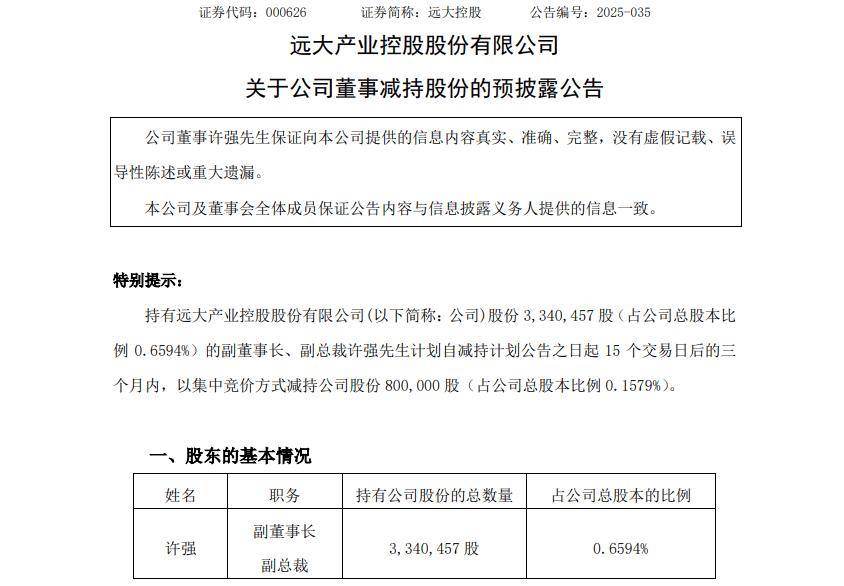
从监管警示到高管减持:远大控股扣非三连亏下,575万套现传递何种信号?
Sou Hu Cai Jing· 2025-08-11 22:05
Core Viewpoint - The announcement from Yuanda Holdings regarding the planned share reduction by Vice Chairman Xu Qiang raises concerns about the company's financial health and ongoing performance issues, particularly in light of its recent losses and the ambiguous reasoning behind the share sale [1][5][6]. Group 1: Share Reduction Details - Xu Qiang, Vice Chairman and Vice President of Yuanda Holdings, plans to reduce his holdings by 800,000 shares, representing approximately 0.1579% of the company's total share capital [1][4]. - The reduction is attributed to "personal funding certainty needs," with the shares coming from non-public offerings and equity distribution [1][5]. - If calculated at the closing price of 7.19 yuan per share on August 11, the total cashing out from this reduction could amount to approximately 5.752 million yuan [1]. Group 2: Financial Performance - Yuanda Holdings has faced continuous financial struggles, reporting net losses for two consecutive years, with a net profit loss of 302 million yuan in 2024, although this was an improvement from the previous year's loss of 377 million yuan [5][6]. - The company's revenue for 2024 was reported at 88.074 billion yuan, reflecting a slight increase of 2.1% year-on-year [5]. - The company has also reported a non-recurring net profit loss of 555 million yuan, indicating ongoing financial difficulties [5]. Group 3: Regulatory Concerns - The accuracy of Yuanda Holdings' financial data has been questioned, leading to a warning from the Jiangsu Securities Regulatory Bureau due to issues with goodwill impairment testing [6]. - The company has projected a net profit of 23 million to 34 million yuan for the first half of 2025, aiming to reverse previous losses, but still anticipates a non-recurring net profit loss of 105 million to 140 million yuan [6][7]. - The company has made adjustments to its business segments, shedding some loss-making operations, but faces uncertainty in achieving profitability amid global economic slowdowns and commodity price fluctuations [7].

潍坊安丘:赋能乡村产业,链动生态未来
Yang Shi Wang· 2025-08-11 07:36
生态农业是农业发展的重要方向,乡村振兴的重要引擎。"物美 安丘生态农业产融合作活动"8月9日在 山东潍坊安丘市举办,活动以"赋能乡村产业 链动生态未来"为主题,汇聚政府、银行、企业、科研机 构、媒体等多方力量,聚焦农业产业化升级、农产品品牌化建设、金融精准服务实体经济等核心议题, 共同探索生态农业高质量发展新路径。 近年来,安丘聚焦打造全国首个全域生态农业县,在全国率先全域推广生态种植技术和"双码"认证,生 态种植面积突破30万亩,年带动农民增收20多亿元,走出了一条模式业态更优,绿色品牌更强,生态价 值更高的农业高质量发展之路。 此次活动搭建了高规格、高水平的对话合作平台,通过深化交流、携手共进、积极探索产融合作新模 式,塑造生态农业新动能,进一步激活消费市场、促进农业增效、助力农民增收。 通过"产地直采、农超对接"模式,物美集团70%以上的生鲜产品实现源头直采。物美集团副总裁、北京 超市事业部总经理张正洋在活动中表示,此次与安丘深化合作,旨在打通"田间到餐桌"全链路,共同收 获产业兴旺、农民幸福的美好未来。 活动现场,专家学者和金融界代表就乡村振兴分享了专业见解。原国家质量监督检验检疫总局总工程师 刘兆彬 ...
奏响人与自然和谐共鸣的时代乐章
Shang Hai Zheng Quan Bao· 2025-08-10 17:40
Core Viewpoint - China is accelerating the optimization of industrial structure and promoting a comprehensive green transition in its economy and society, aiming to enhance the proportion of green low-carbon industries in the overall economy and establish a high-quality development path that prioritizes ecology, conservation, and green low-carbon practices [1] Group 1: Green Economic Transformation - Since 2012, China has supported an average economic growth of over 6.1% with an average energy consumption growth rate of 3.3%, establishing the world's largest clean power and clean steel production systems [1] - China has built the largest and fastest-growing renewable energy system globally and has created the largest carbon trading market for greenhouse gas emissions, which is operating steadily [1] Group 2: Regional Development Strategies - China has positioned regional coordinated development as a major national strategy, promoting significant regional initiatives such as the coordinated development of Beijing-Tianjin-Hebei, the Yangtze River Economic Belt, and the Guangdong-Hong Kong-Macao Greater Bay Area [1] Group 3: Green Lifestyle Promotion - The concept of a green lifestyle emphasizing simplicity, moderation, and health is gaining popularity across China, with various regions adopting green consumption practices [1] Group 4: Economic Models for Ecological Protection - The report outlines three economic transformation paths: "Protecting Green for Wealth," "Gathering Green for Wealth," and "Borrowing Green for Wealth," which have led to various successful practices and development models over the past 20 years [2] - "Protecting Green for Wealth" focuses on ecological protection and restoration as a prerequisite for economic returns through government-led compensation and policy incentives [2] - "Gathering Green for Wealth" emphasizes the development of green industries through technological innovation and brand building, transforming ecological resources into sustainable economic models [2] - "Borrowing Green for Wealth" promotes the development of green markets and finance, facilitating the market circulation of ecological resources [2] Group 5: Green Finance Development - China has established a multi-level green finance product and market system, leading the world in green credit and green bond issuance [3] Group 6: Global Ecological Civilization Contribution - The concept of "Green Mountains and Clear Water are Gold and Silver Mountains" serves as a guiding principle for global ecological civilization, addressing deep-seated contradictions in development and protection [4][5] - China actively participates in global climate governance, providing stability and support for developing countries in addressing climate change [5][6] - In 2024, China is expected to contribute the largest share of the 585 GW of new global renewable energy capacity, significantly reducing the costs of wind and solar power generation [6]
20年“灰山”变“青山” 老乡村“长”出新业态
Yang Shi Xin Wen Ke Hu Duan· 2025-08-10 12:22
Core Viewpoint - The article emphasizes the transformation of Yucun village from a resource-extraction economy to a sustainable, eco-friendly tourism and agriculture model, driven by the philosophy of "Lucid waters and lush mountains are invaluable assets" proposed by Xi Jinping in 2005 [1][29]. Group 1: Historical Context - Yucun village previously relied on mining, leading to severe environmental degradation, with villagers recalling the pollution and health issues caused by mining activities [4][12][22]. - The village's economy thrived on mining, making it a wealthy community, but at the cost of ecological health and quality of life [8][22]. Group 2: Transformation Journey - The villagers recognized the need for change, leading to the closure of mines and factories, and the initiation of environmental restoration projects [21][25]. - Yucun has transitioned from selling stones to selling scenic beauty, focusing on ecological agriculture, eco-tourism, and sustainable economic practices [16][29]. Group 3: Current Developments - In 2024, Yucun attracted 1.22 million tourists, generating over 60 million yuan in tourism revenue, with per capita disposable income rising from over 8,000 yuan in 2005 to 74,000 yuan [29]. - The village has become a hub for new residents and entrepreneurs, fostering innovation and new business models in areas like cycling tourism and digital economy [33][38]. Group 4: Future Prospects - Yucun aims to continue attracting talent and investment by promoting its natural beauty and sustainable practices, with over 1,200 new villagers contributing to the local economy [38][45]. - The village's transformation is seen as a model for rural revitalization, balancing ecological preservation with economic development [46].
薄弱村变身富裕村
Jin Rong Shi Bao· 2025-08-08 07:55
Core Viewpoint - The transformation of Yishao Village from an economically weak area with environmental issues to a thriving tourist destination is largely attributed to the financial support from Wuxing Rural Commercial Bank, which has facilitated significant improvements in infrastructure and local economy [1][2][3] Group 1: Financial Support and Economic Development - Wuxing Rural Commercial Bank provided loans totaling 10 million yuan for the renovation and enhancement of Yishao Village, focusing on environmental cleanup, waste management, transportation, energy, and cultural facilities [1] - The village's operating income reached 3.08 million yuan in 2024, with per capita disposable income increasing to 45,000 yuan, reflecting several times growth compared to previous levels [1] Group 2: Environmental and Cultural Transformation - Yishao Village has been recognized with multiple honors, including "National 3A Scenic Village" and "National 4A Scenic Area," attracting more tourists and revitalizing local culture and economy [3] - The village has developed a new model of integrated development, combining agriculture and tourism, enhancing the utilization of nearly 2,000 acres of arable land [1][3] Group 3: Community Services and Future Plans - Wuxing Rural Commercial Bank established a "Harvest Station" in Yishao Village to provide convenient financial services, including money transfers and bill payments, aiming to enhance community welfare [3] - Future plans include expanding services at the Harvest Station to include parcel delivery and convenience stores, further supporting rural revitalization efforts [3]