脑机接口

Search documents
新华视点|变革与创新:中国基层高质量发展新图景
Xin Hua Wang· 2025-11-14 08:39
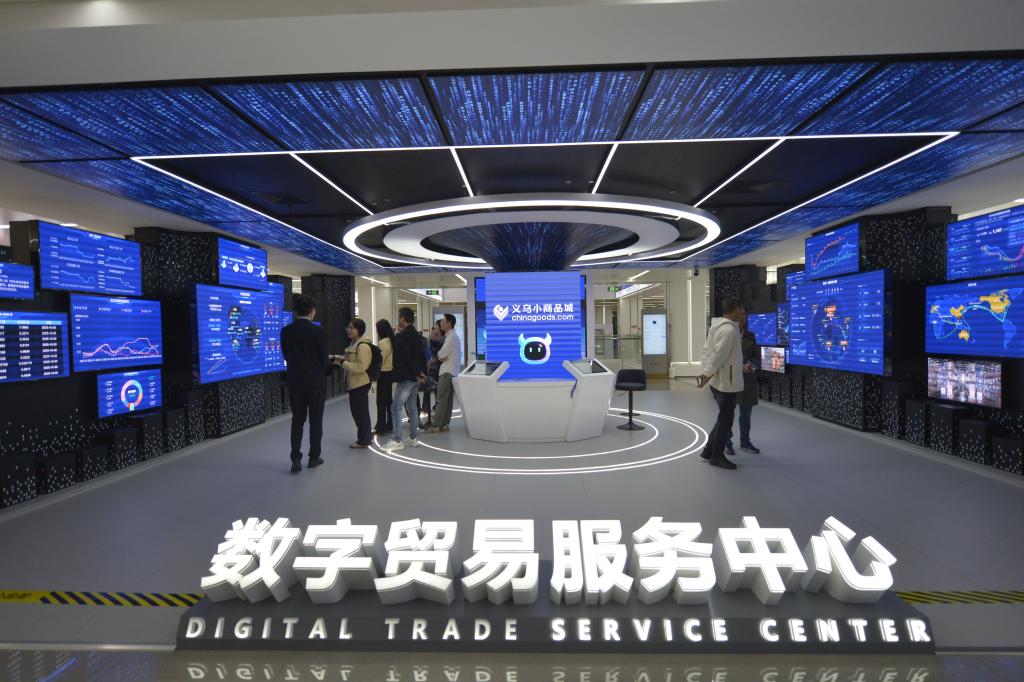
Group 1 - The core viewpoint highlights the transformation of traditional trade models to digital trade ecosystems, exemplified by the launch of the sixth-generation global digital trade center in Yiwu, Zhejiang [2][4] - The global digital trade center spans 1.25 million square meters and includes five functional areas: market, business office, commercial street, apartments, and digital trade port [6] - Yiwu's foreign trade has shown significant growth, with total imports and exports reaching 631.2 billion yuan in the first three quarters of the year, a year-on-year increase of 26.3% [11] Group 2 - The coffee industry in Kunshan has developed a robust ecosystem, accounting for 60% of China's coffee bean roasting volume and over 60% of bean imports, despite not producing raw beans [17][19] - Kunshan has established an Asia-Pacific coffee bean distribution center, which allows for rapid inspection of 90% of imported coffee beans, reducing inspection time by two-thirds [21] - The city aims to build an international coffee industry hub, targeting a scale of 100 billion yuan for its coffee industry and promoting a "coffee+" cultural brand matrix [23]

脑机接口行业深度报告:脑科学产业与政策趋势共振
China Post Securities· 2025-11-14 08:35
Investment Rating - The report maintains an investment rating of "Outperform" for the brain-computer interface (BCI) industry [1] Core Insights - Continuous policy support is evident, with the Ministry of Industry and Information Technology and six other departments releasing implementation opinions to promote BCI innovation [2] - Significant technological and clinical breakthroughs have been achieved, including China's first invasive clinical trial for BCI technology [2] - The global BCI market is projected to exceed $10 billion, with a compound annual growth rate (CAGR) of over 13% from 2019 to 2023 [2] Summary by Sections What is Brain-Computer Interface? - BCI is defined as a communication system that establishes a direct connection between the brain and external devices, enabling interaction through brain wave recognition [7][10] - The technology is expected to revolutionize medical rehabilitation, assistive communication, and intelligent control [7] Why is BCI at a Critical Turning Point for Industrialization? - Policy support has intensified, with a clear roadmap for BCI standardization and development outlined by various government bodies [35][41] - The industry is expected to see significant advancements in technology and clinical applications, with a focus on creating a robust ecosystem by 2030 [35][46] Investment Recommendations - Companies to watch include Sanbo Brain Science, Zhongke Information, Entropy Technology, and Yanshan Technology, which are involved in clinical applications or product development [2]
【图解】权威解读|一图秒懂“十五五”规划建议核心热词
Zhong Guo Jing Ji Wang· 2025-11-14 03:26
Core Viewpoint - The article emphasizes the importance of achieving a moderate level of development for China by 2035, with a focus on enhancing GDP and fostering emerging industries to adapt to global economic changes [2][5][14]. Group 1: Economic Development Goals - The target is to exceed the threshold of $20,000 in per capita GDP by 2020 standards and to double the per capita GDP by 2035 compared to 2020 levels [2]. - Achieving a moderate level of development is seen as crucial for China's economic strategy moving forward [2]. Group 2: Emerging Industries - The "14th Five-Year Plan" aims to develop new pillar industries such as renewable energy, new materials, aerospace, and low-altitude economy [5]. - There is a call for a focus on key areas like quantum technology, biomanufacturing, hydrogen energy, and sixth-generation mobile communication to drive future industrial growth [6]. Group 3: Regional Innovation Systems - The establishment of regional innovation systems is essential, involving collaboration among government, enterprises, universities, and research institutions to enhance innovation capabilities [9]. - A tailored approach based on local resources and industrial foundations is recommended to prevent market bubbles and ensure sustainable development [6]. Group 4: Investment Strategies - Investment in physical assets (infrastructure, buildings, machinery) is crucial for solidifying the material and technical foundation for economic development [10]. - Investment in human capital (education, healthcare, skills training) is equally important for enhancing the capabilities and potential of the population [10]. Group 5: Digital Trade - Digital trade, characterized by data as a key production factor and digital services, is rapidly growing and is identified as a new trend in international trade and economic growth [12]. Group 6: Energy Strategy - Building an energy powerhouse is highlighted as a significant goal, with energy security being critical for national stability and development [13][14]. - The transition to green and low-carbon energy sources is emphasized as a timely and necessary step in the current global context [14].

脑机接口“上海方案”捷报频传 阶梯医疗相关产品率先进入国家药监局“绿色通道” 波达医疗相关技术有望推向临床
Jie Fang Ri Bao· 2025-11-14 01:40
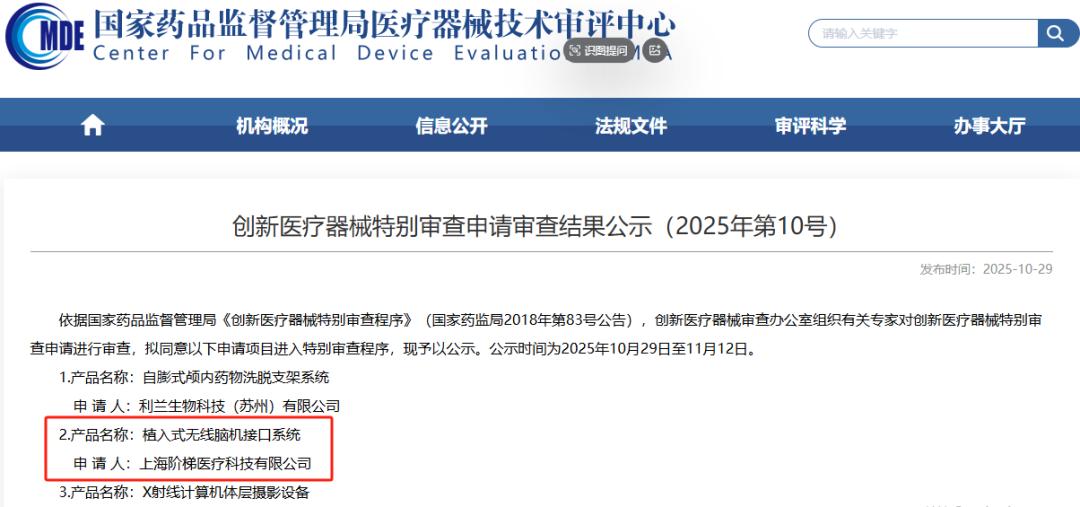
Core Insights - Two brain-computer interface (BCI) companies in Shanghai have made significant advancements in their research, with one company, JieTi Medical, having its "implantable wireless brain-computer interface system" enter the special review process of the National Medical Products Administration, marking it as the first invasive BCI product to enter the "green channel" in China [1] - The other company, Boda Medical, is developing an "ultrasound brain-computer interface" that aims to achieve high spatiotemporal resolution for comprehensive brain function analysis [1] Company Developments - JieTi Medical has invented ultra-flexible electrodes that are 1/100th the diameter of a human hair, significantly reducing the risk of tissue damage and immune response when implanted in the brain [1] - JieTi Medical is collaborating with Huashan Hospital for prospective clinical trials, which have shown initial success in restoring some self-care abilities in patients [1] - Boda Medical's founder introduced a new ultrasound technology with a frame rate of 10,000 frames per second, which surpasses traditional imaging techniques like fMRI and PET in sensitivity [2] - Boda Medical has developed an ultrasound brain blood flow imaging system that is currently being used in clinical settings, showing promising results [2] Industry Trends - The brain-computer interface sector is identified as a key future industry in China, gaining global attention since the establishment of Neuralink by Elon Musk in 2016 [1] - The advancements in BCI technology are expected to facilitate broader applications in areas such as motor and language function replacement, treatment of neurological diseases, and sensory restoration [2] - The 2025 "Innovation in Shanghai" international entrepreneurship competition aims to attract investment for the development of hard-tech startups, including Boda Medical's ultrasound BCI technology [4]
国内首次,侵入式脑机产品进审批“绿色通道”
3 6 Ke· 2025-11-13 02:10
Core Insights - The article highlights the significant potential of new materials and flexible electrodes in China, particularly in the field of brain-computer interfaces (BCIs) [1][7] - The approval of the first invasive brain-computer interface product by Shanghai Ladder Medical Technology Co., Ltd. marks a milestone in the domestic medical device industry [1][4] Industry Overview - The innovative medical device special review procedure established by the National Medical Products Administration (NMPA) aims to encourage innovation in medical devices, providing expedited review for products with core technology patents and significant clinical value [2][3] - The invasive brain-computer interface technology requires surgical implantation, which presents higher technical barriers and risks but offers higher quality and precision in neural signal acquisition compared to non-invasive methods [3][4] Company Developments - Shanghai Ladder Medical, founded in 2021, focuses on the development of implantable brain-computer interface technology and has recently completed a 350 million yuan Series B financing round [3][4] - The company's ultra-flexible electrode technology allows for minimally invasive implantation, significantly reducing the risk of tissue damage and immune response [4][6] Clinical Progress - Ladder Medical has initiated clinical trials, with a recent case demonstrating a participant controlling a computer cursor using thought after undergoing the brain-computer interface implantation [6][8] - The company is now the second globally, after Neuralink, to enter the clinical phase of invasive brain-computer interfaces [6][8] Market Potential - The global brain-computer interface market is projected to grow from approximately $2.62 billion in 2024 to $12.4 billion by 2034, with a compound annual growth rate of 17.35% [8] - The Chinese brain-computer interface market is expected to expand from 3.2 billion yuan in 2024 to 6.14 billion yuan by 2028, indicating strong growth potential in the sector [8] Regulatory Environment - Recent policy developments, including the establishment of industry standards for brain-computer interface medical devices, are expected to facilitate faster market entry for approved products [7][8] - The NMPA's new standards for brain-computer interface terminology will take effect on January 1, 2026, marking a significant step in regulatory clarity for the industry [7][8]
脑机接口产业化加速,全产业链核心标的梳理
Xin Lang Cai Jing· 2025-11-12 13:16
Industry Background - The brain-computer interface (BCI) industry is entering a commercialization phase in 2025, driven by policy support and technological breakthroughs. The Ministry of Industry and Information Technology (MIIT) and other departments have set a goal for key technological breakthroughs by 2027 and the establishment of an industrial system [1] - The National Medical Insurance Administration has added pricing items for BCI implantation and adaptation fees, accelerating clinical applications and charging [1] - Domestic companies are making significant progress, with Shanghai Ladder Medical's implantable wireless BCI system becoming the first to enter the NMPA's green channel for innovative medical devices [1] - Global competition includes Neuralink's plan to launch a Telepathy device by 2029, but domestic companies have achieved technological advantages in certain areas, such as Yanshan Technology's 60ms ultra-low latency control performance [1] Industry Chain Overview - The BCI industry chain consists of three main segments: upstream (electrodes/chips), midstream (EEG processing devices), and downstream (application scenarios), each with distinct technological barriers and commercialization rhythms [3] - Upstream components, particularly implantable and non-invasive electrodes/chips, are critical for signal precision and stability, representing the core competitiveness of the industry [3] Upstream Segment - Implantable electrodes/chips are essential for medical applications, with companies like Gaode Infrared developing flexible tactile sensors that reduce immune rejection and extend signal collection duration [4] - Weisi Medical focuses on optimizing biocompatibility for its microelectrode arrays, which have entered clinical validation for precise localization in epilepsy [4] - Non-invasive chips serve as entry points for consumer applications, with companies like Xiangyu Medical developing multi-modal EEG acquisition devices for rehabilitation [7] Midstream Segment - The midstream segment is responsible for EEG signal acquisition, analysis, and transmission, with a focus on low latency (under 60ms) and multi-modal integration [9] - Companies like iFlytek have achieved a 92% accuracy rate in emotion recognition from EEG signals, indicating significant algorithmic advantages [10] - Yanshan Technology has achieved ultra-low latency control performance, surpassing early versions of Neuralink [11] Downstream Segment - The downstream applications are driven by both medical and consumer sectors, with a focus on epilepsy, Parkinson's disease, and gaming [13] - Medical rehabilitation is a high-demand area supported by policies, with companies like Aipeng Medical developing EEG acquisition devices and achieving a net profit margin of approximately 15% [14] - Consumer applications include gaming and smart home technologies, with companies like Tom Cat integrating BCI into AI games to develop mind-control products [16]
国产侵入式脑机接口进入审评“绿色通道” 资本竞逐前沿医疗蓝海
Zheng Quan Ri Bao Wang· 2025-11-12 12:47
Core Insights - Shanghai Ladder Medical Technology Co., Ltd.'s "Implantable Wireless Brain-Computer Interface System" has entered the special review process of the National Medical Products Administration (NMPA), marking a significant step in the commercialization of invasive brain-computer interface products in China [1] Group 1: Industry Breakthroughs - The invasive brain-computer interface (BCI) technology is seen as a revolutionary method for human-computer interaction, with invasive products offering more precise signal transmission due to direct implantation into the brain cortex [2] - The implementation of the "green channel" significantly shortens the product review cycle from 3-5 years to an expected 1-2 years, which is crucial for rapidly evolving technologies [2] Group 2: Industry Chain Development - China's BCI industry chain has been continuously improving, with a complete chain covering upstream materials, chips, electrodes, midstream signal collection and processing, and downstream medical health and consumer markets [3] - Progress in upstream areas, such as biocompatible materials and low-power chips, supports performance improvements in midstream and downstream products, with clear commercialization paths in the medical field [3] Group 3: Market Growth and Investment - The global BCI market in medical applications is projected to reach $40 billion by 2030 and exceed $145 billion by 2040 [3] - In China, the BCI market is expected to reach 3.203 billion yuan in 2024, with a year-on-year growth of 18.81%, and is forecasted to reach 3.830 billion yuan in 2025 [3] Group 4: Capital Market Dynamics - The BCI industry has seen an annualized financing growth rate of over 30% from 2018 to 2024, with 20 new financing events in just the third quarter of 2025 [4] - Continuous capital influx is expected to accelerate technology transformation and industry consolidation, with the industry still in its early stages and exploring technical routes and business models [4] Group 5: Clinical Applications and Challenges - Clinical trials, such as those conducted by Fujian Sanbo Neurosurgery Hospital, have successfully demonstrated the feasibility of domestic technology in clinical settings [4] - There is a need for a mature standard system for long-term biocompatibility and signal stability assessments, which is a core issue that needs to be addressed in the BCI field [5]
【明日主题前瞻】年产1000万台!特斯拉准备扩建Optimus人形机器人产能
Xin Lang Cai Jing· 2025-11-12 12:10
Group 1: Tesla and Robotics - Tesla is preparing to expand its Texas Gigafactory to produce 10 million units of the Optimus humanoid robot annually, with mass production scheduled to start in 2027 [1] - The Fremont factory is currently producing a limited number of Optimus prototypes, with an expected annual capacity of 1 million units [1] Group 2: Lithium Iron Phosphate (LFP) Market - The price of lithium iron phosphate has reached approximately 37,000 to 38,000 CNY per ton, with a reported production of 399,700 tons in October, reflecting an 11.5% month-over-month increase [2][3] - Major LFP manufacturers are operating at nearly full capacity, with a utilization rate of 75.9% in October, up 2.5 percentage points from the previous month [2] Group 3: AI and Storage Demand - The demand for storage solutions is surging due to AI applications, leading to significant price increases in DRAM and NAND flash memory products [4] - NAND flash prices have risen by 17.1% recently, with expectations of continued price increases into the next quarter due to supply constraints [4] Group 4: Solid-State Battery Development - The solid-state battery industry is accelerating, with mass production expected to begin in 2027 and full-scale production by 2030, driven by policy support and emerging market demands [6] - The global market for solid-state battery equipment is projected to reach 32.06 billion CNY by 2030 [6] Group 5: Brain-Computer Interface Innovations - The brain-computer interface market is expanding, with the first invasive product entering the special review process in China, indicating significant advancements in the field [8] - The global brain-computer interface market is expected to grow from approximately 2.62 billion USD in 2024 to 12.4 billion USD by 2034 [8] Group 6: Dairy Industry Trends - The popularity of traditional snacks like "milk skin" has surged, leading to long queues and high demand, reflecting a successful blend of traditional food with modern marketing [10] - Companies in the dairy sector are adapting to consumer trends, with innovations driving revenue and profit growth [10][11] Group 7: Chemical New Materials Sector - The People's Bank of China emphasizes that financial empowerment and technological innovation will help the chemical new materials industry transition to a high-performance, green, and intelligent development phase [12] - The market for high-performance materials is expected to grow, particularly in aerospace and electronic information sectors [12]


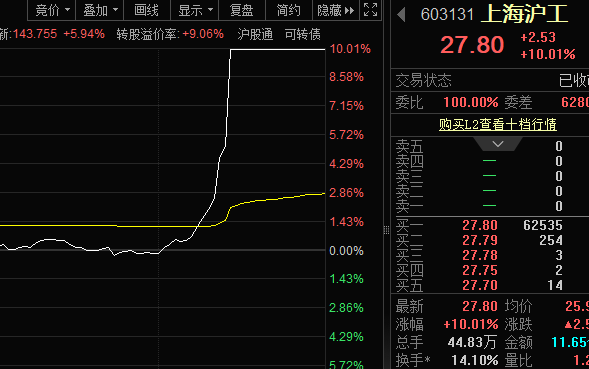
利好将近,603131、605598,尾盘直线涨停!脑机接口市场准入迎突破,资金抢筹股出炉
Zheng Quan Shi Bao· 2025-11-12 10:35
Group 1: Commercial Aerospace Sector - Several commercial aerospace stocks surged in late trading on November 12, with Shanghai Huguang and Shanghai Gangwan hitting the daily limit, and Aerospace Zhizhuang rising by 16.57% [1][3] - The 27th High-Tech Fair will take place from November 14 to 16, where the China Aerospace Science and Technology Corporation will globally launch the Chinese space tourism project [3] - The domestic commercial aerospace sector is entering a busy launch window, with four rocket launches completed in just two days from November 9 to 10 [3] - The number of commercial aerospace companies in China has exceeded 500, and the industry is expected to surpass 2.5 trillion yuan by 2025 [3] - The market size of China's commercial aerospace sector has grown from approximately 0.38 trillion yuan in 2015 to an estimated 2.3 trillion yuan in 2024, with a compound annual growth rate of about 22% [3] Group 2: Brain-Computer Interface Sector - The brain-computer interface index rose by 1.07% on November 12, with notable gains from Taihe Technology and Aipeng Medical, which increased by 8.74% and 8.21% respectively [4] - Shanghai Ladder Medical Technology's "Implantable Wireless Brain-Computer Interface System" has entered the special review process for innovative medical devices, marking a significant step in the commercialization of this technology in China [4][7] - A new industry standard for brain-computer interface medical devices will be implemented starting January 1, 2026, following approval from the National Medical Products Administration [7] - The domestic market for brain-computer interfaces is projected to reach 3.2 billion yuan by 2024 and grow to 6.14 billion yuan by 2028 [7] - Significant net buying of brain-computer interface stocks has been observed in Q4, with Keda Xunfei and Innovation Medical leading with net purchases exceeding 100 million yuan [8][10]

A股收评:三大指数小幅下跌,培育钻石板块回撤,免疫治疗概念逆市爆发
Ge Long Hui· 2025-11-12 07:06
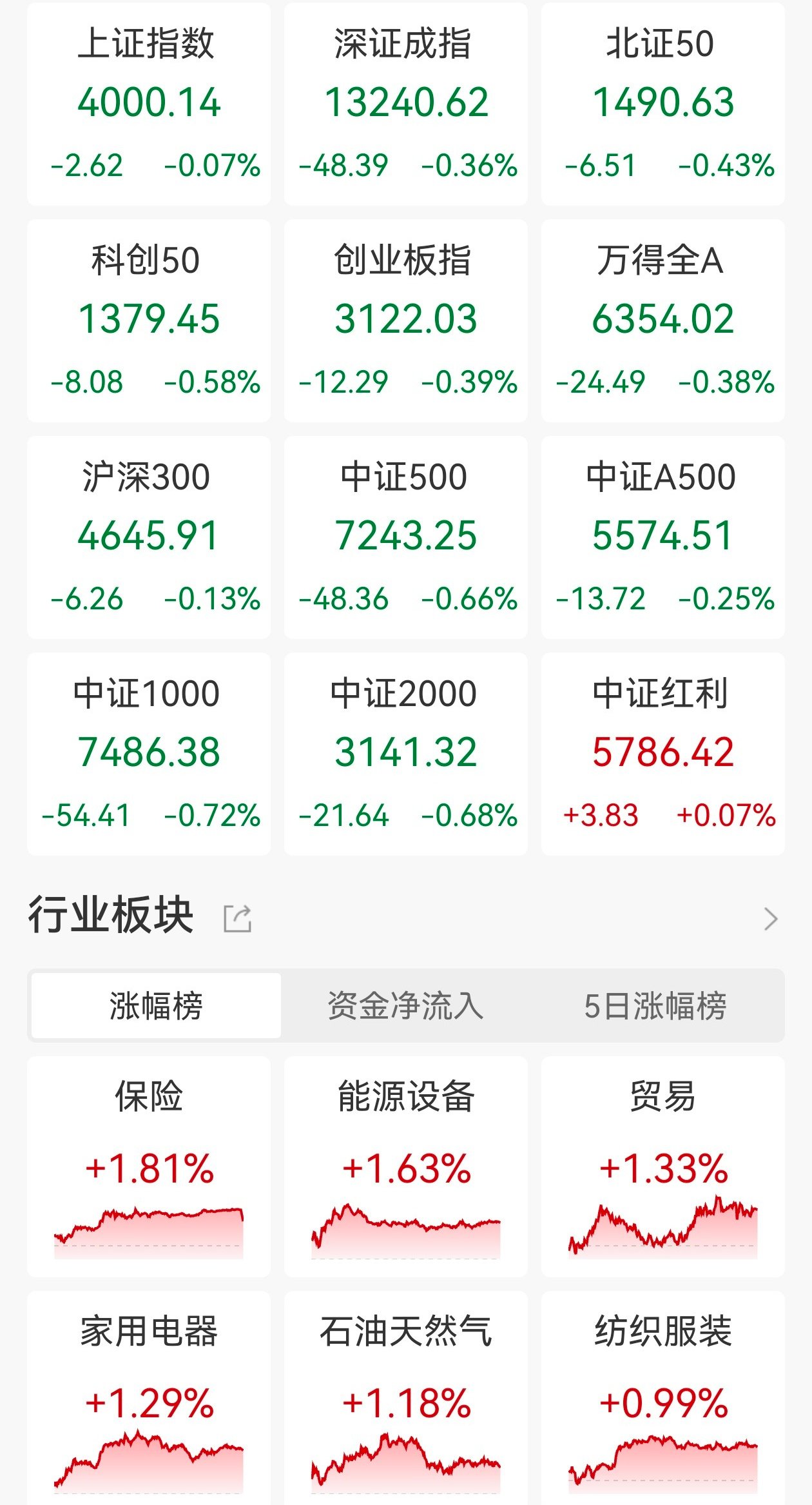
Market Overview - The three major A-share indices experienced a decline in early trading, with the Shanghai Composite Index closing down 0.07% at 4000 points, the Shenzhen Component Index down 0.36%, and the ChiNext Index down 0.39% [1] - The total market turnover was 1.96 trillion yuan, a decrease of 49.1 billion yuan compared to the previous trading day, with over 3500 stocks declining [1] Sector Performance - The cultivated diamond sector saw a significant pullback, with World falling over 11% [1] - The photovoltaic equipment sector also declined, with Aters falling over 14% [1] - The controllable nuclear fusion sector dropped, with Hailu Heavy Industry hitting the daily limit down [1] - The superconducting concept weakened, with Guolan Testing leading the decline [1] - Other sectors with notable declines included BC batteries, non-metallic materials, virtual power plants, and power equipment [1] Gaining Sectors - The immunotherapy concept surged, with multiple stocks such as Zhongyuan Qihua and Kaineng Health hitting the daily limit up [1] - Oil and gas stocks rallied, with PetroChina hitting the daily limit up [1] - The brain-computer interface sector was active, with Taihe Technology rising over 8% [1] - Other sectors with notable gains included pharmaceutical commerce, insurance, recombinant proteins, and medical devices [1] Index Performance - Shanghai Composite Index: 4000.14, down 2.62 points (-0.07%) [1] - Shenzhen Component Index: 13240.62, down 48.39 points (-0.36%) [1] - ChiNext Index: 3122.03, down 12.29 points (-0.39%) [1] - Other indices such as the CSI 300 and CSI 500 also showed declines [1]