
高技术制造业

Search documents
4月份制造业PMI公布 企业生产经营总体稳定
news flash· 2025-04-30 01:39
Core Insights - The manufacturing purchasing managers' index (PMI) in April decreased to 49%, a decline of 1.5 percentage points from the previous month, indicating a contraction in the manufacturing sector [1] - Despite the overall decline in the PMI, high-tech manufacturing industries continue to expand, suggesting resilience in specific sectors [1] - Manufacturing enterprises that focus on domestic sales are maintaining stable production and operations, reflecting a degree of stability in the industry [1]
国家统计局:制造业PMI有所回落
Guo Jia Tong Ji Ju· 2025-04-30 01:37
Group 1: Manufacturing PMI Insights - The manufacturing purchasing managers' index (PMI) decreased to 49.0% in April, down 1.5 percentage points from the previous month, falling below the critical point [2][6] - Both production index and new orders index showed a decline, recorded at 49.8% and 49.2% respectively, down 2.8 and 2.6 percentage points from last month, indicating a slowdown in manufacturing production and market demand [2][3] - High-tech manufacturing PMI remained strong at 51.5%, significantly above the overall manufacturing level, with both production and new orders indices above 52.0% [3] Group 2: Non-Manufacturing PMI Insights - The non-manufacturing business activity index stood at 50.4%, a decrease of 0.4 percentage points from the previous month, but still indicating expansion [4][6] - The service sector's business activity index was 50.1%, down 0.2 percentage points, with certain industries like air transport and telecommunications showing strong growth [4] - The construction sector maintained expansion with a business activity index of 51.9%, despite a decline of 1.5 percentage points, and civil engineering construction saw an increase to 60.9% [4] Group 3: Comprehensive PMI Insights - The comprehensive PMI output index was recorded at 50.2%, down 1.2 percentage points from the previous month, yet still above the critical point, indicating overall expansion in production activities [5][6] - The manufacturing production index and non-manufacturing business activity index contributed to the comprehensive PMI, at 49.8% and 50.4% respectively [6] - The overall economic output has been expanding since January 2023, despite external environmental changes impacting the manufacturing PMI [6]
国家统计局服务业调查中心高级统计师赵庆河解读2025年4月中国采购经理指数
Guo Jia Tong Ji Ju· 2025-04-30 01:35
(二)高技术制造业持续向好。从重点行业看,高技术制造业PMI为51.5%,明显高于制造业总体水平, 其生产指数和新订单指数均位于52.0%及以上,高技术制造业延续较好发展态势。装备制造业、消费品 行业和高耗能行业PMI分别为49.6%、49.4%和47.7%,比上月下降2.4、0.6和1.6个百分点,景气水平不 同程度回落。 (三)价格指数有所下降。受市场需求不足和近期部分大宗商品价格持续下行等因素影响,主要原材料购 进价格指数和出厂价格指数分别为47.0%和44.8%,比上月下降2.8和3.1个百分点,制造业市场价格总体 水平有所下降。 4月份制造业采购经理指数有所回落 非制造业商务活动指数继续保持扩张 ——国家统计局服务业调查中心高级统计师赵庆河解读2025年4月中国采购经理指数 2025年4月30日国家统计局服务业调查中心和中国物流与采购联合会发布了中国采购经理指数。对此, 国家统计局服务业调查中心高级统计师赵庆河进行了解读。 4月份,制造业采购经理指数为49.0%,比上月下降1.5个百分点;非制造业商务活动指数和综合PMI产 出指数分别为50.4%和50.2%,继续保持在扩张区间。 一、制造业采购经理 ...
4月份中国制造业采购经理指数为49% 企业生产经营总体稳定
news flash· 2025-04-30 01:33
Core Viewpoint - In April, China's manufacturing Purchasing Managers' Index (PMI) decreased to 49%, reflecting a decline of 1.5 percentage points from the previous month, influenced by rapid changes in the external environment, while high-tech manufacturing sectors continued to expand [1] Group 1: Manufacturing PMI - The overall manufacturing PMI for April is reported at 49%, indicating a contraction in the manufacturing sector [1] - The decline in the manufacturing PMI is attributed to external environmental changes [1] Group 2: High-Tech Manufacturing - The high-tech manufacturing PMI stands at 51.5%, significantly above the overall manufacturing level, indicating a sustained positive development trend [1] - The demand in the new momentum market remains stable with an overall increase [1] Group 3: Consumer Goods Manufacturing - The new orders index for consumer goods manufacturing is at the critical point of 50%, suggesting a good release of domestic market demand [1] Group 4: Business Expectations - The production and business activity expectation index for April is at 52.1%, remaining in the expansion zone [1]
受前期制造业较快增长形成较高基数叠加外部环境急剧变化等因素影响,制造业PMI为回落至临界点以下
news flash· 2025-04-30 01:33
金十数据4月30日讯,国家统计局服务业调查中心高级统计师赵庆河解读2025年4月中国采购经理指数。 4月份,受前期制造业较快增长形成较高基数叠加外部环境急剧变化等因素影响,制造业PMI为49.0%, 回落至临界点以下。从重点行业看,高技术制造业PMI为51.5%,明显高于制造业总体水平,其生产指 数和新订单指数均位于52.0%及以上,高技术制造业延续较好发展态势。装备制造业、消费品行业和高 耗能行业PMI分别为49.6%、49.4%和47.7%,比上月下降2.4、0.6和1.6个百分点,景气水平不同程度回 落。 受前期制造业较快增长形成较高基数叠加外部环境急剧变化等因素影响,制造业PMI为回落至临界点以 下 相关链接 ...
安徽领跑长三角一季报,做对了什么?
2 1 Shi Ji Jing Ji Bao Dao· 2025-04-29 09:09
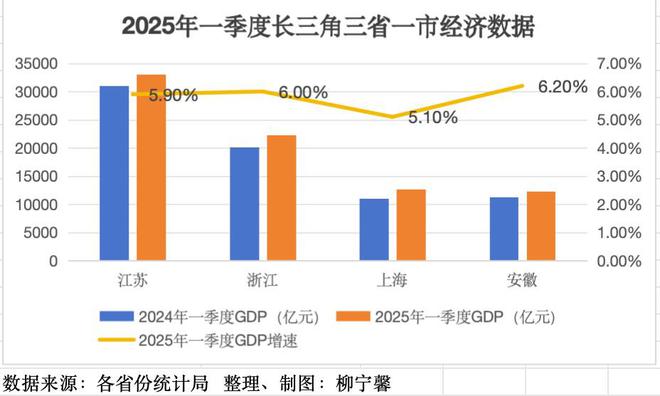
Economic Overview - The Yangtze River Delta (YRD) region achieved a GDP of 80,388.66 billion yuan in Q1, accounting for 25.22% of the national GDP, with an increase of 6,839.2 billion yuan compared to the same period last year [1] - By province, Jiangsu's GDP was 33,088.6 billion yuan (5.9% growth), Zhejiang's was 22,300 billion yuan (6.0% growth), Shanghai's was 12,735.06 billion yuan (5.1% growth), and Anhui's was 12,265 billion yuan (6.2% growth) [1] Industrial Growth - High-tech manufacturing is a key driver of economic growth in the YRD, with Anhui leading in industrial value-added growth at 9.2%, followed by Zhejiang (8.9%), Jiangsu (8.2%), and Shanghai (3.7%) [5] - In Q1, the high-tech manufacturing sector in Jiangsu saw a significant increase, with high-tech industries accounting for 51.4% of the province's industrial output [6] - Anhui's high-tech manufacturing value-added grew by 20.1%, with notable growth in the automotive sector, particularly in new energy vehicles [8] Foreign Trade Performance - The YRD's total import and export volume reached 38.7 trillion yuan in Q1, representing 37.6% of the national total, with Zhejiang contributing 12.9 trillion yuan and a growth rate of 7.3% [4] - Export growth rates for Anhui, Shanghai, Zhejiang, and Jiangsu were 17.3%, 12.6%, 11.1%, and 9.6%, respectively [4] Consumption Trends - Consumption growth varied across provinces, with Anhui (5.8%) and Jiangsu (5.6%) showing positive growth, while Shanghai experienced a decline of 1.1% in retail sales [10] - The YRD is focusing on boosting consumption in Q2, with various provinces implementing specific measures to stimulate consumer spending [12][13] Strategic Development - Experts suggest that the YRD should leverage its integrated development strategy to enhance regional cooperation and optimize the industrial structure, particularly in high-tech sectors [3][7] - There is a call for strengthening links with RCEP countries and enhancing the domestic unified market to drive further economic growth [3]

武汉一季度工业机器人产量增长达1.2倍
Chang Jiang Ri Bao· 2025-04-29 07:52
Economic Overview - Wuhan's GDP for Q1 reached 475.941 billion yuan, showing a year-on-year growth of 5.4% at constant prices [1] - The primary industry added value was 8.163 billion yuan, growing by 4.5%; the secondary industry added value was 168.832 billion yuan, growing by 2.8%; the tertiary industry added value was 298.946 billion yuan, growing by 6.9% [1] Sector Performance - Agricultural production is stable with major agricultural products showing steady growth; industrial production is recovering, with high-tech manufacturing value-added increasing by 20.1% [1] - Production of lithium-ion batteries, medical instruments, and industrial robots saw year-on-year increases of 148.7%, 131.1%, and 122.5% respectively [1] - The service sector is performing well, with all ten major industry categories achieving growth, particularly in leasing, business services, and scientific research, which maintained double-digit growth [1] Investment and Consumption - Fixed asset investment in Wuhan grew by 5.0% year-on-year, with high-tech industry investment increasing by 19.6% and private investment rising by 7.6% [2] - Retail sales of consumer goods totaled 241.021 billion yuan, up 7.3% year-on-year, with a significant increase in smart wearable device sales, which grew by 160% [2] - The total import and export volume reached 94.97 billion yuan, reflecting a year-on-year growth of 17.8% [2] Consumer and Employment Indicators - The Consumer Price Index (CPI) in Wuhan rose by 0.2% year-on-year, indicating moderate inflation [2] - Per capita disposable income for residents was 17,471 yuan, a 4.9% increase year-on-year, with the income gap between urban and rural residents narrowing [2] - Employment conditions remain generally stable, contributing to the overall economic stability [2] Future Outlook - The statistical authorities emphasize the need to consolidate the foundation for economic recovery amid a complex external environment, aiming for a strong performance in Q2 to achieve annual economic and social development goals [2]

西安市第五次全国经济普查顺利完成
Xi An Ri Bao· 2025-04-29 03:45
Core Insights - The fifth national economic census in Xi'an reveals significant growth in the number of legal entities engaged in the secondary and tertiary industries, with a total of 470,800 units by the end of 2023, marking a 91.1% increase compared to the end of 2018 [1][2] Group 1: Legal Entities and Employment - By the end of 2023, the number of legal entities in the secondary and tertiary industries reached 470,800, an increase of 224,500 units, or 91.1% from 2018 [1] - The number of individual business operators reached 651,300, an increase of 118,600, or 22.3% [1] - Employment in the secondary and tertiary industries totaled 5.2973 million, an increase of 1.2681 million, or 31.5% since 2018 [2] Group 2: Industry Breakdown - The top three industries in terms of legal entities in the secondary and tertiary sectors are wholesale and retail (127,800 units, 27.2%), construction (86,200 units, 18.3%), and rental and business services (71,700 units, 15.2%) [1] - In individual business operators, the leading sectors are wholesale and retail (285,900 units, 43.9%), accommodation and catering (120,800 units, 18.6%), and information transmission, software, and IT services (63,100 units, 9.7%) [2] Group 3: High-Tech and Digital Economy - The number of legal entities in the information transmission, software, and IT services sector grew by 155.4% to 39,824 units, with employment increasing by 58.6% to 325,357 [3] - The high-tech manufacturing sector saw a 68.9% increase in legal entities, totaling 500, which represents 27.4% of all large-scale manufacturing entities [4] - The digital economy core industry had 45,903 legal entities, generating an annual revenue of 655.57 billion, with digital product manufacturing accounting for 54.7% of this revenue [6]
透视四川民营经济一季度“成绩单” 投资回暖主体扩容,5.6%的增速“很难得”
Si Chuan Ri Bao· 2025-04-29 00:24
Core Insights - The private economy in Sichuan reported a first-quarter value added of 842.56 billion yuan, growing by 5.6% year-on-year, maintaining a trend of surpassing the provincial GDP growth rate since last year [1] Group 1: Private Investment Growth - In the first quarter, private investment in Sichuan increased by 3.6%, outperforming the provincial growth rate of 4.9 percentage points from 2024 and the national growth rate of 3.2% [2][6] - The recovery in private investment reflects a combination of policy support and restored market confidence, reversing a trend of negative growth in recent years [6] - The significant increase in private investment is attributed to the rise of new industries and manufacturing investments, which have mitigated pressures from the real estate sector [6][7] Group 2: Business Entities and Market Activity - As of the end of the first quarter, Sichuan had 8.9818 million private business entities, an increase of 48,800 from the end of 2024, representing a 97.1% market share [5][8] - The number of newly registered private enterprises reached 83,600 in the first quarter, marking a year-on-year growth of 23.96% [9] - The growth in business entities is supported by policies that simplify registration processes and provide tax reductions and entrepreneurial subsidies [9] Group 3: Financing Environment - By the end of the first quarter, 1.909 million private business entities had outstanding loans, a year-on-year increase of 10.74%, with the total loan balance for the private economy reaching 2.53 trillion yuan, up by 4.88% [11] - The loan balance for private enterprises increased by 95.967 billion yuan since the beginning of the year, reflecting a growing support from financial institutions [11] - Innovative financing products have been introduced to alleviate the financing difficulties faced by private enterprises, particularly small and medium-sized enterprises [12]
一季度制造业利润增长7.6%,释放什么信号
Jin Rong Shi Bao· 2025-04-28 14:32
Core Insights - In the first quarter of this year, industrial enterprises' profits turned from a decline of 3.3% year-on-year to a growth of 0.8%, marking a significant recovery from the continuous decline since the third quarter of the previous year [1] - The revenue of industrial enterprises also saw an increase, with a year-on-year growth of 3.4% in the first quarter, accelerating by 0.6 percentage points compared to the first two months [1] - The improvement in profits and revenues is attributed to enhanced macroeconomic policies and effective regulation, leading to a stabilization in business conditions and an increase in profitability [1] Industry Performance - Nearly 60% of industries reported profit growth in the first quarter, with 24 out of 41 major industrial sectors showing year-on-year profit increases [2] - Manufacturing sector profits grew by 7.6% year-on-year, accelerating by 2.8 percentage points, significantly supporting the overall industrial profit recovery [2] - The main drivers of profit growth in industrial enterprises were the equipment manufacturing and high-tech manufacturing sectors, benefiting from policies that promote technological and industrial innovation [2][3] Specific Sector Insights - Within the manufacturing sector, equipment manufacturing profits increased by 6.4% year-on-year, accounting for 32.0% of total industrial profits, while high-tech manufacturing profits turned from a decline of 5.8% to a growth of 3.5% [3] - The "Two New" policies have positively impacted profits in specialized and general equipment sectors, with profits growing by 14.2% and 9.5% respectively, significantly above the overall industrial average [3] Challenges and Outlook - Despite the positive trends, the industrial sector faces challenges such as increased turnover days for finished products and a decline in profit margins, with the operating profit margin dropping to 4.7% [4] - The external environment remains complex and uncertain, but the effects of macroeconomic policies are becoming evident, with expectations for continued recovery in industrial performance supported by government bond issuance and a favorable manufacturing PMI [4]