
水泥

Search documents
关税战第三次延期?美国的底气正在消失,谁才是世界第一大经济体
Sou Hu Cai Jing· 2025-10-02 03:48
Core Viewpoint - The trade dynamics between the US and China have shifted, with the US showing unexpected compromises despite its historical position as a dominant economic power [1][12]. Economic Comparison - According to purchasing power parity, China's economic scale has surpassed that of the US, indicating that significant value creation is occurring in China [4]. - In 2024, China's GDP is projected to be 189.4 trillion USD, while the US GDP is 291.8 trillion USD, highlighting the economic scale difference [8]. - China's industrial production capabilities are unmatched globally, with steel production accounting for half of the world's output and aluminum nearly 60% [3][7]. Trade and Tariff Impacts - The US initially believed that imposing tariffs would force China to concede, but the outcome resulted in increased costs for American consumers and businesses [10][12]. - The trade conflict has led to significant disruptions in the US supply chain, affecting retail and manufacturing sectors, which in turn has caused price increases for everyday goods [10][13]. Strategic Resource Control - China's control over critical resources, such as rare earth elements, poses a significant challenge to the US, particularly in its military and high-tech industries [15]. - The US's attempts to limit technology transfers to China have backfired, as China's strategic responses have highlighted its importance in global supply chains [10][15]. Global Economic Landscape - The current economic landscape emphasizes the importance of industrial production and supply chain control over traditional financial dominance [16][18]. - The shift in power dynamics indicates that the ability to rapidly scale production and meet market demands is now a key determinant of economic strength, with China emerging as the clear leader in this regard [18].


生态环境部公开征求《2024、2025年度全国碳排放权交易市场钢铁、水泥、铝冶炼行业配额总量和分配方案》意见
智通财经网· 2025-09-30 12:01
Core Viewpoint - The Ministry of Ecology and Environment has included the steel, cement, and aluminum smelting industries in the national carbon emissions trading market management, aiming to enhance carbon reduction efforts and achieve carbon peak and carbon neutrality goals [1][3]. Group 1: Overall Requirements - The allocation plan for carbon emission quotas is based on national greenhouse gas emission control targets and considers various factors such as economic development, industry development stages, historical emissions, and technological innovation [3][4]. - The quota distribution will be conducted gradually, focusing on major emitting enterprises and processes, with free allocation based on carbon emissions per unit of output for the years 2024 and 2025 [3][4]. Group 2: Quota Distribution Scope - The plan applies to key emission units in the steel, cement, and aluminum smelting industries for the years 2024 and 2025, excluding newly established units and those that have ceased operations before quota determination [5]. - The greenhouse gases covered include CO2 for steel and cement, and CO2, CF4, and C2F6 for aluminum smelting, with specific calculations for global warming potential [5]. Group 3: Quota Calculation Method - For 2024, the quotas for key emission units will equal their verified actual carbon emissions, while specific conditions apply for the cement industry in 2025 [6][7]. - The calculation method for quotas involves determining the carbon emissions of steel enterprises, cement production lines, and aluminum electrolysis processes, with a focus on balancing industry profits and losses [8][9]. Group 4: Quota Issuance - The pre-allocation of quotas for 2025 will be based on 70% of the verified emissions from the previous year, with specific procedures for reporting and issuing quotas to key emission units [22][23]. - The quota issuance will be managed by provincial ecological environment authorities, with adjustments made based on compliance and verification results [25][26]. Group 5: Quota Compliance - Key emission units must clear their quotas by December 31 each year based on their verified emissions, with provisions for using certified voluntary emission reductions (CCER) to offset their obligations [27][28]. - The compliance process includes support for units facing difficulties in purchasing quotas, ensuring they can meet their obligations [28].
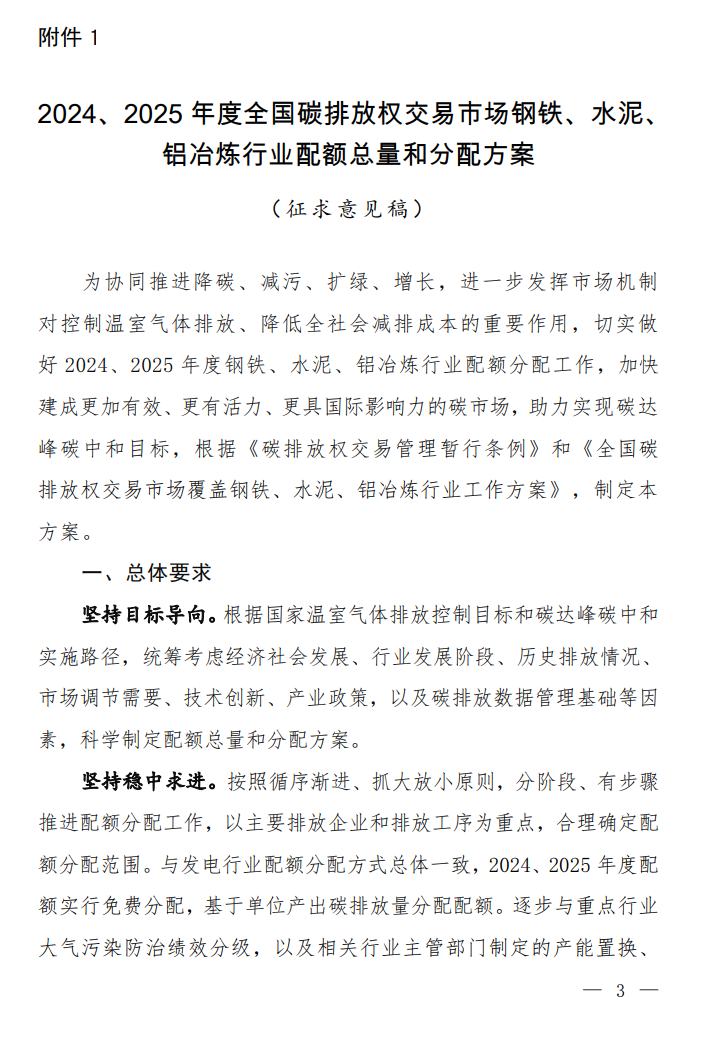
《2024、2025年度全国碳排放权交易市场钢铁、水泥、铝冶炼行业配额总量和分配方案(征求意见稿)》公开征求意见
Zheng Quan Shi Bao Wang· 2025-09-30 11:45
Core Viewpoint - The steel, cement, and aluminum smelting industries have been included in the national carbon emissions trading market management, with a focus on quota allocation for 2024 and 2025 [1] Group 1: Industry Inclusion and Regulation - The inclusion of steel, cement, and aluminum smelting industries in the carbon emissions trading market has been approved by the State Council [1] - The Ministry of Ecology and Environment has prepared a draft for public consultation regarding the total quota and allocation plan for these industries for the years 2024 and 2025 [1] Group 2: Quota Allocation Strategy - The quota allocation will follow a gradual approach, focusing on major emitting enterprises and processes [1] - Quotas for 2024 and 2025 will be allocated for free, based on carbon emissions per unit of output, similar to the method used in the power generation sector [1] Group 3: Market Environment and Policy Direction - The policy aims to create a fair, competitive, and open market environment, emphasizing the importance of market mechanisms in resource allocation [1] - The guiding principle is to "incentivize the advanced and spur the laggards," where lower carbon emissions per unit output will result in higher quota surplus rates [1] - The initiative encourages enterprises to enhance carbon emissions management and adopt green low-carbon technologies, including energy efficiency improvements and alternative raw materials [1]
天山股份:公司市值表现受多种因素影响
Zheng Quan Ri Bao Wang· 2025-09-30 09:14
Core Viewpoint - Tianshan Co., Ltd. emphasizes the importance of market capitalization management and aims to enhance operational performance while improving communication with investors [1] Group 1 - The company's market capitalization performance is influenced by various factors [1] - Tianshan Co., Ltd. is committed to improving production operations and enhancing performance to provide returns to investors [1] - The company will strengthen communication with investors to actively convey its value [1] Group 2 - Tianshan Co., Ltd. plans to disclose the number of shareholders and the holdings of the top ten shareholders in its periodic reports [1]
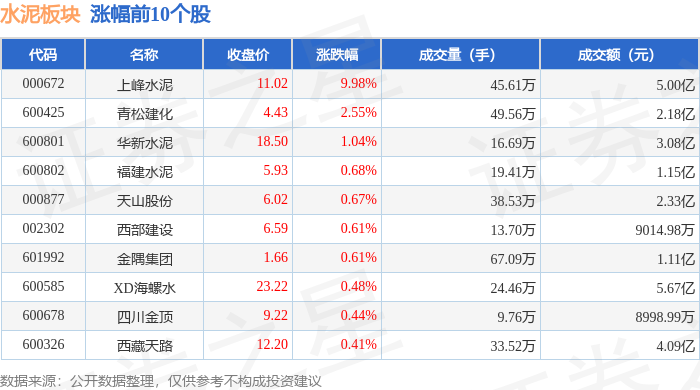
水泥板块9月30日涨0.39%,上峰水泥领涨,主力资金净流入1.88亿元
Zheng Xing Xing Ye Ri Bao· 2025-09-30 08:51
Market Performance - The cement sector increased by 0.39% on September 30, with Shangfeng Cement leading the gains [1] - The Shanghai Composite Index closed at 3882.78, up 0.52%, while the Shenzhen Component Index closed at 13526.51, up 0.35% [1] Individual Stock Performance - Shangfeng Cement (000672) closed at 11.02, up 9.98% with a trading volume of 456,100 shares and a turnover of 500 million yuan [1] - Other notable performers include Yusong Jianhua (600425) with a 2.55% increase, Huaxin Cement (600801) up 1.04%, and Fujian Cement (600802) up 0.68% [1] Capital Flow Analysis - The cement sector saw a net inflow of 188 million yuan from institutional investors, while retail investors experienced a net outflow of 58.18 million yuan [2] - Major stocks like Shangfeng Cement had a significant net inflow of 170 million yuan from institutional investors, indicating strong institutional interest [3] Summary of Stock Flows - Shangfeng Cement had a net institutional inflow of 170 million yuan, accounting for 34.04% of its trading volume, while retail investors showed a net outflow of 81.13 million yuan [3] - Other stocks like Xizang Tianlu (600326) and Huaxin Cement (600801) also experienced net inflows from institutional investors, although retail investors withdrew funds [3]

2025年中报总结:利润大幅改善,水泥、玻纤表现较优
Tianfeng Securities· 2025-09-30 07:43
Investment Rating - The industry rating is maintained as "Outperform" [4] Core Insights - The building materials industry saw a significant improvement in net profit in H1 2025, with a year-on-year increase of 23.9%, while revenue decreased by 5.9% to 270.9 billion yuan [12][9] - The cement and fiberglass sectors performed particularly well, with cement profits increasing by 1487% year-on-year in H1 2025 [38][41] - The report indicates that the traditional demand remains weak, but profit growth is driven by price and cost improvements in certain building materials, as well as increased demand for emerging materials [12][9] Summary by Sections 1. Industry Overview - In H1 2025, the building materials industry achieved a total revenue of 270.9 billion yuan, down 5.9% year-on-year, while net profit reached 14.3 billion yuan, up 23.9% [12][9] - The second quarter saw a net profit growth of 30.2% compared to the first quarter, indicating a positive trend [12][9] 2. Subsector Performance - **Cement**: Revenue of 118.1 billion yuan in H1 2025, down 7.7% year-on-year, with net profit soaring by 1487% to 5.2 billion yuan [41][38] - **Consumer Building Materials**: Revenue of 66.9 billion yuan, down 3.8%, with net profit declining by 12.8% [41][38] - **Fiberglass**: Revenue increased by 20.8% to 10.4 billion yuan, with net profit rising by 127% [41][38] - **New Materials**: The electronic materials sector showed significant growth, benefiting from high demand in computing power [41][38] 3. Investment Recommendations - Key stocks recommended include Zhongcai Technology, Huaxin Cement, and China Jushi, among others, with various ratings from "Buy" to "Hold" based on their performance and market conditions [8][41]



建材行业发布稳增长方案,继续严控水泥玻璃产能 | 投研报告
Zhong Guo Neng Yuan Wang· 2025-09-30 01:56
Core Viewpoint - The Ministry of Industry and Information Technology and five other departments have jointly released the "Construction Materials Industry Stabilization Growth Work Plan (2025-2026)", which outlines five key initiatives to promote industry growth and transformation [1][2]. Group 1: Key Initiatives - The plan emphasizes strengthening industry management to promote survival of the fittest [1][2]. - It calls for enhanced technological innovation in the industry to improve effective supply capacity [1][2]. - The plan aims to expand effective investment to facilitate industry transformation and upgrading [1][2]. - It seeks to stimulate consumer demand to unleash market consumption potential [1][2]. - The initiative includes deepening open cooperation to enhance international development levels [1][2]. Group 2: Industry Specifics - Cement and glass production will be strictly controlled, with a ban on new cement clinker and flat glass capacity, and existing projects must develop capacity replacement plans [2]. - The cement industry is expected to see a decline in capacity under the anti-overproduction policy, with utilization rates significantly improving [3]. - The glass industry is facing a continuous decline in demand due to real estate impacts, but recent policy-driven price increases are leading to inventory replenishment [3]. - The fiberglass sector is experiencing growth driven by demand from the AI industry, with expectations for a significant increase in both volume and price [3]. - The consumer building materials sector has reached a profitability bottom, with strong price increase demands supported by anti-overproduction policies [4]. Group 3: Market Performance - In the past week (September 22-28), the construction materials sector index decreased by 2.11%, ranking 23rd among 31 sub-industry indices [5].
中信证券相关公司新增一项3453.60万元的招标项目
Xin Lang Cai Jing· 2025-09-29 20:28
Group 1 - The core point of the article highlights that Jiangxi Wannianqing Cement Co., Ltd., a company related to CITIC Securities, has announced a tender for a key technology research project on low-carbon alternative fuel application, with a budget of 34.536 million yuan [1] - The project is specifically for the civil engineering and steel structure works of the Wannian Cement Plant [1] - CITIC Securities holds a 0.60% stake in Jiangxi Wannianqing Cement Co., Ltd. according to the equity penetration data [1]


建材行业发布稳增长方案,继续严控水泥玻璃产能
China Post Securities· 2025-09-29 10:45
Industry Investment Rating - The investment rating for the construction materials industry is "Outperform the Market" and is maintained [1] Core Insights - The Ministry of Industry and Information Technology, along with five other departments, has released a "Stabilization Growth Work Plan for the Construction Materials Industry (2025-2026)", which includes five key initiatives aimed at enhancing industry management, promoting technological innovation, expanding effective investment, stimulating consumer demand, and deepening international cooperation [4] - The plan emphasizes strict control over the production capacity of cement and glass, prohibiting new capacity for cement clinker and flat glass, and requiring capacity replacement plans for new and renovated projects [4] - The cement industry is entering its peak season, with demand showing signs of recovery, although growth remains limited. In August 2025, cement production was 148 million tons, a year-on-year decrease of 6.2% [10][5] - The glass industry is experiencing a continuous decline in demand due to real estate impacts, but recent policy catalysts have led to price increases and inventory replenishment in the midstream sector [15][5] Summary by Sections Cement - The cement market is gradually entering the peak season, with overall demand recovering slowly. The construction sector's demand has not fully materialized due to weather disruptions and the pace of demand release [10] - The industry is expected to see a continuous decline in production capacity under the restriction policies, leading to a significant increase in capacity utilization [5] Glass - The glass industry is facing a sustained downward trend in demand due to real estate influences. However, recent policy changes have led to price increases and midstream inventory replenishment [15][5] - The majority of companies in the float glass sector have met environmental requirements, suggesting that the anti-involution policy will not lead to a blanket capacity clearance but will raise environmental standards and costs [5] Fiberglass - The fiberglass sector is experiencing a boom driven by demand from the AI industry, with low dielectric products seeing a significant increase in both volume and price [5] Consumer Building Materials - The profitability of the consumer building materials sector has reached a bottom, with no further downward price pressure. The sector is seeing a strong demand for price increases and profitability improvements, particularly in waterproofing, coatings, and gypsum board [6]
天山股份:市值管理是公司长期的重要工作
Zheng Quan Ri Bao Zhi Sheng· 2025-09-29 09:39
Core Viewpoint - Tianshan Co. emphasizes the importance of market value management as a long-term strategy, focusing on operational excellence and investor communication to enhance company valuation and shareholder returns [1] Group 1 - The company is committed to improving production operations and standardizing practices to boost performance and reward investors [1] - Tianshan Co. has developed and disclosed a "Valuation Enhancement Plan" this year to protect the interests of all shareholders and promote high-quality development [1] - The company aims to strengthen communication with investors to actively convey its value [1]