
交通运输

Search documents
龙江交通(601188.SH):股东穗甬控股减持1156.3万股公司股份
Ge Long Hui A P P· 2025-08-19 12:18
格隆汇8月19日丨龙江交通(601188.SH)公布,公司于2025年8月19日收到持股5%以上股东穗甬控股发来 的《关于权益变动触及5%刻度的告知函》和《简式权益变动报告书(穗甬控股、广州辰崧)》,获悉 其于2025年8月14日—2025年8月18日期间,通过大宗交易方式减持其持有的1156.3万股公司股份,占公 司总股本比例0.88%。 ...

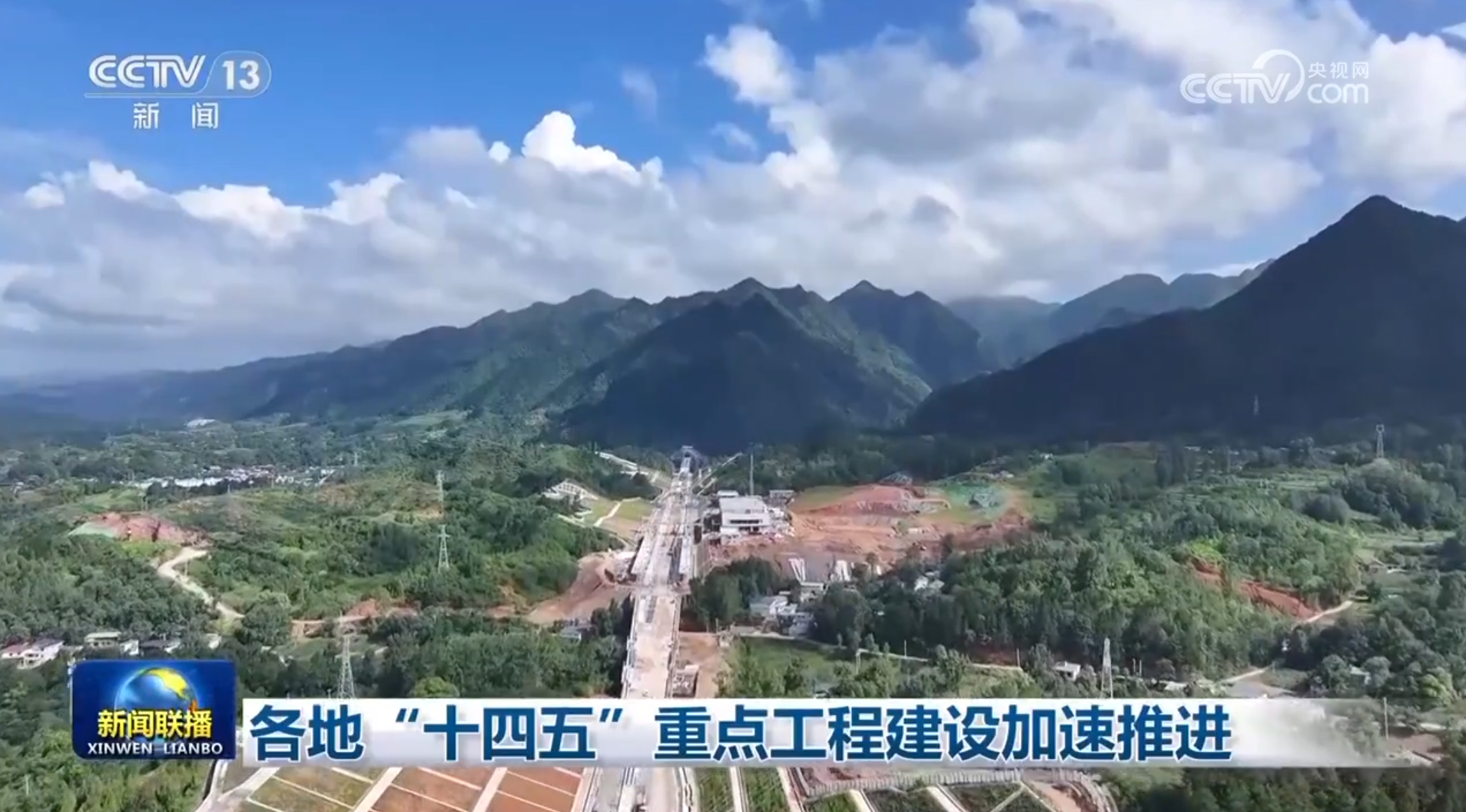
各地“十四五”重点工程建设加速推进
Yang Shi Wang· 2025-08-19 12:17
Group 1 - The completion of the Hanjiang Grand Bridge marks the finishing of the main bridge and tunnel works for the Xi'an to Shiyan high-speed railway, which is approximately 255.7 kilometers long and will reduce travel time from Xi'an to Wuhan from 5 hours to about 2.5 hours upon opening next year [1] - The expansion and renovation of the Jianbi Ship Lock on the Suzhou section of the Grand Canal will allow for a maximum annual cargo throughput of 170 million tons, which is 2.5 times that of the old lock, enabling 2,000-ton vessels to navigate the waterway [3] - The successful completion of the main bridge of the Fuhua Railway, which spans 142.5 kilometers, will reduce travel time from Fuyang to Huaibei from 2 hours to half an hour when it opens in 2026 [5] Group 2 - The Liaoyang irrigation district in Liaoning has been fully completed, providing irrigation for over 100,000 acres of farmland and increasing annual water-saving capacity by over 9 million cubic meters, which is an improvement of over 10% compared to before implementation [7] - The Dashi Gorge Water Conservancy Hub project in the Aksu region of Xinjiang, part of 172 major water-saving supply projects, is nearing 90% completion and is in the final stages of construction, with plans to store water by the end of September [7]

A股平均股价12.96元 36股股价不足2元
Zheng Quan Shi Bao Wang· 2025-08-19 08:37
Summary of Key Points Core Viewpoint - The average stock price of A-shares is 12.96 yuan, with 36 stocks priced below 2 yuan, the lowest being *ST Suwu at 0.93 yuan [1] Group 1: Market Performance - As of August 19, the Shanghai Composite Index closed at 3727.29 points, with a notable presence of low-priced stocks in the market [1] - Among the low-priced stocks, 22 out of 36 saw an increase in price, with Shandong Steel, Pubang Co., and Rongsheng Development leading the gains at 2.63%, 2.17%, and 2.10% respectively [1] - Conversely, 7 stocks experienced declines, with *ST Suwu, *ST Gaohong, and *ST Yunwang showing the largest drops at 5.10%, 4.91%, and 1.57% respectively [1] Group 2: Low-Priced Stocks Overview - The list of stocks priced below 2 yuan includes 13 ST stocks, accounting for 36.11% of the low-priced segment [1] - The lowest priced stock is *ST Suwu at 0.93 yuan, followed by *ST Jinke at 1.39 yuan and Yongtai Energy at 1.44 yuan [1] - The trading characteristics of these low-priced stocks show varying turnover rates, with *ST Suwu having a turnover rate of 7.60% [1] Group 3: Detailed Stock Data - A detailed table lists various low-priced stocks, their latest closing prices, daily price changes, turnover rates, and industry classifications [1][2] - For instance, *ST Suwu is in the pharmaceutical sector, while *ST Jinke and Yongtai Energy belong to real estate and coal industries respectively [1] - Other notable stocks include Shandong Steel and Rongsheng Development, both in the steel and real estate sectors, showing positive daily changes [1]


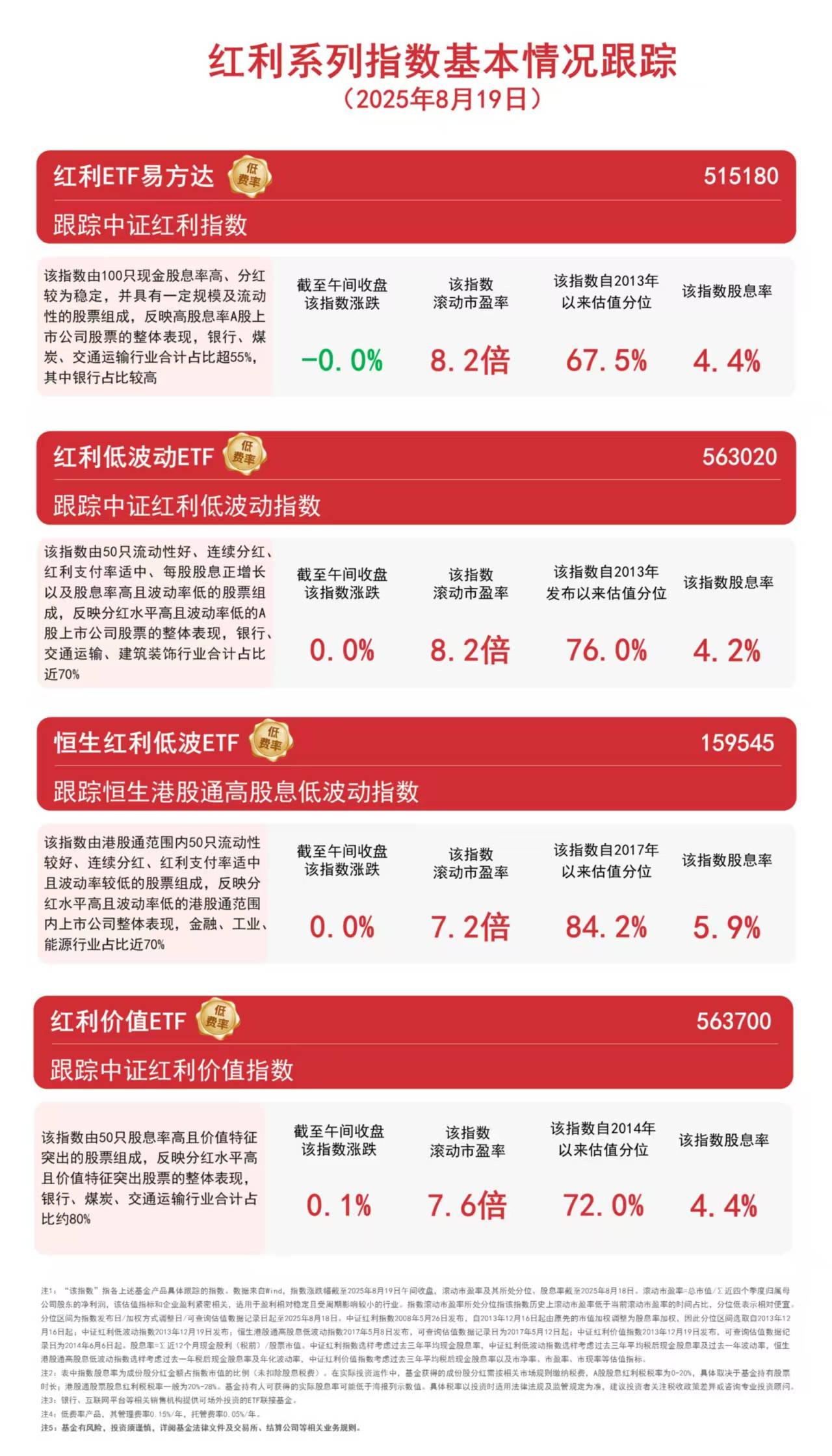
红利系列指数窄幅震荡,关注恒生红利低波ETF(159545)、红利ETF易方达(515180)等产品表现
Sou Hu Cai Jing· 2025-08-19 05:55
Core Viewpoint - The article discusses the performance and characteristics of the China Securities Dividend Value Index, which tracks 50 high dividend yield and value-oriented stocks, primarily in the banking, coal, and transportation sectors, accounting for approximately 80% of the index [3][4]. Summary by Relevant Sections Index Composition and Performance - The China Securities Dividend Value Index consists of 50 stocks with high dividend yields and notable value characteristics, reflecting the overall performance of high dividend and value stocks [3]. - As of the midday close on August 19, 2025, the index showed a performance change of 72.0% [4]. - The rolling price-to-earnings (P/E) ratio of the index is reported at 7.6 times [4]. Historical Context and Adjustments - The index has been in existence since 2014, with its valuation percentile indicating historical performance relative to current valuations [4]. - The index was adjusted from a market capitalization-weighted to a stock rate-weighted methodology on December 16, 2013 [4]. Dividend Yield Calculation - The dividend yield is calculated as the total cash dividends (pre-tax) over the stock market value, with the index considering the average cash dividend yield over the past three years [5]. - The actual dividend yield received by fund holders may be lower than the reported values due to applicable tax rates, which vary between markets [5]. Fund Management and Fees - The fund associated with the index has a low management fee of 0.15% per year and a custody fee of 0.05% per year [5].
徐汇免费巴士覆盖场馆商场酒店 用票根串起消费链条 各方为时代少年团“厉兵秣马”
Jie Fang Ri Bao· 2025-08-19 01:58
Core Insights - The "Champion" concert series by the Times Youth League will take place in Shanghai from August 20 to 24, attracting nearly 300,000 attendees over four shows [1] - Xuhui District is implementing innovative services such as free shuttle buses to facilitate orderly transportation for fans and their families [1] - A promotional campaign titled "Stay in Xuhui, Enjoy Haipai" is being launched, offering discounts at nearly 100 hotels for concert-goers [1] Transportation and Accommodation - Xuhui District has partnered with Dazhong Transportation Group to create three free shuttle bus routes, operating on concert days to connect fans to various commercial areas [1] - Several hotels in the vicinity, including seven specific hotels, are ensuring limited availability for concert attendees [2] Consumer Benefits and Local Economy - Xuhui District is providing various consumer benefits for attendees, including discounts and promotions at participating shopping malls, restaurants, and entertainment venues [2] - Local businesses, including 19 cinemas and nearly 10 KTVs, are offering special packages and discounts for concert-goers [2] - Travel agencies have designed 26 unique itineraries to showcase Shanghai's cultural heritage, expanding the economic impact of the concert [2]
养老金二季度现身26只股前十大流通股东榜
Zheng Quan Shi Bao Wang· 2025-08-19 01:42
Core Insights - Pension funds have increased their presence in the secondary market, appearing in the top ten circulating shareholder lists of 26 stocks by the end of Q2, with 12 new entries and 9 increased holdings [1][2] - The total shareholding amount of pension funds reached 198 million shares, with a total market value of 5.346 billion yuan [1] - The stocks with the highest pension fund holdings include Hongfa Technology and Shenzhen Airport, with holdings of 28.22 million shares and 24.20 million shares respectively [1][2] Summary by Category Shareholding Details - The largest holding by pension funds is in Hongfa Technology, with a total of 28.22 million shares, representing a 64.93% increase from the previous quarter [2][3] - Shenzhen Airport follows with 24.20 million shares, showing a 21.05% increase [2][3] - Other notable stocks include Satellite Chemical with 19.97 million shares (new entry) and Kid King with 15.05 million shares (down 4.25%) [2][3] Sector Distribution - Pension fund holdings are primarily concentrated in the main board with 18 stocks, followed by 3 in the Sci-Tech Innovation Board and 5 in the Growth Enterprise Market [2] - The mechanical equipment and basic chemical industries are the most represented sectors, with 4 and 3 stocks respectively [2] Performance Metrics - Among the stocks held by pension funds, 22 companies reported net profit growth in their semi-annual reports, with Rongzhi Rixin showing the highest increase of 2063.42%, achieving a net profit of 14.24 million yuan [2]


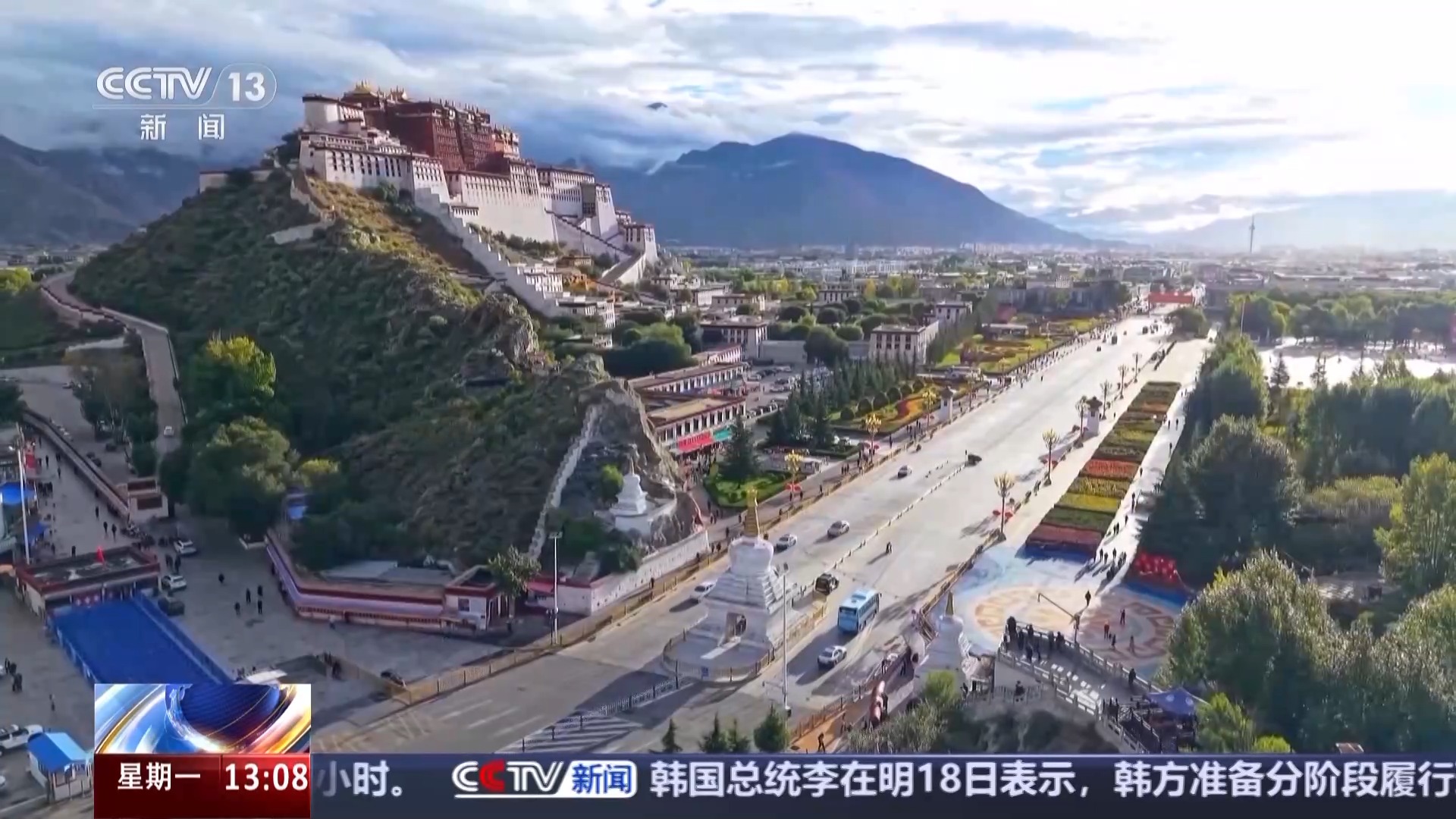
辉煌60载 魅力新西藏丨酸奶店留言条藏着西藏路网的变迁密码
Yang Shi Xin Wen Ke Hu Duan· 2025-08-19 00:39
Core Insights - The development of a comprehensive transportation network centered around Lhasa has significantly improved accessibility to various regions in Tibet, enhancing both tourism and local commerce [1][11][13] Transportation Infrastructure - The "Five Cities Three Hours" economic circle has been established, connecting Lhasa with Shigatse, Shannan, Nyingchi, and Nagqu, facilitating easier travel and logistics [1][11] - The total length of roads in Tibet has reached 124,900 kilometers, with high-grade roads like Lalin, Lazhe, and Larna being completed, contributing to the rapid transportation network [11] Tourism Impact - The tourism season has seen increased foot traffic in local businesses, such as a yogurt shop near the Potala Palace, which has expanded its operations fivefold since opening in 2007 [1][3] - Tourists have expressed positive feedback regarding the improved travel conditions compared to previous years, highlighting the ease of access to the region [1][3] Supply Chain and Logistics - The logistics sector has diversified, with a significant increase in the variety of goods transported to Tibet, including chemical and electronic products, alongside traditional items like food and construction materials [9] - The volume of goods transported through the Lhasa West Railway Freight Yard reached 3.5084 million tons, marking a 7.27% increase year-on-year [9] Local Business Growth - Local businesses, such as the yogurt shop, have benefited from improved transportation, allowing them to source fresher ingredients from farther locations, thus enhancing product quality [7][9] - The yogurt shop's daily sales have exceeded 1,400 servings, indicating strong demand and the need for expanded supply chains [5][7]
8月18日信用债异常成交跟踪
SINOLINK SECURITIES· 2025-08-18 15:24
Report Summary 1. Core Viewpoints - Among the bonds traded at a discount, "24 Railway MTN008B" had a relatively large deviation in valuation price. Among the bonds with rising net prices, "23 Vanke 01" led in terms of valuation price deviation. Among the Tier 2 and perpetual bonds with falling net prices, "20 Langfang Bank Perpetual Bond 01" had a relatively small deviation in valuation price; among the commercial financial bonds with falling net prices, "22 HSBC Bank 02" had a relatively small deviation in valuation price. Among the bonds with a trading yield higher than 6%, real estate bonds ranked at the top [2]. - The changes in credit bond valuation yields were mainly distributed in the (0,5] range. The trading terms of non - financial credit bonds were mainly distributed between 2 and 3 years, with the 0.5 - 1 - year variety having the highest proportion of discounted trades; the trading terms of Tier 2 and perpetual bonds were mainly distributed between 4 and 5 years. By industry, bonds in the petroleum and petrochemical industry had the largest average deviation in valuation price [2]. 2. Summary by Relevant Catalogs 2.1 Discounted Bond Trading - The report tracked bonds with large discounts, including "24 Railway MTN008B" with a valuation price deviation of - 1.05% and a trading volume of 20,857 million yuan, and "GC Three Gorges K4" with a valuation price deviation of - 0.78% and a trading volume of 105 million yuan [3]. 2.2 Bonds with Rising Net Prices - Bonds with significant positive deviations in trading were tracked, such as "23 Vanke 01" with a valuation price deviation of 0.17% and a trading volume of 10 million yuan, and "21 Vanke 06" with a valuation price deviation of 0.17% and a trading volume of 621 million yuan [5]. 2.3 Tier 2 and Perpetual Bond Trading - The trading of Tier 2 and perpetual bonds was monitored. For example, "20 Langfang Bank Perpetual Bond 01" had a valuation price deviation of - 0.01% and a trading volume of 198 million yuan, and "20 Construction Bank Tier 2" had a valuation price deviation of - 0.02% and a trading volume of 3,507 million yuan [6]. 2.4 Commercial Financial Bond Trading - The trading of commercial financial bonds was tracked. "22 HSBC Bank 02" had a valuation price deviation of - 0.01% and a trading volume of 32,014 million yuan, and "22 Hangzhou Bank Bond 01" had a valuation price deviation of - 0.01% and a trading volume of 30,035 million yuan [7]. 2.5 Bonds with Yields Higher than 6% - Bonds with trading yields higher than 6% were monitored, including "22 Vanke 06" with a valuation yield of 7.05% and a trading volume of 1,029 million yuan, and "24 Ruimao 02" with a valuation yield of 8.14% and a trading volume of 328 million yuan [8]. 2.6 Credit Bond Valuation Deviation Distribution - The distribution of credit bond valuation yield changes on the day was mainly in the (0,5] range, and the trading terms of non - financial credit bonds and Tier 2 and perpetual bonds showed different characteristics [2]. 2.7 Industry - wise Non - financial Credit Bond Discounted Trading - By industry, bonds in the petroleum and petrochemical industry had the largest average deviation in valuation price, and different industries had different proportions of discounted trades and trading volumes [2][17]
基本面高频数据跟踪:出口运价下行
GOLDEN SUN SECURITIES· 2025-08-18 10:36
Report Industry Investment Rating No relevant content provided. Core View of the Report The report updates the high - frequency data on various aspects of the economy from August 8th to August 15th, 2025, including the overall fundamental situation, production, demand, prices, inventory, transportation, and financing. The overall fundamental high - frequency index shows a stable trend, while different sub - indicators have different changes, such as the increase in the industrial production high - frequency index, the decline in the real - estate sales high - frequency index, etc. [1][8] Summary by Relevant Catalogs Total Index: Fundamental High - Frequency Index Stable - The current Guosheng fundamental high - frequency index is 127.2 points (previous value: 127.0 points), with a week - on - week increase of 0.1 points and a year - on - year increase of 5.4 points, and the year - on - year growth rate remains unchanged. The long - short signal of interest - rate bonds remains unchanged, with a signal factor of 4.8% (previous value: 4.7%). [1][8] Production: PTA Operating Rate Declines - The industrial production high - frequency index is 126.4, with a week - on - week increase of 0.1 points and a year - on - year increase of 5.1 points, and the year - on - year growth rate rises. The PTA operating rate is 75.0%, a decrease from the previous value of 75.9%. [1][8][15] Real - Estate Sales: Transaction Land Premium Rate Declines - The real - estate sales high - frequency index is 43.3, with a week - on - week decrease of 0.1 points and a year - on - year decrease of 6.4 points, and the year - on - year decline rate remains unchanged. The transaction land premium rate of 100 large - and medium - sized cities is 1.9%, a decrease from the previous value of 3.6%. [1][8][29] Infrastructure Investment: Petroleum Asphalt Operating Rate Rises - The infrastructure investment high - frequency index is 120.3, with a week - on - week increase of 0.2 points and a year - on - year increase of 5.1 points, and the year - on - year growth rate expands. The operating rate of petroleum asphalt devices is 32.9%, an increase from the previous value of 31.7%. [1][8][45] Export: Export Container Freight Rate Index Continues to Decline - The export high - frequency index is 143.8, with a week - on - week increase of 0 points and a year - on - year increase of 2.9 points, and the year - on - year growth rate narrows. The CCFI index is 1193 points, a decrease from the previous value of 1201 points. [1][8][47] Consumption: Daily Average Movie Box Office Declines - The consumption high - frequency index is 119.8, with a week - on - week increase of 0.1 points and a year - on - year increase of 2.7 points, and the year - on - year growth rate remains unchanged. The daily average movie box office is 20,674 yuan, a decrease from the previous value of 24,143 yuan. [1][8][67] CPI: Pork Wholesale Price Declines - The CPI monthly - on - monthly forecast is 0.2% (previous value: 0.2%). The latest average wholesale price of pork is 20.2 yuan/kg, a decrease from the previous value of 20.4 yuan/kg. [1][8][68] PPI: Steam Coal Price Rises - The PPI monthly - on - monthly forecast is 0.2% (previous value: 0.2%). The ex - warehouse price of steam coal (produced in Shanxi) at Qinhuangdao Port is 692 yuan/ton, an increase from the previous value of 674 yuan/ton. [1][8][73] Transportation: Passenger Volume Remains Stable Overall - The transportation high - frequency index is 129.8, with a week - on - week increase of 0.2 points and a year - on - year increase of 9.2 points, and the year - on - year growth rate expands. The subway passenger volume in first - tier cities is 40240,000 person - times, an increase from the previous value of 38860,000 person - times. [2][9][84] Inventory: Electrolytic Aluminum Inventory Declines - The inventory high - frequency index is 161.3, with a week - on - week increase of 0.1 points and a year - on - year increase of 9.0 points, and the year - on - year growth rate narrows. The electrolytic aluminum inventory is 161,000 tons, a decrease from the previous value of 197,000 tons. [2][9][92] Financing: Net Local Bond Financing Turns from Positive to Negative - The financing high - frequency index is 234.5, with a week - on - week increase of 0.6 points and a year - on - year increase of 29.8 points, and the year - on - year growth rate expands. The net local bond financing is - 1.37 billion yuan, a decrease from the previous value of 8.28 billion yuan. [2][9][103]
客运站建成10年未用,背后是公共责任空转
Xin Jing Bao· 2025-08-18 09:26
据《人民日报》8月18日报道,黑龙江绥化市王先生反映,当地东城客运站作为绥化市向社会公布的惠 民工程之一,总投资3600余万元。然而,该工程2015年建成后一直未启用。市民搭乘长途汽车仍在破旧 的老客运站,十分不便。 记者调查发现,王先生反映的事的确存在。而除了东城站,另一座耗资5000余万元建成的六合站,也在 2015年年底建成后,仅运营了一年多就因亏损关闭。 两座客运站相似的命运,背后原因有差异,也有共性。对前者来说,交通运输局将原因归咎于拆迁滞 后、施工单位材料报送不及时、结算拖延,施工单位则反驳称滞迁户不影响车站运营,验收材料早已补 齐,直指"新官不理旧账""干部不作为"。而在这种部门与施工企业的漫长拉锯中,车站成了"没人管的 孩子",一直闲置至今。 这背后,本质上是一种公共责任的空转。因为无论如何,推动惠民工程及时落地,纵有再多困难,也是 公共部门的应尽职责。 如果说东城站的"烂尾"主要源自项目落地过程中的"不作为",那么,差不多同时建成的六合站在运营不 久后便关停,则更多与决策源头的失当有关。 按照当地的说法,六合站的建设寄托于新区规划,但最终新区未获批便仓促上马,导致六合站投运后因 客源不足被关 ...