
啤酒

Search documents
“雪王”,要跨界卖啤酒了?
新浪财经· 2025-10-03 07:42
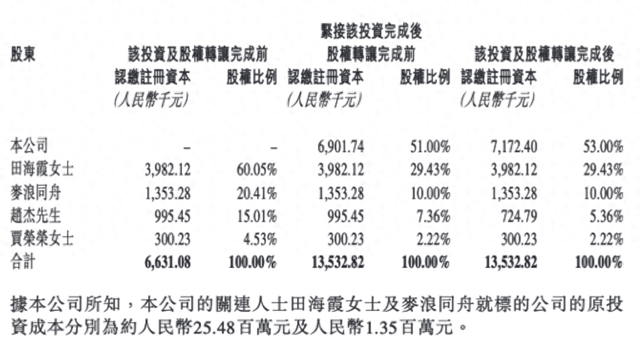
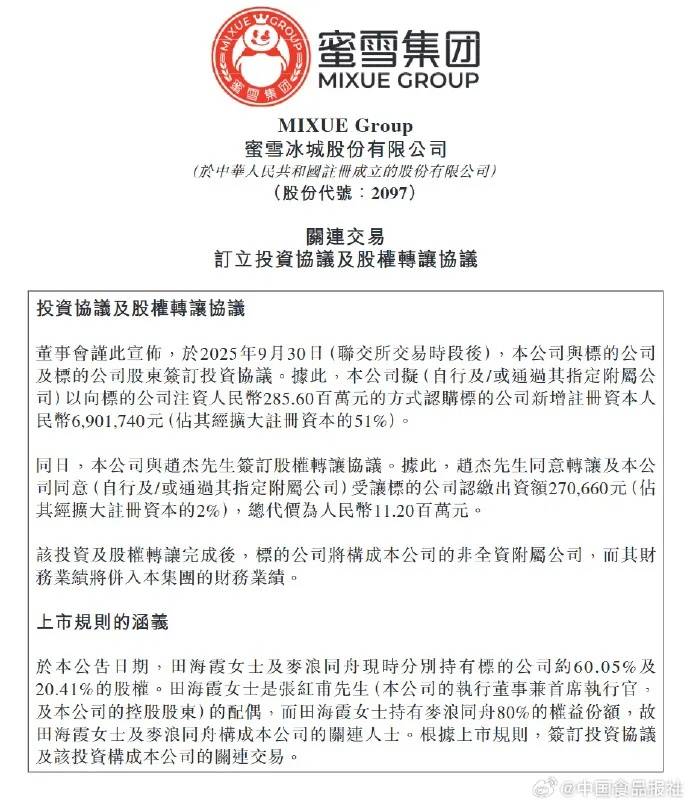
Core Viewpoint - The company, Mixue Group, is expanding its business by acquiring a 53% stake in the fresh beer brand "Xianpi Fulu Jia" for approximately 296.8 million RMB, marking a strategic move into the fresh beer market [2][3]. Investment Details - Mixue Group will invest 285.6 million RMB to subscribe for new registered capital of 6.90174 million RMB, representing 51% of the expanded registered capital [2]. - The acquisition includes a share transfer agreement with Zhao Jie, where Mixue Group will acquire an additional 2% stake for 11.2 million RMB [2]. - The investment will be funded from internal resources and will not involve proceeds from the global offering [2]. Shareholding Structure - Before the investment, the shareholding structure of the target company was as follows: Tian Haixia (60.05%), Mai Lang Tong Zhou (20.41%), Zhao Jie (15.01%), and Jia Rongrong (4.53%) [3]. - Post-investment, Mixue Group's shareholding will increase to 53%, while Tian Haixia's stake will decrease to 29.43% [4]. Financial Performance - The target company reported a pre-tax loss of 1.52772 million RMB for 2023 but is projected to turn a profit of 1.07093 million RMB in 2024 [5][6]. - As of August 31, 2025, the target company's total assets and net assets are estimated to be approximately 92.7 million RMB and 19.52 million RMB, respectively [5]. Market Position and Strategy - Mixue Group is a leading player in the low-priced beverage market, with a strong competitive edge, offering products priced around 6 RMB [6]. - The company has established over 53,000 stores globally, including in 12 countries, and aims to penetrate existing markets while exploring Southeast Asia for further expansion [9]. Fresh Beer Market Potential - "Xianpi Fulu Jia" offers fresh beer products priced between 6 to 10 RMB per 500mL and has developed a network of approximately 1,200 stores through a franchise model [7]. - The fresh beer market is in its early stages but is expected to grow due to consumer preferences for fresh flavors and quality, aligning with current consumption trends [8].

蜜雪集团2.968亿收购鲜啤福鹿家53%股权
Huan Qiu Wang· 2025-10-03 02:55
Core Insights - The acquisition of 53% stake in the target company by Mixue Group through a total investment of 296.8 million yuan is a strategic move to enter the fresh beer market [1][3] - The transaction is structured in two steps, with an initial investment of 285.6 million yuan for 51% equity, followed by a transfer of 2% equity for 1.12 million yuan [3] - The target company has shown improvement in its financial performance, moving from a loss of 1.5277 million yuan in 2023 to a profit of 1.0709 million yuan in 2024 [3] Company Overview - Mixue Group has a mature supply chain system with five production bases and 29 warehouses, achieving cold chain coverage for 97% of its stores [3] - In the first half of 2025, Mixue Group reported revenue exceeding 14.8 billion yuan and a net profit close to 2.7 billion yuan, leading the new tea beverage industry [3] - The target brand "Xianpi Fulujia" focuses on fresh beer priced between 6 to 10 yuan per 500mL and currently operates 1,200 franchise stores [3] Strategic Implications - The acquisition is seen as a significant step for Mixue Group to expand into the fresh beer segment, indicating confidence in the long-term growth potential of this category [3]

“雪王”,要跨界卖啤酒了?
Xin Lang Cai Jing· 2025-10-03 02:45
Core Viewpoint - The company, Mixue Group, is acquiring a 53% stake in the fresh beer brand "Xianpi Fulu Jia" for a total investment of approximately 296.8 million RMB, marking a strategic expansion into the fresh beer market [1][2]. Investment Details - Mixue Group will invest 285.6 million RMB to subscribe to new registered capital of 6.90174 million RMB, representing 51% of the expanded registered capital [1]. - The company will also acquire an additional 2% stake from Zhao Jie for 11.2 million RMB [1]. - The investment will be funded through internal resources and will not involve proceeds from the company's global offering [1]. Shareholding Structure - Post-investment, Mixue Group will hold 53% of the shares in the target company, while the controlling shareholder, Tian Haixia, will hold 29.43% [3]. - The shareholding structure before and after the investment shows a significant increase in Mixue Group's ownership [3]. Financial Performance - The target company reported a pre-tax loss of 1.5277 million RMB for 2023 but is projected to turn a profit of 1.0709 million RMB in 2024 [4][5]. - As of August 31, 2025, the target company's total assets and net assets are estimated to be approximately 92.7 million RMB and 19.52 million RMB, respectively [4]. Market Position and Strategy - Mixue Group is a leading player in the low-priced beverage market, with a strong competitive edge, offering products priced around 6 RMB [5]. - The fresh beer brand aims to provide high-quality, affordable fresh beer, with a network of approximately 1,200 stores by August 31, 2025 [6]. - The investment is seen as a strategic move to tap into the growing fresh beer market, which is characterized by a shift from quantity to quality in the beer industry [7]. Industry Trends - The fresh beer market is in its early stages but is expected to grow due to consumer preferences for fresh flavors and quality [7]. - The new business models and product categories in the beer industry indicate a long-term growth potential for fresh beer products [7]. Future Outlook - Mixue Group plans to penetrate existing markets and explore Southeast Asia while investing in capacity building and innovation [8]. - The company aims to enhance its brand presence through diverse content offerings, including animations and films [8].
蜜雪集团收购鲜啤福鹿家,布局现打鲜啤赛道
36氪未来消费· 2025-10-03 02:18
Core Viewpoint - The article discusses the strategic acquisition of Fresh Beer Fulu Family by Mixue Group, emphasizing the expansion of its "high-quality and affordable" product portfolio and the potential for business synergy and growth in the fresh beer market [4][5][6]. Group 1: Acquisition Details - On October 1, Mixue Group announced an investment of 286 million yuan in Fresh Beer Fulu Family, acquiring a 51% stake, along with an additional 2% from an independent third party, resulting in a total ownership of 53% [4][5]. - Fresh Beer Fulu Family, founded in 2021, specializes in fresh beer products and has rapidly expanded to approximately 1,200 stores across 28 provinces in China by August 2025 [9][10]. Group 2: Market Position and Strategy - The acquisition aligns with Mixue Group's commitment to "high-quality and affordable" products, as Fresh Beer Fulu Family offers fresh beer at a competitive price of approximately 6 to 10 yuan per 500 ml [8]. - The fresh beer market in China is identified as a blue ocean opportunity, with significant growth potential due to low per capita consumption compared to Western markets [11]. Group 3: Financial Assessment - An independent valuation of Fresh Beer Fulu Family estimated its total equity value between 245 million and 277 million yuan, ensuring the fairness of the investment price [17]. - Fresh Beer Fulu Family reported a pre-tax net profit of 1.07 million yuan for 2024, indicating a turnaround from previous losses and improved operational efficiency [18]. Group 4: Synergy and Supply Chain - Mixue Group's extensive supply chain capabilities, developed over 20 years, are expected to enhance Fresh Beer Fulu Family's operations, including procurement, production, and logistics [19][20]. - The integration of Mixue Group's resources is anticipated to strengthen Fresh Beer Fulu Family's market position and operational quality, contributing to the overall competitiveness in the beverage industry [21].

大行评级丨交银国际:维持百威亚太“买入”评级 目标价降至9.5港元
Ge Long Hui A P P· 2025-10-03 02:03
Core Viewpoint - The report from CMB International maintains a "Buy" rating for Budweiser APAC (1876) with a target price adjusted to HKD 9.50, indicating that the current stock price reflects short-term sales pressures, with potential marginal improvement in Q4 and a supporting dividend yield exceeding 5% [1] Financial Performance - The company is expected to announce its Q3 2025 results on October 30, with projected group revenue declining by 6.4% year-on-year [1] - Adjusted EBITDA is anticipated to decrease by 14.4% year-on-year, while adjusted net profit attributable to shareholders is forecasted at USD 190 million, representing a 14.6% decline year-on-year [1] Market Dynamics - Core pressures are identified in the mainland China market, where the ready-to-drink channel remains weak, although this is partially offset by strong growth in the Indian market, price increases in the Korean market, and cost improvements [1]

交银国际:维持百威亚太“买入”评级 目标价降至9.5港元
Zhi Tong Cai Jing· 2025-10-03 01:55
Core Viewpoint - The report from CMB International maintains a "Buy" rating for Budweiser APAC (01876) with a target price adjusted to HKD 9.50, citing that the current stock price reflects short-term sales pressure, with potential marginal improvement in Q4 and a supporting dividend yield exceeding 5% [1] Group 1: Financial Performance Expectations - The company is expected to report a 6.4% year-on-year decline in group revenue for Q3 2025, indicating a slow overall recovery; adjusted EBITDA is projected to decrease by 14.4%, and adjusted net profit attributable to shareholders is anticipated to be USD 190 million, down 14.6% year-on-year [1] - The core pressure on performance is attributed to a weak on-premise channel in mainland China, partially offset by strong growth in the Indian market, price increases in the Korean market, and cost improvements [1][2] Group 2: Regional Market Analysis - In the Asia Pacific West region, the on-premise channel in mainland China is under pressure due to factors such as alcohol bans and price wars on delivery platforms, leading to a soft recovery in the restaurant channel; inventory reduction efforts negatively impacted sales [2] - The Asia Pacific East region, particularly South Korea, is expected to perform relatively well with slight revenue declines; unit sales are projected to decrease in low single digits, while average prices are expected to grow in mid-single digits, with adjusted EBITDA likely to see slight growth [3]
交银国际:维持百威亚太(01876)“买入”评级 目标价降至9.5港元
智通财经网· 2025-10-03 01:52
Core Viewpoint - The report from CMB International maintains a "Buy" rating for Budweiser APAC (01876) but lowers the target price to HKD 9.50, citing that the current stock price reflects short-term sales pressure, with potential marginal improvement in Q4 and a supporting dividend yield exceeding 5% [1] Group 1: Financial Performance Expectations - The company is expected to report a 6.4% year-on-year decline in group revenue for Q3 2025, with adjusted EBITDA anticipated to decrease by 14.4% and adjusted net profit projected at USD 190 million, down 14.6% year-on-year [1] - The core pressure on performance is attributed to the soft on-premise channel in mainland China, partially offset by strong growth in the Indian market, price increases in the Korean market, and cost improvements [1] Group 2: Regional Performance Insights - In the Asia-Pacific West region, particularly mainland China, the on-premise channel is under pressure due to factors such as alcohol bans and price wars on delivery platforms, leading to a high single-digit year-on-year revenue decline and a deeper sequential decline in Q3 [1] - The company has actively adjusted inventory to alleviate pressure on distributors, maintaining good inventory management to support future recovery, with expectations of marginal recovery in Q4 [1] - In the Asia-Pacific East region, the performance is expected to be relatively stable, with slight revenue decline impacted by exchange rates, low single-digit volume decline, and mid-single-digit average price growth, alongside a slight increase in adjusted EBITDA [2]
雪王”整顿鲜啤?蜜雪冰城近3亿买下“鲜啤福鹿家
Guan Cha Zhe Wang· 2025-10-02 13:04
Core Viewpoint - The company Mixue Ice City has acquired a 53% stake in Fresh Beer Fulu Family for approximately 297 million RMB, aiming to expand into the fresh beer market and enhance its product offerings [1][6]. Transaction Details - The acquisition consists of a 285.6 million RMB subscription for new registered capital of approximately 6.9017 million RMB to obtain 51% equity, and an additional 11.2 million RMB to acquire 2% equity from original shareholder Zhao Jie [1]. - Following the transaction, Fresh Beer Fulu Family will become a non-wholly owned subsidiary of Mixue Ice City, with its financial data included in the group's consolidated financial statements [1]. Company Background - Fresh Beer Fulu Family, established in 2021, is the first brand in China to receive national certification for "fresh beer" and has become the leading brand in terms of the number of fresh beer chain stores, with around 1,200 locations across 28 provinces and cities by August 31, 2025 [1][4]. - The brand primarily targets new first-tier and third- to fourth-tier cities, with a significant presence in Zhengzhou [1]. Financial Performance - Fresh Beer Fulu Family reported a net loss of 1.527 million RMB in 2023 but turned a profit in 2024 with a net profit of 1.07 million RMB [4][5]. Shareholding Structure Post-Transaction - After the transaction, Mixue Ice City will hold 53% of Fresh Beer Fulu Family, while the largest shareholder, Tian Haixia, will see her stake reduced from over 60% to 29.43% [5][6]. Strategic Intent - Mixue Ice City aims to address the increasingly diverse beverage demands of consumers by entering the fresh beer sector, aligning with the industry's shift from quantity to quality [6]. - The company plans to leverage its strong supply chain and standardized operational systems to support Fresh Beer Fulu Family in areas such as procurement, production, logistics, and quality management, thereby enhancing efficiency and reducing costs [7].

要卖啤酒了?蜜雪冰城斥资近3亿元,拿下鲜啤福鹿家53%股权
Sou Hu Cai Jing· 2025-10-02 10:37
Core Viewpoint - Mijue Ice City has acquired a 53% stake in Fresh Beer Fulu Family for approximately 297 million RMB, expanding its product offerings to include freshly brewed beer, aligning with its mission to provide high-quality and affordable products to consumers [1][5]. Group 1: Investment and Acquisition - The investment in Fresh Beer Fulu Family is seen as a strategic move for Mijue Ice City to diversify its product range and tap into the freshly brewed beer market [1][5]. - Fresh Beer Fulu Family operates under a franchise model, similar to Mijue Ice City and Lucky Coffee, which allows for rapid expansion of its store network [5][6]. Group 2: Financial Performance and Growth - Mijue Group reported a revenue of 14.87 billion RMB in the first half of 2025, a year-on-year increase of 39.3%, with product and equipment sales contributing 14.49 billion RMB, up 39.6% [5]. - The gross profit margin for product and equipment sales was 30.3%, while the margin for franchise and related services was significantly higher at 82.7% [5]. - As of June 30, 2025, Mijue Group had over 53,000 stores globally, with 48,281 located in China [5].

港交所消息:9月25日,贝莱德持有的青岛啤酒H股多头头寸从7.42%降至6.72%
Xin Lang Cai Jing· 2025-10-02 10:24
Core Viewpoint - BlackRock's holding in Qingdao Beer H shares decreased from 7.42% to 6.72% as of September 25 [1] Company Summary - BlackRock's stake reduction indicates a shift in investment strategy or market sentiment towards Qingdao Beer [1]

