
喜力

Search documents
华润啤酒(00291.HK):结构持续优化 主业稳步向前
Ge Long Hui· 2026-03-31 05:21
Core Viewpoint - The company is experiencing a decline in revenue and net profit for 2025, but shows resilience in EBITDA growth when excluding special items, indicating a focus on operational efficiency and strategic adjustments in product offerings [1][2]. Group 1: Financial Performance - In 2025, the company achieved operating revenue of 37.99 billion yuan, a year-on-year decrease of 1.7%, and a net profit attributable to shareholders of 3.37 billion yuan, down 28.9% [1]. - Excluding special items, the company reported an EBITDA of 9.879 billion yuan, an increase of 9.9% year-on-year, and a net profit attributable to shareholders of 5.72 billion yuan, up 19.6% [1]. - The company declared a year-end dividend of 0.557 yuan per share, with a total annual dividend of 1.021 yuan, resulting in a payout ratio of 53% [1]. Group 2: Beer Segment Performance - The beer segment generated revenue of 36.5 billion yuan in 2025, remaining flat year-on-year, with volume and price changes of +1.4% and -1.4% respectively [1]. - Sales of premium and above products grew nearly 10%, with notable increases in Heineken (approximately +20%), Snow Beer (around +60%), and Red爵 (over +100%) [1]. - The company’s revenue in the eastern, central, and southern regions showed slight variations, with increases of 0.5% and 0.4% in the eastern and southern regions, while the central region saw a decrease of 1.3% [1]. Group 3: White Spirit Segment Performance - The white spirit business faced significant challenges, with revenue dropping to 1.5 billion yuan, a year-on-year decline of 30%, and EBITDA falling to 264 million yuan, down 69% [1]. - The EBITDA margin for the white spirit segment was 17.6%, a decrease of 22 percentage points year-on-year, indicating ongoing pressure in this segment [1]. Group 4: Strategic Outlook - The company is focusing on long-term strategies for the white spirit business, emphasizing price stability and quality improvement to stabilize operations [2]. - The overall gross profit margin improved by 0.4 percentage points to 43%, with the beer segment's gross margin increasing by 1.4 percentage points to 42.5% due to a focus on high-end products and favorable raw material costs [2]. - The company plans to continue expanding its beer production capacity, with 59 breweries and an annual capacity of approximately 19.1 million kiloliters [2].

华润啤酒2025年净利下滑近三成
Zhong Guo Jing Ji Wang· 2026-03-30 00:59
Core Viewpoint - In the context of a declining domestic beer industry and intensified competition, China Resources Beer (Holdings) Co., Ltd. reported a decrease in revenue and profit for the year 2025, highlighting a stark contrast between its beer and liquor business performance [1][2]. Beer Business Performance - For 2025, the company achieved revenue of 37.985 billion yuan, a year-on-year decrease of 1.68%, with a net profit attributable to shareholders of 3.371 billion yuan, down 28.87% [2][3]. - The beer segment generated revenue of 36.489 billion yuan, remaining stable compared to the previous year, while the liquor segment saw revenue drop to 1.496 billion yuan, a decline of 30.39% [2]. - The beer business sold 11.03 million kiloliters, reflecting a year-on-year growth of 1.4%, supported by a high-end strategy that has led to significant growth in premium product sales [2][3]. - High-end beer sales accounted for nearly 25% of total sales, with premium products showing nearly 10 percentage points growth year-on-year, indicating that high-end products are a key growth driver [2][3]. Structural Concerns in Beer Business - Despite the growth in high-end product sales, the overall revenue from the beer business remained flat, with the average selling price per ton decreasing from 3,355.34 yuan per kiloliter in 2024 to 3,308.16 yuan in 2025, a decline of 1.41% [3]. - The industry is experiencing increased concentration among the top five companies, leading to intensified competition in the high-end market, which poses challenges for further growth [3]. - The chairman of the board expressed cautious optimism about the long-term development of the domestic beer industry, suggesting that the high-end trend remains unchanged despite entering a more competitive phase [3]. Liquor Business Challenges - The liquor business faced significant pressure, primarily due to a goodwill impairment of 2.877 billion yuan related to the acquisition of Guizhou Jinsha Distillery Co., Ltd., attributed to a weak market and reduced consumer demand [4]. - Since acquiring control of Jinsha Distillery, the performance has consistently underperformed expectations, with revenue dropping from 3.641 billion yuan in 2021 to 2.067 billion yuan in 2023, a decline of over 40% [4]. - The substantial goodwill impairment has raised doubts about the company's dual-driver strategy of beer and liquor, as the anticipated synergies from the acquisition have not materialized [4][5]. Future Outlook - The company plans to optimize its liquor business strategy while maintaining its commitment to the high-end beer strategy, with management expressing cautious optimism about the liquor industry's prospects in 2026 [5]. - The chairman noted that the liquor market is gradually stabilizing, with opportunities for differentiation in a competitive landscape, suggesting potential for recovery in the liquor segment [5].
华润啤酒(00291):结构持续优化,主业稳步向前
ZHONGTAI SECURITIES· 2026-03-29 12:06
Investment Rating - The investment rating for China Resources Beer (00291.HK) is "Buy" (maintained) [1] Core Views - The report indicates that the company's revenue for 2025 is projected at 37.985 billion yuan, a year-on-year decrease of 1.7%, with a net profit attributable to shareholders of 3.371 billion yuan, down 28.9% year-on-year [5] - The company is focusing on optimizing its beer product structure, with significant growth in mid-to-high-end products, while the white liquor business continues to face challenges [5] - The report anticipates a recovery in the beer segment driven by innovation and new channels, while the white liquor segment aims for stabilization through channel collaboration and price control [5] Financial Projections - Revenue projections for 2026-2028 are 39.179 billion, 40.045 billion, and 40.850 billion yuan respectively, with corresponding net profits of 5.813 billion, 6.044 billion, and 6.259 billion yuan [5][7] - The report highlights an expected increase in earnings per share (EPS) from 1.04 yuan in 2025 to 1.79 yuan in 2026, and further to 1.93 yuan in 2028 [5][7] - The price-to-earnings (P/E) ratio is projected to decrease from 21.8 in 2025 to 12.7 in 2026, indicating improved valuation [5][7] Market Performance - The company's beer revenue for 2025 is expected to remain stable at 36.5 billion yuan, with volume and price changes of +1.4% and -1.4% respectively [5] - The report notes that the company has 59 breweries with an annual capacity of approximately 19.1 million kiloliters, indicating a strong production capability [5][7] - The company plans to maintain a dividend payout ratio of around 53%, reflecting a commitment to shareholder returns [5]
华润啤酒:2025年报点评:啤酒主业韧性升级,白酒业务惯性调整-20260329
Soochow Securities· 2026-03-29 00:24
Investment Rating - The investment rating for China Resources Beer is "Buy" (maintained) [1] Core Views - The report highlights the resilience upgrade in the beer business while the liquor business undergoes inertia adjustment [1] - For 2025, the total revenue is projected at 37.985 billion yuan, a year-on-year decrease of 1.68%, while the net profit attributable to shareholders is expected to be 3.371 billion yuan, down 28.87% year-on-year [1] - The report anticipates a recovery in the liquor business and continued growth in the beer segment, driven by premiumization strategies and cost advantages [1] Financial Summary - Total revenue forecast for 2024A is 38.635 billion yuan, with a slight decline in 2025A to 37.985 billion yuan, followed by growth in subsequent years [1] - Net profit attributable to shareholders is expected to rebound significantly in 2026E to 6.209 billion yuan, reflecting an 84.20% increase year-on-year [1] - The earnings per share (EPS) is projected to be 1.04 yuan in 2025A, increasing to 2.24 yuan by 2028E [1] - The price-to-earnings (P/E) ratio is expected to decrease from 22.28 in 2025A to 10.36 in 2028E, indicating improved valuation over time [1] - The report notes a sales gross margin increase of 0.4 percentage points to 43.1% in 2025, with the beer business gross margin rising to 42.5% [1]
华润啤酒(00291.HK):主业利润稳健增长 关注需求改善
Ge Long Hui· 2026-03-27 21:18
Core Viewpoint - The company reported a decline in revenue and net profit for 2025, primarily due to goodwill impairment in the liquor segment, while the beer segment showed resilience with improved margins and profitability [1][2]. Financial Performance - In 2025, the company achieved revenue of 37.99 billion and net profit of 3.37 billion, representing a year-on-year decline of 1.7% and 28.9% respectively [1]. - Core EBITDA reached 9.88 billion, up 9.9% year-on-year, and adjusted net profit was 5.72 billion, an increase of 19.6% [1]. - The company proposed a final dividend of 0.557 per share, with total annual dividends of 1.021 per share, marking a 34.3% increase and the highest in five years, resulting in a payout ratio of 98% [1]. Beer Segment Performance - The beer segment contributed 36.49 billion in revenue, remaining flat year-on-year, with sales volume of 11.03 million kiloliters, up 1.4% [2]. - The product mix showed clear upgrades, with mid-to-high price segments experiencing single-digit growth, and premium products growing approximately 10% [2]. - The beer gross margin improved by 1.4 percentage points to 42.5%, benefiting from a focus on high-end products and declining raw material costs [2]. Liquor Segment Performance - The liquor segment faced significant challenges, with revenue declining by 30.4% to 1.49 billion due to industry downturns and increased competition [2]. - The company recognized a goodwill impairment of 2.877 billion related to its subsidiary, aligning with market expectations and alleviating financial risks [2]. Cost Management and Efficiency - The company achieved a reduction in beer production costs, with a year-on-year decrease of 2.9% in the second half and 3.7% for the entire year, primarily due to savings in raw material costs [3]. - Sales and management expense ratios showed a mixed trend, with sales expenses increasing slightly while management expenses decreased, indicating effective cost control measures [3]. Future Outlook - The company is focused on upgrading its product offerings and enhancing profitability through cost management and efficiency improvements, with expectations for continued growth in the beer segment [3]. - The liquor business is anticipated to stabilize as goodwill impairments are addressed, with a focus on demand recovery in the market [3].
华润啤酒(00291):主业利润稳健增长,关注需求改善
CMS· 2026-03-27 06:05
Investment Rating - The report maintains a "Strong Buy" rating for China Resources Beer [2] Core Views - The company reported a revenue of 37.99 billion and a net profit of 3.37 billion for 2025, reflecting a year-on-year decline of 1.7% and 28.9% respectively, primarily due to goodwill impairment in the liquor segment [6] - Core EBITDA increased by 9.9% to 9.88 billion, while adjusted net profit rose by 19.6% to 5.72 billion [6] - The beer segment showed stable performance with a revenue contribution of 36.49 billion, maintaining sales volume at 11.03 million kiloliters, a year-on-year increase of 1.4% [6] - The liquor segment faced challenges with a revenue drop of 30.4% to 1.49 billion, leading to a goodwill impairment of 2.88 billion [6] - Cost savings and efficiency improvements helped maintain profitability despite price pressures, with beer gross margin improving by 1.4 percentage points to 42.5% [6] - The company plans to distribute a final dividend of 0.557 HKD per share, marking a 34.3% increase year-on-year, achieving a five-year high dividend payout ratio of 98% [6] Financial Data and Valuation - Total revenue projections for 2026 are estimated at 38.78 billion, with a growth rate of 2% [10] - The company’s total market capitalization is 80.3 billion HKD, with a current share price of 24.74 HKD [2] - The projected earnings per share (EPS) for 2026 is 2.08 HKD, with a price-to-earnings (PE) ratio of 12 times [11] - The company’s return on equity (ROE) stands at 10.4%, with a debt-to-asset ratio of 47.6% [2][11]
华润啤酒2025年报:啤酒利润劲增17.4%,白酒阵痛不改长期航向
Sou Hu Cai Jing· 2026-03-26 18:06
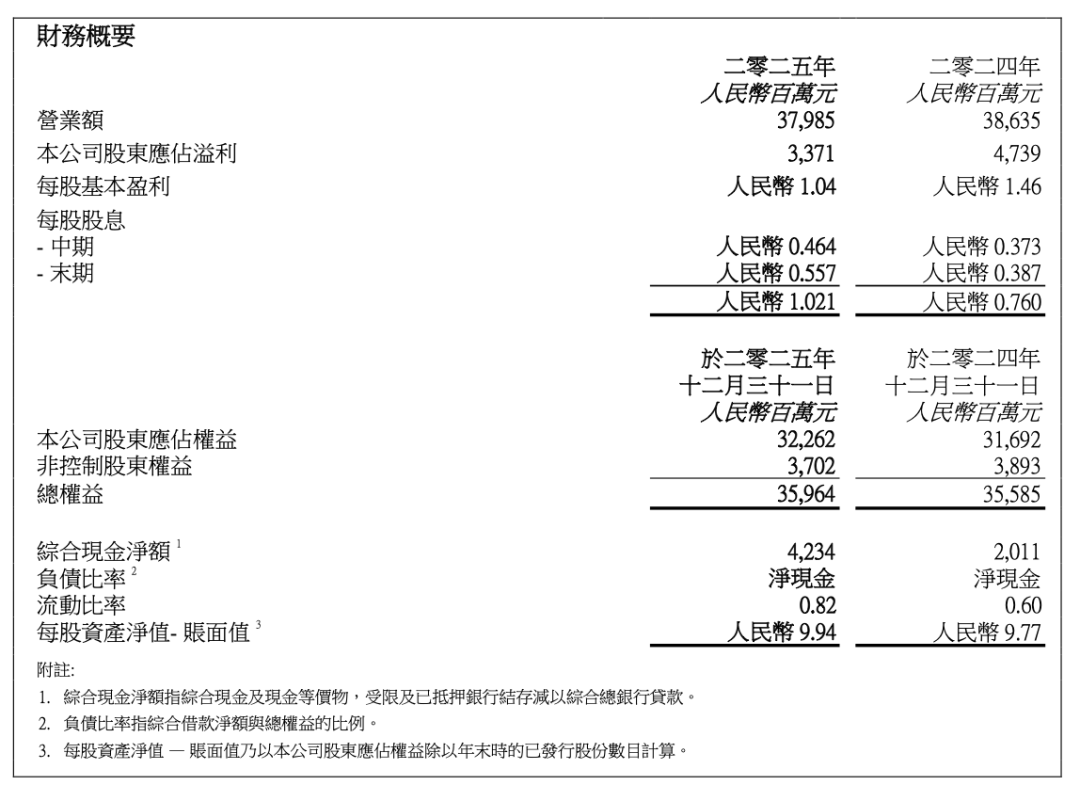
Core Insights - The core viewpoint of the article highlights that China Resources Beer is navigating through industry challenges, with its beer business showing strong profitability despite setbacks in its liquor segment due to goodwill impairment [1][24]. Financial Overview - In 2025, the company's revenue was RMB 37.985 billion, a slight decrease from RMB 38.635 billion in 2024 [2]. - Shareholders' profit attributable to the company was RMB 3.371 billion, down from RMB 4.739 billion in the previous year [2]. - Basic earnings per share were RMB 1.04, compared to RMB 1.46 in 2024 [2]. - The company declared a total dividend of RMB 1.021 per share, a 34.3% increase year-on-year, with a payout ratio of 98.2% [23]. Beer Business Performance - The beer segment achieved an EBITDA of RMB 9.611 billion, reflecting a year-on-year growth of 17.4% [1]. - The total revenue from the beer business was approximately RMB 36.489 billion, with a gross margin increase of 1.4 percentage points to 42.5% [6]. - Beer sales volume reached about 11.03 million kiloliters, a 1.4% increase year-on-year, outperforming the industry average [4]. High-End Product Strategy - The growth in high-end products is a key driver of profit, with mid to high-end product sales growing in the mid to high single digits, accounting for nearly 25% of total sales [7]. - Major products like Heineken and Snow Beer saw significant sales increases, with Heineken growing nearly 20% and Snow Beer increasing by 60% [7]. - The company anticipates that by 2030, the share of mid to high-end products in the Chinese beer market could exceed one million kiloliters, approaching one-third of total volume [8]. Channel Transformation - The company is undergoing a channel transformation, with online business growth exceeding 30% and instant retail growth surpassing 50% in 2025 [9]. - New consumption scenarios, such as late-night instant retail, are emerging, redefining beer consumption boundaries [10][12]. Liquor Business Challenges - The liquor segment reported revenue of RMB 1.496 billion, with a goodwill impairment of RMB 2.877 billion [13]. - The liquor industry faced significant adjustments in 2025, with a contraction in consumption scenarios and increased market concentration among leading companies [14]. - The company remains committed to its liquor strategy, viewing it as a necessary diversification despite current challenges [15][17]. Management and Strategic Planning - 2025 marked a leadership transition for the company, with a new management team initiating a review of the "14th Five-Year Plan" and outlining the "15th Five-Year Plan" for 2026-2030 [19][21]. - The strategic framework for the "15th Five-Year Plan" emphasizes operational efficiency through a "streamlined, lean, and precise" approach [22]. - The company plans to close four breweries while opening one new smart craft brewery, maintaining a total of 59 breweries with an annual capacity of approximately 19.1 million kiloliters [23].

华润啤酒:啤酒业务彰显韧性,白酒减值落地-20260326
Guoyuan International· 2026-03-26 14:24
Investment Rating - The report maintains a "Buy" rating for China Resources Beer (291.HK) with a target price of HKD 31.0 per share, indicating a potential upside of 22.1% from the current price of HKD 25.38 [1][5][13]. Core Insights - The company's revenue for 2025 is projected at HKD 379.85 billion, reflecting a year-on-year decline of 1.68%, primarily due to the underperformance of its liquor business. The net profit attributable to shareholders is expected to be HKD 33.71 billion, down 28.87% year-on-year, largely impacted by a liquor impairment of HKD 28.77 billion. Excluding this impairment, the adjusted net profit would be HKD 57.24 billion, representing a growth of 19.6% [3][8]. - The beer segment shows resilience, with revenue remaining stable at HKD 382.57 billion and beer sales increasing by 1.4% to 11.03 million tons. The company's high-end strategy continues to drive growth, with premium and above beer sales rising nearly 10% [3][9]. - The liquor business faced significant challenges, with revenue dropping 30.39% to HKD 14.96 billion. The company has recognized an impairment of HKD 28.77 billion for goodwill in this segment, but the EBITDA for the liquor business, excluding this impairment, is HKD 2.64 billion [5][12]. Summary by Sections Financial Performance - In 2025, the company achieved a revenue of HKD 379.85 billion, a slight decrease of 1.68% year-on-year. The net profit attributable to shareholders was HKD 33.71 billion, down 28.87% due to the liquor impairment. Adjusted net profit, excluding the impairment, was HKD 57.24 billion, up 19.6% [3][8]. - The gross margin improved to 43.1%, benefiting from cost savings and product mix optimization, while adjusted EBITDA reached HKD 96.11 billion, a 17.4% increase [8][9]. Business Strategy - The company is committed to its high-end strategy in the beer segment, which has shown resilience against industry challenges. The focus on premium products is expected to continue driving growth, with plans to enhance craft beer production and expand into international markets [9][12]. - In response to the liquor market's difficulties, the company is actively seeking to optimize its operations, including expanding wholesale channels and improving organizational efficiency [5][12]. Future Outlook - The report forecasts net profits for 2026-2028 to be HKD 58.95 billion, HKD 63.62 billion, and HKD 68.44 billion, respectively, indicating growth rates of 74.9%, 7.9%, and 7.6% year-on-year [6][13].
华润啤酒:2025年啤酒业务销量微增、结构优化,白酒业务承压-20260326
Guoxin Securities· 2026-03-26 05:45
Investment Rating - The investment rating for China Resources Beer is "Outperform the Market" [5][9] Core Insights - In 2025, the company reported revenue of 39.79 billion yuan, a year-on-year decrease of 1.7%, and a net profit attributable to shareholders of 3.37 billion yuan, down 28.9%, primarily due to goodwill impairment of approximately 2.88 billion yuan related to its liquor business [1][7] - The beer business showed a slight increase in sales volume, with a year-on-year growth of 1.4%, while the average price per ton decreased by 1.4%. The share of premium products increased to nearly 25%, with Heineken sales growing by nearly 20% [1][7] - The liquor business faced significant challenges, with revenue of nearly 1.5 billion yuan, down 30.4% year-on-year, affected by weakened demand and changes in consumption scenarios [2][8] Financial Performance Summary - The beer business achieved a gross margin of 42.5%, an increase of 1.4 percentage points year-on-year, benefiting from lower raw material costs. The core EBITDA margin and EBIT margin increased by 3.9 and 3.8 percentage points, respectively, due to cost reductions and significant expense savings [1][7] - The company maintained a high dividend payout ratio of 98%, with operating cash flow of 7.13 billion yuan, up 3% year-on-year, and free cash flow of approximately 5.29 billion yuan after capital expenditures [2][8] - The earnings forecast for 2026-2028 has been slightly adjusted, with expected revenues of 39.09 billion yuan, 39.86 billion yuan, and 40.75 billion yuan, representing year-on-year growth of 2.9%, 2.0%, and 2.2%, respectively. Net profit is projected to be 5.92 billion yuan, 6.19 billion yuan, and 6.52 billion yuan for the same years, reflecting significant growth in 2026 [3][9]
华润啤酒(00291.HK):白酒业务减值落地 啤酒业务盈利稳步提升
Ge Long Hui· 2026-03-26 05:17
Core Viewpoint - The company demonstrated resilience in overall performance supported by its beer business, while the liquor segment faced short-term pressure due to industry adjustments. In 2025, total revenue was 37.985 billion yuan, a slight decrease of 1.68% year-on-year, with net profit attributable to shareholders at 3.371 billion yuan, down 28.87% primarily due to a goodwill impairment of 2.877 billion yuan related to the liquor business [1]. Group 1: Beer Business Performance - The beer business generated revenue of 13.33 billion yuan, a year-on-year decline of 4.3%. However, the overall beer business revenue remained stable at 36.49 billion yuan, with sales volume reaching 11.03 million kiloliters, a growth of 1.4% [2]. - The average price per ton for beer was 3,308 yuan, down 1.4% year-on-year, mainly due to pressure in the second half of the year. Despite this, the beer business's gross margin improved by 1.4 percentage points to 42.5% [2]. - The core product "Heineken" achieved nearly 20% sales growth, while regional high-end products like "Old Snow" and "Red Duke" saw growth of 60% and 100%, respectively. The company is expected to maintain a high growth rate in 2026 due to a clear trend of structural upgrades and strong core product momentum [2]. Group 2: Liquor Business Challenges - The liquor business reported revenue of 1.496 billion yuan in 2025, a decline of 30.39% year-on-year, facing challenges such as reduced market capacity and increased inventory [3]. - The company recognized a goodwill impairment of 2.877 billion yuan for the liquor business, which, while impacting current profits, alleviated market concerns regarding potential risks associated with goodwill valuation [3]. - The company plans to enhance the liquor business by optimizing personnel and supply chain efficiency, focusing on key products like "Zhai Yao" and "Jin Sha" series. If external demand improves, the liquor business may exhibit significant fundamental elasticity [3]. Group 3: Financial Metrics and Profitability - In 2025, the company achieved a gross margin of 43.07%, an increase of 0.43 percentage points year-on-year, with a sales expense ratio decreasing by 1.36 percentage points to 20.33% [3]. - The adjusted net profit margin (excluding impairments and special items) improved by 2.75 percentage points to 15.07%, indicating ongoing enhancements in profitability [3]. - The company anticipates further optimization of expense ratios, suggesting that profitability improvements may be sustainable in the future [3]. Group 4: Profit Forecast - The company forecasts net profits attributable to shareholders for 2026-2028 to be 6.009 billion, 6.342 billion, and 6.567 billion yuan, with year-on-year growth rates of 78.3%, 5.5%, and 3.5%, respectively [4]. - The current stock price corresponds to price-to-earnings ratios of 11.93, 11.3, and 10.92 for the respective years [4].