医药生物

Search documents
北交所近四成公司晒“成绩单”,盈利修复动能显现
Huan Qiu Wang· 2026-02-04 01:43
Group 1 - The core viewpoint of the articles highlights the performance disclosure of companies listed on the Beijing Stock Exchange (BSE) for the year 2025, indicating a mixed performance trend among these companies [1][3] - As of the end of January, 3 companies have released performance reports, and 123 companies have issued performance forecasts, accounting for over 40% of the total listed companies on the BSE [1] - Among the disclosed companies, 77 reported profits, with a profit margin exceeding 60%, and 6 companies are expected to achieve net profits exceeding 100 million yuan [3] Group 2 - The North Exchange 50 index continues to play a stabilizing role, with companies like Jilin Carbon Valley, Fujida, and Lintai New Materials ranking high in net profit [3] - There is an increase in companies expected to turn losses into profits, with 13 companies projected to achieve this in 2025, a significant rise compared to 2024 [3] - Companies such as Shibibai expect a net profit of 50 to 60 million yuan, with a year-on-year increase of up to 17 times, benefiting from capacity release and improved order acceptance [3] Group 3 - Some companies still face performance pressures, with Haitai New Energy expected to report a loss of 580 to 680 million yuan, potentially marking its first loss since listing in 2022 [3] - Industries showing performance growth are primarily in machinery and automotive sectors, while pharmaceutical and basic chemical industries are under significant pressure [3] - The North Exchange 50 index rebounded by 3.27% to close at 1549.51 points, with trading volume and value increasing by 9.28% and 8.83% respectively [4] Group 4 - Analysts suggest that structural investment opportunities in the BSE are likely to continue, with a focus on companies with positive performance forecasts and core technologies aligned with national strategic directions [4] - The number of qualified investor accounts has surpassed 10 million, indicating a steady increase in market vitality and attractiveness [4]


【读财报】1月董监高增减持动态:增持总额同比增逾六成 大中矿业、凯普生物增持金额较多
Xin Hua Cai Jing· 2026-02-03 23:27
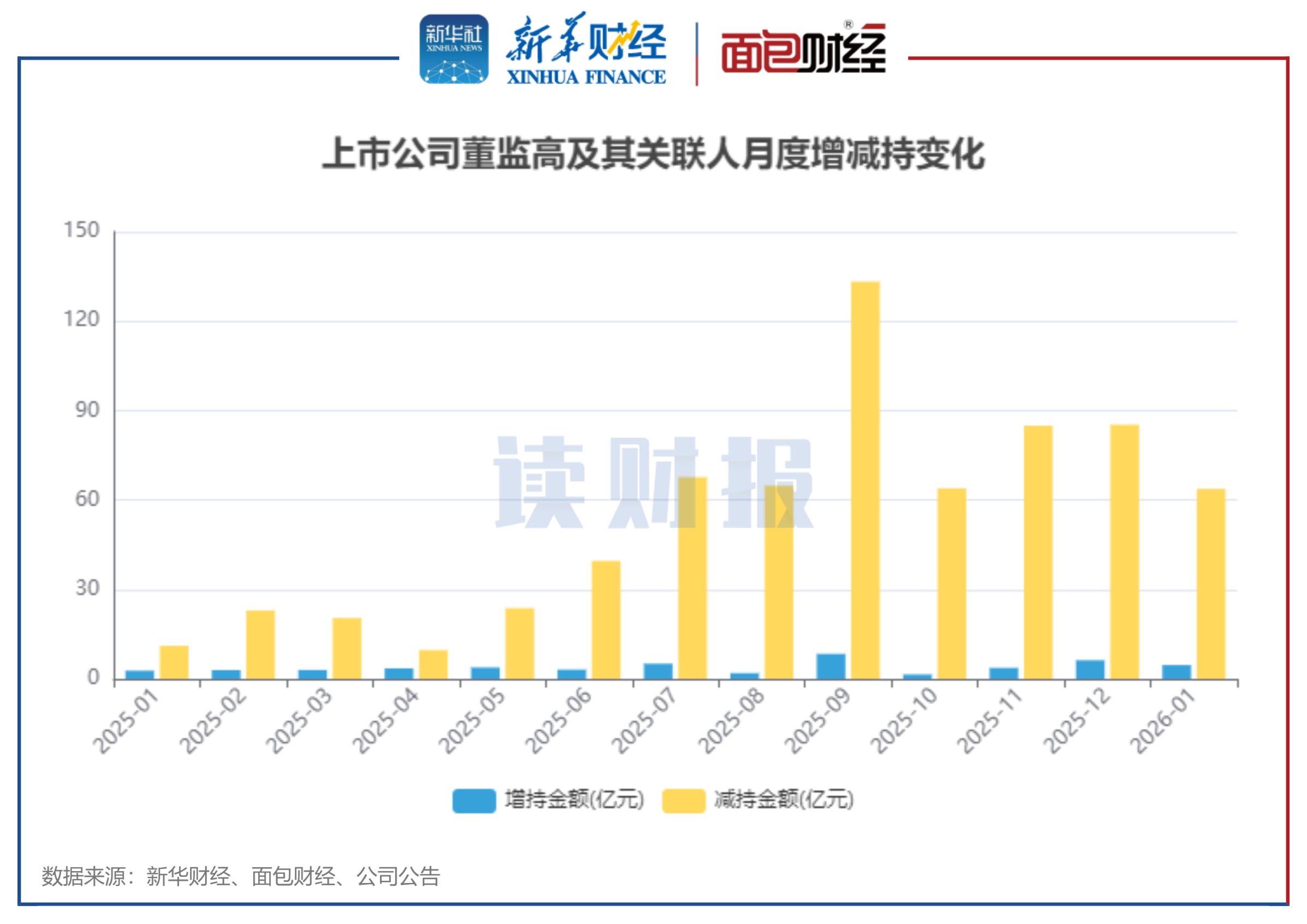
Core Viewpoint - In January 2026, the total amount of stock reduction by executives and their related parties in the Shanghai and Shenzhen stock markets reached approximately 6.373 billion yuan, with a net reduction of about 5.91 billion yuan after accounting for increases [1][4]. Group 1: Stock Reduction - The total reduction amount in January 2026 was approximately 6.373 billion yuan, involving 222 companies [4][12]. - The highest reduction amount was from Tianshan Aluminum, with a reduction of approximately 816 million yuan [5][12]. - The second highest reduction was from Gaode Infrared, totaling approximately 798 million yuan [5][12]. - Perfect World ranked third with a reduction of approximately 464 million yuan [5][12]. - The non-metallic mineral industry had the highest reduction amount, approximately 1.113 billion yuan, followed by the defense industry at about 889 million yuan [12][21]. Group 2: Stock Increase - The total amount of stock increase in January 2026 was approximately 462 million yuan, involving 34 companies [13][21]. - The highest increase was from Dazhong Mining, with an increase of approximately 392 million yuan [15][18]. - The second highest increase was from Kaipu Biological, totaling approximately 27 million yuan [15][18]. - The third highest increase was from Sentai Co., with an increase of approximately 15 million yuan [15][18]. - The steel industry had the highest increase amount, approximately 392 million yuan, followed by the pharmaceutical industry at about 27 million yuan [21].
山东省上市公司白皮书(2026)-山东省亚太资本研究院
Sou Hu Cai Jing· 2026-02-03 17:04
2025 年,在资本市场高质量发展与科技创新双向赋能下,山东上市公司呈现稳中有进、结构优化的发展态势,为全省经济高质量发展注入强劲动力。 核心发展态势 截至 2025 年末,山东上市公司达 311 家,总市值 4.91 万亿元,同比增长 35.82%,首现超 5000 亿元市值企业(中际旭创)。股权融资表现亮眼,IPO 融资 34.26 亿元,同比增长 23.02%;股权再融资 214.75 亿元,同比激增 534.23%,定向增发为主要融资方式。市场生态持续净化,全年受处罚次数和金额分别下 降 46.21% 和 74.30%。 对比与展望 与粤苏浙相比,山东上市公司数量、融资规模仍有差距,但板块指数涨幅 44.25% 居全国第三,新质生产力布局成效初显。随着新旧动能转换推进,山东上 市公司在科技研发与产业创新融合上持续发力,未来将进一步依托资本市场实现高质量发展。 融资结构优化:5 家 IPO 企业集中在医药生物、电子等高新领域,3 家为专精特新企业,新股上市首日平均涨幅超 6 倍,赚钱效应显著。 市值与行业变革:烟台上市公司市值增长 94.15%,占全省增量 56.67%,跃居省内首位;通信行业市值首超基 ...

私募机构今年首月调研超2000次 重视科技主线
Zheng Quan Ri Bao Zhi Sheng· 2026-02-03 16:38
Group 1 - In January 2026, a total of 743 private equity firms participated in the A-share market company research, involving 366 stocks across 28 first-level industries, with a total of 2028 research instances [1] - The electric equipment industry saw significant interest, with companies like Dajin Heavy Industry attracting 54 private equity firms for research, indicating a strong focus on this sector [1] - The computer industry led the research activity with 326 instances, involving 34 listed companies, highlighting the sector's attractiveness for private equity investments [2] Group 2 - The automotive industry had two companies, Chaojie Co. and Ninebot, ranked among the top ten in research frequency, with 41 and 40 instances respectively, showing strong interest from major private equity firms [2] - Private equity firms are focusing heavily on the computer sector due to its potential for excess returns, driven by advancements in AI applications and semiconductor supply chains [3] - In January, 34 private equity firms conducted at least 10 research instances, with firms like Shanghai Jianshun Investment and Guangdong Zhengyuan Private Fund being particularly active [3]
——转债月报20260203:业绩预告披露收尾,整体延续改善-20260203
Huachuang Securities· 2026-02-03 14:22
1. Industry Investment Rating No information about the industry investment rating is provided in the report. 2. Core Views - The disclosure rate and pre - happy rate of listed companies' performance forecasts have both increased. The overall performance shows significant repair characteristics, and the market's consensus expectation for the whole year is more optimistic [1][2]. - As February enters the period of performance and economic data vacuum, the market's policy - gaming sentiment may gradually heat up. The stock market generally has good expected performance after the Spring Festival and before the Two Sessions. Attention can be paid to sectors with strong performance expectations and low premium rates [22]. - The convertible bond valuation still has support and may maintain high - level fluctuations. The new bond issuance continues to be light, but the pace of pre - plans has accelerated [3][4][60]. 3. Summary by Directory 3.1 Annual Report Forecast Period Ends, Driving Force Shifts to Performance Verification - **Disclosure and Pre - happy Rates**: As of January 30, 2026, the disclosure rate of performance forecasts of listed companies was 54.98%, a year - on - year increase of 1.83pct. The overall pre - happy rate was 36.87%, a year - on - year increase of 4.46pct [10]. - **Performance Repair**: The median year - on - year growth rate of the net profit attributable to the parent of the whole market in 2025 was 20.29%, a significant improvement compared with - 18.58% in 2024. The growth of industrial added value and the narrowing of PPI decline contributed to the positive growth of industrial enterprise profits [12]. - **Sector Performance**: The net profit growth rate of the GEM was relatively strong, with a growth rate center of 26.57% and a year - on - year increase of 74.62pct, driven by the low - base effect and the performance explosion in the computing power sector [12]. - **Industry Performance**: The pre - happy rates of the non - bank finance and non - ferrous metals industries led, and the net profit growth rate centers of these two industries were also among the top [18]. - **Convertible Bond Underlying Stocks**: The disclosure rate of convertible bond underlying stocks was 49.86%, and the pre - happy rate was 31.11%. The year - on - year growth rate center of the net profit in 2025 turned from loss to profit [20]. 3.2 Valuation Outlook - **Valuation Increase in January**: The convertible bond ETF share continued to grow, and major holders such as public funds increased their holdings. The convertible bond valuation rose to a new high, with the 100 - yuan parity fitted conversion premium rate reaching 37.11% as of January 30, 2026, a 3.05pct increase from the end of 2025 [23]. - **Future Valuation**: The probability of the spring rally continuing is not low. The adjustment of positions of financial products and insurance may be the key incremental factor in the first half of the year. The valuation may maintain high - level fluctuations [23]. 3.3 Key Focused Convertible Bonds - **January Performance**: From December 31, 2025, to January 30, 2026, the convertible bond portfolio rose 13.79%, outperforming the benchmark index by 7.95pct. Huayi and Huachen had obvious increases [36]. - **February Portfolio Adjustment**: The "Huachuang Convertible Bond" February key - focused portfolio was adjusted to include Xingqiu, Mingli, Yirui, Huachen, Huayi, Yifeng, Bengang, Peidi, Ziyin, Qingnong, Zhongyin, and Xingye [38]. 3.4 Market Review - **Market Performance in January**: The convertible bond market fluctuated strongly, with the small - cap style leading. The Shanghai Composite Index, Shenzhen Component Index, and other major indexes all rose, and the convertible bond valuation increased by 3.05pct month - on - month [45]. - **Market Trends**: The TMT and manufacturing sectors were popular, while the financial and real - estate sectors were relatively stable. Most industries in the convertible bond and underlying stock markets rose, and there was obvious rotation among sectors [49]. - **Fund Performance**: The daily trading volume of the equity and convertible bond markets increased, and the margin trading balance also increased. Most industries received net margin purchases [55][56]. 3.5 Supply and Demand Situation - **New Bond Issuance in January**: Five new convertible bonds were issued, with a total scale of 57.80 billion yuan, and four new convertible bonds were listed, with a total scale of 41.97 billion yuan. The online new - bond subscription decreased [60]. - **Pending Issuance and New Plans**: The total pending issuance scale was about 129.911 billion yuan. Eleven new board plans were added in January, with a total scale of 137.99 billion yuan, showing both month - on - month and year - on - year increases [67]. - **Redemption and Downward Revision**: Sixteen convertible bonds announced redemption, and five convertible bonds announced proposals for downward revision [75]. - **Holder Changes**: The total scale of convertible bonds held by various entities in the Shanghai and Shenzhen Stock Exchanges decreased. The scale of convertible bonds held by public funds increased, while that of enterprise annuities and securities companies decreased [82][85][89].
百诚医药动态跟踪——短期业绩承压,自研驱动创新转型
Orient Securities· 2026-02-03 13:25
Investment Rating - The report maintains a "Buy" rating for the company with a target price of 53.84 CNY [4][7]. Core Insights - The company's short-term performance is under pressure due to intensified competition and policy impacts, leading to a downward revision of revenue and profit forecasts for 2025-2026 [4][10]. - Despite the short-term challenges, the company has significant long-term growth potential driven by self-research and innovation transformation [4][10]. - The company is expected to leverage its integrated service capabilities in contract research and development (CRO) and contract development and manufacturing organization (CDMO) to enhance its business structure and return to a growth trajectory [10]. - The company has a robust pipeline of self-researched products, with 132 projects under development, including 37 approved projects, which are anticipated to contribute positively to future revenues [10]. - The company is actively transitioning to innovative drug development, with 15 ongoing projects in critical therapeutic areas, which could provide a second growth curve through partnerships and milestone payments [10]. Financial Summary - Revenue is projected to decline from 1,017 million CNY in 2023 to 696 million CNY in 2025, with a recovery expected in subsequent years [6][12]. - The net profit attributable to the parent company is forecasted to be a loss of 53 million CNY in 2024, with a gradual return to profitability by 2026 [6][12]. - The earnings per share (EPS) is expected to drop to -0.63 CNY in 2025, before recovering to 0.37 CNY in 2026 and 0.61 CNY in 2027 [6][12]. - The gross margin is projected to decrease from 65.5% in 2023 to 52.0% in 2024, with a gradual recovery thereafter [6][12].
百诚医药(301096):动态跟踪:短期业绩承压,自研驱动创新转型
Orient Securities· 2026-02-03 11:47
Investment Rating - The report maintains a "Buy" rating for the company with a target price of 53.84 CNY [4][7]. Core Insights - The company's short-term performance is under pressure due to intensified competition and policy impacts, leading to a downward revision of revenue and profit forecasts for 2025-2026 [4][10]. - Despite the short-term challenges, the company has significant long-term growth potential driven by self-research and innovation transformation [4][10]. - The company is expected to leverage its integrated service capabilities in contract research and development (CRO) and contract development and manufacturing organization (CDMO) to enhance its business structure and return to a growth trajectory [10]. - The company has a robust pipeline of self-researched products, with 132 projects under development, including 37 approved products, which are anticipated to contribute to stable revenue growth as they enter commercialization [10]. - The company is actively transitioning to innovative drug development, with 15 ongoing projects in key therapeutic areas, which could provide a second growth curve through partnerships and milestone payments [10]. Financial Summary - Revenue is projected to decline from 1,017 million CNY in 2023 to 696 million CNY in 2025, with a recovery to 889 million CNY by 2027 [6]. - The net profit attributable to the parent company is expected to turn negative in 2024 and 2025, with forecasts of -53 million CNY and -69 million CNY respectively, before recovering to 67 million CNY in 2027 [6]. - The earnings per share (EPS) is forecasted to be -0.63 CNY in 2025, with a recovery to 0.61 CNY by 2027 [6]. - The gross margin is expected to decrease from 65.5% in 2023 to 52.0% in 2024, before gradually improving to 56.4% by 2027 [6].
2月3日创业板医疗(970082)指数涨2.37%,成份股诺思格(301333)领涨
Sou Hu Cai Jing· 2026-02-03 10:53
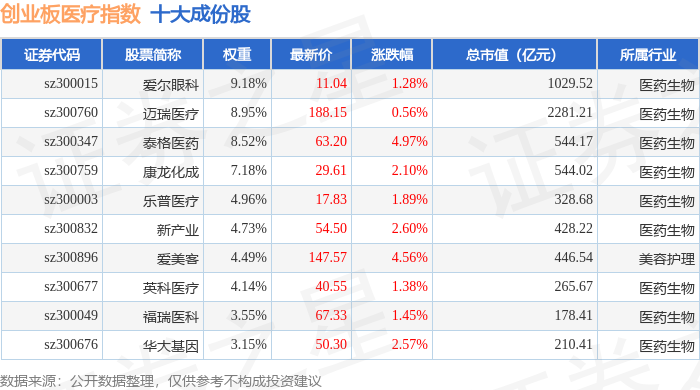
Core Viewpoint - The ChiNext Medical Index (970082) closed at 3876.07 points on February 3, with a gain of 2.37% and a trading volume of 13.236 billion yuan, indicating positive market sentiment in the medical sector [1]. Group 1: Index Performance - The ChiNext Medical Index saw 49 constituent stocks rise, with NuoSiGe leading the gains at 8.76% [1]. - The index's turnover rate was 1.71%, reflecting moderate trading activity [1]. Group 2: Top Constituents - The top ten constituents of the ChiNext Medical Index include: - YuanEr Eye Hospital (sz300015) with a weight of 9.18% and a latest price of 11.04 yuan, up 1.28% [1]. - MaiRui Medical (sz300760) with a weight of 8.95% and a latest price of 188.15 yuan, up 0.56% [1]. - TaiGe Medical (sz300347) with a weight of 8.52% and a latest price of 63.20 yuan, up 4.97% [1]. - KangLong HuaCheng (sz300759) with a weight of 7.18% and a latest price of 29.61 yuan, up 2.10% [1]. - LePu Medical (sz300003) with a weight of 4.96% and a latest price of 17.83 yuan, up 1.89% [1]. - New Industry (sz300832) with a weight of 4.73% and a latest price of 54.50 yuan, up 2.60% [1]. - AiMeiKe (sz300896) with a weight of 4.49% and a latest price of 147.57 yuan, up 4.56% [1]. - YingKe Medical (sz300677) with a weight of 4.14% and a latest price of 40.55 yuan, up 1.38% [1]. - FuRui Medical (sz300049) with a weight of 3.55% and a latest price of 67.33 yuan, up 1.45% [1]. - HuaDa Gene (sz300676) with a weight of 3.15% and a latest price of 50.30 yuan, up 2.57% [1]. Group 3: Capital Flow - The net inflow of main funds into the ChiNext Medical Index constituents totaled 145 million yuan, while retail investors experienced a net outflow of 106 million yuan [1]. - The detailed capital flow indicates that TaiGe Medical had a main fund net inflow of 10.514 million yuan, while retail investors had a net outflow of 18.28% [2].





机构1月调研动向曝光!银行业调研热度上升
证券时报· 2026-02-03 10:52
Group 1 - In January 2026, over 600 A-share listed companies were surveyed by institutions, indicating a high level of interest in investment opportunities in the A-share market [1][3] - The sectors that attracted the most attention included electronics, machinery, pharmaceuticals, power equipment, and computers, with a notable increase in the banking sector's activity [1][8] - Jiemai Technology was the most frequently surveyed company, with over 10 surveys conducted in January, highlighting the interest from various types of institutions including public funds, private funds, and foreign capital [3][4] Group 2 - Ice Wheel Environment and Taihe New Materials also received significant attention, each with over 10 surveys, discussing their product developments and market strategies [4][5] - The banking sector saw a marked increase in survey activity, with institutions like Hu Nong Commercial Bank and Suzhou Bank outlining their credit strategies and growth plans for 2026 [7][9] - Hu Nong Commercial Bank emphasized a balanced approach to risk while setting aggressive credit targets, focusing on major projects and green transformation initiatives [9][10]






晚间公告|2月3日这些公告有看头
Di Yi Cai Jing· 2026-02-03 10:24
Investment Projects - Huangshan Tourism plans to invest approximately 530 million yuan in the construction of the Huangshan Binjiang East Road No. 12 hotel project, with a total construction area of 79,178.15 square meters and a construction period of 24 months [2] - Xuguang Electronics intends to raise no more than 1 billion yuan through a private placement to fund projects including the expansion of high-voltage vacuum arc extinguishing chambers and other R&D initiatives [4] - Jichuan Pharmaceutical's subsidiary has paid 80 million yuan for exclusive commercialization rights of the Inusimab injection, indicating a strategic move into the biopharmaceutical market [5] Stock Performance and Risks - Hangdian Co. reported a significant stock price increase of 32.97% over three trading days, but warns of potential trading risks due to a negative rolling P/E ratio and expected net loss of approximately 300 million yuan for 2025 [3] - Sanbian Technology and Tiantong Co. both experienced abnormal stock price fluctuations, with no undisclosed significant information affecting their operations [6][7] - Wanfeng Co. noted a stock price increase of 46.43% while highlighting uncertainties regarding the price changes of core intermediate products and their impact on future earnings [8] Financial Performance - Gaotie Electric reported a net profit of 51.46 million yuan for 2025, a year-on-year increase of 14.02%, with total revenue of 1.181 billion yuan, up 17.16% [10] - Yaokang Bio achieved a net profit of 144.40 million yuan, reflecting a 31.49% increase year-on-year, driven by improved overseas sales and domestic demand recovery [11] - Babi Foods reported a slight decline in net profit to 273 million yuan, despite a revenue increase of 11.22% to 1.859 billion yuan, indicating challenges in maintaining profitability [12] - Zhongyuan Media's net profit rose by 30.99% to 1.349 billion yuan, despite a revenue decline of 5.13% [13] Shareholding Changes - Shangluo Electronics' controlling shareholder plans to reduce their stake by 3% due to personal financial needs [15] - Yilian Technology's shareholder intends to reduce their holdings by up to 2% within three months [16] - Wuxi Zhenhua's shareholders plan to reduce their stakes by 2% and 1% respectively [17] - Changchun Yidong's shareholder intends to reduce their stake by 3% through various trading methods [18] Major Contracts - Yitong Century has been pre-selected for a 1.07 billion yuan comprehensive maintenance service project with China Tower [20] - Chengbang Co. signed new project contracts worth 40.03 million yuan in Q4 2025, contributing to a total of 1.43 billion yuan for the year [21] - Hongfuhan signed a contract worth 480 million yuan with Guangdong Quanxiang for the supply of robots and related products, which is expected to significantly impact future earnings [22]