
基金业

Search documents
黄金强劲反弹!黄金股ETF(517520)开盘涨近2%
Xin Lang Cai Jing· 2025-10-21 02:21
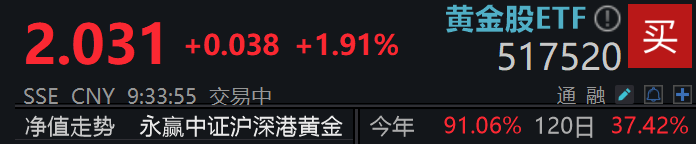
Core Insights - The gold sector is experiencing a strong upward trend, with the CSI Gold Industry Index rising by 1.70% and key stocks like Zhaojin Mining and Zijin Mining showing significant gains [1] - The Gold Stock ETF has seen a notable increase in both scale and shares, indicating growing investor interest and confidence in gold as a safe-haven asset [2] - The ongoing U.S. government shutdown is contributing to economic uncertainty, which is further driving demand for gold and other precious metals [3] Group 1: Market Performance - The CSI Gold Industry Index (931238) increased by 1.70%, with Zhaojin Mining (01818) up 4.13% and Zijin Mining (02899) up 3.82% [1] - The Gold Stock ETF (517520) rose by 1.91%, with a 10.48% increase over the past month [1][2] Group 2: Fund Flows and Investor Sentiment - The Gold Stock ETF has seen a scale increase of 320 million yuan over the past week, ranking it among the top in its category [2] - The ETF's shares reached a new high of 6.8 billion, reflecting strong investor interest [2] - Continuous net inflows into the Gold Stock ETF over the past eight days totaled 1.965 billion yuan, with a peak single-day inflow of 583 million yuan [2] Group 3: Economic Context - The U.S. government shutdown has led to significant delays in economic data releases, increasing market uncertainty and boosting safe-haven demand for gold [3] - Political and economic concerns are identified as key drivers for the recent rebound in gold prices following a decline [3] - Expectations for a potential interest rate cut by the Federal Reserve have risen to 97%, further supporting gold prices [3]

金价涨超50%破4200美元!银行只买不卖,美元体系要变天?
Sou Hu Cai Jing· 2025-10-21 00:09
Core Viewpoint - Central banks worldwide are aggressively accumulating gold, leading to a historic shift in the monetary system, with global central bank gold reserves surpassing U.S. Treasury holdings for the first time in 30 years [1] Group 1: Gold Price Surge - In October 2025, gold prices soared past $4,300 per ounce, marking the fastest annual increase since 1980, with prices rising from over $3,000 just months earlier [3] - The unusual simultaneous rise of both gold and U.S. stocks reflects a market divided between optimism over tax cuts and concerns over trade protectionism and geopolitical risks [3] - The Federal Reserve's decision to cut interest rates by 25 basis points in September 2025, due to weakening economic data, has decreased the attractiveness of dollar assets and lowered the opportunity cost of holding gold [3] Group 2: Global Risk Factors - By October 2025, global risk aversion peaked due to multiple crises, including the U.S. government shutdown and escalating conflicts in the Middle East, driving strong demand for safe-haven assets like gold [5] - The U.S. federal debt surpassed $35 trillion, with a debt-to-GDP ratio of 126.8%, further diminishing the appeal of dollar assets [5] - Central banks adopted a "buy and hold" strategy, with global official gold reserves increasing by 166 tons in Q2 2025, and annual purchases exceeding 1,000 tons from 2022 to 2024 [5][6] Group 3: Central Bank Behavior - The People's Bank of China has increased its gold reserves for 11 consecutive months, reaching 2,303.5 tons by the end of September 2025 [6] - Emerging market central banks are actively converting part of their foreign reserves into physical gold to reduce their exposure to dollar assets [6] - Central banks' gold purchases are strategic, aimed at hedging against dollar credit risks and enhancing their geopolitical influence [6] Group 4: Changing Dynamics of Gold Pricing - The share of the U.S. dollar as a global reserve currency has declined from 71.5% in 2000 to about 55% in Q2 2025, while gold's share in official reserves has risen to 20% [8] - The shift in gold pricing logic has transformed it from an inflation hedge to a core asset for mitigating sovereign credit risks [11] - Major financial institutions have differing forecasts for gold prices, with Goldman Sachs raising its 2026 price target to $4,900 per ounce, while Bank of America predicts $5,000 [12][13]

“十五五”规划前瞻:国际篇+金融篇
2025-10-19 15:58
Summary of Key Points from Conference Call Records Industry Overview - The records discuss the Chinese economy and its strategic responses to global geopolitical challenges, particularly in the context of the "14th Five-Year Plan" and the upcoming "15th Five-Year Plan" [1][2][3]. Core Insights and Arguments - **Economic Growth Projections**: China's economic growth is expected to maintain a range of 4.6% to 4.8% during the "15th Five-Year Plan" period, with a focus on energy supply security through strategic partnerships, particularly with Russia [1][3]. - **Foreign Trade Expansion**: By 2024, China's foreign trade is projected to reach $6.16 trillion, marking a 32.4% increase compared to the previous five-year period, maintaining its position as the world's largest trading nation [1][4]. - **Trade Structure Optimization**: The importance of ASEAN and the EU as trading partners is increasing, while the significance of the U.S. is declining. High-tech, green, and electromechanical products are identified as core drivers of exports [4]. - **Financial Policy Focus**: The financial policies during the "14th Five-Year Plan" emphasized service to the real economy, financial security, and supply-side structural reforms, with a new goal of building a financial powerhouse [5]. Important but Overlooked Content - **Challenges for Private and Tech Enterprises**: Private and tech enterprises face high loan interest rates, reliance on collateral for financing, and a low proportion of direct financing (31.6%) compared to developed countries (60%-80%) [6]. - **Strategic Directions for Financial Institutions**: Financial institutions are expected to adjust their strategies to focus on technology finance, green finance, and pension finance, with an emphasis on supporting innovation and sustainable development [7][9][10]. - **Internationalization of the Renminbi**: There is a push for the gradual internationalization of the Renminbi, with current foreign holdings of domestic bonds and stocks at only 3%-4%, indicating significant room for growth [8]. Sector-Specific Developments - **Banking Sector**: The banking industry will prioritize resources towards strategic areas such as technology innovation and green finance, utilizing differentiated products like intellectual property pledge loans [9]. - **Insurance Sector**: The insurance industry aims to enhance health insurance and long-term care systems to address aging population needs while increasing equity asset allocation in tech and green sectors [9]. - **Fund Management**: The fund industry is transitioning from a focus on scale to one on returns, emphasizing investments in pension-targeted funds and ESG products [10]. - **Securities Sector**: The securities industry is expected to evolve towards a more integrated, professional, and digital approach, focusing on investment banking and wealth management [10].
M2与社融增速保持较高水平
Jin Rong Shi Bao· 2025-10-16 00:50
Core Insights - The central viewpoint of the reports indicates that the growth rates of M2 and social financing remain high, creating a favorable monetary environment for economic recovery [1][2][3] Monetary Supply and Financing - As of September 2025, the M2 balance reached 335.38 trillion yuan, with a year-on-year growth of 8.4%, which is 1.5 percentage points higher than the same period last year [1] - The social financing scale stood at 437.08 trillion yuan, with a year-on-year increase of 8.7%, reflecting a sustained high growth rate [2] - Government bonds have significantly supported the growth of social financing, with accelerated issuance this year aiding direct financing [2][3] Credit Growth and Structure - In September, the year-on-year growth of RMB loans was 6.6%, which adjusts to approximately 7.7% after accounting for local special bond replacements [4] - Corporate loans have shown strong growth, particularly in the manufacturing sector, which accounted for over half of the bank's corporate loans [4][7] - Personal consumption loans have increased due to lower interest costs and adjustments in housing purchase policies in major cities, leading to a rise in housing loan demand [5][6] Financial Support for the Real Economy - The financial system's support for the real economy is not limited to loans, as banks are also significant participants in bond investments, holding about 25% of total bank assets in bonds [3][6] - The balance of inclusive small and micro loans reached 36.09 trillion yuan, growing by 12.2%, while medium and long-term loans for manufacturing increased by 8.2% [7][8] - The structure of credit is evolving, with a shift towards supporting manufacturing and technology innovation, while traditional sectors like real estate are seeing a decrease in loan proportions [7][8]
前三季度新增社融超30万亿元,背后信号很大
2 1 Shi Ji Jing Ji Bao Dao· 2025-10-15 13:54
Core Insights - The People's Bank of China reported that the total social financing increased by 4.42 trillion yuan year-on-year, reaching 30.09 trillion yuan in the first three quarters of 2025, indicating a robust financial support for the real economy [1][11] - Government bond issuance has accelerated, significantly contributing to the social financing scale, with net financing of government bonds reaching 11.46 trillion yuan, an increase of 4.28 trillion yuan year-on-year [1][12] - The structure of financing shows that loans to the real economy accounted for 61.1% of the total social financing stock, while government bonds represented 21.2%, reflecting a shift towards more diversified financing channels [2][11] Financing Structure - By the end of September, the balance of RMB loans to the real economy was 61.1% of the total social financing stock, down 1.3 percentage points year-on-year [2] - The balance of corporate bonds accounted for 7.7%, down 0.3 percentage points year-on-year, while government bonds increased to 21.2%, up 2.1 percentage points year-on-year [2] - Non-financial corporate stock financing reached 316.8 billion yuan, an increase of 1.463 billion yuan year-on-year, indicating a growing reliance on equity financing [1] Deposit and Loan Trends - By the end of September, the balance of RMB deposits was 324.94 trillion yuan, growing by 8% year-on-year, with household deposits increasing by 12.73 trillion yuan [4][6] - The balance of loans was 270.39 trillion yuan, with a year-on-year growth of 6.6%, and the average interest rate for new loans was approximately 3.1%, down 40 basis points from the previous year [7][11] - The phenomenon of "deposit migration" is observed, where residents shift their savings into higher-yielding assets, influenced by changing interest rates [4][6] Monetary Policy and Economic Outlook - The M2 money supply reached 335.38 trillion yuan, growing by 8.4% year-on-year, supported by proactive fiscal policies and moderately loose monetary policies [9][11] - The narrowing gap between M1 and M2 indicates increased business activity and consumer demand, suggesting a recovery in the economy [9][11] - Experts predict that the fourth quarter will see continued monetary support for the real economy, with fiscal policies also playing a significant role in sustaining economic growth [12]

央行重磅数据发布
Zhong Guo Ji Jin Bao· 2025-10-15 13:06
Group 1 - The People's Bank of China reported that the total social financing scale exceeded 30 trillion yuan in the first three quarters of the year, reaching 30.09 trillion yuan, an increase of 4.42 trillion yuan compared to the same period last year [1] - The growth rates of social financing and broad money (M2) remained high, indicating that monetary finance continues to create a favorable environment for economic recovery [1] - The narrow money (M1) growth rate showed a significant rebound, reaching 7.2% by the end of September, reflecting increased business activity and consumer demand [1][8] Group 2 - Government bonds and corporate bonds contributed over 40% of the new social financing, with net financing from government bonds at 11.46 trillion yuan, an increase of 4.28 trillion yuan year-on-year [4] - The proportion of new social financing from RMB loans decreased to 48%, indicating a shift towards more diversified financing channels [4] - The average proportion of bonds in bank assets is around 25%, with banks being major participants in both credit issuance and bond investments [4] Group 3 - The growth of RMB loans remained stable, with new loans in September amounting to approximately 1.29 trillion yuan, despite a decrease in growth rate to 6.6% [6] - The structure of loans continued to optimize, with inclusive small and micro loans growing by 12.2% year-on-year [6] - Loan interest rates remained low, with the weighted average interest rate for new corporate loans at about 3.1%, down approximately 40 basis points from the previous year [6] Group 4 - The M1 growth rate has been rising, with a notable increase of 7.1 percentage points from the year's low in February, indicating a recovery in economic activity [9] - The "scissors difference" between M1 and M2 has narrowed, suggesting improved business operations and consumer investment [9] - The concept of "deposit migration" reflects a reallocation of residents' assets based on changes in return rates, rather than a direct impact on the stock market [10]
英华号周播报|资源和科技引领节后开门红!黄金涨疯了,还能上车吗?
Zhong Guo Ji Jin Bao· 2025-10-15 11:28
Group 1 - The article discusses the recent surge in gold prices and questions whether it is still a good time to invest in gold [1] - It highlights the performance of the resource and technology sectors, which have led the A-share market's positive momentum after the holiday [1] - The article mentions the long-term investment potential of the CSI 2000 index, particularly benefiting from technological upgrades in AI, semiconductor innovation, and high-end manufacturing [2] Group 2 - The article emphasizes the long-term opportunities in the biotechnology sector, driven by demographic trends such as population aging and the engineer dividend [2] - It notes that the valuation attractiveness of the biotechnology sector is gradually becoming evident, presenting a favorable environment for long-term investments [2]
存款搬家引关注,权威人士回应
第一财经· 2025-10-15 10:44
Core Viewpoint - The article discusses the phenomenon of "deposit migration," which is essentially a reallocation of residents' assets under the influence of interest rate mechanisms, as indicated by a market authority [3]. Group 1: Financial Statistics - In the first three quarters, the increase in RMB deposits reached 22.71 trillion yuan, with household deposits rising by 12.73 trillion yuan, non-financial enterprise deposits by 1.53 trillion yuan, fiscal deposits by 1.37 trillion yuan, and deposits from non-banking financial institutions by 4.81 trillion yuan [3]. - The growth rate of household deposits has slowed compared to previous highs, while non-bank deposits have maintained rapid growth [3]. Group 2: Deposit Migration - The term "deposit migration" refers to the phenomenon where residents convert their savings deposits in banks into other assets based on changes in asset return rates, reflecting a reallocation of their assets [3]. - Over the past 20 years, various asset types such as stocks, real estate, internet financial products, bank wealth management, and funds have served as destinations for the migration of household deposits, with these flows being dynamic and bidirectional based on market conditions [3]. Group 3: Market Dynamics - Experts suggest that deposit migration is a result of relative changes in yields across different financial markets rather than a cause. When expected yields on bonds and stocks rise, there is a tendency to increase holdings in these assets, leading to a corresponding reduction in other assets under budget constraints [4]. - Since 2023, the elasticity of the interest rate differential between deposit rates and other financial asset yields has increased, resulting in frequent occurrences of both "deposit migration" and "reflow" phenomena [4].

前三季度社融增量突破30万亿元,M1增速攀升至7.2%有何信号?
Zheng Quan Shi Bao· 2025-10-15 09:54
Group 1 - The core viewpoint of the article highlights the significant increase in social financing scale and the stability of credit growth in China during the first three quarters of the year, indicating a supportive monetary environment for economic recovery [1][8] - The total social financing scale reached 30.09 trillion yuan, an increase of 4.42 trillion yuan compared to the same period last year, with RMB loans increasing by 14.75 trillion yuan and RMB deposits by 22.71 trillion yuan [1][10] - The growth rates of social financing and broad money (M2) remained high, with social financing stock growth at 8.7% year-on-year and M2 growth at 8.4%, both higher than the previous year [1][12] Group 2 - In September, the narrow money (M1) growth rate rose significantly to 7.2%, reflecting increased activity in corporate operations and a recovery in personal investment and consumption demand [6][13] - The contribution of government and corporate bonds to new social financing exceeded 40%, with net financing from government bonds at 11.46 trillion yuan, up 4.28 trillion yuan year-on-year [8][10] - The structure of credit has been optimizing, with inclusive small and micro loans growing by 12.2% year-on-year and medium to long-term loans in the manufacturing sector increasing by 8.2% [10][11] Group 3 - The average interest rate for newly issued loans in September was approximately 3.1%, lower than the previous year, indicating a low-interest environment that may stimulate demand [11][12] - The phenomenon of "deposit migration" is observed, where residents are reallocating their assets based on changes in return rates, with total resident deposits increasing by 12.73 trillion yuan in the first three quarters [13][14] - Experts suggest that the monetary policy will continue to support the real economy, with fiscal policies also actively contributing to investment, aiming for a growth target of around 5% for the year [14]
前三季度社融增量突破30万亿元 M1增速攀升至7.2%有何信号?
Zheng Quan Shi Bao Wang· 2025-10-15 09:40
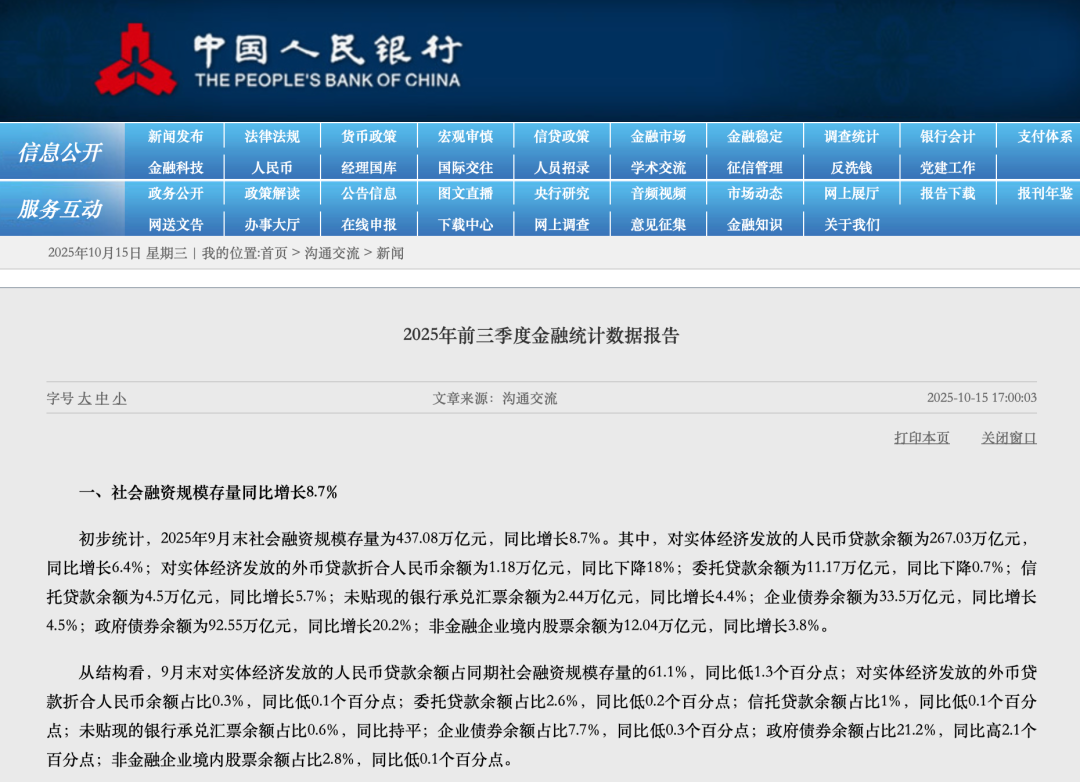
Group 1 - The People's Bank of China reported that the total social financing scale exceeded 30 trillion yuan in the first three quarters of the year, reaching 30.09 trillion yuan, an increase of 4.42 trillion yuan compared to the same period last year [1] - The growth rates of social financing and broad money (M2) remained high, indicating that monetary finance continues to create a favorable environment for economic recovery [1] - The narrow money (M1) growth rate showed a significant rebound, reaching 7.2% by the end of September, reflecting increased business activity and consumer demand [1][6] Group 2 - The combination of government and corporate bonds contributed over 40% of the new social financing, with government bond net financing at 11.46 trillion yuan, an increase of 4.28 trillion yuan year-on-year [3] - The share of corporate bond financing also increased due to supportive policies and low issuance rates, with net financing reaching 1.57 trillion yuan [3] - The proportion of new social financing from RMB loans decreased to 48%, indicating a shift towards more diversified financing channels [3] Group 3 - Credit growth remained stable, with new RMB loans in September at approximately 1.29 trillion yuan, despite a decrease in growth rate to 6.6% [4] - The structure of loans continued to optimize, with inclusive small and micro loans growing by 12.2% year-on-year, and medium to long-term loans for manufacturing increasing by 8.2% [4] - The average interest rates for new loans remained low, with corporate loans at about 3.1%, down approximately 40 basis points year-on-year [4] Group 4 - The M1 growth rate's increase is attributed to the activation of both corporate and individual deposits, with a notable narrowing of the M1 and M2 "scissors difference" to 1.2 percentage points [6] - The concept of "deposit migration" reflects a reallocation of residents' assets based on changing return rates, with total resident deposits increasing by 12.73 trillion yuan in the first three quarters [7] - Experts suggest that the monetary policy will continue to support the real economy, with fiscal policies also actively contributing to investment [7]