建筑

Search documents
一空壳公司用200元假公章伪造430亿国家项目丨企查查锐观察
Qi Cha Cha· 2026-02-11 06:36
Core Viewpoint - The article highlights a fraudulent scheme involving a shell company that deceived multiple enterprises by fabricating a large-scale national project worth 430 billion yuan using a fake company seal costing only 200 yuan [1][3]. Group 1: Company Overview - The fraudulent entity, "Zhongneng Jingrun International Construction Engineering Co., Ltd." (Zhongneng Jingrun), was registered in Chongqing in 2020 and boasted a registered capital of 98 billion yuan, misleading many into believing it was a robust enterprise [2][5]. - Despite its impressive facade, Zhongneng Jingrun lacked operational funds, fixed assets, and construction equipment, functioning solely as a shell company [2][4]. Group 2: Fraud Mechanism - The scheme began as Zhongneng Jingrun targeted the nuclear waste recovery sector, creating a fictitious project valued at 430 billion yuan to attract investments [3]. - A fake company seal was created for 200 yuan, which was used to forge contracts that appeared to be endorsed by a state-owned enterprise, thus lending credibility to the scam [3][4]. - The company staged a construction site in the Gobi Desert, complete with machinery and personnel, to convince potential investors of the project's legitimacy [3][4]. Group 3: Deception Tactics - Zhongneng Jingrun falsely claimed to be a subsidiary of a state-owned enterprise and fabricated documents to support this claim, including a stock ownership proof [4]. - The company increased its registered capital from 5 billion yuan to 98 billion yuan, which misled many into assuming it had substantial financial backing [5][6]. - The fraudsters collected over 40 million yuan from 20 companies across various regions, with one company losing 10 million yuan [6]. Group 4: Lessons for Enterprises - The case illustrates the importance of verifying project authenticity, especially when presented with "internal projects" that bypass standard bidding processes [8]. - Companies often mistakenly equate registered capital with actual financial strength, neglecting to verify the real capital contributions [9]. - Background checks on key personnel are crucial, as the core members of the fraud ring were identified as individuals with a history of financial misconduct [10]. - The article emphasizes the need for companies to recognize the signs of shell companies and to utilize tools that can analyze corporate data to avoid falling victim to similar scams [12].
五矿信托:2026年宏观经济与大类资产配置展望
Jin Rong Jie· 2026-02-11 02:43
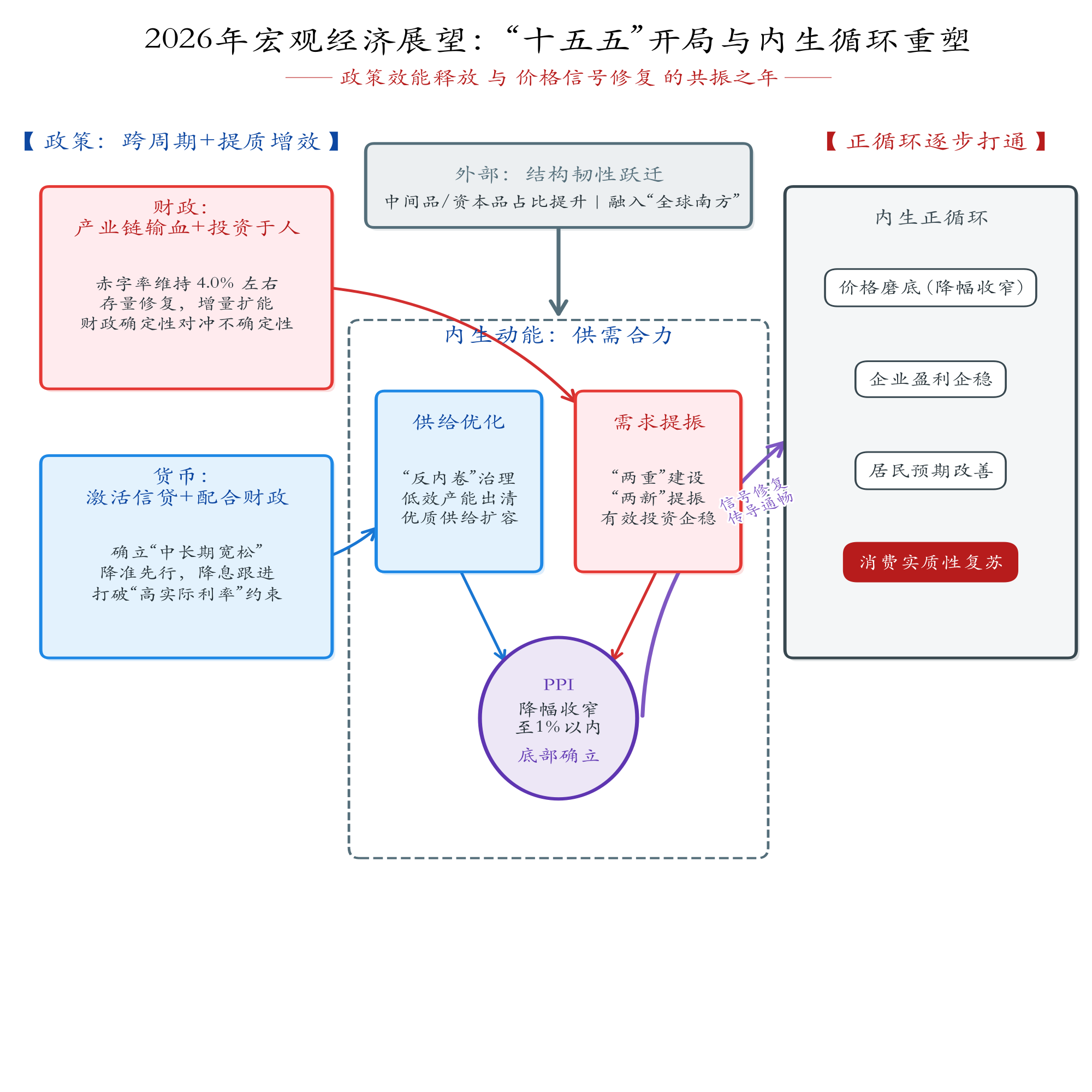
Core Viewpoint - The macroeconomic outlook for 2026 indicates a significant restructuring of macroeconomic policies, focusing on long-term stability and structural adjustments rather than merely smoothing short-term fluctuations. The year marks a transition towards quality-driven growth and a proactive transformation of the economy [1][4]. Group 1: Macroeconomic Policy - Fiscal policy will maintain a high intensity, with a deficit rate expected to remain between 4.0% and 4.2%, translating to approximately 5.9 trillion yuan in deficit. This aims to boost effective demand and facilitate the transition between old and new growth drivers [6][7]. - Monetary policy is set to shift towards "moderate easing," with expectations of a reserve requirement ratio cut in the first quarter and interest rate reductions in the second quarter, aimed at stimulating credit demand and supporting fiscal efforts [10][12]. Group 2: Investment Dynamics - Fixed asset investment is projected to recover, with growth rates expected to rise to 3.0%-3.5%. Infrastructure investment will be the main driver, anticipated to grow by around 5.5%, supported by fiscal measures [13][15]. - Manufacturing investment is expected to remain resilient, with a growth rate of about 5.0%, as companies shift focus from expansion to upgrading capabilities, aided by a structural shift towards high-value intermediate and capital goods [15]. Group 3: Consumption Trends - Consumer spending is expected to transition from stimulus-driven growth to normalized growth, with retail sales growth projected at 4.0%-4.5%. Durable goods consumption will stabilize, while service consumption is anticipated to become the largest incremental growth area, driven by policy support [17]. Group 4: External Trade and Balance - China's export structure is evolving from "end-product manufacturing" to "industrial base," enhancing export resilience. The export growth rate is expected to remain around 5.5%, supported by a shift towards high-value products [21][24]. - The focus on deepening cooperation with emerging markets will facilitate a transition from simple product exports to a model of "technology + capacity," which is expected to provide a solid foundation for maintaining export growth [24].

中金 • 全球研究 | 泰国大选初定乾坤,市场指数应声上涨
中金点睛· 2026-02-10 23:37
Core Viewpoint - The upcoming Thai general election in February 2026 is expected to be a turning point for the political landscape, potentially catalyzing economic recovery despite short-term policy adjustments and market volatility [2]. Election Overview - The election will select 500 members of the House of Representatives, with initial polls indicating approximately 59.8% of voters supporting constitutional amendments [2]. - The political landscape has seen frequent changes, with three prime ministers in three years, culminating in the dissolution of the House of Representatives by Prime Minister Anutin Charnvirakul in December 2025 [2]. Election Results - Preliminary results show the Palang Pracharath Party (PPP) leading with an estimated 193 seats, while the Pheu Thai Party (PTP) is projected to secure around 118 seats [4]. - The victory of the PPP is viewed as favorable for the market, ensuring policy continuity and accelerating the implementation of existing agendas [4]. Government Formation Timeline - The government transition period is expected to last four months, with the election commission required to certify at least 95% of the seats by April 9, 2026 [6]. - The first parliamentary meeting is to be held within 15 days of certification, with the prime minister election anticipated to conclude by early May [6]. Economic Opportunities Post-Election - If the PPP wins, political risk premiums are likely to decrease, benefiting several sectors: - **Consumer and Retail**: The PPP's economic commitments include ongoing fiscal support and consumer stimulus policies, which are expected to boost the fast-moving consumer goods and retail sectors [8]. - **Infrastructure and Construction**: The PPP prioritizes infrastructure development, particularly in secondary road networks and branch railways, benefiting the construction industry [8]. - **Banking and Financial Services**: Political stability may restore investor confidence and attract capital inflows, improving the asset quality of the banking sector in the long term [8]. - **Establishment-Linked Enterprises**: The PPP's victory is seen as advantageous for large corporate groups closely tied to traditional power centers [8]. Market Reaction - Following the election, the Thai stock market reacted positively, with the SET index rising by 3.3% and a projected P/E ratio of 15.2 for 2026 [10]. - The transportation and logistics sector surged by 7.5%, driven by strong earnings growth expectations, while the financial and securities sector saw a 5.5% increase [10]. - Thailand has recorded significant foreign capital inflows, with a net inflow of $473 million in the equity market and $1.7 billion in the bond market since the beginning of 2026 [10].

NYSE Indexes Win In Mixed Day For Stock Market; Will This Dow Jones Stock Break Out?
Investors· 2026-02-10 23:25
NYSE-listed stocks largely led the upside during a mixed Tuesday session for the stock market. Building stocks shined. ...

中国建筑股份有限公司2026年1月经营情况简报
Shang Hai Zheng Quan Bao· 2026-02-10 18:53
Core Viewpoint - The company has released its operational performance summary for January 2026, providing key metrics for investors to review [2]. Group 1 - The company emphasizes that the data presented may differ from those in regular reports due to various uncertainties, and the figures are considered preliminary and for reference only [3]. - The board of directors assures that the announcement does not contain any false records, misleading statements, or significant omissions, and they bear legal responsibility for the content's authenticity, accuracy, and completeness [1]. - The announcement was made by the board of directors on February 10, 2026 [4].

A股晚间热点 | 央行重磅报告!继续实施好适度宽松的货币政策
智通财经网· 2026-02-10 14:24
重要程度:★★★★★ 央行发布2025年第四季度中国货币政策执行报告。报告指出,继续实施好适度宽松的货币政策。把促进经济稳定增长、物价合理回升作为货币政策的重要考 量,根据国内外经济金融形势和金融市场运行情况,把握好政策实施的力度、节奏和时机。 灵活高效运用降准降息等多种政策工具,保持流动性充裕和社会融资条件相对宽松,引导金融总量合理增长、信贷均衡投放,使社会融资规模、货币供应量 增长同经济增长、价格总水平预期目标相匹配。 2、五部门重磅发布,低空经济迎利好!绩优低估值潜力股揭秘 重要程度:★★★★ 工业和信息化部等五部门办公厅(秘书局、综合局、综合司)发布《关于加强信息通信业能力建设 支撑低空基础设施发展的实施意见》,其中提到,持续提升 信息通信业技术基础能力、产业供给能力、网络支撑能力和安全保障能力,有序推进低空场景通信网络建设,丰富拓展感知技术手段,辅助提升导航定位精 度,支撑建设低空智能网联系统,为低空经济发展提供坚实基础。 西南证券认为,国家"十五五"规划建议加快航空航天、低空经济产业发展。国家战略聚焦低空经济新赛道,各地相继出台低空经济发展纲领性政策,国资央 企密集成立低空经济公司。从应用场景来看 ...

DuPont(DD) - 2025 Q4 - Earnings Call Transcript
2026-02-10 14:02
Financial Data and Key Metrics Changes - The company reported full-year organic sales growth of 2%, operating EBITDA growth of 6%, and adjusted EPS of $1.68 per share, up 16% year-over-year [5][6][12] - Free cash flow generation was strong, with expectations for solid free cash flow conversion of greater than 90% in 2026 [12][21] Business Line Data and Key Metrics Changes - Healthcare and Water technologies saw fourth-quarter net sales of $821 million, up 4% year-over-year, driven by 3% organic growth [17] - Diversified Industrials reported fourth-quarter net sales of $872 million, a 3% decline year-over-year, with a 4% organic decline [18] - Organic sales for Healthcare and Water technologies grew 5% in the second half of 2025, while Diversified Industrials experienced a 1% decline [16] Market Data and Key Metrics Changes - Organic growth in Europe was up 2% year-over-year, while Asia-Pacific saw a 2% decline [16] - The company expects mid-single-digit growth in Healthcare and Water technologies for 2026, while Diversified Industrials is expected to grow in the low single digits [22] Company Strategy and Development Direction - The company aims to drive above-market organic growth and build a robust business system while maintaining a balanced capital allocation model [8][11] - The strategic priorities for 2026 include enhancing core values, focusing on growth, and continuing operational excellence [7][9] Management's Comments on Operating Environment and Future Outlook - Management noted a mixed macro environment, with expectations for mid-single-digit growth in Healthcare and Water technologies, while automotive demand is expected to be flat [12][13] - The company is seeing improving order trends in its Industrial Technologies business, indicating market stabilization [14] Other Important Information - The company completed the separation of Qnity Electronics and is focused on operational and portfolio transformation [6][7] - A $2 billion share repurchase authorization was announced, with $500 million executed in the fourth quarter of 2025 [11][50] Q&A Session Summary Question: Insights on industrial orders and channel inventories - Management indicated that industrial orders are picking up, particularly in aerospace, with low double-digit improvements expected [30][32] Question: Pricing and inflation outlook - The company does not expect significant headwinds from inflation and anticipates improvements in gross margins due to productivity initiatives [33] Question: Shelter business outlook - The Shelter business is expected to start slightly down in 2026 but improve throughout the year, aiming for flat performance overall [40] Question: Vitality Index and product innovations - The Vitality Index remains strong at about 30%, with new products contributing positively to both top-line growth and margins [42][44] Question: Margin improvements in diversified segments - Margin expansion in Diversified Industrials was attributed to favorable mix and productivity gains, with benefits from ongoing initiatives expected in the future [56] Question: M&A opportunities - The company is actively scouting M&A opportunities, particularly in the healthcare sector, to enhance its portfolio [106] Question: Water business growth in China - Slower growth in China is attributed to reduced industrial production, but the company expects to ramp up to mid-single-digit growth by the end of the year [68] Question: U.S. construction outlook - The outlook for U.S. construction is flat, with low single-digit growth expected in non-residential and repair and remodel sectors, offset by declines in residential [99]

企业年会缩水或消失,员工平静应对生存压力
Sou Hu Cai Jing· 2026-02-10 12:40
Core Viewpoint - The decline of annual company meetings reflects a broader trend of cost-cutting and a shift in employee priorities towards job security and tangible benefits rather than ceremonial events [2][9][28]. Group 1: Changes in Annual Meetings - Many companies have significantly reduced or eliminated annual meetings, with a consensus among employees that survival is more important than tradition [2][3][9]. - The scale and budget of annual meetings have decreased, with companies opting for smaller, less formal gatherings or entirely virtual events since 2020 [3][22][28]. - In the traditional manufacturing sector, companies that previously held annual meetings for decades are now canceling them due to financial constraints [3][25]. Group 2: Employee Perspectives - Employees express a sense of resignation regarding the cancellation of annual meetings, indicating a shift from emotional attachment to a focus on practical concerns like job stability [9][32][35]. - The importance of annual meetings as a marker of the end of the work year has diminished, with employees prioritizing the company's survival over ceremonial gatherings [33][35]. - There is a growing sentiment among employees that financial rewards or direct benefits are preferred over the traditional festivities of annual meetings [30][32]. Group 3: Industry Impact - The hotel industry has seen a significant decline in revenue from annual meetings, with a reported 20% drop in bookings for such events [8][27]. - Companies in sectors like technology and logistics continue to hold annual meetings, while industries like real estate and finance have largely stopped, reflecting broader economic conditions [18][37]. - The evolution of annual meetings serves as a barometer for industry health, with those that still host them often indicating a more stable or optimistic outlook [18][37].

西藏天路:关联方以1.29亿元酒店资产抵偿项目应收账款
Xin Lang Cai Jing· 2026-02-10 08:10
Core Viewpoint - The company has completed the acceptance of the Linzhi Tianlu Enterprise Management Exchange Center project but has not yet recovered the payment of 148 million yuan [1] Group 1: Project and Financial Details - The company has undertaken the Linzhi Tianlu Enterprise Management Exchange Center project, which has now passed the completion acceptance [1] - The outstanding amount of 148 million yuan has not been recovered, leading to negotiations with Xiamen Dongxiang [1] - Xiamen Dongxiang will compensate the debt with the hotel property and related rights of the Linzhi Woolen Factory, valued at 129 million yuan [1] Group 2: Debt Repayment Plan - There remains an unpaid balance of 14.5241 million yuan, for which Xiamen Dongxiang has proposed a repayment plan to pay in installments by the end of 2026 [1] - Additionally, the Linzhi Woolen Factory has agreed to pay overdue interest on the project amounting to 15.4109 million yuan [1] - The company will supervise the repayment and asset transfer to protect shareholder interests [1]

公告精选︱源杰科技:拟投资约12.51亿元建设光电通讯半导体芯片和器件研发生产基地二期项目
Ge Long Hui A P P· 2026-02-09 14:01
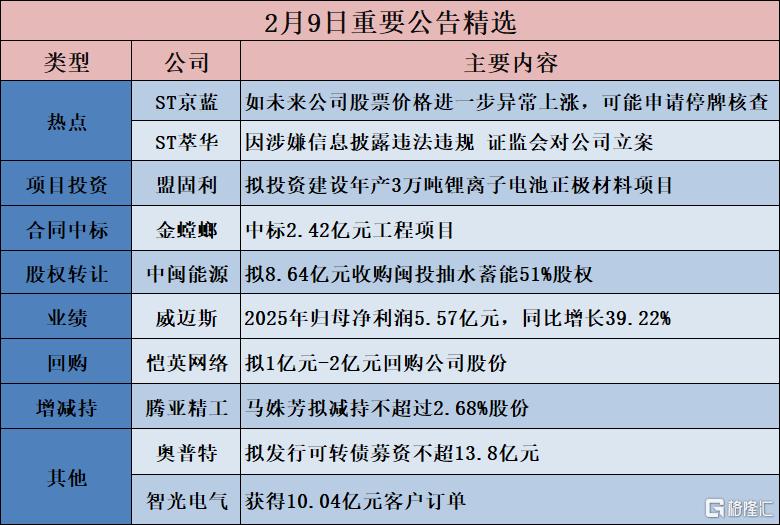
Group 1 - ST京蓝 may apply for suspension of trading if stock price continues to rise abnormally [1] - ST * 4 is under investigation by the CSRC for suspected information disclosure violations [1] - Alliance Material plans to invest in a project to produce 30,000 tons of lithium-ion battery cathode materials annually [1] - Jin Tanglang has won a contract for a project worth 242 million yuan [1] - Zhongmin Energy intends to acquire a 51% stake in Mintou Pumped Storage for 864 million yuan [1] - Weimais expects a net profit of 557 million yuan for 2025, a year-on-year increase of 39.22% [1] - Kaiying Network plans to repurchase shares worth 100 million to 200 million yuan [1] - Tengya Precision plans to reduce its stake by up to 2.68% [1] - Optoelectronics intends to issue convertible bonds not exceeding 1.38 billion yuan [1] - Zhiguang Electric has received customer orders worth 1.004 billion yuan [1] Group 2 - Borui Communication plans to acquire a 9% stake in its subsidiary Hongxing Education [2] - Changchuan Technology's actual controller plans to reduce its stake by up to 1.1128% [2] - Optoelectronics plans to issue convertible bonds to raise no more than 1.38 billion yuan for AI intelligent vision solution R&D [2] - Zhiguang Electric has secured customer orders worth 1.004 billion yuan [2] - Xiamen Tungsten plans to acquire a 39% stake in Jiujiang Dadi [2] - Fangda Carbon plans to acquire 100% of Tongda Huanyu for 319 million yuan [2] - Eastern Airlines Logistics intends to acquire a 49% stake in Eastern Airlines Supply Chain for 200 million yuan [2] - Jinhui Co. plans to acquire 100% of Fusheng Mining for 210 million yuan [2] - Zhongmin Energy intends to acquire a 51% stake in Mintou Pumped Storage for 864 million yuan [2] - Yunyi Electric plans to repurchase shares worth 100 million to 150 million yuan [2] - Gaoweida plans to repurchase shares worth 30 million to 35 million yuan [2] - Kaiying Network plans to repurchase shares worth 100 million to 200 million yuan [2] - Tiankang Biological plans to repurchase shares worth 100 million to 200 million yuan [2] - Dianzhu Technology plans to repurchase shares worth 100 million to 200 million yuan [2] - Tengya Precision plans to reduce its stake by up to 2.68% [2] - Bowei Alloy plans to increase its stake by 100 million to 150 million yuan [2]